
GHRP-6 vs Ipamorelin: A Structural and Regulatory Comparison
A structural and regulatory comparison of GHRP-6, the prototype growth-hormone-releasing hexapeptide, and ipamorelin, the pentapeptide reported as the first selective GHS-R1a agonist. Educational reference.
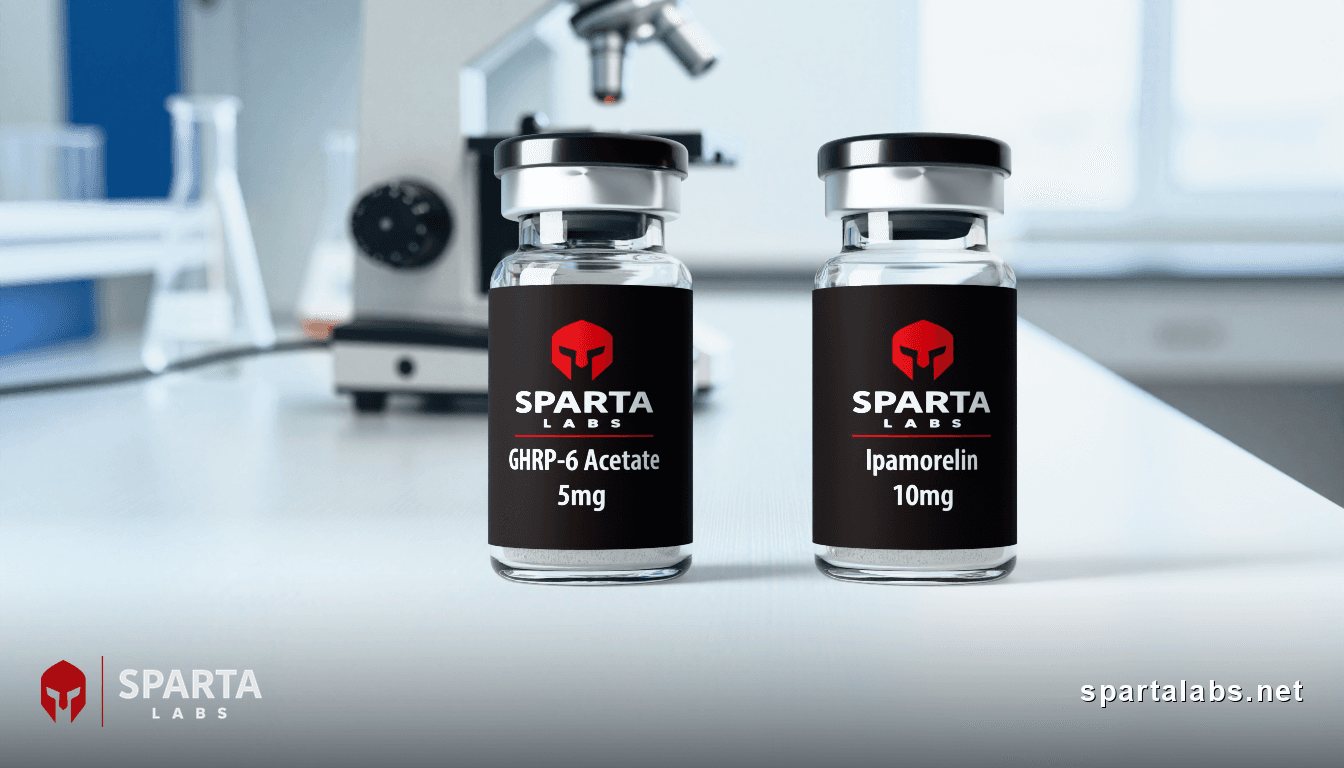
Introduction
GHRP-6 and ipamorelin are close relatives. Both are short synthetic peptides that act as agonists at the growth hormone secretagogue receptor subtype 1a (GHS-R1a), the receptor later identified as the ghrelin receptor, and ipamorelin's design descends directly from the structure-activity lineage that GHRP-6 founded. The meaningful differences between them lie in sequence chemistry, in the hormonal selectivity profile each was reported to display in preclinical models, and in how their research records developed. Neither compound has ever been approved as a drug in any jurisdiction. This article compares the two on structure, origin, class, regulatory status, and published research record, reporting what investigators published without drawing efficacy comparisons. Research-grade GHRP-6 and ipamorelin reference materials are cataloged with per-batch certificates of analysis.
GHRP-6: The Prototype Growth-Hormone-Releasing Hexapeptide
GHRP-6 (His-D-Trp-Ala-Trp-D-Phe-Lys-NH2) originated in the laboratory of Cyril Bowers at Tulane University. Momany, Bowers, and colleagues reported in Endocrinology in 1981 on the design, synthesis, and biological activity of enkephalin-derived peptides that released growth hormone in vitro [1]. Bowers and colleagues then reported in 1984 on the in vitro and in vivo activity of "a new synthetic hexapeptide that acts on the pituitary to specifically release growth hormone," the paper that established GHRP-6 as the class prototype [2]. Bowers later reviewed the growth-hormone-releasing peptide field in Cellular and Molecular Life Sciences in 1998 [3].
Findings from research models do not establish safety or efficacy in humans. Sparta Labs makes no claims about the use of this compound.
GHRP-6's scientific consequence lay in what it implied: it released growth hormone through a mechanism distinct from growth-hormone-releasing hormone, pointing to an unknown receptor. Howard and colleagues at Merck cloned that receptor, GHS-R1a, in Science in 1996 using GHRP-type ligands as probes [4], and Kojima and colleagues identified its endogenous ligand ghrelin in Nature in 1999 [5]. Structural work has since clarified how the hexapeptide engages the receptor: a 2021 cryo-electron microscopy study in Nature Communications reported that GHRP-6 and ghrelin occupy the same orthosteric pocket in GHS-R1a but in distinct binding orientations [6]. Berlanga-Acosta and colleagues have also reviewed published reports that GHRP-6 interacts with the class B scavenger receptor CD36, an interaction the authors treated as mechanistically separate from GHS-R1a signaling [7]. The GHRP-6 mechanism of action article covers this receptor-level detail.
Human data on GHRP-6 remain limited. Cabrales and colleagues published a pharmacokinetic study in nine healthy male volunteers in the European Journal of Pharmaceutical Sciences in 2013, reporting a bi-exponential plasma disposition consistent with a two-compartment model [8]. GHRP-6 was never developed toward marketing approval and is not an active ingredient in any approved drug product; it has instead served for four decades as a pharmacological tool compound for investigating the ghrelin receptor axis. Its research history within the wider hexapeptide family is covered in the GHRP-2 vs GHRP-6 comparison.
Ipamorelin: The Selective Pentapeptide
Ipamorelin (development code NNC 26-0161) was identified in a structure-activity program at Novo Nordisk A/S in Denmark roughly 15 years after GHRP-6. Raun and colleagues reported in the European Journal of Endocrinology in 1998 that the program began from the GHRP-1 scaffold and that ipamorelin emerged from a series of compounds lacking the central Ala-Trp dipeptide characteristic of the earlier hexapeptides [9]. The resulting pentapeptide, Aib-His-D-2-Nal-D-Phe-Lys-NH2, released growth hormone in primary rat pituitary cells and in conscious swine with potency the authors described as comparable to GHRP-6.
The defining finding of the Raun report concerned selectivity. Earlier growth-hormone-releasing peptides, GHRP-6 among them, had been reported to co-stimulate release of ACTH, cortisol, and prolactin alongside growth hormone. Raun and colleagues reported that ipamorelin did not significantly affect ACTH, cortisol, FSH, LH, prolactin, or TSH at concentrations more than 200-fold above its ED50 for growth hormone release in their models, and on that basis titled the paper "Ipamorelin, the first selective growth hormone secretagogue" [9]. Ankersen and colleagues described a further series of potent secretagogues derived from the ipamorelin template in the Journal of Medicinal Chemistry the same year [10].
Johansen and colleagues published a direct pharmacokinetic comparison of ipamorelin, GHRP-2, and GHRP-6 in rats in Xenobiotica in 1998, reporting that ipamorelin displayed a systemic plasma clearance several-fold lower than that of GHRP-6 and was eliminated predominantly by the urinary rather than the biliary route [11]. Ipamorelin's only published late-stage human study is a phase 2 randomized, placebo-controlled proof-of-concept trial reported by Beck and colleagues in 2014 in patients recovering from bowel-resection surgery [12]. The compound's discovery context is covered in the ipamorelin history article and its chemistry in the ipamorelin research overview.
Structural Comparison
- Sequence. GHRP-6: His-D-Trp-Ala-Trp-D-Phe-Lys-NH2, six residues. Ipamorelin: Aib-His-D-2-Nal-D-Phe-Lys-NH2, five residues. Both are C-terminally amidated and both mix L- and D-amino acids, a design element the Bowers program introduced for enzymatic stability [2, 3].
- The missing dipeptide. The central Ala-Trp of GHRP-6 is absent in ipamorelin. Raun and colleagues reported that removing this motif from the GHRP-1 scaffold produced the series from which ipamorelin was selected, and associated the change with the compound's selectivity profile [9].
- N-terminal residue. GHRP-6 begins with histidine. Ipamorelin begins with alpha-aminoisobutyric acid (Aib), a non-natural, conformationally restricted residue, followed by histidine [9, 10].
- Aromatic residues. GHRP-6 carries D-tryptophan at position 2 and L-tryptophan at position 4. Ipamorelin replaces these with a single D-2-naphthylalanine, the same non-natural aromatic residue found in GHRP-2 [9].
- Molecular weight. GHRP-6 is approximately 873 daltons; ipamorelin is approximately 712 daltons.
- Reported selectivity. GHRP-6 was reported to co-release ACTH, cortisol, and prolactin in preclinical models; ipamorelin was reported not to affect those hormones at the concentrations tested [9]. These are attributed findings from specific studies, not properties established in humans.
- Additional receptor interactions. GHRP-6 has been reported to interact with CD36 in addition to GHS-R1a [7]; no comparable interaction has been reported for ipamorelin.
- Regulatory status. Neither compound holds approval from the FDA, the European Medicines Agency, or any other regulator. Both are investigational research compounds; both have been reviewed in the FDA's evaluation of bulk drug substances nominated for compounding under Section 503A of the Federal Food, Drug, and Cosmetic Act [13].
Pharmacological Class Context
GHRP-6 and ipamorelin sit at opposite ends of the same class. The peptidyl growth hormone secretagogues, from GHRP-6 through GHRP-1, GHRP-2, hexarelin, and ipamorelin, all act at GHS-R1a, a class A G protein-coupled receptor coupled primarily to Gq and phospholipase C, and all were characterized before the receptor's natural ligand was known [4, 5]. Within that class, the literature describes a progression: the first-generation hexapeptides established the receptor's existence and pharmacology, while later designs such as ipamorelin were reported to refine the hormonal selectivity of the response [3, 9].
The class as a whole is distinct from the growth-hormone-releasing hormone (GHRH) analogues, such as sermorelin and tesamorelin, which act at the GHRH receptor through Gs and cyclic AMP. Published research has used GHS-R1a agonists and GHRH analogues as independent tools for dissecting growth hormone regulation, and the two classes are treated as separate categories in reviews of the secretagogue field. GHRP-6 and ipamorelin were compared directly in the original Novo Nordisk pharmacology and pharmacokinetic reports [9, 11], but those comparisons were preclinical characterizations, not clinical trials, and this article makes no comparative efficacy statement.
Research-grade GHRP-6 and ipamorelin sold by chemical suppliers are laboratory reference materials, not pharmaceutical products, and are strictly for research use only.
References
- Momany FA, Bowers CY, Reynolds GA, Chang D, Hong A, Newlander K. Design, synthesis, and biological activity of peptides which release growth hormone in vitro. Endocrinology. 1981;108(1):31-39. PMID: 6109621
- Bowers CY, Momany FA, Reynolds GA, Hong A. On the in vitro and in vivo activity of a new synthetic hexapeptide that acts on the pituitary to specifically release growth hormone. Endocrinology. 1984;114(5):1537-1545. PMID: 6714155
- Bowers CY. Growth hormone-releasing peptide (GHRP). Cell Mol Life Sci. 1998;54(12):1316-1329. PMID: 9893708
- Howard AD, Feighner SD, Cully DF, et al. A receptor in pituitary and hypothalamus that functions in growth hormone release. Science. 1996;273(5277):974-977. PMID: 8688086
- Kojima M, Hosoda H, Date Y, Nakazato M, Matsuo H, Kangawa K. Ghrelin is a growth-hormone-releasing acylated peptide from stomach. Nature. 1999;402(6762):656-660. PMID: 10604470
- Wang Y, Guo S, Zhuang Y, et al. Molecular recognition of an acyl-peptide hormone and activation of ghrelin receptor. Nat Commun. 2021;12(1):5064. PMID: 34417468
- Berlanga-Acosta J, Abreu-Cruz A, Herrera DGB, et al. Synthetic Growth Hormone-Releasing Peptides (GHRPs): A Historical Appraisal of the Evidences Supporting Their Cytoprotective Effects. Clin Med Insights Cardiol. 2017;11:1179546817694558. PMID: 28469491
- Cabrales A, Gil J, Fernández E, et al. Pharmacokinetic study of Growth Hormone-Releasing Peptide 6 (GHRP-6) in nine male healthy volunteers. Eur J Pharm Sci. 2013;48(1-2):40-46. PMID: 23099431
- Raun K, Hansen BS, Johansen NL, Thøgersen H, Madsen K, Ankersen M, et al. Ipamorelin, the first selective growth hormone secretagogue. Eur J Endocrinol. 1998;139(5):552-561. PMID: 9849822
- Ankersen M, Johansen NL, Madsen K, Hansen BS, Raun K, Nielsen KK, et al. A new series of highly potent growth hormone-releasing peptides derived from ipamorelin. J Med Chem. 1998;41(19):3699-3704. PMID: 9733495
- Johansen PB, Hansen KT, Andersen JV, Johansen NL. Pharmacokinetic evaluation of ipamorelin and other peptidyl growth hormone secretagogues with emphasis on nasal absorption. Xenobiotica. 1998;28(11):1083-1092. PMID: 9879640
- Beck DE, Sweeney WB, McCarter MD, et al. Prospective, randomized, controlled, proof-of-concept study of the Ghrelin mimetic ipamorelin for the management of postoperative ileus in bowel resection patients. Int J Colorectal Dis. 2014;29(12):1527-1534. PMID: 25331030
- US Food and Drug Administration. Drug Products Containing Certain Bulk Drug Substances That May Not Be Compounded Under Section 503A of the Federal Food, Drug, and Cosmetic Act. Docket FDA-2015-N-0863. FDA compounding page
Frequently asked questions
What is the difference between GHRP-6 and ipamorelin?
Both are synthetic agonists of the growth hormone secretagogue receptor GHS-R1a, but they differ in structure and reported selectivity. GHRP-6 is a hexapeptide (His-D-Trp-Ala-Trp-D-Phe-Lys-NH2) from the original Bowers program of the early 1980s. Ipamorelin is a pentapeptide (Aib-His-D-2-Nal-D-Phe-Lys-NH2) from Novo Nordisk, and Raun and colleagues reported in 1998 that it released growth hormone without significantly affecting ACTH, cortisol, or prolactin in preclinical models, unlike GHRP-6.
What is GHRP-6?
GHRP-6 (growth-hormone-releasing peptide 6) is a synthetic hexapeptide first characterized by Bowers and colleagues in 1984. It was the first growth-hormone-releasing peptide to demonstrate activity in vivo and is regarded as the founding member of the peptidyl growth hormone secretagogue class. Its receptor, GHS-R1a, was cloned in 1996, and the receptor's natural ligand ghrelin was identified in 1999.
What is ipamorelin?
Ipamorelin (development code NNC 26-0161) is a synthetic pentapeptide developed at Novo Nordisk in the 1990s through structure-activity work on the GHRP-1 scaffold. It carries non-natural residues including an N-terminal alpha-aminoisobutyric acid and a D-2-naphthylalanine, and it acts at the same GHS-R1a receptor as GHRP-6.
Is GHRP-6 FDA approved?
No. GHRP-6 does not hold approval from the FDA for any therapeutic indication and is not an active ingredient in any FDA-approved drug product. It has served for four decades as a pharmacological tool compound and is supplied as a research-use-only material.
Is ipamorelin FDA approved?
No. Ipamorelin has never received marketing approval from the FDA or the European Medicines Agency. Its published human data are limited to early-phase trials, including a phase 2 proof-of-concept study reported in 2014, and it is supplied only as a research-use-only material.
Do GHRP-6 and ipamorelin act on the same receptor?
Yes. Both act at the growth hormone secretagogue receptor subtype 1a (GHS-R1a), a class A G protein-coupled receptor that signals primarily through Gq and phospholipase C. Published research has also reported that GHRP-6 interacts with the scavenger receptor CD36, an interaction not reported for ipamorelin.