
Ipamorelin: Discovery and Regulatory History
Tracing ipamorelin from the 1970s GHRP tradition through its 1998 characterization at Novo Nordisk, the ghrelin discovery that redefined its target, its postoperative-ileus clinical program, and the FDA 503A compounding review. Educational reference.
For research use only. Not for human consumption. This article is educational reference material. It is not medical advice and is not a recommendation to use any substance.
From Opioid Peptides to a Selective Pentapeptide
Ipamorelin (developmental code NNC 26-0161) is a synthetic pentapeptide, Aib-His-D-2-Nal-D-Phe-Lys-NH2, that acts as an agonist at the growth hormone secretagogue receptor (GHS-R1a). Its history is best read not as a single discovery event but as the endpoint of roughly two decades of medicinal chemistry that began with an accidental observation about opioid analogs and ended with a compound engineered for receptor selectivity. This account traces that arc: the growth hormone-releasing peptide (GHRP) tradition that made ipamorelin conceivable, its characterization at Novo Nordisk in 1998, the 1999 identification of ghrelin that redefined its target, the preclinical program that broadened its research profile, and the clinical and regulatory milestones that followed.
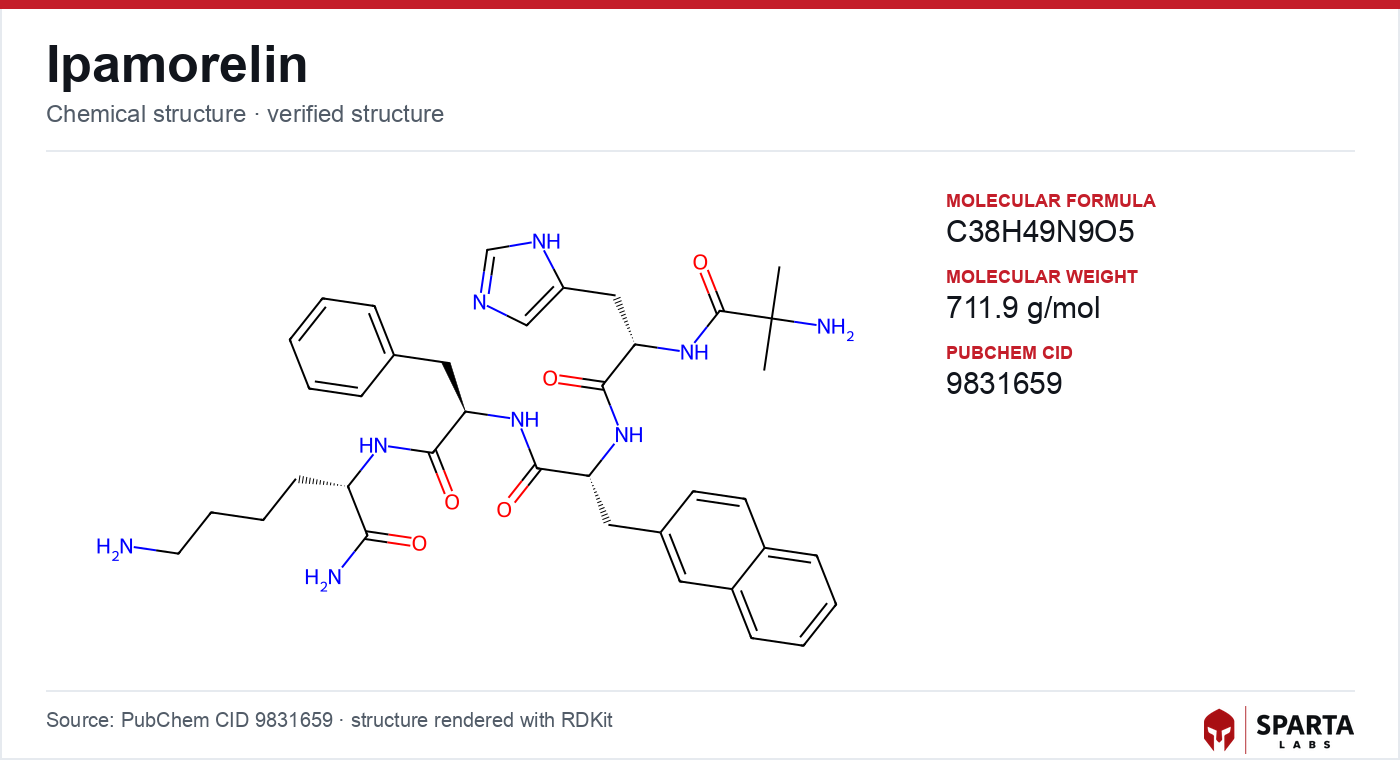
Figure: chemical structure of Ipamorelin.
The GHRP Lineage That Preceded It
The conceptual groundwork was laid in the mid-1970s, when Cyril Bowers and colleagues at Tulane University observed that certain synthetic enkephalin analogs, structural modifications of opioid peptides, could stimulate growth hormone (GH) release from pituitary tissue in a manner not explained by opioid receptor pharmacology. That anomaly implied a distinct receptor system responsive to a new class of GH-releasing peptides.
Through structure-activity relationship (SAR) work in the 1980s, Bowers and colleagues characterized a first generation of dedicated GHRPs, among them GHRP-6. These hexapeptides showed appreciable GH-releasing potency but co-stimulated adrenocorticotropic hormone (ACTH), cortisol, and prolactin, a lack of selectivity that would become the central design problem for later compounds in the class. In parallel, Roy Smith and colleagues at Merck Research Laboratories pursued non-peptidyl secretagogues such as MK-0677 (ibutamoren), and in 1996 a Merck group led by Howard reported the molecular cloning of GHS-R1a, giving the field a defined receptor target and formal name. Ipamorelin was designed against this backdrop, with selectivity as an explicit objective.
Characterization at Novo Nordisk (1998)
Ipamorelin emerged from a GHS research program at Novo Nordisk A/S in Måløv, Denmark, in the late 1990s. The investigators, K. Raun, B.S. Hansen, N.L. Johansen, H. Thøgersen, K. Madsen, M. Ankersen, and P.H. Andersen, identified the pentapeptide within a series derived from the GHRP-1 scaffold, specifically from structures lacking the central Ala-Trp dipeptide that had recurred in earlier GHRPs.
The defining report appeared in the European Journal of Endocrinology in November 1998 [1]. It established the properties that fixed ipamorelin's scientific identity: potent GH release in primary rat pituitary cells and in conscious swine; and a selectivity profile in which ACTH, cortisol, follicle-stimulating hormone, luteinizing hormone, prolactin, and thyroid-stimulating hormone were reported as not significantly elevated even at doses far above the concentration producing half-maximal GH release. Pharmacological evidence indicated action through a GHRP-like receptor rather than the growth hormone-releasing hormone (GHRH) receptor.
Findings from research models do not establish safety or efficacy in humans. Sparta Labs makes no claims about the use of this compound.
A companion paper by Ankersen and colleagues in the Journal of Medicinal Chemistry the same year described the SAR program that ipamorelin anchored, positioning the pentapeptide as a structural template for further GHS design [2]. Johansen and colleagues added pharmacokinetic characterization, reporting comparative plasma clearance and excretion for ipamorelin alongside GHRP-2 and GHRP-6 and emphasizing nasal absorption profiles [3]. Together these three 1998 papers form the primary-source foundation cited throughout the later literature; the reported chemistry is discussed further in the ipamorelin research overview.
How the 1999 Ghrelin Discovery Reframed the Target
A conceptual shift arrived in December 1999, when Kojima and colleagues at Kurume University identified ghrelin, a 28-amino-acid acylated peptide predominantly produced by gastric X/A-like cells, as the endogenous ligand for GHS-R1a. Published in Nature, this finding transformed the vocabulary of the field: compounds once called GHRP-like agonists were now understood as ghrelin mimetics or ghrelin receptor agonists, and the receptor gained an endogenous physiological anchor.
For ipamorelin, the recontextualization mattered. A compound initially framed strictly in terms of GH release was now understood to act on a receptor also implicated in appetite regulation, gastric motility, and energy homeostasis. This broader receptor biology opened research directions beyond the pituitary somatotroph axis and set up the gastrointestinal program that would eventually dominate ipamorelin's clinical trajectory. The receptor pathway itself is examined in the ipamorelin mechanism of action article.
Broadening the Preclinical Record (1999–2009)
After the 1998 characterization, ipamorelin appeared in preclinical studies extending its profile into new tissues and endpoints.
Johansen and colleagues (1999) reported that ipamorelin administration was associated with dose-dependent longitudinal bone growth in rats over a 15-day study, an effect the authors attributed to downstream GH-mediated action rather than a direct skeletal mechanism [4].
Adeghate and Ponery (2004) reported that ipamorelin was associated with insulin secretion from isolated pancreatic fragments of both normal and diabetic rats in vitro, with pharmacological evidence implicating calcium- and adrenergic-dependent pathways, an early characterization of ipamorelin in pancreatic tissue [5].
Venkova and colleagues (2009) then reported that ipamorelin was associated with altered gastrointestinal transit in a rodent model of postoperative ileus, work that directly informed the compound's clinical direction [6]. This body of animal and in vitro data is summarized alongside later studies in the ipamorelin published research article.
The Postoperative Ileus Clinical Program
Ipamorelin's clinical development concentrated on postoperative ileus (POI), the delayed return of gastrointestinal motility that can follow abdominal surgery, a direction consistent with the ghrelin receptor's role in gut physiology. Greenwood-Van Meerveld and colleagues (2012) added mechanistic support from gastric preparations, reporting that ipamorelin restored suppressed contractile responses in surgically manipulated tissue through what the authors attributed to GHS-R1a-mediated cholinergic activation [7].
Clinical trials for POI were registered on ClinicalTrials.gov under identifiers NCT00672074 and NCT01280344, with Helsinn Therapeutics (U.S.), Inc. as sponsor. These phase 2 studies enrolled patients undergoing bowel resection with primary anastomosis.
Beck and colleagues published results from the multicenter, double-blind, proof-of-concept phase 2 trial (the Ipamorelin 201 study) in the International Journal of Colorectal Disease in 2014 [8]. The trial enrolled 117 patients and reported that ipamorelin was well tolerated, with adverse-event rates similar between the treatment and placebo groups. The reported median time to tolerating a solid meal was 25.3 hours with ipamorelin versus 32.6 hours with placebo, a directional difference that did not reach statistical significance (p=0.15) on the primary composite gastrointestinal endpoint in that cohort. The published record therefore reflects a proof-of-concept study that generated human safety and tolerability data while not meeting its primary endpoint as defined at the studied dose and population.
Regulatory Status and the 503A Compounding Review
Ipamorelin has not received marketing approval from the U.S. Food and Drug Administration or the European Medicines Agency. Its most significant regulatory chapter in the United States concerns pharmaceutical compounding. Under Section 503A of the Federal Food, Drug, and Cosmetic Act, state-licensed pharmacies may compound from bulk drug substances only when those substances meet specified criteria. Ipamorelin has no approved United States Pharmacopeia or National Formulary monograph and is not an active ingredient in any FDA-approved drug product.
The FDA's Pharmacy Compounding Advisory Committee (PCAC) evaluated ipamorelin as part of its ongoing review of bulk drug substances nominated for the 503A bulks list, situating the compound within the agency's broader scrutiny of peptides used in compounding. This review represents ipamorelin's most recent regulatory milestone in the United States and reflects a general tightening of the compounding landscape for research peptides.
Ipamorelin's Place in the Ghrelin-Receptor Field Today
The ghrelin receptor agonist field advanced beyond ipamorelin's own program. Relamorelin (RM-131), a modified ghrelin peptide, was studied in phase 2 trials for diabetic gastroparesis, and macimorelin, a non-peptidyl GHS-R1a agonist, received FDA approval in December 2017 under the brand name Macrilen for the diagnosis of adult growth hormone deficiency, marking the first FDA-approved compound in the ghrelin receptor agonist class. Within the wider GH secretagogue landscape, the GHRH-analog lineage followed a distinct regulatory arc, illustrated by the tesamorelin history.
Ipamorelin's durable contribution, as recognized in the primary literature, is its demonstration that GHS-R1a agonism could be pharmacologically dissociated from co-stimulation of the hypothalamic-pituitary-adrenal axis, evidence of signal diversity at the receptor that informed subsequent compound design. It remains available as a research-use-only material and continues to be cited as a pharmacological reference point for selective GHS-R1a agonism. Research-grade ipamorelin from Sparta Labs is supplied with batch-level certificate of analysis documentation, and its purity and verification standards are described in the ipamorelin sourcing and quality article.
References
-
Raun K, Hansen BS, Johansen NL, Thøgersen H, Madsen K, Ankersen M, et al. Ipamorelin, the first selective growth hormone secretagogue. Eur J Endocrinol. 1998;139(5):552-61. PMID: 9849822. DOI: 10.1530/eje.0.1390552
-
Ankersen M, Johansen NL, Madsen K, Hansen BS, Raun K, Nielsen KK, et al. A new series of highly potent growth hormone-releasing peptides derived from ipamorelin. J Med Chem. 1998;41(19):3699-704. PMID: 9733495. DOI: 10.1021/jm9801962
-
Johansen PB, Hansen KT, Andersen JV, Johansen NL. Pharmacokinetic evaluation of ipamorelin and other peptidyl growth hormone secretagogues with emphasis on nasal absorption. Xenobiotica. 1998;28(11):1083-92. PMID: 9879640. DOI: 10.1080/004982598238976
-
Johansen PB, Nowak J, Skjaerbaek C, Flyvbjerg A, Andreassen TT, Wilken M, et al. Ipamorelin, a new growth-hormone-releasing peptide, induces longitudinal bone growth in rats. Growth Horm IGF Res. 1999;9(2):106-13. PMID: 10373343. DOI: 10.1054/ghir.1999.9998
-
Adeghate E, Ponery AS. Mechanism of ipamorelin-evoked insulin release from the pancreas of normal and diabetic rats. Neuroendocrinol Lett. 2004;25(6):403-6. PMID: 15665799. PubMed
-
Venkova K, Mann W, Nelson R, Greenwood-Van Meerveld B. Efficacy of ipamorelin, a novel ghrelin mimetic, in a rodent model of postoperative ileus. J Pharmacol Exp Ther. 2009;329(3):1110-6. PMID: 19289567. DOI: 10.1124/jpet.108.149211
-
Greenwood-Van Meerveld B, Tyler K, Mohammadi E, Pietra C. Efficacy of ipamorelin, a ghrelin mimetic, on gastric dysmotility in a rodent model of postoperative ileus. J Exp Pharmacol. 2012;4:149-55. PMID: 27186127. DOI: 10.2147/JEP.S35396
-
Beck DE, Sweeney WB, McCarter MD, et al. Prospective, randomized, controlled, proof-of-concept study of the ghrelin mimetic ipamorelin for the management of postoperative ileus in bowel resection patients. Int J Colorectal Dis. 2014;29(12):1527-34. PMID: 25331030. DOI: 10.1007/s00384-014-2030-8
Disclaimer. Statements in this article have not been evaluated by the Food and Drug Administration. This compound is not intended to diagnose, treat, cure, or prevent any disease. Sparta Labs sells research-use-only materials. Content is provided for educational and informational purposes only and does not constitute medical advice. Consult a qualified medical professional for any health concerns.
Frequently asked questions
When and where was ipamorelin discovered?
Ipamorelin was identified and characterized at Novo Nordisk A/S in Måløv, Denmark, in the late 1990s. Its foundational description was published by Raun and colleagues in the European Journal of Endocrinology in November 1998, where it carried the developmental code NNC 26-0161.
What made ipamorelin distinct among earlier GHRPs?
Earlier growth hormone-releasing peptides such as GHRP-6 co-stimulated ACTH, cortisol, and prolactin. The 1998 characterization reported that ipamorelin released growth hormone with a selectivity profile in which those other hormones were not significantly elevated even well above the dose producing half-maximal GH release, evidence of signal selectivity at the GHS-R1a receptor.
How did the 1999 discovery of ghrelin affect ipamorelin's scientific framing?
Kojima and colleagues identified ghrelin in 1999 as the endogenous ligand of GHS-R1a. This recontextualized ipamorelin from a GHRP-like agonist to a ghrelin mimetic and opened research directions in gastrointestinal motility, appetite, and energy homeostasis beyond the pituitary axis.
What was the outcome of ipamorelin's clinical trials?
Phase 2 trials for postoperative ileus (NCT00672074 and NCT01280344) were sponsored by Helsinn Therapeutics. Beck and colleagues reported in 2014 that the 117-patient proof-of-concept study found ipamorelin well tolerated but did not reach statistical significance on its primary composite gastrointestinal endpoint at the studied dose.
What is ipamorelin's current regulatory status?
Ipamorelin has not received marketing approval from the FDA or EMA and has no USP or NF monograph. The FDA's Pharmacy Compounding Advisory Committee reviewed it under Section 503A of the Federal Food, Drug, and Cosmetic Act as part of the agency's evaluation of bulk drug substances used in compounding.