
Ipamorelin: A Research Overview
Ipamorelin traced from a research angle: how a GHRP-1-derived pentapeptide came to be described as the first selective growth hormone secretagogue, its GHS-R1a classification, discovery lineage at Novo Nordisk, and RUO regulatory standing.
For research use only. Not for human consumption. This article is educational reference material. It is not medical advice and is not a recommendation to use any substance.
Introduction
Ipamorelin (developmental designation NNC 26-0161) is a synthetic pentapeptide classified as a growth hormone secretagogue (GHS) and a selective agonist of the growth hormone secretagogue receptor subtype 1a (GHS-R1a), the G protein-coupled receptor later identified as the target of the endogenous peptide ghrelin. It was characterized by researchers at Novo Nordisk A/S in Måløv, Denmark, and first reported in the peer-reviewed literature in 1998. Ipamorelin is of research interest largely because of a single distinguishing feature described in its founding paper: an unusually selective endocrine profile relative to the growth hormone-releasing peptides that preceded it. This overview traces ipamorelin's chemical identity, the structure-activity lineage that produced it, that defining 1998 selectivity report, its reclassification as a ghrelin receptor agonist after 1999, its clinical-trial arc in postoperative ileus, and its current regulatory standing.
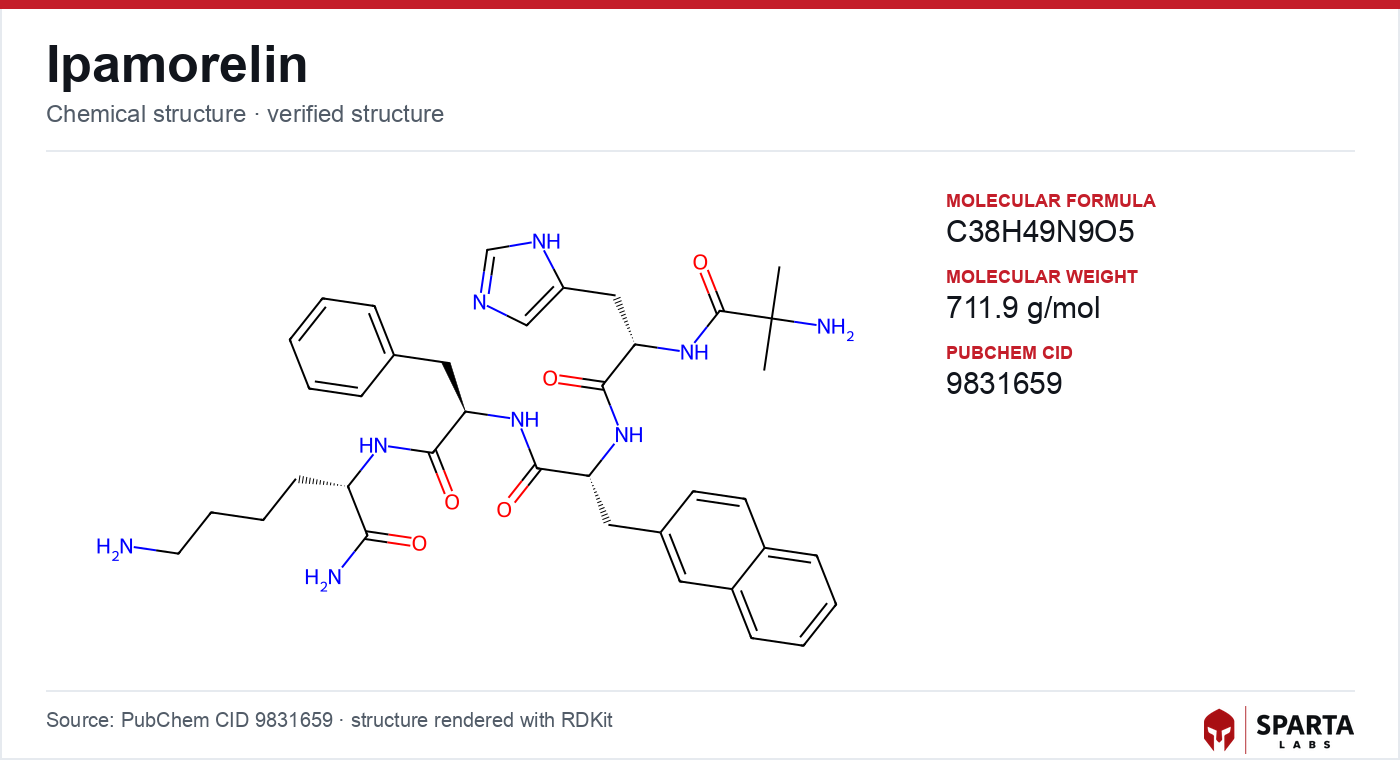
Figure: chemical structure of Ipamorelin.
Identity and Molecular Description
Ipamorelin is a pentapeptide with the amino acid sequence Aib-His-D-2-Nal-D-Phe-Lys-NH₂. Its molecular formula is C₃₈H₄₉N₉O₅, corresponding to a molecular weight of approximately 711.9 daltons. Two of its five residues are non-proteinogenic: an N-terminal α-aminoisobutyric acid (Aib), a doubly methylated glycine analog that introduces conformational rigidity and resists aminopeptidase cleavage, and D-2-naphthylalanine (D-2-Nal), a bulky aromatic residue. A D-phenylalanine and a C-terminal lysine carboxamide complete the sequence.
The molecule is compact and unmodified. It carries no glycosylation and no fatty-acid chain, which sets it apart structurally from later-generation ghrelin mimetics that use lipidation to prolong plasma residence. The combination of the Aib cap and the C-terminal amide gives the peptide a defined, protease-resistant terminal architecture that features in most descriptions of its physicochemical behavior.
The GHRP Lineage That Produced It
Ipamorelin did not appear in isolation. It is the product of roughly two decades of medicinal-chemistry work on synthetic peptides that release pituitary growth hormone (GH) through a pathway distinct from growth hormone-releasing hormone (GHRH). The first generation of these growth hormone-releasing peptides, including GHRP-6, GHRP-2, and hexarelin, were reported to be potent GH secretagogues in research models. They also co-stimulated adrenocorticotropic hormone (ACTH), cortisol, and prolactin, a broader endocrine footprint that complicated their pharmacological characterization.
Ipamorelin was generated through structure-activity relationship (SAR) work that began from the GHRP-1 scaffold. Raun and colleagues reported that the compound emerged from a series lacking the central Ala-Trp dipeptide of GHRP-1, and that these modifications tracked with the more selective profile observed in preclinical testing [1]. A companion medicinal-chemistry paper by Ankersen and colleagues in 1998 extended the program, reporting that the ipamorelin template served as the anchor for a further series of highly potent GHS compounds spanning a range of physicochemical properties [2]. The ipamorelin scaffold thus sits at a branch point in this chemical family: derived from an earlier GHRP, and itself a starting structure for later analogs.
The 1998 Selectivity Report
The defining event in ipamorelin's scientific record is the 1998 report by Raun et al. in the European Journal of Endocrinology, which introduced the compound and gave it the description that still frames it. In both in vitro and in vivo research models, ipamorelin displayed GH-releasing potency comparable to GHRP-6 while showing a markedly narrower hormonal response. The authors reported that ipamorelin did not measurably stimulate ACTH or cortisol at concentrations more than 200-fold above its median effective dose (ED₅₀) for GH release in conscious swine, and did not significantly alter follicle-stimulating hormone (FSH), luteinizing hormone (LH), prolactin, or thyroid-stimulating hormone (TSH). On that basis, they described it as "the first selective growth hormone secretagogue" [1].
Findings from research models do not establish safety or efficacy in humans. Sparta Labs makes no claims about the use of this compound.
This reported selectivity is the property that distinguishes ipamorelin from its predecessors in nearly every subsequent description of the molecule. The receptor-level basis for the effect, and the signaling detail behind it, are treated in the companion ipamorelin mechanism of action article; the present overview notes only that the selectivity claim is anchored to this specific preclinical dataset and to the endocrine panel measured within it.
Reclassification as a Ghrelin Receptor Agonist
When ipamorelin was first described, its molecular target was known as the growth hormone secretagogue receptor, a receptor identified pharmacologically but without a confirmed endogenous ligand. That changed in 1999, when Kojima and colleagues identified ghrelin as the natural ligand of GHS-R1a. The discovery reframed the entire GHS field: compounds previously described as "GHRP-like agonists" were now understood as synthetic ghrelin receptor agonists acting at a defined physiological system spanning the pituitary, hypothalamus, and gastrointestinal tract.
GHS-R1a is a G protein-coupled receptor that signals principally through the Gαq/phospholipase C pathway, a signaling context reviewed in later literature on the receptor's intracellular biology [3]. Within this reframed picture, ipamorelin is best described as a peptidyl, selective GHS-R1a agonist, and is distinct from GHRH analogs such as CJC-1295 without DAC, which act through the separate GHRH receptor rather than GHS-R1a. Research after 1999 extended the ipamorelin profile into adjacent areas, including longitudinal bone growth in rats [4] and somatotroph biology in vitro [7].
The Postoperative Ileus Research Arc
Ipamorelin is one of the relatively few compounds in its class to reach human clinical trials, and its clinical program centered not on growth-hormone endocrinology but on gastrointestinal motility. Rodent work provided the preclinical rationale: Venkova and colleagues reported activity of ipamorelin in a rodent model of postoperative ileus [5], and a later study by Greenwood-Van Meerveld and colleagues examined gastric dysmotility in a comparable model [6]. Pharmacokinetic characterization of ipamorelin alongside other peptidyl secretagogues was published in 1998 [8].
On that basis, ipamorelin advanced to phase 2 trials for postoperative ileus sponsored by Helsinn Therapeutics (U.S.), Inc. (ClinicalTrials.gov identifiers NCT00672074 and NCT01280344). A published proof-of-concept phase 2 trial by Beck and colleagues in 2014 enrolled 117 patients undergoing bowel resection. The authors reported that ipamorelin was well tolerated, with a median time to tolerating a solid meal of 25.3 hours in the ipamorelin arm versus 32.6 hours with placebo; the difference did not reach statistical significance on the primary composite endpoint in this proof-of-concept cohort [9]. The trial contributed human tolerability data to the record and is a rare instance of a research-grade ghrelin receptor agonist evaluated in a controlled clinical setting.
Regulatory Status
Ipamorelin has not received marketing approval from the United States Food and Drug Administration (FDA) or the European Medicines Agency (EMA) for any therapeutic indication in humans.
The FDA's Pharmacy Compounding Advisory Committee (PCAC) reviewed ipamorelin-related bulk drug substances (ipamorelin acetate and ipamorelin free base) at its October 29, 2024 meeting as nominations for the list of bulk drug substances that may be used in compounding under Section 503A of the Federal Food, Drug, and Cosmetic Act [10].
The FDA briefing document for that meeting states that there is no United States Pharmacopeia (USP) or National Formulary (NF) drug substance monograph for ipamorelin or its acetate form, that neither is a component of an FDA-approved drug, and that the agency's evaluation criteria weigh against placing them on the 503A list [11].
Research-grade ipamorelin from Sparta Labs is supplied as a research-use-only (RUO) material with batch-specific analytical documentation. The analytical methods and identity-verification standards applied to peptides of this class are discussed further in the ipamorelin sourcing and verification reference, and its discovery timeline is covered in the ipamorelin discovery and regulatory history article.
The compound's development timeline is covered in ipamorelin: history.
References
-
Raun K, Hansen BS, Johansen NL, Thøgersen H, Madsen K, Ankersen M, et al. Ipamorelin, the first selective growth hormone secretagogue. Eur J Endocrinol. 1998;139(5):552-61. PMID: 9849822. DOI: 10.1530/eje.0.1390552. PubMed
-
Ankersen M, Johansen NL, Madsen K, Hansen BS, Raun K, Nielsen KK, et al. A new series of highly potent growth hormone-releasing peptides derived from ipamorelin. J Med Chem. 1998;41(19):3699-704. PMID: 9733495. DOI: 10.1021/jm9801962. PubMed
-
Yin Y, Li Y, Zhang W. The growth hormone secretagogue receptor: its intracellular signaling and regulation. Int J Mol Sci. 2014;15(3):4837-55. PMID: 24651458. DOI: 10.3390/ijms15034837. PubMed
-
Johansen PB, Nowak J, Skjaerbaek C, Flyvbjerg A, Andreassen TT, Wilken M, et al. Ipamorelin, a new growth-hormone-releasing peptide, induces longitudinal bone growth in rats. Growth Horm IGF Res. 1999;9(2):106-13. PMID: 10373343. DOI: 10.1054/ghir.1999.9998. PubMed
-
Venkova K, Mann W, Nelson R, Greenwood-Van Meerveld B. Efficacy of ipamorelin, a novel ghrelin mimetic, in a rodent model of postoperative ileus. J Pharmacol Exp Ther. 2009;329(3):1110-6. PMID: 19289567. PubMed
-
Greenwood-Van Meerveld B, Tyler K, Mohammadi E, Pietra C. Efficacy of ipamorelin, a ghrelin mimetic, on gastric dysmotility in a rodent model of postoperative ileus. J Exp Pharmacol. 2012;4:149-55. PMID: 27186127. DOI: 10.2147/JEP.S35396. PubMed
-
Jiménez-Reina L, Cañete R, de la Torre MJ, Bernal G. Influence of chronic treatment with the growth hormone secretagogue ipamorelin, in young female rats: somatotroph response in vitro. Histol Histopathol. 2002;17(3):707-14. PMID: 12168778. DOI: 10.14670/HH-17.707. PubMed
-
Johansen PB, Hansen KT, Andersen JV, Johansen NL. Pharmacokinetic evaluation of ipamorelin and other peptidyl growth hormone secretagogues with emphasis on nasal absorption. Xenobiotica. 1998;28(11):1083-92. PMID: 9879640. DOI: 10.1080/004982598238976. PubMed
-
Beck DE, Sweeney WB, McCarter MD, et al. Prospective, randomized, controlled, proof-of-concept study of the ghrelin mimetic ipamorelin for the management of postoperative ileus in bowel resection patients. Int J Colorectal Dis. 2014;29(12):1527-34. PMID: 25331030. DOI: 10.1007/s00384-014-2030-8. PubMed
-
U.S. Food and Drug Administration. October 29, 2024: Meeting of the Pharmacy Compounding Advisory Committee. Meeting announcement and agenda. FDA meeting page
-
U.S. Food and Drug Administration. FDA Briefing Document: Ipamorelin-Related Bulk Drug Substances (Ipamorelin Acetate and Ipamorelin (Free Base)). Pharmacy Compounding Advisory Committee Meeting, October 29, 2024. FDA briefing document
Disclaimer. Statements in this article have not been evaluated by the Food and Drug Administration. This compound is not intended to diagnose, treat, cure, or prevent any disease. Sparta Labs sells research-use-only materials. Content is provided for educational and informational purposes only and does not constitute medical advice. Consult a qualified medical professional for any health concerns.
Frequently asked questions
What is ipamorelin?
Ipamorelin is a synthetic pentapeptide classified as a growth hormone secretagogue and a selective agonist of the ghrelin receptor (GHS-R1a). It was first described in scientific literature in the late 1990s and is studied as a research compound. It is not an FDA-approved drug.
What is ipamorelin peptide?
Ipamorelin is a short peptide made of five amino acids (Aib-His-D-2-Nal-D-Phe-Lys-NH2). In the published literature it is characterized as a selective growth hormone secretagogue, meaning research described it as acting on the ghrelin/GHS-R1a receptor system rather than on other hormone pathways.
What does ipamorelin do?
In published preclinical research, ipamorelin was reported to act as a selective agonist at the growth hormone secretagogue receptor (GHS-R1a). Early studies by Raun and colleagues (1998) described this receptor binding in animal and in-vitro models. Findings from research models do not establish effects in humans.
Is ipamorelin FDA approved?
No. Ipamorelin is not approved by the U.S. Food and Drug Administration for any use, and it has not received marketing authorization as a drug. It is sold and studied strictly as a research-use-only material and is not intended for human consumption.
What is CJC-1295 ipamorelin?
CJC-1295 and ipamorelin are two distinct peptides that appear together in research discussions. CJC-1295 is a modified growth-hormone-releasing hormone (GHRH) analog, while ipamorelin is a ghrelin-receptor (GHS-R1a) agonist. They belong to different pharmacological classes and are studied as separate research compounds.
Is CJC-1295 ipamorelin a peptide?
Yes. Both CJC-1295 and ipamorelin are peptides, meaning molecules built from chains of amino acids. Ipamorelin is a five-amino-acid (pentapeptide) growth hormone secretagogue, and CJC-1295 is a GHRH-analog peptide. Neither is FDA approved, and both are handled as research-use-only materials.