
GHRP-6: A Research Overview
An educational overview of GHRP-6, the founding peptidyl growth hormone secretagogue: its enkephalin-derived hexapeptide chemistry, GHS-R1a classification, and the discovery record that preceded ghrelin. Educational reference.
For research use only. Not for human consumption. This article is educational reference material. It is not medical advice and is not a recommendation to use any substance.
Introduction
GHRP-6 (Growth Hormone-Releasing Peptide 6) is a synthetic hexapeptide classified in the pharmacological literature as a peptidyl growth hormone secretagogue (GHS) and an agonist at the growth hormone secretagogue receptor type 1a (GHS-R1a). It occupies an unusual position in endocrine pharmacology: it was designed and studied as a growth hormone-releasing agent for roughly fifteen years before the endogenous receptor it activates, and the natural ligand for that receptor, were identified. This overview draws exclusively on peer-reviewed primary literature and regulatory documents to describe GHRP-6's chemical identity, its enkephalin-derived lineage, its receptor classification, and its place in the historical record.
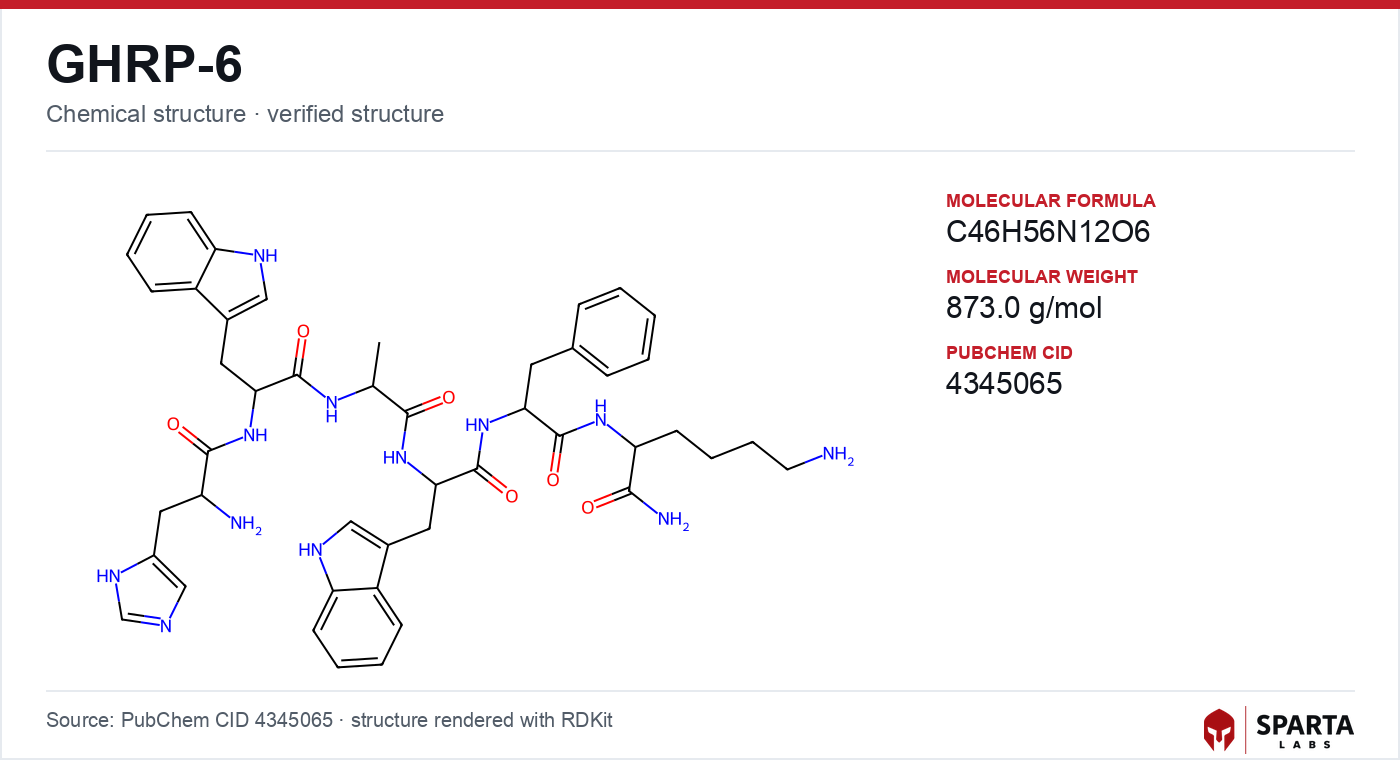
Figure: chemical structure of GHRP-6.
From Enkephalin Scaffold to Hexapeptide
The origin of GHRP-6 is one of the clearer examples of rational peptide design following an accidental observation. Work in the laboratory of Cyril Y. Bowers began from met-enkephalin, an opioid pentapeptide, after derivatives of that scaffold were found to release growth hormone (GH) from cultured pituitary cells. Bowers and colleagues pursued this systematically, and in 1984 formally characterized a synthetic hexapeptide that elicited GH release both in vitro and in vivo across multiple species [1].
Findings from research models do not establish safety or efficacy in humans. Sparta Labs makes no claims about the use of this compound.
Two aspects of that lineage matter for understanding the molecule. First, GHRP-6 retains no meaningful opioid-receptor selectivity; the medicinal-chemistry program moved the pharmacology entirely away from the parent enkephalin activity. Second, the sequence that resulted is not a fragment of any known hormone. It is a wholly synthetic construct, which is why identifying its endogenous receptor and natural ligand became a distinct research problem that took years to resolve [1]. The relationship between this hexapeptide and the later peptidyl secretagogues is discussed further in the GHRP-6 discovery and regulatory history article.
Chemistry and Structure
GHRP-6 has the amino acid sequence His-D-Trp-Ala-Trp-D-Phe-Lys-NH2 and a molecular weight of approximately 873 daltons. Three structural features are consistently emphasized in the primary literature:
- Two D-configuration residues. D-tryptophan sits at position 2 and D-phenylalanine at position 5. These non-natural stereochemistries are absent from ribosomally synthesized human peptides and are documented as contributing to the compound's resistance to proteolytic degradation relative to all-L-amino-acid peptides [1].
- A C-terminal amide. The carboxy terminus is amidated rather than a free acid, a common feature of bioactive peptides that alters charge and stability at the C-terminal end.
- Aromatic side-chain geometry. The tryptophan and phenylalanine residues contribute aromatic side chains whose spatial arrangement was central to how the medicinal-chemistry series was optimized [1].
Because the sequence is compact and fully synthetic, GHRP-6 is amenable to standard solid-phase peptide synthesis, and its structural simplicity relative to larger hormones is part of why it became a durable laboratory tool. Related structural notes on the sequences of the peptidyl secretagogues appear in the GHRP-2 research overview.
Pharmacological Classification: GHS-R1a Agonism
GHRP-6 is classified as an agonist at GHS-R1a, a class A (rhodopsin-like) G protein-coupled receptor. The receptor was cloned and reported in 1996 by Howard and colleagues, who described it at that time as an orphan receptor known only through its pharmacological response to synthetic secretagogues [2]. The identity of the endogenous ligand remained unknown until 1999, when Kojima and colleagues isolated ghrelin, an acylated peptide from stomach tissue, and identified it as the natural agonist of the receptor [3].
Structural biology has since described how peptide agonists engage and activate this receptor. Cryo-electron microscopy work reported in 2022 characterized the molecular mechanism of agonism at the ghrelin receptor and the resulting activated-state conformation, providing a structural framework for interpreting how synthetic secretagogues occupy the orthosteric binding pocket [4]. GHRP-6's engagement of that site, and the ways synthetic ligands differ from ghrelin in binding orientation, are treated in more detail in the GHRP-6 mechanism of action article.
The pharmacological profile reported for GHRP-6 in the founding literature is notable for its selectivity: GH release was described without concurrent stimulation of luteinizing hormone, follicle-stimulating hormone, thyroid-stimulating hormone, or prolactin, distinguishing it from non-selective agents [1]. This selectivity is one reason the compound has been used as a reference secretagogue in comparative studies alongside later peptides such as those covered in the hexarelin research overview and the ipamorelin research overview.
Regulatory and Research Context
Research-grade GHRP-6 from Sparta Labs is supplied as a research-use-only material with batch documentation. GHRP-6 does not hold approval from the United States Food and Drug Administration (FDA) for any therapeutic indication and is not a component of any FDA-approved drug product. It has not been the subject of a completed FDA new-drug approval, and no statement in this article should be read as describing an approved use.
Within the scientific literature, GHRP-6 has functioned for four decades as a pharmacological tool for interrogating the GHS-R1a signaling axis. Its historical role is unusual in that it served as a probe of a receptor system before that system's endogenous components were characterized, a sequence of events that retroactively positioned the compound as an early instrument for studying what is now understood as the ghrelin receptor pathway [2][3]. Its continued use occurs under the standard institutional and regulatory frameworks that govern investigational research compounds [5].
Position in the Secretagogue Lineage
The characterization of GHRP-6 stimulated a broader research program in growth hormone secretagogues. The peptidyl class expanded to include related compounds studied in the same laboratories and elsewhere, and non-peptide secretagogue analogues followed as separate medicinal-chemistry efforts. The pivotal downstream events were the 1996 cloning of the receptor [2] and the 1999 isolation of ghrelin [3], which together closed the loop between the synthetic tool and the physiological system it had been used to probe.
Viewed across that timeline, GHRP-6 is best understood not as an isolated molecule but as the entry point to a receptor pharmacology that was reconstructed in reverse: a synthetic ligand first, an orphan receptor second, and an endogenous hormone last. That inverted discovery order is what gives the compound its distinct standing in the endocrine literature.
References
-
Bowers CY, Momany FA, Reynolds GA, Hong A. On the in vitro and in vivo activity of a new synthetic hexapeptide that acts on the pituitary to specifically release growth hormone. Endocrinology. 1984;114(5):1537–45. PMID: 6714155. View on PubMed
-
Howard AD, Feighner SD, Cully DF, Arena JP, Liberator PA, Rosenblum CI, et al. A receptor in pituitary and hypothalamus that functions in growth hormone release. Science. 1996;273(5277):974–7. PMID: 8688086. View on PubMed
-
Kojima M, Hosoda H, Date Y, Nakazato M, Matsuo H, Kangawa K. Ghrelin is a growth-hormone-releasing acylated peptide from stomach. Nature. 1999;402(6762):656–60. PMID: 10604470. View on PubMed
-
Qin J, Cai Y, Xu Z, Ming Q, Ji SY, Wu C, et al. Molecular mechanism of agonism and inverse agonism in ghrelin receptor. Nat Commun. 2022;13(1):300. PMID: 35027551. View on PubMed
-
US Food and Drug Administration. Human Drug Compounding: Bulk Drug Substances Used in Compounding Under Section 503A of the Federal Food, Drug, and Cosmetic Act. Source: fda.gov
Disclaimer. Statements in this article have not been evaluated by the Food and Drug Administration. This compound is not intended to diagnose, treat, cure, or prevent any disease. Sparta Labs sells research-use-only materials. Content is provided for educational and informational purposes only and does not constitute medical advice. Consult a qualified medical professional for any health concerns.
Frequently asked questions
What is GHRP-6 and how is it classified?
GHRP-6 is a synthetic hexapeptide classified as a peptidyl growth hormone secretagogue and an agonist at the growth hormone secretagogue receptor type 1a (GHS-R1a). It was first characterized in the peer-reviewed literature by Bowers and colleagues in 1984 and is described in that record as a founding member of the peptidyl secretagogue class.
What is the amino acid sequence of GHRP-6?
GHRP-6 has the sequence His-D-Trp-Ala-Trp-D-Phe-Lys-NH2, a six-residue chain with a molecular weight near 873 daltons. It carries two D-configuration residues (D-tryptophan at position 2 and D-phenylalanine at position 5) and a C-terminal amide, structural features documented in the literature as distinguishing it from endogenous L-amino acid peptides.
Why is GHRP-6 described as an enkephalin analogue?
The published discovery record traces GHRP-6 to systematic modification of met-enkephalin, an opioid pentapeptide, after early observations that certain enkephalin derivatives elicited growth hormone release in pituitary cell cultures. GHRP-6 was optimized through medicinal chemistry from that starting scaffold and retains no opioid-receptor selectivity, according to the cited literature.
What receptor does GHRP-6 act on?
Published research reports that GHRP-6 is an agonist at GHS-R1a, a class A G protein-coupled receptor. GHS-R1a was cloned and reported in 1996 as an orphan receptor and was later identified as the receptor for the stomach-derived peptide ghrelin, described by Kojima and colleagues in 1999.
Is GHRP-6 approved by the FDA?
GHRP-6 does not hold United States Food and Drug Administration approval for any therapeutic indication and is not a component of any FDA-approved drug product. It is characterized here as a research-use-only material intended for laboratory investigation.