
GHRP-6: Discovery and Regulatory History
How a hexapeptide from a 1970s opioid laboratory became the founding growth hormone secretagogue and a decade-long probe of the then-unknown ghrelin receptor system.
For research use only. Not for human consumption. This article is educational reference material. It is not medical advice and is not a recommendation to use any substance.
An accidental discovery in an opioid laboratory
GHRP-6 (growth hormone-releasing peptide-6) is a synthetic hexapeptide whose scientific history is unusually instructive: it was the founding member of the peptidyl growth hormone secretagogue class, and for more than a decade it functioned as a pharmacological probe of a receptor system that had not yet been recognized to exist. The compound's lineage runs from enkephalin structure-activity work in the late 1970s, through the 1996 cloning of an orphan receptor, to the 1999 isolation of ghrelin, the endogenous ligand that GHRP-6 had been mimicking all along. This account traces that arc using published peer-reviewed literature and publicly available regulatory records.
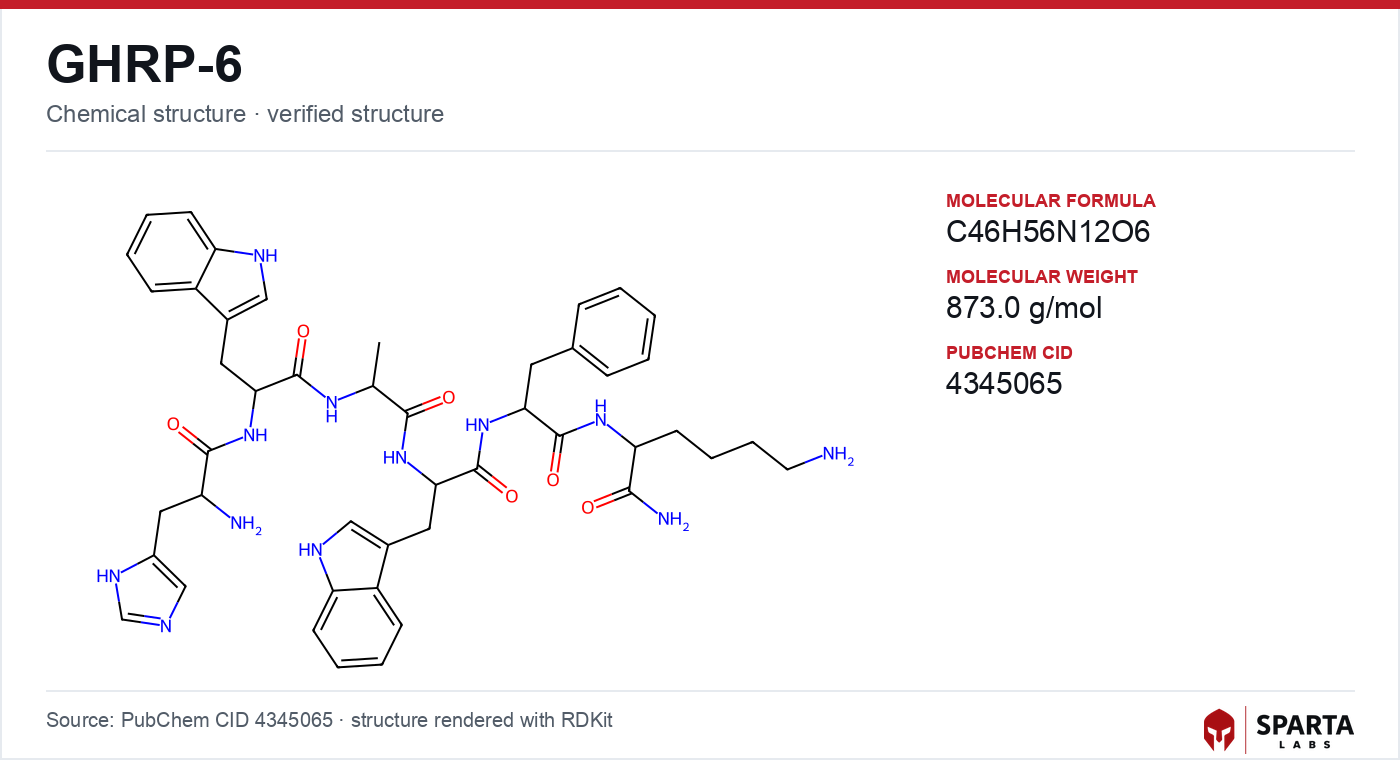
Figure: chemical structure of GHRP-6.
The enkephalin connection (1977-1984)
The origin of GHRP-6 is conventionally traced to the laboratory of Cyril Y. Bowers at Tulane University Medical School [1]. Bowers and colleagues were performing structure-activity relationship work on opioid peptides, principally enkephalin analogues, when they observed that certain modifications to the enkephalin pentapeptide scaffold conferred an unexpected property: growth hormone (GH)-releasing activity in cultured rat anterior pituitary cells. Enkephalins had not previously been described as GH secretagogues, so the finding was incidental to the opioid pharmacology it emerged from.
The activity was notable because it appeared distinct from opioid receptor engagement and from the hypothalamic factor that would later be characterized as growth hormone-releasing hormone (GHRH). Working with the computational chemist Frank Momany, who applied conformational energy calculations to refine the pharmacophore, the group synthesized progressively shorter and more selective enkephalin-derived peptides. That optimization converged on a synthetic hexapeptide with the sequence His-D-Trp-Ala-Trp-D-Phe-Lys-NH2, incorporating two D-amino acids that improved metabolic stability relative to an all-L sequence.
The formal introduction of the compound into the peer-reviewed literature came in 1984, when Bowers, Momany, Reynolds and Hong published in Endocrinology [2]. The paper reported selective, dose-independent-of-GHRH GH release from rat pituitary cells in vitro without concomitant release of the other pituitary hormones tested, and reported GH-releasing activity across several species under experimental conditions. It established GHRP-6 as the prototype of a new pharmacological class, the synthetic growth hormone secretagogues, positioned as distinct from both GHRH and somatostatin.
Findings from research models do not establish safety or efficacy in humans. Sparta Labs makes no claims about the use of this compound.
Building a compound class (1984-1996)
The 1984 characterization prompted sustained medicinal chemistry across multiple groups. Researchers varied the hexapeptide scaffold to generate second-generation peptidyl secretagogues, a lineage that includes hexarelin and GHRP-2, each modifying potency, selectivity and stability relative to the parent compound. Readers tracing that structural family may find the parallel accounts of these analogues useful for comparison.
A decisive translational step occurred at Merck Research Laboratories, where medicinal chemists used GHRP-6's pharmacological profile as a template to develop non-peptide secretagogues, including the orally active compound MK-0677 (ibutamoren) [3]. The success of that program supplied strong indirect evidence that the GH-releasing activity of GHRP-6 resided at a specific, druggable receptor with a defined orthosteric pocket, rather than at a diffuse or non-specific target. Mechanistic work over this period placed the activity of GHRP-6 and its analogues on a signaling pathway distinct from the cyclic-AMP route used by GHRH, consistent with action at a separate receptor [3].
Cloning an orphan receptor (1996)
The receptor was identified and cloned in 1996 by Howard and colleagues at Merck, reported in Science [4]. Using an expression-cloning strategy with GHRP-6 and its non-peptide analogue MK-0677 as pharmacological probes, the authors isolated a seven-transmembrane G protein-coupled receptor and designated it the growth hormone secretagogue receptor, subtype 1a (GHS-R1a). The study reported expression in the hypothalamus and anterior pituitary and high sequence conservation across the human, porcine and rat homologues, and noted no significant homology to the GHRH receptor.
At this point GHS-R1a was an orphan receptor: it had well-characterized synthetic agonists, GHRP-6 chief among them, but no known endogenous ligand. That gap, which framed GHRP-6 as a key that fit a lock whose natural key was still unidentified, would be closed three years later.
The ghrelin resolution (1999)
The orphan status of GHS-R1a was resolved in 1999 by Kojima and colleagues at the National Cardiovascular Center Research Institute in Osaka, who reported the isolation of ghrelin in Nature [5]. Reasoning that the endogenous agonist might have a gastrointestinal origin analogous to motilin, the group extracted and fractionated rat stomach tissue to purify the natural ligand of GHS-R1a. Ghrelin was characterized as a 28-amino acid peptide bearing an n-octanoyl modification on the serine at position 3, an unusual fatty-acid acylation reported to be essential for receptor activation.
The discovery recast the preceding 15 years of GHRP-6 research. A synthetic compound had, in effect, been probing an entirely uncharacterized gastric endocrine axis long before that axis was known, an unusual case of synthetic pharmacology preceding the discovery of the endogenous biology it engaged. Retroactively classifying GHRP-6 as a ghrelin receptor agonist situated it within research programs on appetite regulation, energy balance and neuroendocrine signaling that became major foci of GHS-R1a study in the following two decades. Readers may find the corresponding GHRP-6 mechanism of action article a useful companion on the receptor pharmacology itself.
Regulatory status and research posture
GHRP-6's contribution to the ghrelin receptor field has not been accompanied by a conventional pharmaceutical development pathway; it has been studied principally as a research tool rather than as an approved product. Its non-peptide descendant MK-0677 (ibutamoren) advanced further into clinical investigation and has appeared in published randomized controlled trials, illustrating the translational reach of the underlying scaffold even where the parent hexapeptide did not follow the same route.
In the US compounding context, FDA records reflect that GHRP-6 does not appear in the United States Pharmacopeia or National Formulary and is not a component of an approved drug product; nominations for compounding-related bulk-substance lists were assessed by the agency as insufficiently supported [6]. These determinations are consistent with the compound's research-use status. Details on synthesis, purity benchmarks and third-party verification for research-grade material are covered in the GHRP-6 sourcing and quality article, and analytical characterization of reference material offered for research is described on the GHRP-6 product page.
A four-decade research afterlife
Scientific interest in GHRP-6 has persisted into the 2020s, with the literature branching well beyond its original identity as a GH secretagogue. A review by Berlanga-Acosta and colleagues surveyed a body of preclinical work attributing cytoprotective observations in cardiac, hepatic and dermal tissue models to GHRP-6, with authors in that literature generally invoking interactions with the CD36 scavenger receptor rather than GHS-R1a alone [7]. That review is a useful entry point to the primary studies underlying those investigational lines.
A more recent structural chapter opened with the 2021 cryo-electron microscopy determination of GHRP-6 bound to GHS-R1a, reported by Wang and colleagues in Nature Communications [8]. The structure provided atomic-level detail on how the synthetic hexapeptide engages the acyl-peptide receptor and renewed interest in GHRP-6 as a reference ligand for ghrelin receptor structural pharmacology. GHRP-6 thus occupies a distinctive place in the record: the founding member of a compound class that preceded, and helped reveal, its own endogenous receptor system, and whose pharmacological profile continues to generate published findings more than 40 years after its first characterization.
References
-
Bowers CY. Growth hormone-releasing peptide (GHRP). Cell Mol Life Sci. 1998;54(12):1316-29. PMID: 9893708. View on PubMed
-
Bowers CY, Momany FA, Reynolds GA, Hong A. On the in vitro and in vivo activity of a new synthetic hexapeptide that acts on the pituitary to specifically release growth hormone. Endocrinology. 1984;114(5):1537-45. PMID: 6714155. View on PubMed
-
Smith RG, Van der Ploeg LH, Howard AD, Feighner SD, Cheng K, Hickey GJ, et al. Peptidomimetic regulation of growth hormone secretion. Endocr Rev. 1997;18(5):621-45. PMID: 9331547. View on PubMed
-
Howard AD, Feighner SD, Cully DF, Arena JP, Liberator PA, Rosenblum CI, et al. A receptor in pituitary and hypothalamus that functions in growth hormone release. Science. 1996;273(5277):974-7. PMID: 8688086. View on PubMed
-
Kojima M, Hosoda H, Date Y, Nakazato M, Matsuo H, Kangawa K. Ghrelin is a growth-hormone-releasing acylated peptide from stomach. Nature. 1999;402(6762):656-60. PMID: 10604470. View on PubMed
-
US Food and Drug Administration. Human Drug Compounding: bulk drug substances and the 503A/503B bulks-list evaluation process. Source: fda.gov
-
Berlanga-Acosta J, Abreu-Cruz A, García-del Barco Herrera D, Mendoza-Marí Y, Rodríguez-Ulloa A, García-Ojalvo A, et al. Synthetic Growth Hormone-Releasing Peptides (GHRPs): A Historical Appraisal of the Evidences Supporting Their Cytoprotective Effects. Clin Med Insights Cardiol. 2017;11:1179546817694558. PMID: 28469491. PMC: PMC5392015. DOI: 10.1177/1179546817694558. Full text on PMC
-
Wang Y, Guo S, Zhuang Y, et al. Molecular recognition of an acyl-peptide hormone and activation of ghrelin receptor. Nat Commun. 2021;12(1):5064. PMID: 34417468. View on PubMed
Disclaimer. Statements in this article have not been evaluated by the Food and Drug Administration. This compound is not intended to diagnose, treat, cure, or prevent any disease. Sparta Labs sells research-use-only materials. Content is provided for educational and informational purposes only and does not constitute medical advice. Consult a qualified medical professional for any health concerns.
Frequently asked questions
When was GHRP-6 first characterized?
GHRP-6 emerged from enkephalin structure-activity work in the laboratory of Cyril Y. Bowers at Tulane University Medical School, where modifications to enkephalin analogues were reported to confer growth hormone-releasing activity in rat pituitary cell cultures. The compound was formally introduced into the peer-reviewed literature in Endocrinology in 1984 by Bowers, Momany, Reynolds and Hong.
Who developed GHRP-6?
GHRP-6 was developed by Cyril Y. Bowers and colleagues at Tulane University Medical School, working with computational chemist Frank Momany, who applied conformational energy calculations to refine the pharmacophore. Systematic structure-activity work converged on the hexapeptide sequence His-D-Trp-Ala-Trp-D-Phe-Lys-NH2.
How is GHRP-6 connected to ghrelin?
GHRP-6 served as a pharmacological probe of the receptor later designated GHS-R1a, which was cloned in 1996 while still an orphan receptor with no known endogenous ligand. In 1999, Kojima and colleagues isolated ghrelin from rat stomach as the natural ligand of that receptor, retroactively classifying GHRP-6 as a ghrelin receptor agonist that had been engaging the system for over a decade before ghrelin was identified.
What is the regulatory status of GHRP-6 in the United States?
GHRP-6 has not received FDA approval for any therapeutic indication and is not a component of any approved drug product. FDA records reflect that it does not appear in the United States Pharmacopeia or National Formulary, and compounding-related bulk-substance nominations were assessed as insufficiently supported. The compound is handled as a research-use-only material.
Has recent research continued to study GHRP-6?
Yes. A 2017 review surveyed preclinical work examining GHRP-6 in cardiac, hepatic and dermal tissue models, and a 2022 cryo-electron microscopy study resolved GHRP-6 bound to the ghrelin receptor GHS-R1a. These publications indicate continued scientific interest in GHRP-6 as a reference ligand more than four decades after its first characterization.