
Hexarelin: Discovery and Regulatory History
A chronological history of hexarelin: its origin in the Bowers GHRP lineage, Deghenghi's early-1990s synthesis, human endocrine characterization at Turin, the GHS-R1a and CD36 receptor milestones, and its Phase II regulatory arc.
For research use only. Not for human consumption. This article is educational reference material. It is not medical advice and is not a recommendation to use any substance.
From Enkephalins to a Named Investigational Peptide
Hexarelin (examorelin; EP-23905) occupies a specific place in the lineage of synthetic growth hormone-releasing peptides (GHRPs), a family of small acylated hexapeptides that trace back to unexpected pharmacology observed in opioid-peptide chemistry during the late 1970s. Rather than being designed against growth hormone-releasing hormone (GHRH), the GHRP scaffold arose from the observation that certain enkephalin derivatives released growth hormone (GH) through a receptor distinct from the GHRH receptor. Hexarelin was later synthesized by Romano Deghenghi and colleagues at Europeptides (Argenteuil, France) as a structurally refined member of this class, and its documented arc runs from early rodent pharmacology through human endocrine characterization, Phase II clinical investigation, and a continuing body of preclinical literature. This article organizes that history chronologically around the discoveries that defined the compound.
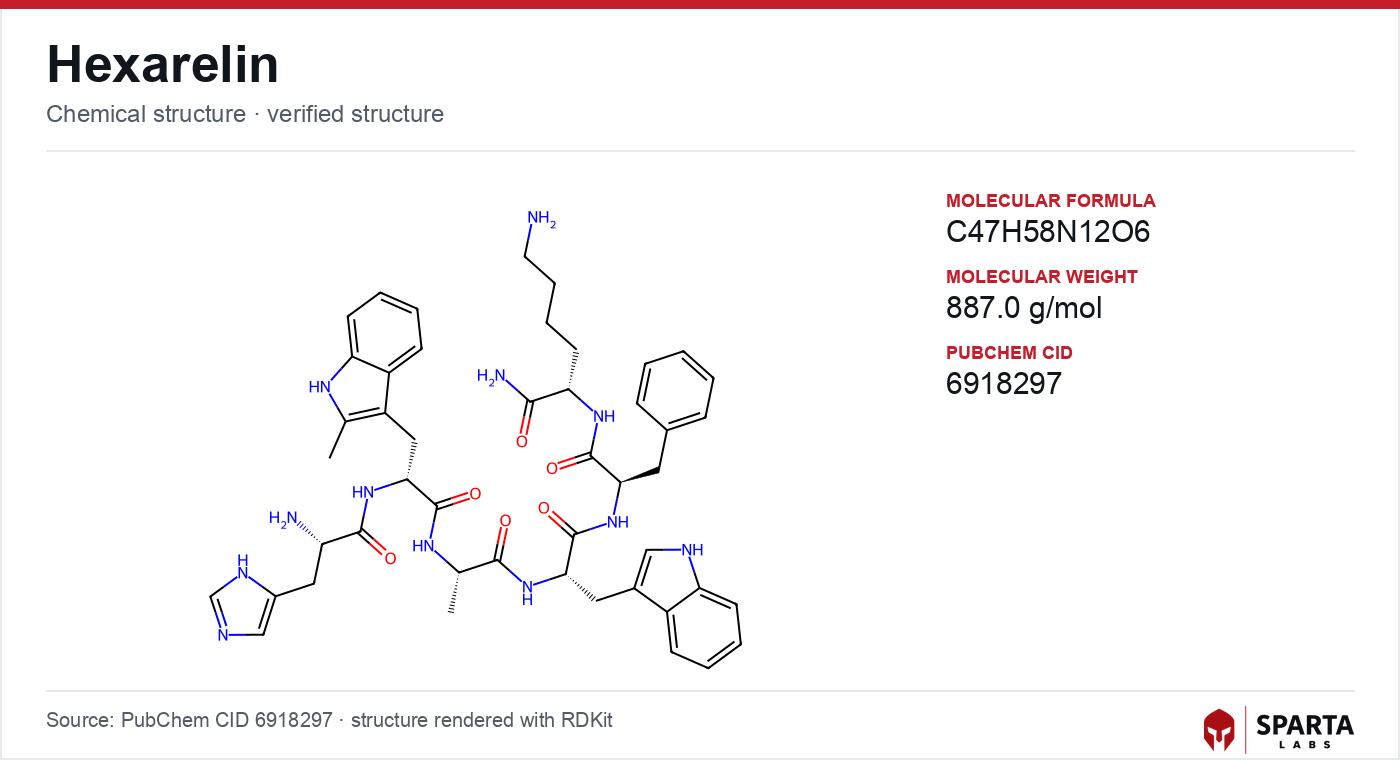
Figure: chemical structure of Hexarelin.
The Bowers Lineage and the GHRP Scaffold (Late 1970s–1980s)
The conceptual origin of hexarelin lies in the work of endocrinologist Cyril Y. Bowers, whose group reported that synthetic derivatives of met-enkephalin displayed GH-releasing activity in pituitary systems that did not depend on the GHRH receptor [1]. Because these opioid-derived scaffolds bore no structural resemblance to GHRH, the finding implied a separate secretagogue mechanism and defined a new avenue of pituitary pharmacology.
Iterative medicinal chemistry on this scaffold produced GHRP-6 (His-D-Trp-Ala-Trp-D-Phe-Lys-NH2), a synthetic hexapeptide that displayed reproducible GH-releasing activity and became the structural template for the class [1]. The pharmacophore residues within this sequence guided subsequent analog design. The parallel evolution of the class is documented in the GHRP-6 discovery and regulatory history and GHRP-2 discovery and history articles, both of which describe the same Bowers-derived medicinal chemistry program from which hexarelin emerged.
Hexarelin's defining structural change was substitution of the D-tryptophan residue at position two of the GHRP-6 template with D-2-methyltryptophan (D-2-Me-Trp), producing the hexapeptide designated EP-23905. This modification was reported to alter GH-releasing potency and metabolic stability relative to earlier analogs in the series.
First Primary Literature and the 1994 Rodent Reports
The earliest primary literature describing hexarelin appeared in 1994, when Deghenghi and colleagues published GH-releasing activity data in Life Sciences, characterizing the compound's pharmacological profile in infant and adult rats [2]. This paper established hexarelin's identity as a discrete named GHRP and provided the rodent pharmacology on which later human work would build.
Findings from research models do not establish safety or efficacy in humans. Sparta Labs makes no claims about the use of this compound.
The rodent characterization situated hexarelin within a comparative framework alongside GHRP-6 and GHRP-2, which shared the same secretagogue mechanism but differed in potency and stability parameters. The chemistry and classification that this early work established are examined further in the hexarelin research overview.
Human Endocrine Characterization (1995–1998)
Human pharmacology of hexarelin developed rapidly after the rodent reports. Laron and colleagues described intranasal administration of hexarelin in a cohort of children with short stature, reporting GH secretion in response to the peptide [3]. This work is notable historically as one of the earliest accounts of hexarelin administration in human subjects.
A substantial body of clinical endocrine characterization followed at the University of Turin, where Arvat, Maccario, Ghigo, and colleagues published systematic comparisons of hexarelin and GHRP-2 against GHRH, TRH, and hCRH. Their study examined GH, prolactin, ACTH, and cortisol responses, reporting that both synthetic GHRPs elicited GH release in human subjects along with modest, statistically detectable changes in ACTH and cortisol [4]. This work helped define the endocrine selectivity profile of the GHRP class in humans and remains a frequently cited reference for hexarelin's neuroendocrine pharmacology.
Deconvoluting the Receptor: GHS-R1a and Ghrelin (1996–1999)
Two receptor-science milestones reshaped the interpretation of hexarelin pharmacology in the late 1990s. In 1996, Howard and colleagues at Merck Research Laboratories reported the cloning and characterization of the growth hormone secretagogue receptor (GHS-R1a), a G protein-coupled receptor in the pituitary and hypothalamus that mediated the GH-releasing effects of hexarelin and related GHRPs [5]. This identification provided the molecular target that had been inferred, but not isolated, since the Bowers-era observations.
In 1999, Kojima and colleagues reported the isolation of ghrelin, an acylated 28-amino-acid peptide from stomach that they identified as the endogenous ligand for GHS-R1a [6]. This discovery retrospectively reframed hexarelin and the other synthetic GHRPs as pharmacological agonists at the receptor for a natural hormone with documented roles in GH regulation and energy balance. The receptor-level consequences of these findings for hexarelin are treated in detail in the hexarelin mechanism of action article.
A Second Binding Site: CD36 and GH-Independent Effects
A distinct thread of hexarelin receptor science concerns binding sites outside GHS-R1a. Bodart and colleagues used photoaffinity cross-linking to identify CD36, a scavenger receptor, as a binding site for hexarelin and structurally related GHRPs [7]. This finding offered a molecular rationale for effects reported in cardiovascular tissue that appeared to occur independently of the GH axis, and it established hexarelin as a probe with dual-receptor pharmacology. The dual GHS-R1a and CD36 interaction remains central to contemporary mechanistic interpretations of the compound and distinguishes hexarelin from more receptor-selective secretagogues in the class.
Regulatory Development, INN Assignment, and Phase II
Under the Europeptides development program, hexarelin advanced to Phase II clinical investigation. The World Health Organization assigned the compound the International Nonproprietary Name examorelin through its standard INN process, a routine step formally acknowledging pharmaceutical development status. Reported investigational indications for the class included growth hormone deficiency, reflecting the secretagogue pharmacology characterized during the 1990s.
Phase II investigation did not advance to Phase III development. The peer-reviewed literature does not articulate a single definitive basis for this transition; development decisions of this kind are typically shaped by a combination of Phase II findings, tolerability data, commercial considerations, and competitive-landscape factors that are not always publicly disclosed. Hexarelin has not received marketing authorization from the FDA, the EMA, or comparable authorities for any therapeutic indication, a regulatory status it shares with most compounds in the GHRP class.
Hexarelin appears on the World Anti-Doping Agency (WADA) Prohibited List within the category of peptide hormones, growth factors, related substances, and mimetics. This listing reflects the compound's pharmacological classification within a prohibited class rather than any record of approved or marketed therapeutic use.
The Compound as a Contemporary Research Tool
Despite the absence of a regulatory approval pathway, hexarelin has continued to appear in primary research literature as an investigational tool compound for studying GHS-R1a and CD36 biology. Its well-characterized pharmacology and dual receptor activity make it a reference agonist in mechanistic studies of ghrelin-receptor signaling. Hexarelin from Sparta Labs is supplied as a research-use-only reference material for this kind of laboratory work.
Within the broader field, the characterization of hexarelin and its GHRP siblings informed the development of later ghrelin-receptor agonists with varied tissue selectivity, several of which have entered clinical investigation. Readers evaluating research-grade supply parameters for laboratory work will find synthesis and verification standards discussed in the hexarelin sourcing and quality article, and a bibliographic summary of the primary literature in the hexarelin published research summary.
References
-
Bowers CY. Growth hormone-releasing peptide (GHRP). Cell Mol Life Sci. 1998;54(12):1316–1329. PMID: 9893709. DOI: 10.1007/s000180050257
-
Deghenghi R, Cananzi MM, Torsello A, Battisti C, Müller EE, Locatelli V. GH-releasing activity of Hexarelin, a new growth hormone releasing peptide, in infant and adult rats. Life Sci. 1994;54(18):1321–1328. PMID: 7910650. DOI: 10.1016/0024-3205(94)00845-X
-
Laron Z, Frenkel J, Deghenghi R, Anin S, Klinger B, Silbergeld A. Intranasal administration of the GHRP hexarelin accelerates growth in short children. Clin Endocrinol (Oxf). 1995;43(5):631–635. PMID: 7585287. DOI: 10.1111/j.1365-2265.1995.tb02929.x
-
Arvat E, Maccario M, Di Vito L, Broglio F, Ramunni J, Corneli G, et al. Effects of GHRP-2 and hexarelin, two synthetic GH-releasing peptides, on GH, prolactin, ACTH and cortisol levels in man. Comparison with the effects of GHRH, TRH and hCRH. Eur J Endocrinol. 1997;136(5):445–452. PMID: 9186262. DOI: 10.1530/eje.0.1360445
-
Howard AD, Feighner SD, Cully DF, Arena JP, Liberator PA, Rosenblum CI, et al. A receptor in pituitary and hypothalamus that functions in growth hormone release. Science. 1996;273(5277):974–977. PMID: 8688086. DOI: 10.1126/science.273.5277.974
-
Kojima M, Hosoda H, Date Y, Nakazato M, Matsuo H, Kangawa K. Ghrelin is a growth-hormone-releasing acylated peptide from stomach. Nature. 1999;402(6762):656–660. PMID: 10604470. DOI: 10.1038/45230
-
Bodart V, Febbraio M, Demers A, McNicoll N, Pohankova P, Perreault A, et al. CD36 mediates the cardiovascular action of growth hormone-releasing peptides in the heart. Circ Res. 2002;90(8):844–849. PMID: 11988484. DOI: 10.1161/01.RES.0000016164.02525.B4
Disclaimer. Statements in this article have not been evaluated by the Food and Drug Administration. This compound is not intended to diagnose, treat, cure, or prevent any disease. Sparta Labs sells research-use-only materials. Content is provided for educational and informational purposes only and does not constitute medical advice. Consult a qualified medical professional for any health concerns.
Frequently asked questions
When was hexarelin discovered and who developed it?
Hexarelin (EP-23905) was synthesized by Romano Deghenghi and colleagues at Europeptides in Argenteuil, France, in the early 1990s, with the first primary literature describing its GH-releasing activity in rats published in 1994. Its scaffold derived from earlier structure-activity work in the growth hormone-releasing peptide class traced to Cyril Bowers' observations on enkephalin derivatives.
What structural change distinguishes hexarelin from GHRP-6?
Hexarelin was built on the GHRP-6 hexapeptide template. Its defining modification was substitution of the D-tryptophan residue at position two with D-2-methyltryptophan (D-2-Me-Trp), a change reported to alter GH-releasing potency and metabolic stability relative to earlier analogs in the series.
What is examorelin?
Examorelin is the International Nonproprietary Name (INN) assigned to hexarelin by the World Health Organization through its standard INN process. The assignment formally acknowledged the compound's pharmaceutical development status during its investigational period.
Why is CD36 significant in hexarelin's history?
Bodart and colleagues reported that CD36, a scavenger receptor, is a binding site for hexarelin and related GHRPs. This finding provided a molecular rationale for cardiovascular effects observed in animal models that appeared independent of the growth hormone axis, establishing hexarelin as a probe with dual GHS-R1a and CD36 pharmacology.
Did hexarelin ever reach the market?
No. Hexarelin advanced to Phase II clinical investigation under the Europeptides program but did not proceed to Phase III, and it has not received marketing authorization from the FDA, the EMA, or comparable authorities for any therapeutic indication. It also appears on the World Anti-Doping Agency Prohibited List within the peptide-hormone class.