
Hexarelin: Published Research
A structured survey of the hexarelin research literature, organized around its GH-releasing pharmacology and the CD36-linked cardiovascular, metabolic, and neuroprotective models that have shaped later work. Educational reference.
For research use only. Not for human consumption. This article is educational reference material. It is not medical advice and is not a recommendation to use any substance.
Introduction
Hexarelin (examorelin) is a synthetic hexapeptide first characterized in the early 1990s and classified in the published literature as a growth hormone-releasing peptide (GHRP) and growth hormone secretagogue (GHS). Its research record is notable less for its original neuroendocrine purpose than for the direction the literature took afterward: after early work established that hexarelin stimulated growth hormone (GH) release through the receptor now known as GHS-R1a, a second line of investigation reported cardiovascular and metabolic observations that did not appear to depend on GH at all. That divergence, and the later identification of the scavenger receptor CD36 as a second binding partner, organizes much of the modern hexarelin literature. This article surveys that literature by research question rather than by a generic template, attributing each finding to its source with methodological context.
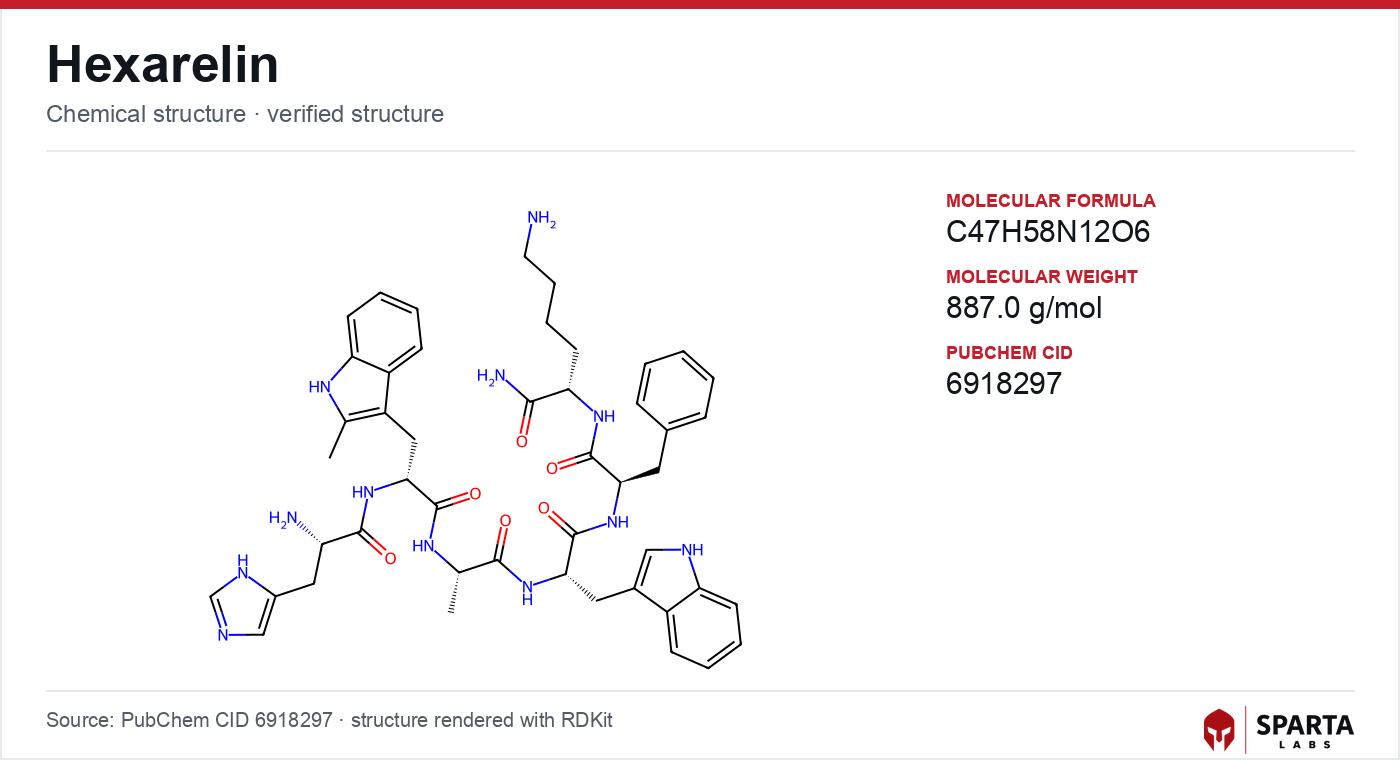
Figure: chemical structure of Hexarelin.
The GH-Secretagogue Origin of the Literature
Hexarelin emerged from structure-activity work on the growth hormone-releasing peptides descended from GHRP-6, the first GHRP characterized in this family. The compound's readable identity as a potent stimulator of GH release was the reason it entered human pharmacology studies in the 1990s: investigators at the University of Turin and elsewhere reported dose-related GH responses in healthy volunteers and in subjects with hypothalamic-pituitary abnormalities, work that helped map the GHS axis before the endogenous ligand ghrelin was identified in 1999. Readers tracing this pharmacological lineage may find the parallel record for the related secretagogue GHRP-6 published research and the growth-hormone-releasing-hormone analog CJC-1295 without DAC published research useful for comparing the experimental contexts applied across the secretagogue and releasing-hormone classes.
Findings from research models do not establish safety or efficacy in humans. Sparta Labs makes no claims about the use of this compound.
The key conceptual shift in the hexarelin literature is that its most active research frontier moved away from the pituitary. The sections below follow that shift into cardiovascular, metabolic, and neuroprotective models, where a recurring theme is the proposal that hexarelin engages tissue targets beyond the classical GHS-R1a receptor.
The GH-Independent Cardiovascular Line
The observation that reoriented hexarelin research was that its reported cardiovascular effects appeared even where GH signaling was absent or suppressed. Tivesten and colleagues (2000) examined hexarelin in a rat model of experimental myocardial infarction and reported that treatment was associated with measures of improved systolic function relative to controls; the authors framed the finding within a broader argument that hexarelin's cardiovascular pharmacology could be dissociated from its neuroendocrine activity [1]. This dissociation became the organizing hypothesis for later work and prompted the search for a cardiac receptor distinct from the pituitary GHS-R1a.
Huang and colleagues (2017) pursued the mechanism in a rat model of in vivo myocardial ischemia-reperfusion injury, reporting that hexarelin-treated animals differed from vehicle controls in cardiomyocyte survival and markers associated with interleukin-1 signaling, and identifying GHS-R1a activation in cardiac tissue as a mediating factor [2]. A companion 2020 study in a mouse ischemia-reperfusion model examined neuroinflammatory and autonomic pathways, reporting preserved cardiac morphology and reduced inflammatory infiltrate in treated animals, with the authors proposing a contribution from vagal anti-inflammatory signaling [3].
The CD36 hypothesis received its clearest treatment in remodeling models. McDonald and colleagues (2018) used a mouse model of acute myocardial infarction over a 21-day protocol and reported that hexarelin-treated animals showed preservation of systolic function by echocardiography alongside reductions in interstitial collagen deposition, TGF-β1 expression, and myofibroblast differentiation, proposing that both GHS-R1a and CD36 signaling contributed to the observations [4]. Together these studies frame hexarelin's cardiac record around a dual-receptor model, a theme developed further in the hexarelin mechanism of action article.
Metabolic and Insulin-Resistance Models
A smaller metabolic literature applies the same dual-receptor lens to glucose and lipid handling. Mosa and colleagues (2017) examined hexarelin in the MKR mouse, a model of non-obese insulin resistance, and reported associations between hexarelin treatment and changes in lipid metabolic parameters [5]. Zhang and colleagues (2018) used a streptozotocin-induced diabetic rat model and reported differences in cardiomyocyte contractile function alongside markers of oxidative stress and calcium handling, identifying MAPK and PI3K/Akt pathways as associated with the observed outcomes [6]. In both reports the authors proposed that GHS-R1a and CD36 pathways jointly contributed to the metabolic and cardiac observations, extending the cardiovascular dual-receptor framing into metabolic tissue. The CD36 connection is of particular interest here because CD36 is itself a fatty-acid transporter, which situates these findings within a coherent, if still preclinical, mechanistic narrative.
Neuroprotective and Cell-Survival Models
The most recent expansion of the hexarelin literature is into neuronal cell-survival research. Meanti and colleagues (2021) reported that hexarelin pre-treatment in Neuro-2A neuronal cells subjected to hydrogen peroxide-induced oxidative stress was associated with attenuation of apoptotic markers, modulation of MAPK phosphorylation, and activation of the PI3K/Akt survival pathway relative to untreated challenged cells [7]. The shared appearance of the PI3K/Akt axis across the metabolic and neuronal studies is one of the more consistent signaling motifs in the modern literature.
Meanti and colleagues (2023) extended this line into a disease-relevant cellular context, examining hexarelin and a structurally related compound (JMV2894) in human neuroblastoma cells expressing the SOD1-G93A mutation, a model used in amyotrophic lateral sclerosis (ALS) research [8]. The authors reported protection against cell death in the mutant SOD1 context and proposed that both GHS-R1a and mitochondrial mechanisms contributed to the observed cytoprotective outcomes. This publication illustrates the continued movement of hexarelin research into emerging model systems well beyond its GH-secretagogue origins.
Knowledge Gaps and the State of Translation
Two gaps define the current hexarelin literature. First, the dual-receptor question, how much of the observed pharmacology is attributable to GHS-R1a versus CD36, remains unresolved; most studies infer receptor contributions from pathway markers and knockout comparisons rather than direct binding quantification in the tissue of interest. Second, the modern cardiovascular, metabolic, and neuroprotective record is overwhelmingly preclinical, built on cell lines and rodent injury models, while the human data remain limited to the 1990s GH-secretion pharmacology. Bridging that gap between animal-model observations and human physiology is the principal open direction for the field. For adjacent context on how the growth-hormone secretagogue class is positioned within Sparta Labs' library, the hexarelin research overview situates this compound alongside its peers. Research-grade hexarelin from Sparta Labs is batch-verified by third-party analytical testing to support reproducible experimental work.
References
-
Tivesten A, Bollano E, Caidahl K, Kujacic V, Sun XY, Hedner T, et al. The growth hormone secretagogue hexarelin improves cardiac function in rats after experimental myocardial infarction. Endocrinology. 2000;141(1):60-66. PMID: 10614623. DOI: 10.1210/endo.141.1.7249
-
Huang J, Li Y, Zhang J, Liu Y, Lu Q. The Growth Hormone Secretagogue Hexarelin Protects Rat Cardiomyocytes From in vivo Ischemia/Reperfusion Injury Through Interleukin-1 Signaling Pathway. Int Heart J. 2017;58(2):257-263. PMID: 28321024. DOI: 10.1536/ihj.16-241
-
McDonald H, Peart J, Kurniawan ND, Galloway G, Royce SG, Samuel CS, Chen C. Hexarelin targets neuroinflammatory pathways to preserve cardiac morphology and function in a mouse model of myocardial ischemia-reperfusion. Biomed Pharmacother. 2020;127:110165. PMID: 32403043. DOI: 10.1016/j.biopha.2020.110165
-
McDonald H, Peart J, Kurniawan N, Galloway G, Royce S, Samuel CS, Chen C. Hexarelin treatment preserves myocardial function and reduces cardiac fibrosis in a mouse model of acute myocardial infarction. Physiol Rep. 2018;6(9):e13699. PMID: 29756411. DOI: 10.14814/phy2.13699
-
Mosa R, Huang L, Wu Y, Fung C, Mallawakankanamalage O, LeRoith D, Chen C. Hexarelin, a Growth Hormone Secretagogue, Improves Lipid Metabolic Aberrations in Nonobese Insulin-Resistant Male MKR Mice. Endocrinology. 2017;158(10):3174-3187. PMID: 28977588. DOI: 10.1210/en.2017-00168
-
Zhang X, Qu L, Chen L, Chen C. Improvement of cardiomyocyte function by in vivo hexarelin treatment in streptozotocin-induced diabetic rats. Physiol Rep. 2018;6(4):e13612. PMID: 29446246. DOI: 10.14814/phy2.13612
-
Meanti R, Rizzi L, Bresciani E, Molteni L, Locatelli V, Coco S, et al. Hexarelin Modulation of MAPK and PI3K/Akt Pathways in Neuro-2A Cells Inhibits Hydrogen Peroxide-Induced Apoptotic Toxicity. Pharmaceuticals (Basel). 2021;14(5):444. PMID: 34066741. DOI: 10.3390/ph14050444
-
Meanti R, Licata M, Rizzi L, Bresciani E, Molteni L, Coco S, et al. Protective Effects of Hexarelin and JMV2894 in a Human Neuroblastoma Cell Line Expressing the SOD1-G93A Mutated Protein. Int J Mol Sci. 2023;24(2):993. PMID: 36674509. DOI: 10.3390/ijms24020993
Disclaimer. Statements in this article have not been evaluated by the Food and Drug Administration. This compound is not intended to diagnose, treat, cure, or prevent any disease. Sparta Labs sells research-use-only materials. Content is provided for educational and informational purposes only and does not constitute medical advice. Consult a qualified medical professional for any health concerns.
Frequently asked questions
What is hexarelin, and what class of compound does the research literature assign it to?
Hexarelin (examorelin) is a synthetic hexapeptide first characterized in the early 1990s and classified in the published literature as a growth hormone-releasing peptide (GHRP) and growth hormone secretagogue (GHS). Studies describe it as an agonist at the GHS-R1a receptor, the same receptor later identified as the target of the endogenous peptide ghrelin. Much of its literature is preclinical, using cell and rodent models.
Why do hexarelin studies frequently discuss the CD36 receptor?
Several cardiovascular and metabolic studies reported that some of hexarelin's observed effects persisted in settings where GHS-R1a signaling alone did not fully account for them, and identified CD36, a scavenger receptor expressed in heart and vascular tissue, as a second binding partner. This dual-receptor framing (GHS-R1a and CD36) recurs across the cardiac and metabolic literature and is a central mechanistic question in ongoing work.
What kinds of models dominate the hexarelin research base?
The predominant models are in vitro cell cultures (cardiomyocytes, neuronal lines such as Neuro-2A, and neuroblastoma lines) and in vivo rodent studies using surgically or pharmacologically induced injury, such as myocardial ischemia-reperfusion, myocardial infarction, and streptozotocin-induced diabetes. A smaller set of early human pharmacology studies examined growth hormone secretion. These are research-model findings and do not establish outcomes in humans.
Has hexarelin been examined in neurological research contexts?
Yes. Mosa and colleagues (2021) reported that hexarelin pre-treatment was associated with reduced apoptotic markers in Neuro-2A neuronal cells under oxidative challenge, and Bresciani and colleagues (2023) examined hexarelin in human neuroblastoma cells expressing the SOD1-G93A mutation used in amyotrophic lateral sclerosis research. Both are cell-model studies and do not establish safety or efficacy in humans.