
Ipamorelin: Sourcing, Purity, and Verification Standards
A sourcing and quality reference for ipamorelin: solid-phase synthesis of its Aib and D-2-Nal residues, C-terminal amidation, HPLC and mass-spec verification, counterion salt forms, and batch documentation. Educational reference.
For research use only. Not for human consumption. This article is educational reference material. It is not medical advice and is not a recommendation to use any substance.
Introduction
Ipamorelin is a synthetic pentapeptide with the sequence Aib-His-D-2-Nal-D-Phe-Lys-NH2 and a free-base molecular weight of approximately 711.9 daltons. It was characterized in published pharmacology as a selective agonist of the growth-hormone secretagogue receptor (GHS-R1a) [1]. Two structural features distinguish it from an ordinary peptide and shape how it must be sourced and verified: it contains residues that no living cell can synthesize, and its identity is defined by a specific stereochemistry and a C-terminal amide.
This article addresses the manufacturing and analytical questions that follow from those features, including why the compound must be made chemically, how identity and purity are confirmed, what the salt form means, and what documentation accompanies a research-grade lot.
A broader treatment of the compound's chemistry and classification appears in the ipamorelin research overview, and its reported receptor pharmacology is discussed in the ipamorelin mechanism of action article. All content here pertains to research-use-only material and does not describe or imply any human use.
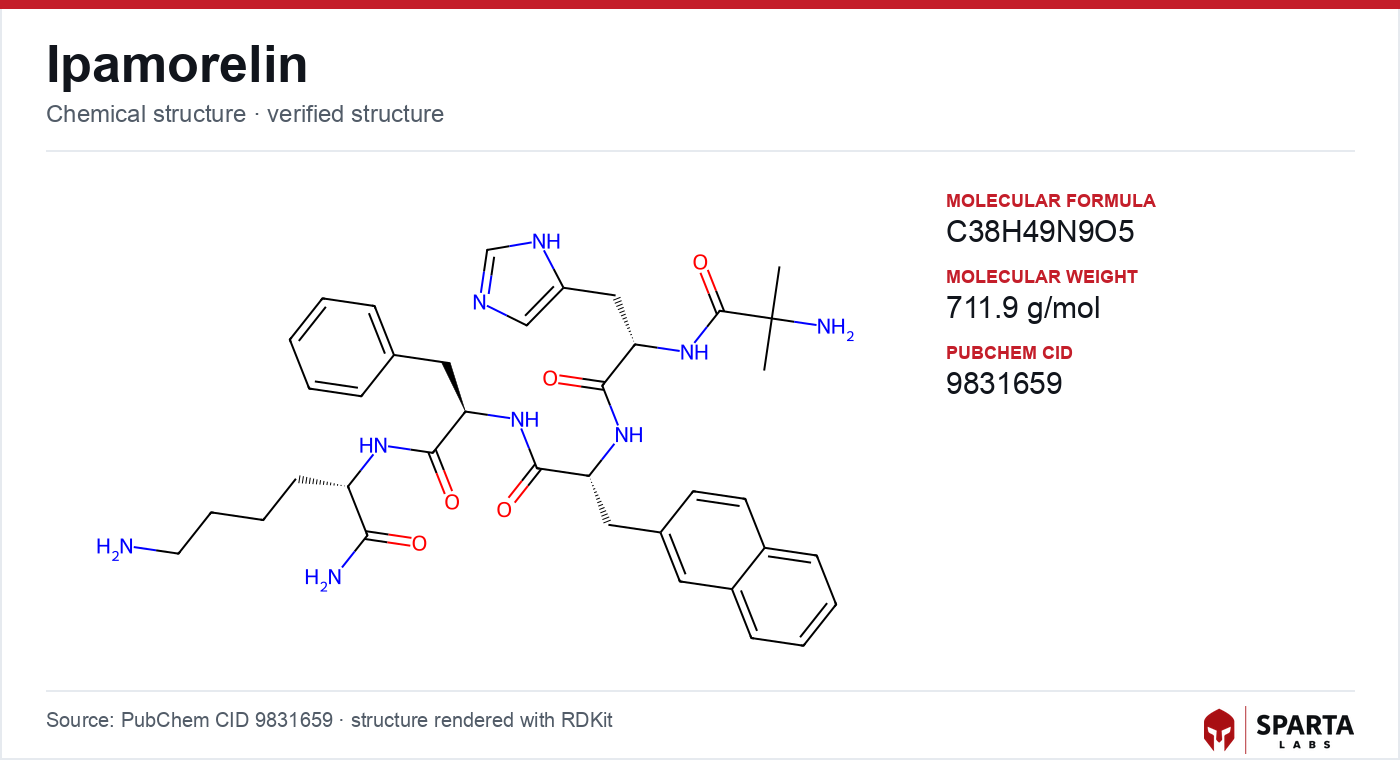
Figure: chemical structure of ipamorelin.
Why Ipamorelin Must Be Made Chemically
The reason ipamorelin cannot be produced by biological expression is written into its sequence. Ribosomal protein synthesis draws from the 20 standard proteinogenic amino acids in the L configuration; ipamorelin includes three departures from that set.
Its N-terminal residue is alpha-aminoisobutyric acid (Aib), a non-natural residue that is not genetically encoded. Its third and fourth positions are D-2-naphthylalanine (D-2-Nal) and D-phenylalanine, both bearing the D rather than L stereochemistry that ribosomes install. Finally, the C-terminus is an amide (Lys-NH2) rather than the free carboxylic acid that a ribosome or a protease-based process would leave behind.
Each of these features rules out recombinant expression and dictates chemical assembly. Solid-phase peptide synthesis (SPPS), first described by Merrifield in 1963 and recognized with the Nobel Prize in Chemistry [2], anchors the growing chain to an insoluble resin and adds one protected residue per coupling cycle.
Because SPPS operates on activated, protected building blocks rather than a translation apparatus, it accommodates Aib, D-amino acids, and other non-proteinogenic residues directly. The C-terminal amide is set by resin choice: an amide-forming resin (such as a Rink amide support) releases the peptide as the Lys-NH2 amide upon cleavage rather than as a free acid.
The Synthetic Sequence and Its Difficult Steps
Assembling ipamorelin is not uniformly straightforward across its five positions. The Aib residue is sterically hindered because it carries two methyl groups on its alpha carbon, and couplings onto or from hindered residues are a recognized source of incomplete reactions and deletion sequences in SPPS.
Reviews of large-scale peptide manufacture describe the coupling-reagent and reaction-condition optimization used to drive such difficult steps to completion and to suppress the deletion and truncation byproducts that would otherwise accumulate [3]. Maintaining the correct D stereochemistry at the D-2-Nal and D-Phe positions requires building blocks of defined configuration and conditions chosen to limit epimerization during activation.
After the full-length chain is assembled, the peptide is cleaved from the resin with simultaneous removal of the side-chain protecting groups, typically using a trifluoroacetic-acid-based cleavage cocktail. The crude product is then purified by preparative reverse-phase HPLC to separate the target pentapeptide from closely related impurities, and the purified fractions are lyophilized to a dry powder. Similar synthetic considerations apply across the growth-hormone secretagogue class; comparable sourcing treatments are available for GHRP-2 and hexarelin, which share the SPPS route and the same analytical framework.
Confirming Identity and Purity
Two complementary analytical methods establish the analytical credentials of a research-grade lot, and they answer different questions.
Reverse-phase analytical HPLC answers "how pure is it." A chromatographic run separates the peptide from process-related impurities such as deletion sequences, truncated chains, and diastereomers arising from epimerization, and purity is reported as the area percentage of the main peak relative to all detected peaks. A high purity result indicates that a large majority of the ultraviolet-absorbing material in the sample is the intended compound, though it does not by itself confirm that the main peak is ipamorelin rather than a co-eluting isomer.
Mass spectrometry answers "is it the right molecule." By measuring the mass-to-charge ratio of the compound, mass spectrometry confirms identity against the theoretical value derived from the Aib-His-D-2-Nal-D-Phe-Lys-NH2 sequence, approximately 711.9 daltons for the free base. Because HPLC purity and mass-spectrometric identity address separate failure modes, competent verification uses both rather than either alone. Sparta Labs verifies each ipamorelin batch by analytical HPLC and mass spectrometry and documents both results before a lot is released.
Salt Form and the Counterion Question
A detail specific to synthetic peptides, and easy to overlook, is the counterion salt form. Peptides purified over trifluoroacetic-acid-buffered reverse-phase columns are frequently isolated as the trifluoroacetate (TFA) salt, and an additional ion-exchange step can convert the material to the acetate salt.
The salt form is not a cosmetic detail: the counterion contributes mass, so a given weight of TFA-salt powder contains a slightly different quantity of peptide than the same weight of acetate-salt or free-base material. Analytical documentation therefore typically records the salt form and residual counterion or solvent content so that the peptide content of a lot is unambiguous.
The published free-base molecular weight of approximately 711.9 daltons refers to the peptide without any associated counterion; a salt-form molecular weight is higher by the mass of the associated acid. Certificates of analysis generally state which value is being reported to avoid ambiguity between the free-base and salt-form figures.
Third-Party Confirmation and Certificates of Analysis
Independent analytical testing adds a checkpoint that internal quality control cannot supply on its own: a laboratory with no stake in the manufacturing outcome, running calibrated instrumentation under its own quality system, provides an external corroboration of the HPLC and mass-spectrometry results. Sparta Labs submits each ipamorelin batch to an independent laboratory for confirmatory purity and identity testing in addition to internal release testing.
A Certificate of Analysis (COA) is the lot-specific record that ties this testing to a particular production batch. For ipamorelin, a COA typically records:
- the HPLC purity result as an area percentage, with a chromatogram traceable to the specific batch;
- the mass-spectrometry identity result, with observed versus theoretical mass;
- the salt form and, where measured, residual counterion or solvent content;
- the batch number and manufacturing date;
- storage and recommended use-by guidance; and
- the identity of any independent laboratory that performed confirmatory testing.
Researchers can access batch documentation from the ipamorelin product page. Recording the analytical credentials of the specific lot used is increasingly expected as part of materials-transparency reporting in published work, and lot-level COA data supports that practice. The same documentation approach is applied to related secretagogue and growth-hormone-axis compounds such as CJC-1295 without DAC.
Storage and Stability of the Lyophilized Powder
Ipamorelin is supplied as a lyophilized (freeze-dried) powder, the physical form in which short synthetic peptides are most stable for extended storage. General principles from the peptide and protein stability literature indicate that lyophilized peptides are best held at low temperature and protected from light and moisture, and that elevated temperature, humidity, and repeated freeze-thaw cycling can accelerate degradation pathways such as oxidation, deamidation, and peptide-bond hydrolysis [4].
Ipamorelin's structure gives it some intrinsic resistance to enzymatic and conformational degradation relative to an all-L-amino-acid peptide: the Aib residue and the D-amino acids interrupt the geometry that proteases recognize, and this stability profile was part of the compound's original design rationale in the founding pharmacology report [1]. The general storage principles above nonetheless remain applicable to the lyophilized material. Sparta Labs records storage and use-by guidance for each batch on the accompanying COA.
Why Verified Sourcing Matters for the Research Record
The published literature on ipamorelin rests on experiments conducted with well-characterized material. The founding pharmacological study by Raun and colleagues in 1998, which established the compound's GHS-R1a selectivity profile in conscious swine, used peptide synthesized and characterized under the analytical standards of a pharmaceutical research organization [1].
For that work to be reproduced or extended, later researchers require material whose chemical identity and purity are demonstrably equivalent to the compound as originally described, which is why a defined salt form, HPLC purity, and mass-spectrometric identity are treated as prerequisites rather than optional extras.
Findings from research models do not establish safety or efficacy in humans. Sparta Labs makes no claims about the use of this compound.
Impure or misidentified starting material undermines this reproducibility in a specific way: if an observed experimental effect is attributed to ipamorelin but the material actually contained a diastereomer, a deletion sequence, or an unexpected counterion load, the resulting data can be difficult to reconcile between laboratories. Chemical identity verification, purity quantification, salt-form documentation, and independent confirmation are the standard analytical safeguards against that class of problem, and they define the quality posture Sparta Labs applies to ipamorelin.
References
-
Raun K, Hansen BS, Johansen NL, Thøgersen H, Madsen K, Ankersen M, et al. Ipamorelin, the first selective growth hormone secretagogue. Eur J Endocrinol. 1998;139(5):552-61. PMID: 9849822. DOI: 10.1530/eje.0.1390552
-
Merrifield RB. Solid phase peptide synthesis. I. The synthesis of a tetrapeptide. J Am Chem Soc. 1963;85(14):2149-54. DOI: 10.1021/ja00897a025
-
Andersson L, Blomberg L, Flegel M, Lepsa L, Nilsson B, Verlander M. Large-scale synthesis of peptides. Biopolymers. 2000;55(3):227-50. PMID: 11074417. DOI: 10.1002/1097-0282(2000)55:3<227::AID-BIP50>3.0.CO;2-7
-
Manning MC, Chou DK, Murphy BM, Payne RW, Katayama DS. Stability of protein pharmaceuticals: an update. Pharm Res. 2010;27(4):544-75. PMID: 20143196. DOI: 10.1007/s11095-009-0045-6
Disclaimer. Statements in this article have not been evaluated by the Food and Drug Administration. This compound is not intended to diagnose, treat, cure, or prevent any disease. Sparta Labs sells research-use-only materials. Content is provided for educational and informational purposes only and does not constitute medical advice. Consult a qualified medical professional for any health concerns.
Frequently asked questions
Why can ipamorelin not be produced by recombinant expression?
Ipamorelin contains two residues that are not among the 20 ribosomally encoded amino acids: alpha-aminoisobutyric acid (Aib) at the N-terminus and D-2-naphthylalanine (D-2-Nal). Because ribosomal protein synthesis cannot incorporate these non-proteinogenic residues, ipamorelin is instead assembled by chemical solid-phase peptide synthesis. Its C-terminal amide (Lys-NH2) likewise requires a chemical route with an appropriate amide-forming resin.
What analytical methods confirm ipamorelin identity and purity?
Two complementary techniques are standard. Reverse-phase HPLC separates the target peptide from related impurities and reports purity as the area percentage of the main peak. Mass spectrometry independently confirms molecular identity by measuring the observed mass against the theoretical value derived from the Aib-His-D-2-Nal-D-Phe-Lys-NH2 sequence, approximately 711.9 daltons for the free base.
What is the counterion salt form of synthetic ipamorelin, and why does it matter?
Peptides purified by trifluoroacetic-acid-based reverse-phase HPLC are commonly isolated as the trifluoroacetate (TFA) salt, and a subsequent ion-exchange step can convert them to the acetate salt. The salt form and residual counterion content affect the net peptide mass in a given quantity of powder and can be relevant in certain research contexts, so analytical documentation typically records the salt form and residual solvent or counterion levels.
What information appears on an ipamorelin Certificate of Analysis?
A Certificate of Analysis is a lot-specific record of the analytical testing performed on one production batch. For ipamorelin it typically reports the HPLC purity result with a traceable chromatogram, the mass-spectrometry identity result comparing observed and theoretical mass, the batch number and manufacturing date, storage and use-by guidance, and the name of any independent laboratory that performed confirmatory testing.
How does the salt form affect the reported molecular weight of ipamorelin?
Published characterization of ipamorelin reports a free-base molecular weight of approximately 711.9 daltons for the Aib-His-D-2-Nal-D-Phe-Lys-NH2 sequence. When the peptide is isolated as an acetate or trifluoroacetate salt, the counterion adds mass, so the salt-form molecular weight is higher than the free-base value. Certificates of analysis generally specify which value is being reported.