
CJC-1295 Without DAC: Sourcing, Purity, and Verification Standards
A sourcing and quality reference for CJC-1295 without DAC (Modified GRF 1-29): the four sequence modifications, SPPS synthesis considerations, analytical verification, and storage of the lyophilized peptide. Educational reference.
For research use only. Not for human consumption. This article is educational reference material. It is not medical advice and is not a recommendation to use any substance.
Introduction
CJC-1295 without DAC, also written as Modified GRF 1-29, is a 29-residue synthetic analog of the N-terminal fragment of human growth-hormone-releasing factor, GRF(1-29). This article documents the chemistry-specific sourcing and quality-verification considerations that follow from its sequence: how the four engineered substitutions shape the way the peptide is built, how its identity and purity are confirmed analytically, and how the lyophilized material is stored. The reliability of any dataset generated with a synthetic peptide rests on the chemical identity, purity, and stability of the material, because synthesis-related impurities and degradation products can confound experimental readouts. For the pharmacology and classification of the compound, see the CJC-1295 without DAC research overview; this sourcing article assumes that background and focuses on manufacturing and verification. Research-grade CJC-1295 without DAC is characterized against the standards described below.
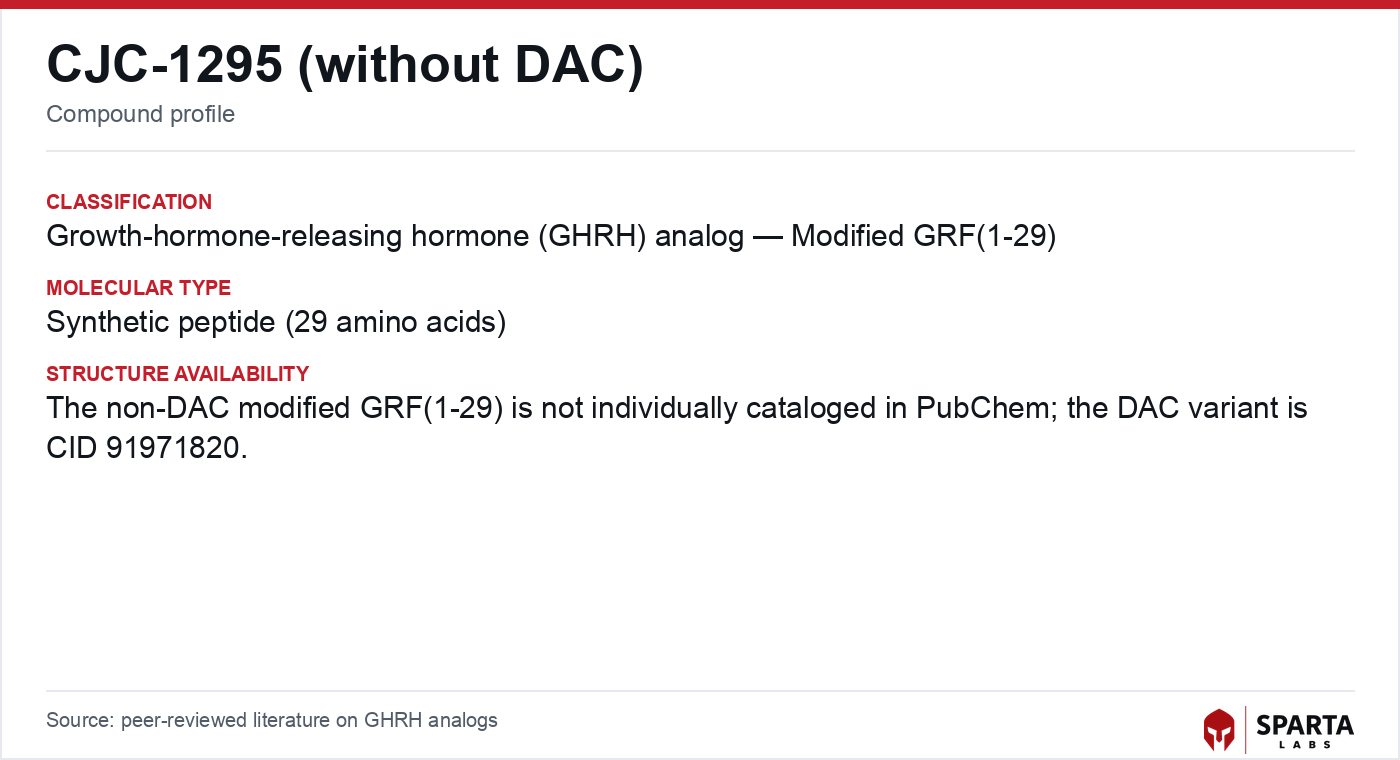
Figure: chemical structure of CJC-1295 (without DAC).
Four Sequence Modifications That Define the Compound
CJC-1295 without DAC is not simply the native GRF(1-29) fragment. It carries four substitutions relative to the human sequence, and each one is a deliberate response to a chemical liability of the parent peptide. Understanding these substitutions is a prerequisite for understanding why the material is synthesized and verified the way it is.
- D-Ala at position 2. The native peptide is cleaved near its N-terminus by dipeptidyl peptidase-IV (DPP-IV). Substituting the D-enantiomer of alanine at position 2 was described by Jette and colleagues as part of the tetrasubstituted GRF design intended to reduce enzymatic degradation at that site [1].
- Gln at position 8. This substitution replaces a residue prone to deamidation, a hydrolytic reaction that converts asparagine or glutamine residues and can generate charge-variant impurities.
- Ala at position 15. A stabilizing substitution within the tetrasubstituted design reported in the same primary literature [1].
- Nle (norleucine) at position 27. The native sequence carries a methionine at position 27. Methionine is among the residues most susceptible to oxidation in peptides and proteins, and norleucine is a non-oxidizable isostere frequently used to remove that liability in analog design [2].
The distinction from CJC-1295 with DAC is structural and directly relevant to sourcing: the "with DAC" analog carries the identical four substitutions plus a Drug Affinity Complex (a maleimidopropionyl-lysine moiety) at the C-terminus, whereas the "without DAC" form omits that conjugation step. A structural comparison of the two forms and their respective quality documentation is covered in the CJC-1295 with DAC sourcing article.
Synthesis Implications of the Sequence
A 29-residue peptide of this class is assembled almost exclusively by solid-phase peptide synthesis (SPPS), the method introduced by Merrifield in 1963, work recognized with the 1984 Nobel Prize in Chemistry and now standard for peptides up to approximately 50 residues [3]. In SPPS, amino acids are coupled sequentially onto a resin support with their reactive side chains protected; after the chain is complete, the peptide is cleaved from the resin and deprotected to yield crude peptide in solution.
Findings from research models do not establish safety or efficacy in humans. Sparta Labs makes no claims about the use of this compound.
Two of the four substitutions place specific demands on the synthesis. The D-Ala at position 2 requires a validated coupling step: incomplete incorporation of a D-configured residue, or epimerization at an adjacent residue, produces stereochemical impurities that can co-elute closely with the target on reverse-phase columns. The Nle at position 27 must be supplied as an appropriately protected building block; because it removes the methionine, it also removes a downstream oxidation pathway, which simplifies purity control for the finished material. Andersson and colleagues reviewed the process considerations for large-scale SPPS, emphasizing that optimization of coupling cycles, resin selection, and cleavage and deprotection conditions governs sequence fidelity and the level of truncation and deletion sequences in the crude product [4].
After cleavage, the crude peptide is purified by preparative reverse-phase HPLC to separate the target from synthesis-related impurities such as deletion sequences and incompletely deprotected species, then lyophilized to a dry powder. Bray reviewed the industrial-scale realities of chemical peptide manufacture, including the role of chromatographic purification and residual-reagent control in producing defined material [5].
Analytical Verification of Identity and Purity
Purity for a synthetic peptide is the proportion of material corresponding to the intended sequence at the correct molecular weight, established by validated analytical methods. Two orthogonal instruments carry most of that burden.
Reverse-phase HPLC separates species by hydrophobicity and detects them by UV absorbance; purity is reported as the target peak area divided by total peak area. Mass spectrometry confirms molecular identity by establishing that the dominant species carries the expected mass. For CJC-1295 without DAC the target free-base molecular weight is approximately 3,367 daltons, and mass confirmation is what distinguishes correctly assembled peptide from co-eluting impurities of similar retention but different composition, including deletion-sequence variants and oxidation adducts. Because the Nle-27 substitution eliminates the methionine, the characteristic +16 Da methionine-oxidation adduct that complicates purity assignment for the native scaffold is absent from the correctly synthesized analog.
The same analytical logic underpins the quality documentation for other growth-hormone-secretagogue-class peptides; comparable verification for a related compound in this cluster is described in the tesamorelin sourcing and quality article.
Certificate of Analysis and Batch Documentation
A Certificate of Analysis (COA) is the document that communicates the verified specifications of a specific manufacturing batch. For CJC-1295 without DAC, a batch COA typically records:
- HPLC purity result: the measured target-peak purity from the analytical run.
- Mass spectrometry result: confirmation that the dominant mass species matches the expected molecular weight for the Modified GRF 1-29 sequence.
- Batch number: a unique identifier linking the document to a specific lot.
- Manufacturing and expiry dates: the synthesis and quality-completion date and the shelf-life period under the specified storage conditions.
Batch-specific COA documentation is what allows a research group to tie catalog specifications to the properties of the material actually received, and to reference those specifications in laboratory records or supplementary materials. The mechanism of action that motivates interest in this batch-level rigor is summarized in the CJC-1295 without DAC mechanism of action article.
Storage and Stability of the Lyophilized Peptide
CJC-1295 without DAC is supplied lyophilized. Freeze-drying removes water by sublimation under vacuum, converting the peptide to a dry powder that is substantially more stable than peptide held in aqueous solution. Cold storage, protection from light, and desiccation to limit moisture uptake are standard measures for lyophilized peptides of this class.
The stability profile of this analog is partly a designed property. The Nle-27 substitution removes the oxidation-prone methionine of the parent sequence, and the Gln-8 substitution addresses a deamidation-prone site, so two of the principal solution-phase degradation routes that affect the native fragment are attenuated by the sequence itself. Manning and colleagues catalogued the chemical and physical degradation pathways relevant to peptide and protein stability, including hydrolysis, oxidation, deamidation, and aggregation, and the environmental factors that govern their rates [6]. Consistent with those principles, peptide in aqueous solution generally degrades faster than the lyophilized solid, and repeated freeze-thaw cycling of solutions is associated with aggregation, which is a consideration in experimental design.
References
-
Jette L, Leger R, Thibaudeau K, et al. Human growth hormone-releasing factor (hGRF)1-29-albumin bioconjugates activate the GRF receptor on the anterior pituitary in rats: identification of CJC-1295 as a long-lasting GRF analog. Endocrinology. 2005;146(7):3052-3058. PMID: 15817669. DOI: 10.1210/en.2004-1286. Full text via DOI
-
Manning MC, Chou DK, Murphy BM, Payne RW, Katayama DS. Stability of protein pharmaceuticals: an update. Pharm Res. 2010;27(4):544-575. PMID: 20143256. DOI: 10.1007/s11095-009-0045-6. Full text via DOI
-
Merrifield RB. Solid phase peptide synthesis. I. The synthesis of a tetrapeptide. J Am Chem Soc. 1963;85(14):2149-2154. DOI: 10.1021/ja00897a025. Full text via DOI
-
Andersson L, Blomberg L, Flegel M, Lepsa L, Nilsson B, Verlander M. Large-scale synthesis of peptides. Biopolymers. 2000;55(3):227-250. PMID: 11074420. DOI: 10.1002/1097-0282(2000)55:3<227::AID-BIP50>3.0.CO;2-7. View on PubMed
-
Bray BL. Large-scale manufacture of peptide therapeutics by chemical synthesis. Nat Rev Drug Discov. 2003;2(7):587-593. PMID: 12838269. DOI: 10.1038/nrd1133. Full text via DOI
-
Manning MC, Chou DK, Murphy BM, Payne RW, Katayama DS. Stability of protein pharmaceuticals: an update. Pharm Res. 2010;27(4):544-575. PMID: 20143256. DOI: 10.1007/s11095-009-0045-6. Full text via DOI
Disclaimer. Statements in this article have not been evaluated by the Food and Drug Administration. This compound is not intended to diagnose, treat, cure, or prevent any disease. Sparta Labs sells research-use-only materials. Content is provided for educational and informational purposes only and does not constitute medical advice. Consult a qualified medical professional for any health concerns.
Frequently asked questions
What are the four amino acid modifications in CJC-1295 without DAC?
Relative to native human GRF(1-29), CJC-1295 without DAC (Modified GRF 1-29) carries four substitutions: D-Ala at position 2, Gln at position 8, Ala at position 15, and Nle (norleucine) at position 27. Each substitution addresses a specific liability of the parent sequence, such as enzymatic cleavage or methionine oxidation. These are the same tetra-substitution set incorporated into the DAC-bearing analog described in the published tetrasubstituted GRF literature.
How is CJC-1295 without DAC synthesized?
As a 29-residue peptide it is assembled by solid-phase peptide synthesis (SPPS), the method introduced by Merrifield in 1963 and standard for chains up to roughly 50 residues. Protected amino acids are coupled sequentially on a resin, then the chain is cleaved and deprotected, purified by preparative reverse-phase HPLC, and lyophilized. The D-Ala at position 2 requires a validated coupling step because incomplete incorporation of the D-configured residue is a recognized impurity source.
Why does the norleucine-27 substitution matter for stability?
Native GRF(1-29) carries a methionine at position 27, and methionine is a common oxidation-prone site in peptides. Substituting norleucine (Nle), a non-oxidizable isostere of methionine, removes that oxidation liability. This is a documented rationale in the peptide-stabilization literature for replacing methionine with norleucine in analog design.
How is the identity and purity of CJC-1295 without DAC confirmed analytically?
Reverse-phase HPLC quantifies purity as the target peak area relative to total UV-absorbing peak area, and mass spectrometry confirms that the dominant species matches the expected monoisotopic mass of the Modified GRF 1-29 sequence. Together these distinguish the target from deletion sequences, oxidation products, and co-eluting impurities. A Certificate of Analysis records the batch-specific HPLC and mass-spec results.
How is lyophilized CJC-1295 without DAC stored?
It is supplied as a lyophilized (freeze-dried) powder, a form that is substantially more stable than peptide in aqueous solution because water is removed by sublimation under vacuum. Cold storage, protection from light, and desiccation are standard measures for lyophilized peptides. General peptide-stability principles indicate that solution-phase material degrades faster through hydrolysis, oxidation, and aggregation.