
CJC-1295 with DAC: Sourcing, Purity, and Verification Standards
A sourcing and quality reference for CJC-1295 with DAC, centered on the analytical challenges its maleimide DAC modification adds to identity and purity verification. Educational reference.
For research use only. Not for human consumption. This article is educational reference material. It is not medical advice and is not a recommendation to use any substance.
Introduction
CJC-1295 with DAC is a synthetic analog of the first 29 residues of growth-hormone-releasing hormone (GHRH) carrying a chemical modification known as a Drug Affinity Complex, or DAC. What separates it from most research peptides, and from its own DAC-free counterpart, is that the molecule is designed to carry a reactive chemical handle rather than being a simple linear sequence. That handle is what a sourcing and verification program has to account for. This reference describes how the peptide backbone is assembled, why the DAC group changes the analytical picture, what identity and purity methods are appropriate for a conjugation-capable peptide, and what documentation accompanies each batch of the material Sparta Labs supplies for research use.
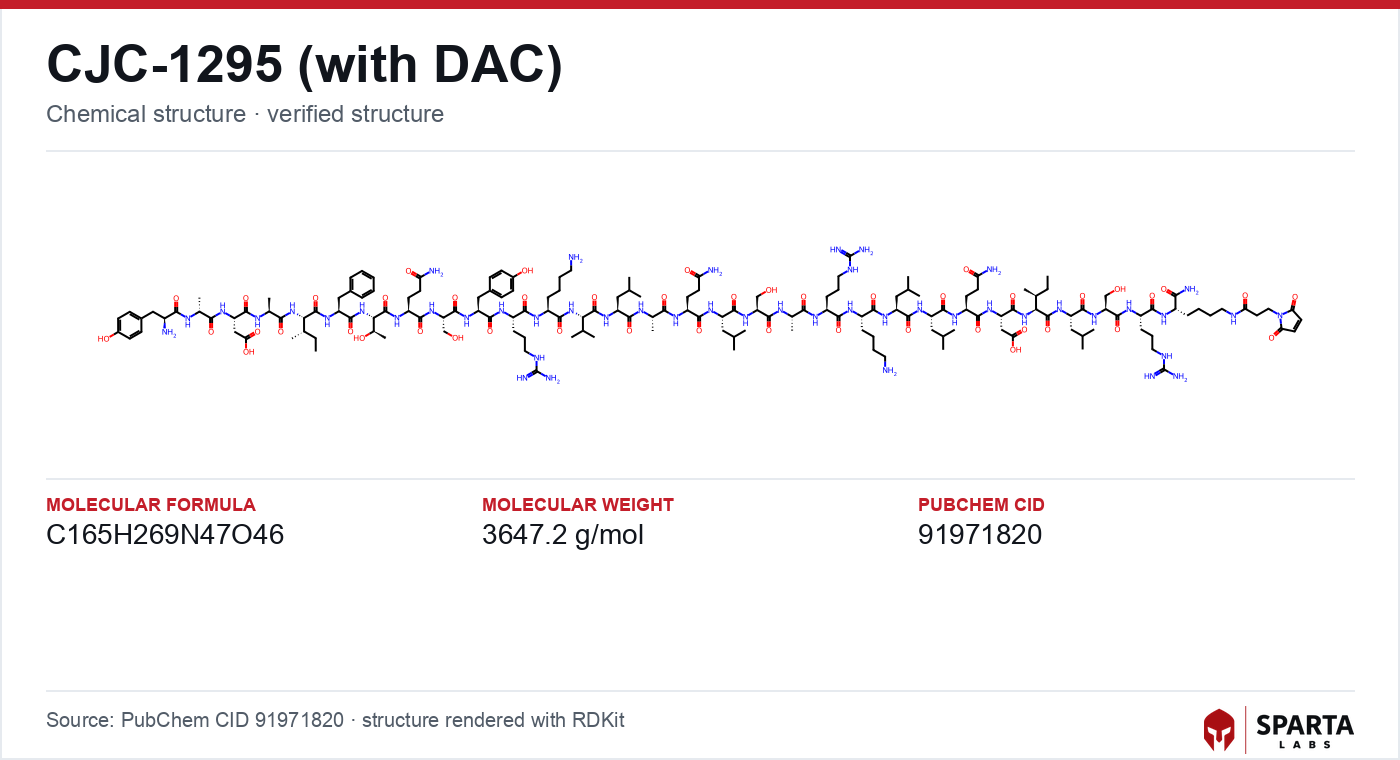
Figure: chemical structure of CJC-1295 (with DAC).
The DAC handle and why it defines the sourcing problem
The "with DAC" designation is the defining chemical fact of this compound. The Drug Affinity Complex concept attaches a maleimidopropionyl group to a peptide through a lysine residue placed at the C-terminus of the modified GHRH(1-29) sequence. Maleimide chemistry is among the most widely used thiol-selective conjugation strategies in bioconjugate work: a maleimide reacts with a free cysteine sulfhydryl to form a stable thioether adduct, a reaction surveyed in the protein-conjugation literature [1].
For CJC-1295 with DAC, the practical consequence is that the finished molecule is not merely a peptide chain but a peptide bearing an electrophilic handle. That handle is chemically labile in ways an ordinary peptide bond is not, and it is the reason a generic peptide-verification workflow is insufficient. Any credible sourcing program for this material must treat the intact, unreacted maleimide as a critical quality attribute in its own right, not simply confirm that a peptide of roughly the right mass is present.
Researchers comparing this compound with the simpler analog may find the CJC-1295 without DAC sourcing article useful, since that molecule presents none of the maleimide-related analytical considerations discussed below.
Assembling the peptide backbone
The GHRH(1-29) core of CJC-1295 is a 29-residue sequence carrying non-native substitutions intended to resist enzymatic degradation, with the DAC-bearing lysine extending the assembled chain. A sequence of this length sits comfortably within the range routinely achievable by solid-phase peptide synthesis (SPPS), the method introduced by Merrifield in his 1963 paper in the Journal of the American Chemical Society [2]. SPPS builds the chain one residue at a time on an insoluble resin support; contemporary research-grade synthesis overwhelmingly uses fluorenylmethyloxycarbonyl (Fmoc) protection, whose orthogonal deprotection chemistry and protecting-group strategy are surveyed in the modern methodology literature [3].
Findings from research models do not establish safety or efficacy in humans. Sparta Labs makes no claims about the use of this compound.
Two features of the CJC-1295 backbone raise the difficulty above that of a plain sequence. First, the engineered substitutions require reliable coupling at sterically and electronically atypical positions; incomplete couplings generate deletion sequences that are among the hardest impurities to resolve chromatographically. Andersson and colleagues, writing on large-scale peptide synthesis in Biopolymers, described how coupling efficiency and resin loading must be controlled for sequences that challenge standard conditions [4]. Second, side reactions intrinsic to SPPS, such as the intramolecular aminolysis characterized by Gisin and Merrifield [5], accumulate across a long synthesis and must be kept below the level at which they compromise the final purity figure. The lability of the DAC handle then adds the requirement that the conjugation chemistry be introduced without premature reaction or hydrolysis.
Confirming identity when a reactive group is present
Reverse-phase HPLC is the primary tool for characterizing content uniformity in research-grade peptides. The peptide is separated from truncation products, deletion sequences, and process-related impurities on the basis of differential interaction with a hydrophobic stationary phase, and the result is reported as an area-percent purity at the expected retention time. For CJC-1295 with DAC, Sparta Labs's internal specification is an HPLC purity of at least 98 percent.
HPLC purity alone, however, cannot confirm molecular identity, and this limitation is amplified for a conjugation-capable peptide. An area-percent figure describes how much of the sample elutes as a single peak; it does not establish that the peak is the intended molecule, nor that the reactive handle is intact. Mass spectrometry closes that gap. Electrospray ionization (ESI-MS) or matrix-assisted laser desorption/ionization (MALDI-MS) confirms that the observed mass of the detected species matches the theoretical mass of the intact conjugate to within instrument tolerance. Because a hydrolyzed maleimide differs from the intact form by only a small mass increment, mass confirmation is the step that distinguishes an intact DAC handle from a degraded one, something no purity percentage can do by itself.
The order of the two methods matters: HPLC establishes that a dominant single species is present, and mass spectrometry establishes what that species is. Neither alone is sufficient for a modification-bearing peptide, which is why a defensible verification workflow for CJC-1295 with DAC pairs them. This same identity-confirmation logic applies to another engineered GHRH analog discussed in the tesamorelin sourcing article.
Independent verification and batch documentation
In-house analytical data alone leave the researcher without independent confirmation that the sample analyzed matches the sample shipped, that instruments were calibrated, or that methods were appropriate. Independent laboratory verification addresses this by generating HPLC purity and mass-spectrometric identity data outside the manufacturing operation. Sparta Labs engages independent third-party laboratories to verify HPLC purity and mass-spectrometric identity for each batch of CJC-1295 with DAC before release.
The output of that process is recorded on a Certificate of Analysis (COA), the document that ties a specific batch to its measured results. A complete COA for CJC-1295 with DAC records HPLC area-percent purity under stated chromatographic conditions, mass-spectrometric confirmation of observed versus theoretical mass, batch number, manufacturing date, a retest or expiry date, the counter-ion form (acetate or trifluoroacetate), and the identity of the testing laboratory. Endotoxin data, relevant where a batch is intended for cell-based or in vivo research models and measured by the Limulus amoebocyte lysate assay, are included where available. Each product listing links to the current batch COA so that the batch number on the documentation can be matched to the lot before purchase.
Counter-ion and residual-solvent considerations
SPPS uses trifluoroacetic acid (TFA) during resin cleavage and side-chain deprotection, and TFA persists as a residual counter-ion unless deliberately exchanged for acetate. For research where the counter-ion is a relevant variable, the salt form should be stated on the COA rather than assumed. Documenting whether the material is supplied as a free base, acetate salt, or trifluoroacetate salt is a routine element of transparent research-peptide sourcing and is treated as such in the Sparta Labs documentation for this compound.
Storage, and the specific fragility of the DAC group
Lyophilized (freeze-dried) peptides in the solid state are substantially more stable than reconstituted solutions, and CJC-1295 with DAC is supplied lyophilized. General peptide-handling practice is storage below minus 20 degrees Celsius, protected from light, in the sealed vial, with the retest interval for solid-state peptide material verified from the COA rather than assumed.
The DAC modification warrants attention beyond ordinary peptide storage. Free maleimides are subject to ring hydrolysis in aqueous solution, converting the reactive maleimide to a non-conjugating maleamic acid; Baldwin and Kiick documented that this hydrolysis is pH- and temperature-dependent and proceeds over hours to days near physiological conditions [6]. That degradation pathway is distinct from the stability of the peptide backbone itself, which is robust when lyophilized. For work that depends on the intact conjugation handle rather than a pre-formed adduct, solid-state storage is therefore the consideration that most directly preserves the material's defining chemistry. As a general laboratory matter, repeated freeze-thaw cycling of any reconstituted peptide solution can promote aggregation, and single-use aliquoting before freezing is standard practice.
Why this matters for reproducible research
The integrity of a study is bounded by the integrity of its materials, and for a molecule whose research interest rests on a reactive chemical handle, "purity" and "identity" are not the same question. A high HPLC purity figure describes a homogeneous peak; it does not confirm that the DAC group survived synthesis, workup, and storage in a reactive state. Confirming that requires mass-spectrometric identity data, and ideally sequence-level confirmation, layered on top of the chromatographic purity number.
Sparta Labs's quality posture for this compound, an HPLC purity specification of at least 98 percent, independent third-party mass-spectrometric confirmation, a published COA for every batch, and traceability from that COA to the product listing, is structured around the specific analytical demands the DAC handle imposes. Researchers evaluating CJC-1295 with DAC for scientific investigation can review the batch-specific documentation before committing the material to experimental work. Background on the compound's pharmacological classification and reported mechanism is available in the CJC-1295 with DAC research overview and the CJC-1295 with DAC mechanism of action article.
References
-
Ravasco JMJM, Faustino H, Trindade A, Gois PMP. Bioconjugation with maleimides: a useful tool for chemical biology. Chemistry - A European Journal. 2019;25(1):43-59. PMID: 30095185. DOI: 10.1002/chem.201803174.
-
Merrifield RB. Solid phase peptide synthesis. I. The synthesis of a tetrapeptide. J Am Chem Soc. 1963;85(14):2149-2154. DOI: 10.1021/ja00897a025.
-
Isidro-Llobet A, Alvarez M, Albericio F. Amino acid-protecting groups. Chem Rev. 2009;109(6):2455-2504. PMID: 19364184. DOI: 10.1021/cr800323s.
-
Andersson L, Blomberg L, Flegel M, Lepsa L, Nilsson B, Verlander M. Large-scale synthesis of peptides. Biopolymers. 2000;55(3):227-250. PMID: 11074421. DOI: 10.1002/1097-0282(2000)55:3<227::AID-BIP50>3.0.CO;2-7.
-
Gisin BF, Merrifield RB. Carboxyl-catalyzed intramolecular aminolysis. A side reaction in solid-phase peptide synthesis. J Am Chem Soc. 1972;94(9):3102-3106. DOI: 10.1021/ja00764a042.
-
Baldwin AD, Kiick KL. Tunable degradation of maleimide-thiol adducts in reducing environments. Bioconjug Chem. 2011;22(10):1946-1953. PMID: 21892817. PMC: PMC3200479. DOI: 10.1021/bc200148v.
Disclaimer. Statements in this article have not been evaluated by the Food and Drug Administration. This compound is not intended to diagnose, treat, cure, or prevent any disease. Sparta Labs sells research-use-only materials. Content is provided for educational and informational purposes only and does not constitute medical advice. Consult a qualified medical professional for any health concerns.
Frequently asked questions
What is the DAC modification on CJC-1295, chemically?
DAC stands for Drug Affinity Complex. On CJC-1295 it refers to a maleimidopropionyl group attached through a lysine at the C-terminus of the modified GHRH(1-29) sequence. In the published bioconjugation literature, maleimide handles of this type react selectively with a free cysteine thiol to form a stable thioether adduct. The presence of this reactive handle is the structural feature that distinguishes CJC-1295 with DAC from the DAC-free analog.
Why does the maleimide group complicate purity analysis?
A reactive maleimide can undergo ring hydrolysis to the corresponding maleamic acid in aqueous solution, a process documented for maleimide bioconjugates by Baldwin and Kiick (2011). Because the hydrolyzed and intact forms differ only slightly in mass and hydrophobicity, distinguishing them requires both reverse-phase HPLC and mass-spectrometric mass confirmation rather than a single chromatographic purity figure.
What analytical methods characterize CJC-1295 with DAC?
Reverse-phase HPLC separates the target peptide from truncation, deletion, and process-related impurities and reports an area-percent purity. Electrospray or MALDI mass spectrometry then confirms that the observed molecular mass matches the theoretical mass of the intact conjugate. For a modification-bearing peptide the two methods are complementary, because HPLC alone cannot confirm that the DAC handle is present and unmodified.
What does a Certificate of Analysis for CJC-1295 with DAC document?
A Certificate of Analysis links a specific batch to its measured results: HPLC area-percent purity under stated chromatographic conditions, mass-spectrometric confirmation of observed versus theoretical mass, batch number, manufacturing date, a retest or expiry date, the counter-ion form, and the identity of the testing laboratory. Endotoxin data are included where available for a given lot.
How is lyophilized CJC-1295 with DAC stored for stability?
Lyophilized peptides in the solid state are more stable than solutions. CJC-1295 with DAC is supplied freeze-dried and, per general peptide-handling practice, stored below minus 20 degrees Celsius, protected from light, in a sealed vial. Because the maleimide handle is susceptible to aqueous hydrolysis, solid-state storage is particularly relevant for preserving the reactivity of the DAC group.