
GHRP-2 vs GHRP-6: A Structural and Research-History Comparison
A structural and research-history comparison of GHRP-2 and GHRP-6, the two most-studied growth-hormone-releasing peptides from the original Bowers hexapeptide program. Educational reference.
Introduction
GHRP-2 and GHRP-6 are the two most frequently cited members of the growth-hormone-releasing peptide (GHRP) family, a class of synthetic oligopeptides developed in the laboratory of Cyril Bowers beginning in the late 1970s. Unlike compounds from different receptor classes, these two are true siblings: same program, same receptor, overlapping investigators. The meaningful differences between them are in sequence chemistry, discovery chronology, and how far each traveled in clinical research. This article compares the two on those axes, reporting what investigators published without drawing efficacy comparisons. Research-grade GHRP-6 and GHRP-2 reference materials are cataloged with per-batch certificates of analysis.
GHRP-6: The Prototype Growth-Hormone-Releasing Peptide
GHRP-6 (His-D-Trp-Ala-Trp-D-Phe-Lys-NH2) was the first GHRP to demonstrate activity in vivo. Its design grew out of conformational-energy calculations on enkephalin-derived sequences by Momany and Bowers, whose peptide design work in the early 1980s described synthetic peptides that released growth hormone in vitro [1]. Bowers and colleagues then reported in Endocrinology in 1984 on the in vitro and in vivo activity of "a new synthetic hexapeptide that acts on the pituitary to specifically release growth hormone", the paper that established GHRP-6 as the class prototype [2].
Findings from research models do not establish safety or efficacy in humans. Sparta Labs makes no claims about the use of this compound.
What made GHRP-6 scientifically consequential was less the molecule itself than what it implied: it released growth hormone through a mechanism distinct from growth-hormone-releasing hormone, suggesting an unknown receptor system. That inference was vindicated when Howard and colleagues cloned the growth hormone secretagogue receptor (GHS-R1a) in Science in 1996, using GHRP-type ligands as probes [3], and when Kojima and colleagues identified ghrelin, the receptor's endogenous ligand, in Nature in 1999 [4]. The GHRP-6 mechanism of action article covers the receptor-level detail.
GHRP-2: The Second-Generation Analog
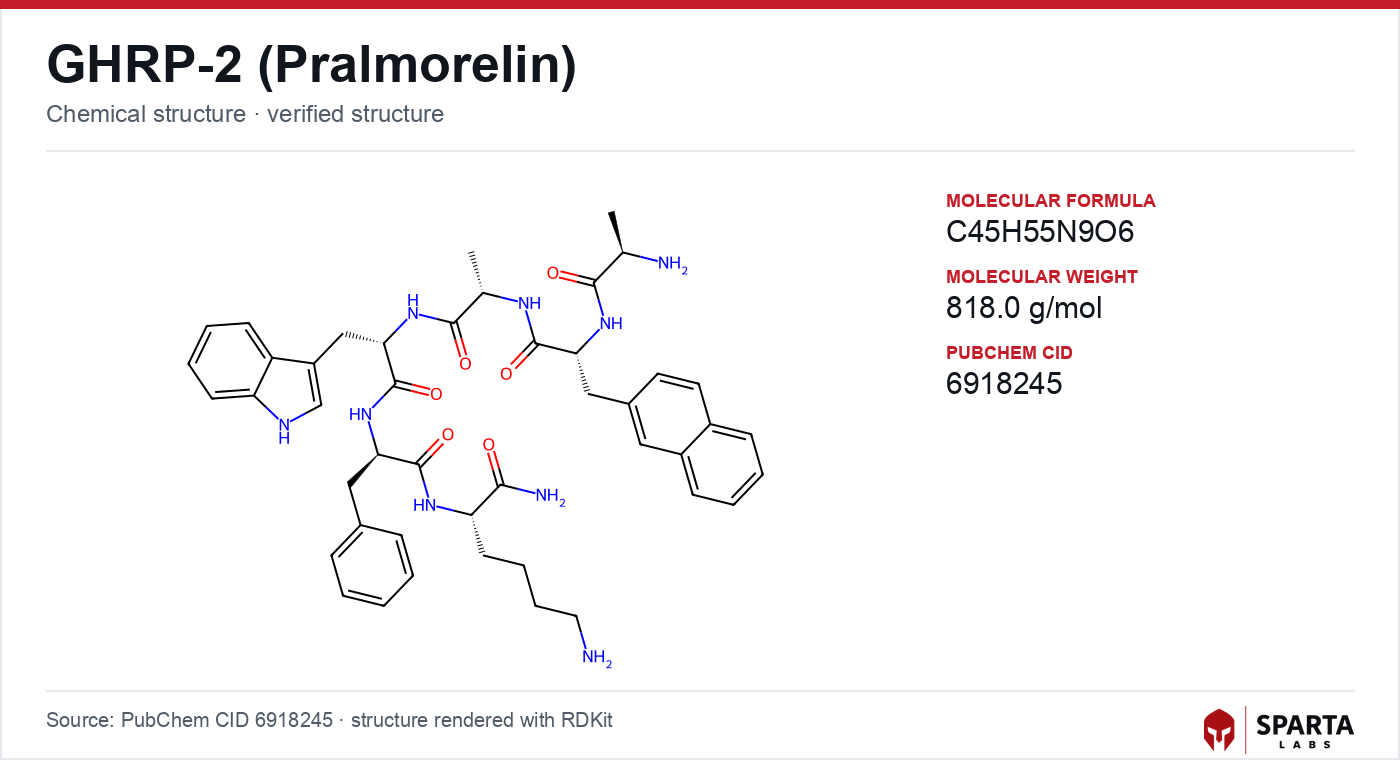
GHRP-2 (D-Ala-D-2-Nal-Ala-Trp-D-Phe-Lys-NH2), also known by the international nonproprietary name pralmorelin, came out of the same program as a second-generation design incorporating a D-alanine at position one and a D-2-naphthylalanine in place of GHRP-6's D-tryptophan. Published human studies followed: Pihoker, Badger, Reynolds, and Bowers reported on intranasal GHRP-2 administration in short-statured children in the Journal of Endocrinology in 1997 [5], and Laferrère and colleagues, including Bowers, reported in the Journal of Clinical Endocrinology and Metabolism in 2005 that GHRP-2 administration, like ghrelin, was associated with increased food intake in healthy men, a finding the authors framed as consistent with ghrelin-receptor pharmacology [6].
GHRP-2's most distinctive milestone is regulatory: as pralmorelin, it was approved in Japan as a single-administration diagnostic agent for growth hormone deficiency, the only regulatory approval achieved by any compound in the GHRP class, as reviewed in the growth hormone secretagogue development literature [7]. It remains unapproved in the United States and is handled as a research compound there.
Structural Comparison
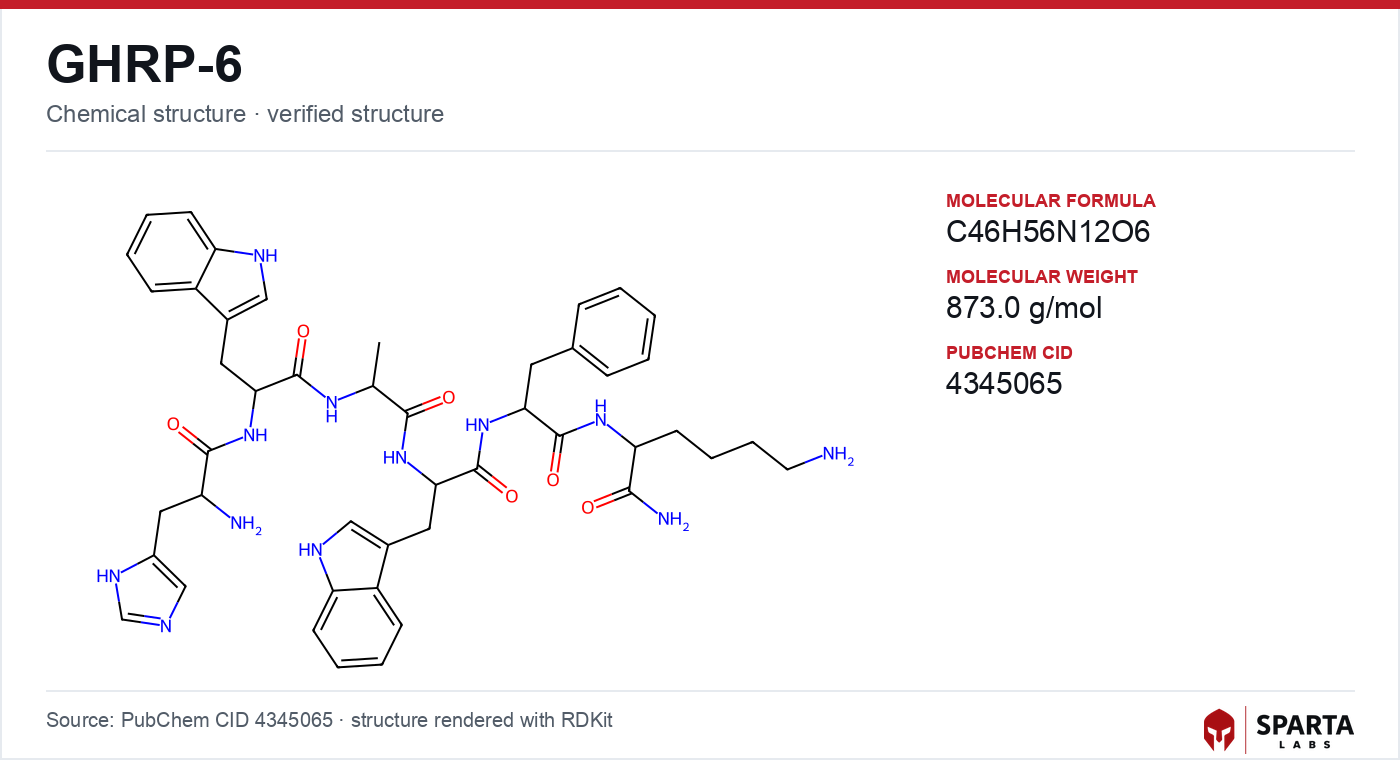
- Sequence. GHRP-6: His-D-Trp-Ala-Trp-D-Phe-Lys-NH2. GHRP-2: D-Ala-D-2-Nal-Ala-Trp-D-Phe-Lys-NH2. Both are C-terminally amidated hexapeptides mixing L- and D-amino acids; the D-residues were a deliberate design element for enzymatic stability.
- Key substitutions. GHRP-2 replaces GHRP-6's N-terminal histidine with D-alanine and its D-tryptophan with D-2-naphthylalanine, a non-natural aromatic residue. The naphthylalanine substitution recurs across later secretagogue chemistry, including ipamorelin's D-2-Nal residue, a family resemblance discussed in the CJC-1295 vs ipamorelin comparison.
- Receptor. Both peptides act at GHS-R1a [3]. Neither engages the GHRH receptor; they are pharmacologically distinct from GHRH analogs such as sermorelin, tesamorelin, and CJC-1295.
- Reported secondary pharmacology. The GHRP literature reported that first-generation peptides, including GHRP-6, were associated with co-release of ACTH, cortisol, and prolactin at higher doses in some study designs, a property that later programs (notably ipamorelin's) treated as a selectivity benchmark [7].
Pharmacological Class Context
The GHRP family occupies an unusual place in endocrine research history: the synthetic ligands preceded the natural hormone. GHRP-6 and GHRP-2 were characterized, refined, and studied in humans years before ghrelin was identified in 1999 [4], making the class a textbook case of reverse pharmacology. Within the class, GHRP-6 is the historically foundational tool compound with the largest early literature, while GHRP-2 carries the only regulatory approval (Japan, diagnostic use) and a larger later-stage human dataset [5, 6, 7]. Both compounds remain widely used reference materials in secretagogue-receptor research. This comparison reports structural and historical differences only; it makes no claim that either peptide is preferable for any purpose.
Neither GHRP-2 nor GHRP-6 is an FDA-approved drug. Both are sold strictly as research-use-only reference materials.
References
- Momany FA, Bowers CY, Reynolds GA, Chang D, Hong A, Newlander K. Design, synthesis, and biological activity of peptides which release growth hormone in vitro. Endocrinology. 1981;108(1):31-39.
- Bowers CY, Momany FA, Reynolds GA, Hong A. On the in vitro and in vivo activity of a new synthetic hexapeptide that acts on the pituitary to specifically release growth hormone. Endocrinology. 1984;114(5):1537-1545. DOI: 10.1210/endo-114-5-1537
- Howard AD, Feighner SD, Cully DF, et al. A receptor in pituitary and hypothalamus that functions in growth hormone release. Science. 1996;273(5277):974-977. DOI: 10.1126/science.273.5277.974
- Kojima M, Hosoda H, Date Y, Nakazato M, Matsuo H, Kangawa K. Ghrelin is a growth-hormone-releasing acylated peptide from stomach. Nature. 1999;402(6762):656-660. DOI: 10.1038/45230
- Pihoker C, Badger TM, Reynolds GA, Bowers CY. Treatment effects of intranasal growth hormone releasing peptide-2 in children with short stature. J Endocrinol. 1997;155(1):79-86.
- Laferrère B, Abraham C, Russell CD, Bowers CY. Growth hormone releasing peptide-2 (GHRP-2), like ghrelin, increases food intake in healthy men. J Clin Endocrinol Metab. 2005;90(2):611-614. DOI: 10.1210/jc.2004-1719
- Ishida J, Saitoh M, Ebner N, Springer J, Anker SD, von Haehling S. Growth hormone secretagogues: history, mechanism of action, and clinical development. JCSM Rapid Communications. 2020;3(1):25-37.
Frequently asked questions
What is the difference between GHRP-2 and GHRP-6?
Both are synthetic hexapeptides from the same growth-hormone-releasing-peptide (GHRP) research program and both act at the growth hormone secretagogue receptor GHS-R1a. They differ in sequence chemistry (GHRP-6 is His-D-Trp-Ala-Trp-D-Phe-Lys-NH2, while GHRP-2 (pralmorelin) substitutes D-alanine and a naphthylalanine residue) and in research trajectory: GHRP-2 advanced to regulatory approval in Japan as a diagnostic agent, while GHRP-6 remained primarily an experimental tool compound.
Which came first, GHRP-6 or GHRP-2?
GHRP-6. It emerged from Bowers and Momany's peptide design work published in the early 1980s and became the prototype growth-hormone-releasing peptide. GHRP-2 was developed later as a second-generation analog within the same program.
Are GHRP-2 and GHRP-6 approved drugs in the United States?
No. Neither compound is FDA-approved. GHRP-2, under the name pralmorelin, received approval in Japan as a single-administration diagnostic agent for growth hormone deficiency, which is the only regulatory approval in the class. In the US both peptides are research compounds only.
What receptor do GHRP-2 and GHRP-6 act on?
Both bind the growth hormone secretagogue receptor GHS-R1a, cloned in 1996 using GHRP-type ligands as pharmacological probes. The receptor's endogenous ligand, ghrelin, was identified in 1999, meaning the synthetic GHRPs historically preceded the discovery of the natural hormone whose receptor they engage.