
CJC-1295 vs Ipamorelin: A Structural and Pharmacological Comparison
A structural and pharmacological comparison of CJC-1295 and ipamorelin, two peptides studied in growth hormone research that act through entirely different receptor systems. Educational reference.
Introduction
CJC-1295 and ipamorelin are two of the most frequently referenced peptides in the growth hormone secretion research literature, and they are often discussed side by side. From a pharmacological standpoint, however, they are not variants of the same thing: they belong to different structural classes, bind different receptors, and were developed through unrelated medicinal chemistry programs.
This article compares the two compounds on structure, receptor pharmacology, half-life chemistry, and published research history. It is a bibliographic and structural comparison only; it reports what investigators have published and does not evaluate either compound's suitability for any purpose. Research-grade CJC-1295 with DAC and ipamorelin reference materials are cataloged with per-batch certificates of analysis.
CJC-1295: A Long-Acting GHRH Analog
CJC-1295 originated in a bioconjugation program at ConjuChem (Montreal) aimed at extending the very short circulating life of growth-hormone-releasing hormone fragments. Jetté and colleagues reported the identifying work in Endocrinology in 2005, describing human GRF(1-29)-albumin bioconjugates and characterizing CJC-1295 as a long-lasting GRF analog that activates the GRF receptor on the anterior pituitary in rats [1].
Findings from research models do not establish safety or efficacy in humans. Sparta Labs makes no claims about the use of this compound.
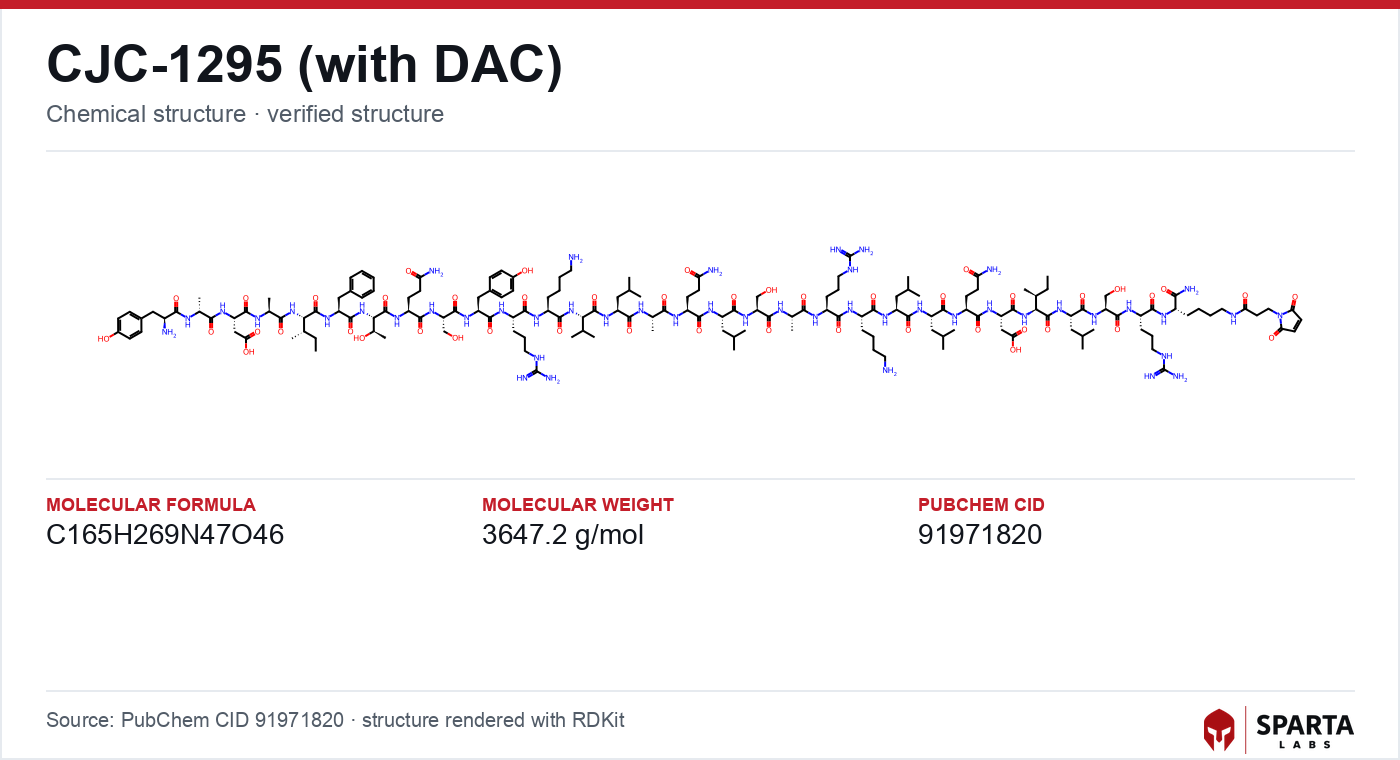
The molecule is a 29-amino-acid analog of the biologically active GHRH fragment GRF(1-29) carrying four amino-acid substitutions (D-Ala2, Gln8, Ala15, Leu27) that were reported to confer resistance to dipeptidyl peptidase-4 cleavage and reduce asparagine rearrangement. Its defining feature is a C-terminal lysine bearing a maleimidopropionic acid group, the "drug affinity complex" (DAC), which forms a covalent bond with cysteine-34 of circulating serum albumin.
Teichman and colleagues reported in the Journal of Clinical Endocrinology and Metabolism in 2006 that this albumin conjugation extended the compound's half-life to an estimated 5.8–8.1 days in healthy adults, with prolonged elevations of growth hormone and IGF-I observed after single administrations in that early-phase trial [2]. The only CJC-1295 study registered on ClinicalTrials.gov, a ConjuChem-sponsored phase 2 trial in HIV patients with visceral obesity that began in December 2005 (NCT00267527), is recorded as terminated [9]. In a companion analysis, Ionescu and Frohman reported that pulsatile growth hormone secretion persisted during continuous CJC-1295 stimulation, a finding the authors discussed in the context of preserved hypothalamic regulation [3]. The receptor-level detail is covered in the CJC-1295 mechanism of action article.
Ipamorelin: A Selective Growth Hormone Secretagogue
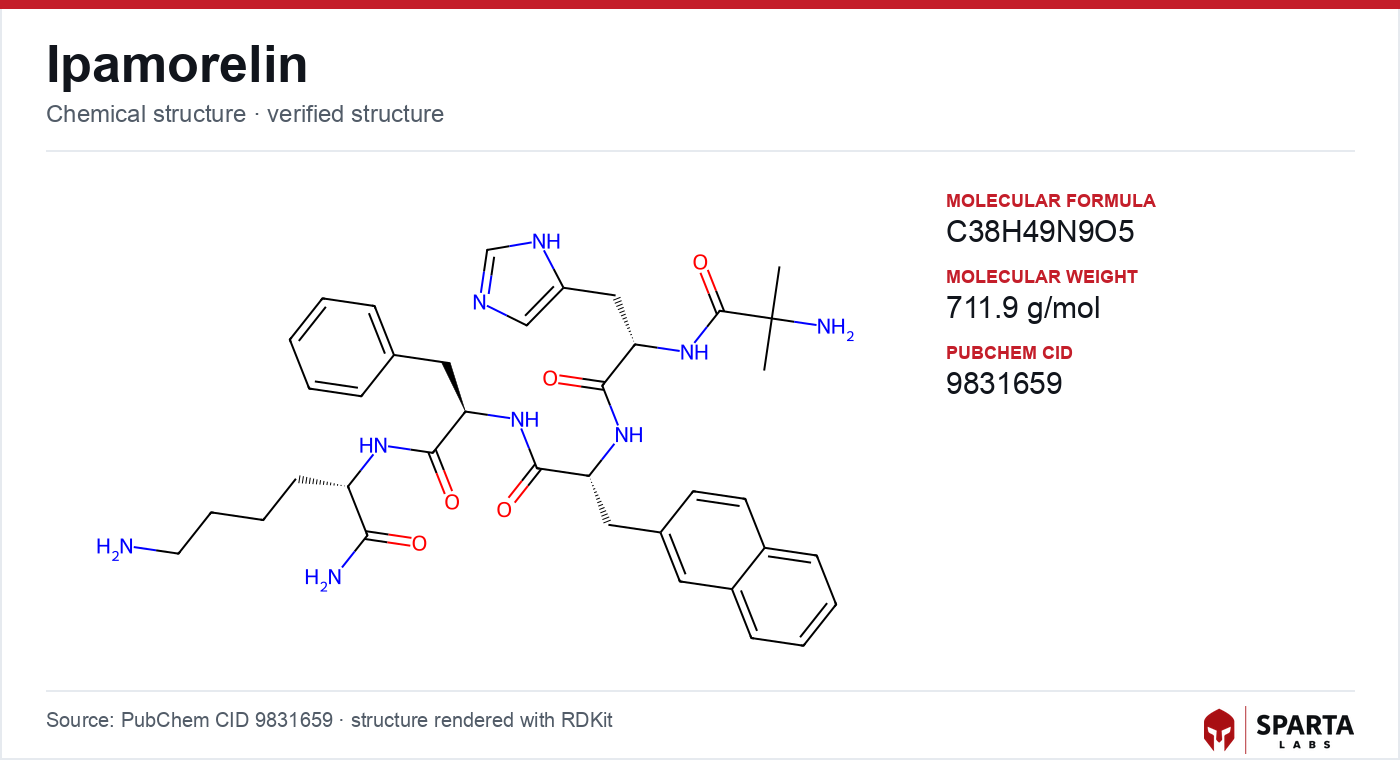
Ipamorelin came from an entirely different lineage: the growth-hormone-releasing-peptide (GHRP) program that began with Bowers' laboratory in the early 1980s. Raun and colleagues at Novo Nordisk described ipamorelin in the European Journal of Endocrinology in 1998 as "the first selective growth hormone secretagogue", a pentapeptide (Aib-His-D-2-Nal-D-Phe-Lys-NH2) that displaced radiolabeled GHRP ligand and released growth hormone in vitro and in vivo, while showing no significant release of ACTH or cortisol at doses far above those affecting growth hormone in the reported swine models [4].
Johansen and colleagues subsequently reported that ipamorelin administration induced longitudinal bone growth in rats [5], and Gobburu and colleagues published pharmacokinetic-pharmacodynamic modeling of the compound in human volunteers, reporting a short elimination half-life of roughly two hours [6].
The receptor ipamorelin engages, the growth hormone secretagogue receptor GHS-R1a, was cloned by Howard and colleagues in Science in 1996 [7], and its endogenous ligand, ghrelin, was identified by Kojima and colleagues in Nature in 1999 [8]. Ipamorelin is therefore best understood structurally as a synthetic ghrelin-receptor agonist, not a GHRH analog. Additional published work is summarized in the ipamorelin published research article.
Structural Comparison
The two molecules differ on nearly every structural axis:
- Size. CJC-1295 is a 29-residue peptide (plus the DAC linker); ipamorelin is a 5-residue peptide amide.
- Backbone origin. CJC-1295 is a substituted fragment of an endogenous human hormone (GHRH). Ipamorelin is a fully synthetic sequence containing non-natural residues (aminoisobutyric acid, D-2-naphthylalanine, D-phenylalanine) with no endogenous counterpart.
- Half-life strategy. CJC-1295 achieves persistence chemically, through covalent albumin binding via its DAC group, a bioconjugation approach [1, 2]. Ipamorelin was not engineered for persistence; published human modeling reported an elimination half-life of about two hours [6].
- Receptor target. CJC-1295 binds the GHRH receptor, a class B G-protein-coupled receptor on pituitary somatotrophs. Ipamorelin binds GHS-R1a, a class A G-protein-coupled receptor with distinct downstream signaling [4, 7].
- Selectivity findings. The ipamorelin discovery paper's central claim was receptor-level selectivity relative to earlier GHRPs, which had been reported to co-release ACTH and cortisol [4]. For CJC-1295, the reported selectivity question centers instead on preserving physiological pulsatility during continuous receptor stimulation [3].
Pharmacological Class Context
Growth hormone secretion research distinguishes two pharmacological entry points: the GHRH receptor pathway and the ghrelin/GHS-R1a pathway. The GHRP literature of the 1980s and 1990s, beginning with GHRP-6 and continuing through GHRP-2 and ipamorelin, established the second pathway and ultimately led to the discovery of ghrelin itself [7, 8].
CJC-1295 sits in the first pathway, alongside other GHRH analogs such as sermorelin and tesamorelin, the latter being the only GHRH analog to have reached FDA approval. Because the two receptor systems are distinct, published mechanistic studies treat compounds like CJC-1295 and ipamorelin as complementary experimental tools rather than interchangeable ones. This article makes no comparative efficacy assessment; the compounds' published profiles are simply not measurements of the same pathway.
Neither compound is an approved drug in any jurisdiction. Both are sold strictly as research-use-only reference materials.
References
- Jetté L, Léger R, Thibaudeau K, et al. Human growth hormone-releasing factor (hGRF)1-29-albumin bioconjugates activate the GRF receptor on the anterior pituitary in rats: identification of CJC-1295 as a long-lasting GRF analog. Endocrinology. 2005;146(7):3052-3058. PMID: 15817669. DOI: 10.1210/en.2004-1286
- Teichman SL, Neale A, Lawrence B, Gagnon C, Castaigne JP, Frohman LA. Prolonged stimulation of growth hormone (GH) and insulin-like growth factor I secretion by CJC-1295, a long-acting analog of GH-releasing hormone, in healthy adults. J Clin Endocrinol Metab. 2006;91(3):799-805. PMID: 16352683. DOI: 10.1210/jc.2005-1536
- Ionescu M, Frohman LA. Pulsatile secretion of growth hormone (GH) persists during continuous stimulation by CJC-1295, a long-acting GH-releasing hormone analog. J Clin Endocrinol Metab. 2006;91(12):4792-4797. DOI: 10.1210/jc.2006-1702
- Raun K, Hansen BS, Johansen NL, et al. Ipamorelin, the first selective growth hormone secretagogue. Eur J Endocrinol. 1998;139(5):552-561. DOI: 10.1530/eje.0.1390552
- Johansen PB, Nowak J, Skjærbæk C, et al. Ipamorelin, a new growth-hormone-releasing peptide, induces longitudinal bone growth in rats. Growth Horm IGF Res. 1999;9(2):106-113.
- Gobburu JV, Agersø H, Jusko WJ, Ynddal L. Pharmacokinetic-pharmacodynamic modeling of ipamorelin, a growth hormone releasing peptide, in human volunteers. Pharm Res. 1999;16(9):1412-1416.
- Howard AD, Feighner SD, Cully DF, et al. A receptor in pituitary and hypothalamus that functions in growth hormone release. Science. 1996;273(5277):974-977. DOI: 10.1126/science.273.5277.974
- Kojima M, Hosoda H, Date Y, Nakazato M, Matsuo H, Kangawa K. Ghrelin is a growth-hormone-releasing acylated peptide from stomach. Nature. 1999;402(6762):656-660. DOI: 10.1038/45230
- ConjuChem. A Study to Evaluate CJC 1295 in HIV Patients With Visceral Obesity. ClinicalTrials.gov identifier NCT00267527; phase 2; study start December 2005; overall status: terminated. ClinicalTrials.gov
Frequently asked questions
What is the main difference between CJC-1295 and ipamorelin?
The two compounds act on entirely different receptors. CJC-1295 is a modified analog of growth-hormone-releasing hormone (GHRH) that binds the GHRH receptor, while ipamorelin is a synthetic pentapeptide that binds the growth hormone secretagogue receptor (GHS-R1a), the same receptor later identified as the target of the endogenous hormone ghrelin. They also differ substantially in size and in half-life chemistry.
Why are CJC-1295 and ipamorelin often discussed together?
Because they engage two separate arms of the same physiological axis, published research has characterized each compound as a distinct pharmacological tool for studying growth hormone secretion. Research on dual-pathway stimulation of pituitary somatotrophs dates to the growth-hormone-releasing-peptide literature of the 1980s and 1990s.
Is either compound an approved drug?
No. Neither CJC-1295 nor ipamorelin is an FDA-approved drug. Both remain investigational research compounds. Ipamorelin advanced into clinical investigation programs that were later discontinued, and CJC-1295 was studied in early-phase clinical trials in the mid-2000s (Jetté et al., 2005, PMID 15817669; Teichman et al., 2006, PMID 16352683); the only registered CJC-1295 trial, a ConjuChem-sponsored phase 2 study in HIV patients with visceral obesity (ClinicalTrials.gov NCT00267527), is recorded as terminated.
What structural class does each peptide belong to?
CJC-1295 is a 29-amino-acid GHRH(1-29) analog carrying four stabilizing amino-acid substitutions and a maleimidopropionic acid "drug affinity complex" (DAC) group that binds serum albumin. Ipamorelin is a much smaller pentapeptide (Aib-His-D-2-Nal-D-Phe-Lys-NH2) developed from growth-hormone-releasing-peptide chemistry.