
Tesamorelin vs CJC-1295: A Structural and Regulatory Comparison
A structural and regulatory comparison of tesamorelin and CJC-1295, two growth-hormone-releasing hormone (GHRH) analogs with very different stabilization chemistry and research histories. Educational reference.
Introduction
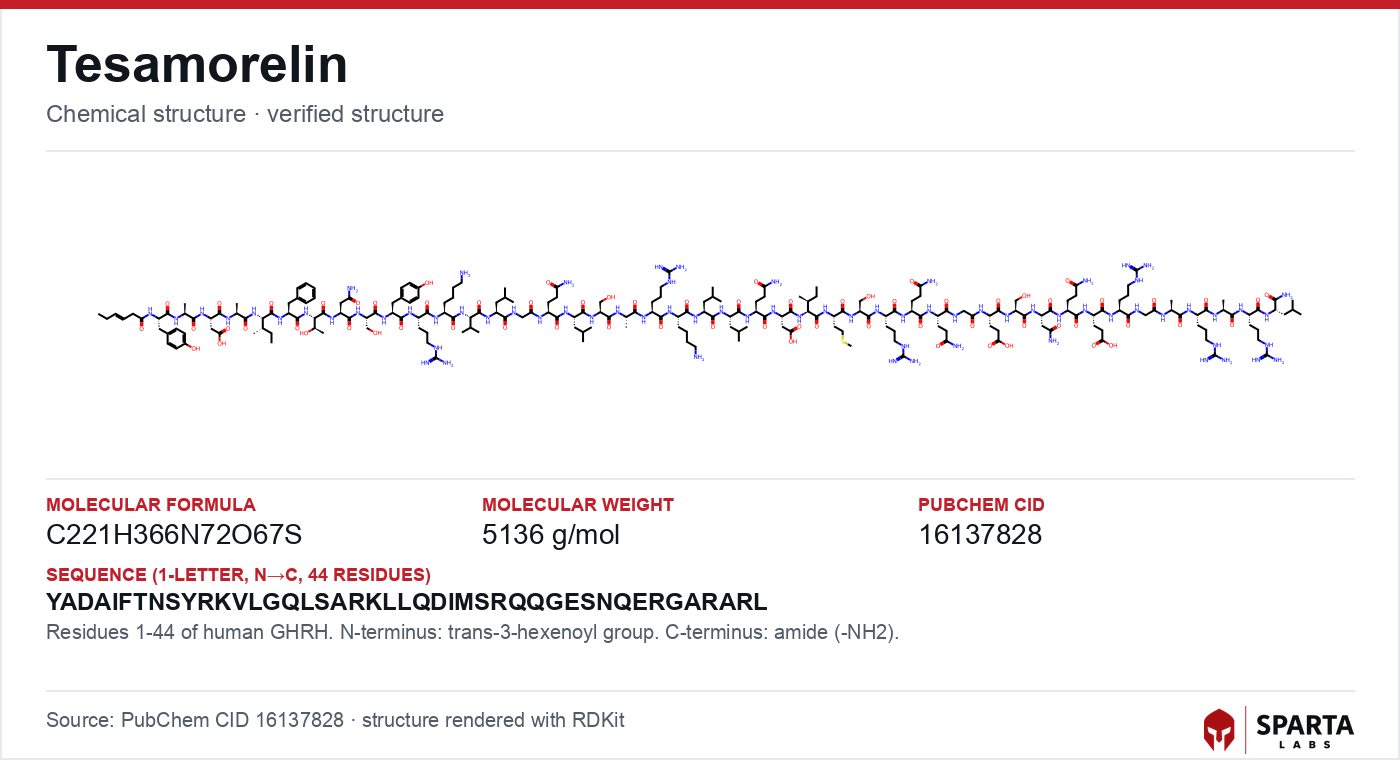
Tesamorelin and CJC-1295 are both synthetic analogs of human growth-hormone-releasing hormone (GHRH): the same 44-amino-acid hypothalamic hormone underlies both molecules, and both act at the GHRH receptor. They are nonetheless very different research articles: different backbone lengths, opposite stabilization strategies, and sharply divergent regulatory histories, with tesamorelin holding an FDA approval for a specific indication while CJC-1295 never advanced past early-phase trials. This article compares the two compounds structurally and historically, reporting what investigators and regulators have published without drawing conclusions about either compound's suitability for any purpose. Research-grade tesamorelin and CJC-1295 with DAC reference materials are cataloged with per-batch certificates of analysis.
Tesamorelin: A Stabilized Full-Length GHRH Analog
Tesamorelin (originally TH9507, marketed as Egrifta) is the complete GHRH(1-44) amide sequence bearing a single modification: a trans-3-hexenoyl group conjugated to the N-terminal tyrosine. That acyl cap was reported to protect the molecule from dipeptidyl peptidase-4 (DPP-4) cleavage, the enzyme chiefly responsible for native GHRH's circulating half-life of only minutes, while leaving the receptor-interacting sequence otherwise native.
The compound's clinical literature is unusually deep for a peptide in this class. Falutz and colleagues published a randomized, placebo-controlled trial in the New England Journal of Medicine in 2007 reporting the metabolic effects of the growth-hormone-releasing factor analog in HIV-infected patients with abdominal fat accumulation [1]. A pooled analysis of two phase 3 trials followed in the Journal of Clinical Endocrinology and Metabolism in 2010 [2]; Stanley and colleagues reported a randomized clinical trial of tesamorelin's effect on visceral and liver fat in JAMA in 2014 [3]; and a randomized, double-blind trial in The Lancet HIV in 2019 examined tesamorelin in HIV-associated nonalcoholic fatty liver disease [4].
Findings from these trials apply to the studied clinical populations and do not establish safety or efficacy in any other context. Sparta Labs makes no claims about the use of this compound.
In 2010 the FDA approved tesamorelin under the brand name Egrifta for reduction of excess abdominal fat in HIV-infected patients with lipodystrophy, making it the only GHRH analog to reach US approval [5]. Additional published work is summarized in the tesamorelin published research article.
CJC-1295: A Truncated, Albumin-Bound GHRH Analog
CJC-1295 approaches the same degradation problem from the opposite direction. Rather than capping the full-length hormone, it starts from the minimal biologically active fragment, GHRH(1-29), and adds four amino-acid substitutions (D-Ala2, Gln8, Ala15, Leu27) reported to resist DPP-4 cleavage and chemical rearrangement. Its signature feature is the "drug affinity complex" (DAC): a maleimidopropionic acid group on a C-terminal lysine that forms a covalent bond with cysteine-34 of serum albumin after administration. Jetté and colleagues identified CJC-1295 as a long-lasting GRF analog in Endocrinology in 2005 [6], and Teichman and colleagues reported in 2006 that albumin conjugation extended the half-life to an estimated 5.8–8.1 days in healthy adults [7]. Ionescu and Frohman further reported that pulsatile growth hormone secretion persisted during continuous CJC-1295 stimulation [8].
CJC-1295's clinical development ended in early phase; it holds no approval in any jurisdiction and exists today as a research compound. Receptor-level detail is covered in the CJC-1295 mechanism of action article, and its relationship to the secretagogue class is discussed in the CJC-1295 vs ipamorelin comparison.
Structural Comparison
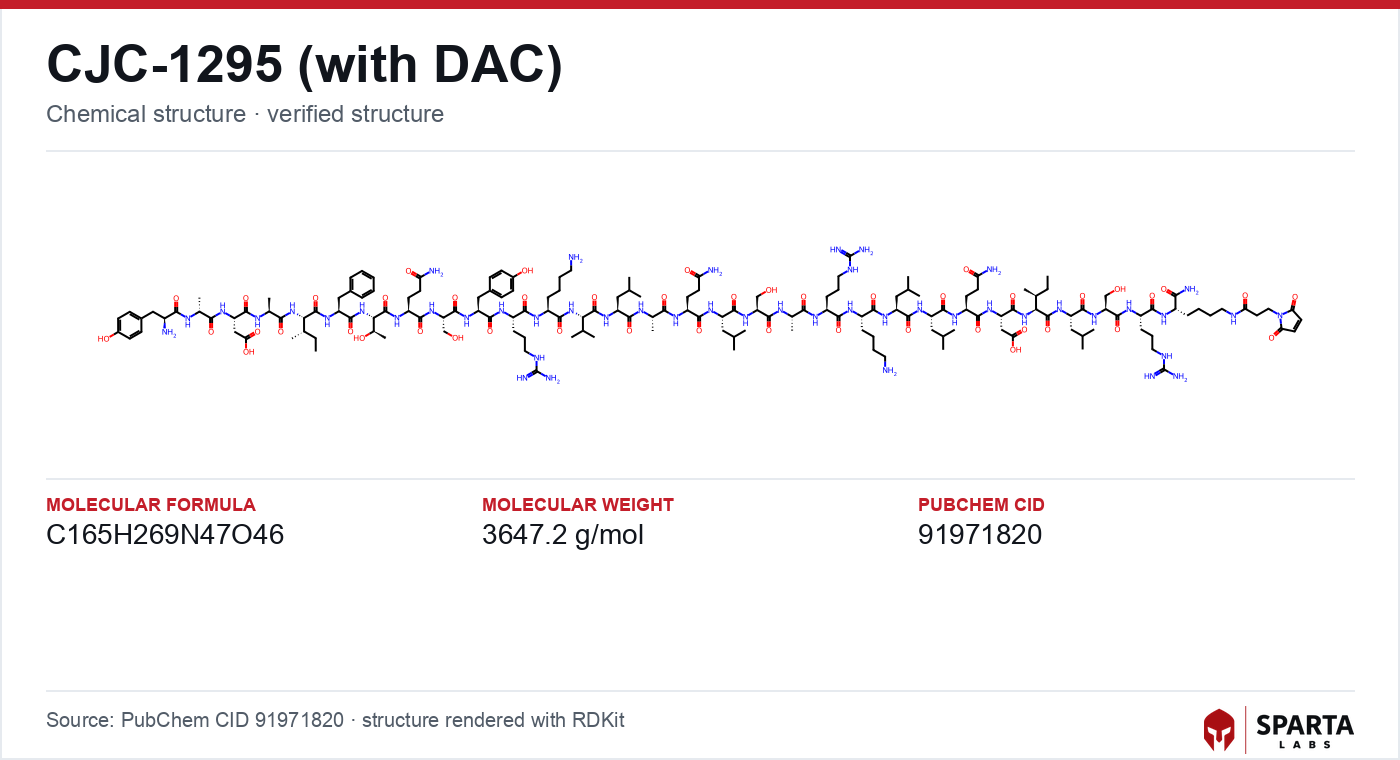
- Backbone. Tesamorelin: full-length GHRH(1-44) amide, sequence otherwise native. CJC-1295: truncated GHRH(1-29) amide with four substitutions.
- Stabilization chemistry. Tesamorelin uses a small N-terminal acyl modification (trans-3-hexenoyl) targeting DPP-4 resistance. CJC-1295 uses covalent albumin conjugation via its DAC group, a bioconjugation strategy that changes the molecule's effective size and distribution by hitching it to a 66 kDa carrier protein [6, 7].
- Half-life profile. Published human data describe tesamorelin's half-life in minutes (with once-daily administration used in its trials), versus days for albumin-bound CJC-1295 [7]. The two molecules therefore represent short-acting and long-acting engineering answers to the same enzymatic problem.
- Receptor. Both act at the GHRH receptor; neither engages the ghrelin receptor GHS-R1a, which distinguishes this pair from the growth-hormone-releasing-peptide family (GHRP-2 vs GHRP-6).
- Regulatory status. Tesamorelin: FDA-approved (2010) for a specific HIV-lipodystrophy indication [5]. CJC-1295: never approved, investigational only.
Pharmacological Class Context
Within GHRH-analog research, three compounds anchor the published literature: sermorelin (the unmodified 1-29 fragment, an earlier diagnostic product), tesamorelin (stabilized full-length, FDA-approved), and CJC-1295 (truncated, albumin-conjugated, investigational). The class is defined by engagement of the GHRH receptor and preservation of physiologic feedback regulation, a property investigated explicitly in the CJC-1295 pulsatility analysis [8] and discussed throughout the tesamorelin trial literature [1, 3]. Comparisons between class members in the published record are structural and pharmacokinetic; the compounds were never tested head-to-head, and this article accordingly makes no comparative efficacy statement.
Research-grade tesamorelin and CJC-1295 sold by chemical suppliers are laboratory reference materials, not pharmaceutical products, and are strictly for research use only.
References
- Falutz J, Allas S, Blot K, et al. Metabolic effects of a growth hormone-releasing factor in patients with HIV. N Engl J Med. 2007;357(23):2359-2370. DOI: 10.1056/NEJMoa072375
- Falutz J, Mamputu JC, Potvin D, et al. Effects of tesamorelin, a growth hormone-releasing factor analog, in HIV-infected patients with excess abdominal fat: a pooled analysis of two multicenter, double-blind placebo-controlled phase 3 trials with safety extension data. J Clin Endocrinol Metab. 2010;95(9):4291-4304. DOI: 10.1210/jc.2010-0490
- Stanley TL, Feldpausch MN, Oh J, et al. Effect of tesamorelin on visceral fat and liver fat in HIV-infected patients with abdominal fat accumulation: a randomized clinical trial. JAMA. 2014;312(4):380-389. DOI: 10.1001/jama.2014.8334
- Stanley TL, Fourman LT, Feldpausch MN, et al. Effects of tesamorelin on non-alcoholic fatty liver disease in HIV: a randomised, double-blind, multicentre trial. Lancet HIV. 2019;6(12):e821-e830. DOI: 10.1016/S2352-3018(19)30338-8
- US Food and Drug Administration. EGRIFTA (tesamorelin for injection): approval documents and prescribing information, 2010. FDA Drugs Database
- Jetté L, Léger R, Thibaudeau K, et al. Human growth hormone-releasing factor (hGRF)1-29-albumin bioconjugates activate the GRF receptor on the anterior pituitary in rats: identification of CJC-1295 as a long-lasting GRF analog. Endocrinology. 2005;146(7):3052-3058. DOI: 10.1210/en.2004-1286
- Teichman SL, Neale A, Lawrence B, Gagnon C, Castaigne JP, Frohman LA. Prolonged stimulation of growth hormone (GH) and insulin-like growth factor I secretion by CJC-1295, a long-acting analog of GH-releasing hormone, in healthy adults. J Clin Endocrinol Metab. 2006;91(3):799-805. DOI: 10.1210/jc.2005-1536
- Ionescu M, Frohman LA. Pulsatile secretion of growth hormone (GH) persists during continuous stimulation by CJC-1295, a long-acting GH-releasing hormone analog. J Clin Endocrinol Metab. 2006;91(12):4792-4797. DOI: 10.1210/jc.2006-1702
Frequently asked questions
What do tesamorelin and CJC-1295 have in common?
Both are synthetic analogs of human growth-hormone-releasing hormone (GHRH) and both act at the GHRH receptor on pituitary somatotrophs. Each was engineered to resist the rapid enzymatic degradation that limits native GHRH, but they solve that problem with entirely different chemistry.
What is the main structural difference between tesamorelin and CJC-1295?
Tesamorelin is the full-length 44-amino-acid GHRH sequence with a trans-3-hexenoyl group attached at the N-terminus, which was reported to protect against dipeptidyl peptidase-4 cleavage while leaving the sequence otherwise native. CJC-1295 is the shorter GHRH(1-29) fragment carrying four amino-acid substitutions plus a maleimidopropionic acid (DAC) group that covalently binds serum albumin, extending its circulating half-life to several days.
Is tesamorelin an approved drug?
Tesamorelin was approved by the FDA in 2010 under the brand name Egrifta for a specific indication: reduction of excess abdominal fat in HIV-infected patients with lipodystrophy. CJC-1295 has never been approved anywhere; its published human data come from early-phase trials in the mid-2000s. Research-grade material of either compound is sold for laboratory research use only.
What published research exists on tesamorelin?
The tesamorelin literature includes multiple randomized controlled trials published in journals including the New England Journal of Medicine (2007), the Journal of Clinical Endocrinology and Metabolism (2010), JAMA (2014), and The Lancet HIV (2019), along with the FDA review documents accompanying its 2010 approval.