
Tesamorelin vs Ipamorelin: A Structural and Regulatory Comparison
A structural and regulatory comparison of tesamorelin, an FDA-approved GHRH analogue, and ipamorelin, an unapproved pentapeptide agonist of the ghrelin receptor GHS-R1a. Educational reference.
Introduction
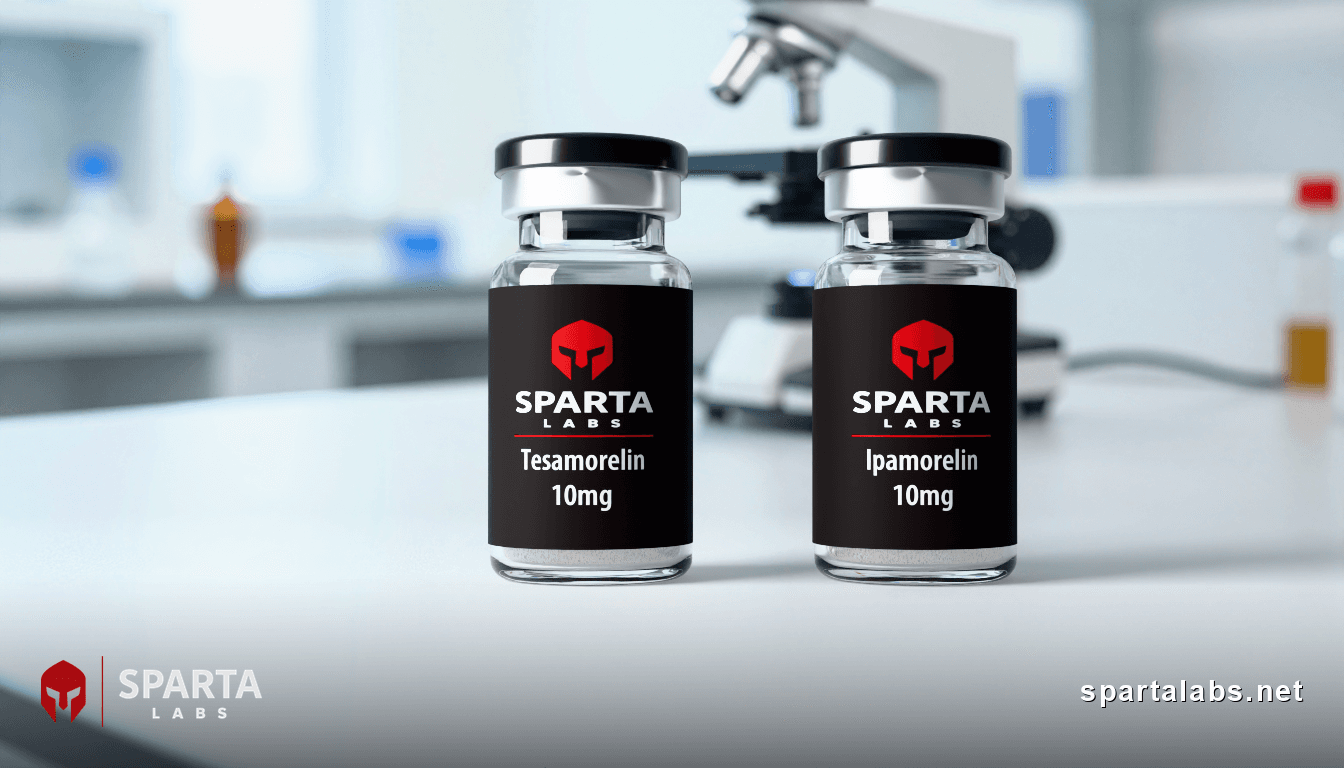
Tesamorelin and ipamorelin are often searched together because both are classified in the broad literature as growth hormone secretagogues, yet they are unrelated molecules from different pharmacological classes. Tesamorelin is a stabilized analogue of the 44-amino-acid hypothalamic hormone growth-hormone-releasing hormone (GHRH) and holds a US Food and Drug Administration (FDA) approval for one specific indication. Ipamorelin is a five-residue synthetic peptide that acts at an entirely different receptor, the growth hormone secretagogue receptor subtype 1a (GHS-R1a), and has never been approved anywhere. This article compares the two compounds on structure, origin, pharmacological class, regulatory status, and published research record. It reports what investigators and regulators have published and makes no statement about either compound's suitability for any purpose. Research-grade tesamorelin and ipamorelin reference materials are cataloged with per-batch certificates of analysis.
Tesamorelin: A Stabilized Full-Length GHRH Analogue
The GHRH lineage begins with the isolation of the native hormone. Guillemin and colleagues reported in Science in 1982 the characterization of a growth-hormone-releasing factor from a human pancreatic tumor that had caused acromegaly, establishing the 44-residue sequence on which every later GHRH analogue is based [1]. The GHRH receptor (GHRH-R), a class B G protein-coupled receptor expressed on anterior pituitary somatotrophs, signals through Gs-mediated cyclic AMP accumulation, a pathway reviewed in detail by Siejka and Barabutis in 2025 [2].
Tesamorelin (development code TH9507, marketed as Egrifta) is the complete GHRH(1-44) amide sequence bearing a single modification: a trans-3-hexenoyl group conjugated to the N-terminal tyrosine. That acyl cap was reported to protect the molecule from dipeptidyl peptidase-4 (DPP-4) cleavage, the enzyme chiefly responsible for native GHRH's plasma half-life of minutes, while leaving the receptor-interacting sequence otherwise native. The compound was developed by Theratechnologies Inc. of Montreal; its background and chemistry are covered in the tesamorelin research overview.
The tesamorelin clinical literature is unusually deep for a peptide in this class. Falutz and colleagues published a randomized, placebo-controlled trial in the New England Journal of Medicine in 2007 reporting the metabolic effects of the growth-hormone-releasing factor analogue in HIV-infected patients with abdominal fat accumulation [3], and a pooled analysis of two phase 3 trials followed in the Journal of Clinical Endocrinology and Metabolism in 2010 [4]. Stanley and colleagues reported in 2011 that endogenous growth hormone pulsatility persisted during tesamorelin administration in a study of healthy men [5].
Findings from these trials apply to the studied populations and do not establish safety or efficacy in any other context. Sparta Labs makes no claims about the use of this compound.
In November 2010 the FDA approved tesamorelin under NDA 022505 for the reduction of excess abdominal fat in HIV-infected adults with lipodystrophy, making it the only GHRH analogue to reach US marketing approval [6]. Its relationship to other GHRH analogues is discussed in the tesamorelin vs CJC-1295 comparison.
Ipamorelin: A Selective GHS-R1a Pentapeptide
Ipamorelin belongs to a lineage that developed independently of GHRH. The growth-hormone-releasing peptide (GHRP) family originated in the laboratory of Cyril Bowers in the late 1970s and early 1980s, when enkephalin-derived synthetic peptides were found to release growth hormone through a mechanism distinct from GHRH. The receptor responsible was cloned by Howard and colleagues at Merck in 1996 and named the growth hormone secretagogue receptor, GHS-R1a [7]. Three years later Kojima and colleagues identified its endogenous ligand, the acylated stomach peptide ghrelin, in Nature [8]. The synthetic secretagogues therefore preceded the discovery of the natural hormone whose receptor they engage.
Ipamorelin (development code NNC 26-0161) emerged from a structure-activity program at Novo Nordisk A/S in Denmark. Raun and colleagues reported in the European Journal of Endocrinology in 1998 that the pentapeptide Aib-His-D-2-Nal-D-Phe-Lys-NH2 released growth hormone in primary rat pituitary cells and in conscious swine with potency comparable to GHRP-6, while not significantly affecting ACTH, cortisol, or prolactin at concentrations far above its ED50 for growth hormone release; the authors titled the paper "Ipamorelin, the first selective growth hormone secretagogue" [9]. A companion medicinal-chemistry report by Ankersen and colleagues described a new series of potent secretagogues derived from the ipamorelin template [10], and Johansen and colleagues published a comparative pharmacokinetic evaluation of ipamorelin alongside GHRP-2 and GHRP-6 in rats the same year [11].
The compound's only published late-stage human study is a phase 2 randomized, placebo-controlled proof-of-concept trial reported by Beck and colleagues in 2014, which evaluated the ghrelin mimetic in patients recovering from bowel-resection surgery [12]. Ipamorelin was never submitted for marketing approval and holds no approval from the FDA or the European Medicines Agency. The FDA's Pharmacy Compounding Advisory Committee reviewed the compound under Section 503A of the Federal Food, Drug, and Cosmetic Act in 2024 as part of its ongoing evaluation of nominated bulk drug substances [13]. Receptor-level detail is covered in the ipamorelin mechanism of action article.
Structural Comparison
- Length and origin. Tesamorelin is a 44-residue peptide derived directly from the native human GHRH sequence, modified only at the N-terminus. Ipamorelin is a five-residue synthetic sequence with no natural counterpart; it was designed through iterative medicinal chemistry beginning from the GHRP-1 scaffold rather than by modifying a hormone [9, 10].
- Sequence chemistry. Tesamorelin is composed of the standard L-amino acids of GHRH(1-44) plus the trans-3-hexenoyl cap. Ipamorelin incorporates non-natural residues throughout: an N-terminal alpha-aminoisobutyric acid (Aib), a D-2-naphthylalanine, and a D-phenylalanine, with a C-terminal lysine amide. The D-residues and the Aib residue were reported as design elements for conformational rigidity and enzymatic stability [9, 10].
- Molecular size. Tesamorelin's molecular weight is roughly 5.1 kilodaltons; ipamorelin's is approximately 712 daltons, about one-seventh the mass.
- Stabilization strategy. Tesamorelin addresses degradation through a single N-terminal acylation targeting DPP-4. Ipamorelin, like the other GHRPs, relies on D-amino-acid substitution and its short length; Johansen and colleagues reported a systemic clearance for ipamorelin several-fold lower than that of GHRP-6 in their rat comparison [11].
- Receptor. Tesamorelin acts at the GHRH receptor, a class B G protein-coupled receptor coupled to Gs and cyclic AMP [2]. Ipamorelin acts at GHS-R1a, a class A G protein-coupled receptor coupled primarily to Gq and phospholipase C [7]. Neither compound is reported to engage the other's receptor.
- Regulatory status. Tesamorelin: FDA-approved in 2010 for a single, specific indication [6]. Ipamorelin: never approved in any jurisdiction; investigational compound with early-phase human data [12, 13].
Pharmacological Class Context
The term "growth hormone secretagogue" is applied loosely to both compounds in some sources, but the published pharmacology places them in separate classes. Tesamorelin belongs to the GHRH-analogue class, which also includes sermorelin (the GHRH(1-29) fragment) and the CJC-1295 series. Members of that class act at the hypothalamic hormone's own receptor and were reported to preserve the pulsatile pattern of growth hormone secretion under continued stimulation [5]. Ipamorelin belongs to the GHS-R1a agonist class, alongside GHRP-6, GHRP-2, and hexarelin, whose members act at the ghrelin receptor and were historically characterized before that receptor's natural ligand was known [7, 8].
Because the two classes act through independent receptors and signaling pathways, published research has occasionally examined them side by side as pharmacological tools for dissecting growth hormone regulation. The structural relationship between a GHRH analogue and a GHS-R1a pentapeptide is examined from the other direction in the CJC-1295 vs ipamorelin comparison. Tesamorelin and ipamorelin have never been tested head-to-head in a published trial, and this article accordingly makes no comparative efficacy statement.
Research-grade tesamorelin and ipamorelin sold by chemical suppliers are laboratory reference materials, not pharmaceutical products, and are strictly for research use only.
References
- Guillemin R, Brazeau P, Böhlen P, Esch F, Ling N, Wehrenberg WB. Growth hormone-releasing factor from a human pancreatic tumor that caused acromegaly. Science. 1982;218(4572):585-587. PMID: 6812220
- Halmos G, Szabo Z, Dobos N, Juhasz E, Schally AV. Growth hormone-releasing hormone receptor (GHRH-R) and its signaling. Rev Endocr Metab Disord. 2025;26(3):343-352. PMID: 39934495
- Falutz J, Allas S, Blot K, et al. Metabolic effects of a growth hormone-releasing factor in patients with HIV. N Engl J Med. 2007;357(23):2359-2370. DOI: 10.1056/NEJMoa072375
- Falutz J, Mamputu JC, Potvin D, et al. Effects of tesamorelin, a growth hormone-releasing factor analog, in HIV-infected patients with excess abdominal fat: a pooled analysis of two multicenter, double-blind placebo-controlled phase 3 trials with safety extension data. J Clin Endocrinol Metab. 2010;95(9):4291-4304. DOI: 10.1210/jc.2010-0490
- Stanley TL, Chen CY, Branch KL, Makimura H, Grinspoon SK. Effects of a growth hormone-releasing hormone analog on endogenous GH pulsatility and insulin sensitivity in healthy men. J Clin Endocrinol Metab. 2011;96(1):150-158. PMID: 20943777
- US Food and Drug Administration. Summary Review for Regulatory Action: Egrifta (tesamorelin for injection), NDA 022505. Silver Spring: FDA; 2010. FDA document
- Howard AD, Feighner SD, Cully DF, et al. A receptor in pituitary and hypothalamus that functions in growth hormone release. Science. 1996;273(5277):974-977. PMID: 8688086
- Kojima M, Hosoda H, Date Y, Nakazato M, Matsuo H, Kangawa K. Ghrelin is a growth-hormone-releasing acylated peptide from stomach. Nature. 1999;402(6762):656-660. PMID: 10604470
- Raun K, Hansen BS, Johansen NL, Thøgersen H, Madsen K, Ankersen M, et al. Ipamorelin, the first selective growth hormone secretagogue. Eur J Endocrinol. 1998;139(5):552-561. PMID: 9849822
- Ankersen M, Johansen NL, Madsen K, Hansen BS, Raun K, Nielsen KK, et al. A new series of highly potent growth hormone-releasing peptides derived from ipamorelin. J Med Chem. 1998;41(19):3699-3704. PMID: 9733495
- Johansen PB, Hansen KT, Andersen JV, Johansen NL. Pharmacokinetic evaluation of ipamorelin and other peptidyl growth hormone secretagogues with emphasis on nasal absorption. Xenobiotica. 1998;28(11):1083-1092. PMID: 9879640
- Beck DE, Sweeney WB, McCarter MD, et al. Prospective, randomized, controlled, proof-of-concept study of the Ghrelin mimetic ipamorelin for the management of postoperative ileus in bowel resection patients. Int J Colorectal Dis. 2014;29(12):1527-1534. PMID: 25331030
- US Food and Drug Administration. Drug Products Containing Certain Bulk Drug Substances That May Not Be Compounded Under Section 503A of the Federal Food, Drug, and Cosmetic Act. Docket FDA-2015-N-0863. FDA compounding page
Frequently asked questions
What is the difference between tesamorelin and ipamorelin?
Tesamorelin is a 44-amino-acid analogue of growth-hormone-releasing hormone (GHRH) that acts at the GHRH receptor, while ipamorelin is a synthetic pentapeptide that acts at the growth hormone secretagogue receptor GHS-R1a, the receptor later identified as the ghrelin receptor. The two compounds belong to different pharmacological classes, engage different receptors, and have very different regulatory histories.
Is tesamorelin FDA approved?
Yes. The FDA approved tesamorelin in 2010 under the brand name Egrifta for a single specific indication, the reduction of excess abdominal fat in HIV-infected adults with lipodystrophy. It is the only GHRH analogue with a current US marketing approval. Research-grade tesamorelin sold as a reference material is not the approved drug product.
Is ipamorelin FDA approved?
No. Ipamorelin has never received marketing approval from the FDA or the European Medicines Agency for any indication. Its published human data come from early-phase clinical trials, and it is supplied only as a research-use-only material.
What is tesamorelin?
Tesamorelin (development code TH9507) is a synthetic analogue of the full-length human GHRH(1-44) amide with a trans-3-hexenoyl group attached to its N-terminal tyrosine. Published reports describe that modification as conferring resistance to dipeptidyl peptidase-4 cleavage, the enzyme largely responsible for native GHRH's short plasma half-life.
What is ipamorelin?
Ipamorelin (development code NNC 26-0161) is a synthetic pentapeptide with the sequence Aib-His-D-2-Nal-D-Phe-Lys-NH2, developed at Novo Nordisk in the 1990s. Raun and colleagues described it in 1998 as the first selective growth hormone secretagogue on the basis of its reported hormonal profile in preclinical models.
Do tesamorelin and ipamorelin act on the same receptor?
No. Tesamorelin acts at the GHRH receptor, a class B G protein-coupled receptor that signals through Gs and cyclic AMP. Ipamorelin acts at GHS-R1a, a class A G protein-coupled receptor that signals primarily through Gq and phospholipase C. The two receptors are pharmacologically independent.