
CJC-1295 DAC vs No DAC: A Structural and Regulatory Comparison
A structural and regulatory comparison of CJC-1295 with DAC and CJC-1295 without DAC (Modified GRF 1-29), two GHRH(1-29) analogs that share the same four amino-acid substitutions but differ by a single albumin-binding group. Educational reference.
Introduction
CJC-1295 with DAC and CJC-1295 without DAC are two synthetic analogs of growth-hormone-releasing hormone (GHRH) that are frequently confused because they share a name, a backbone and a research lineage. Both are derived from the biologically active N-terminal fragment GHRH(1-29), both carry the same four stabilizing amino-acid substitutions, and both act at the GHRH receptor on pituitary somatotroph cells. They differ by exactly one structural feature: the Drug Affinity Complex (DAC), a small reactive group that binds the peptide to serum albumin after administration. That single difference changes the molecule's effective size, distribution and circulating half-life, and it separates a compound with a published human pharmacokinetic record from one whose literature is largely inferential.
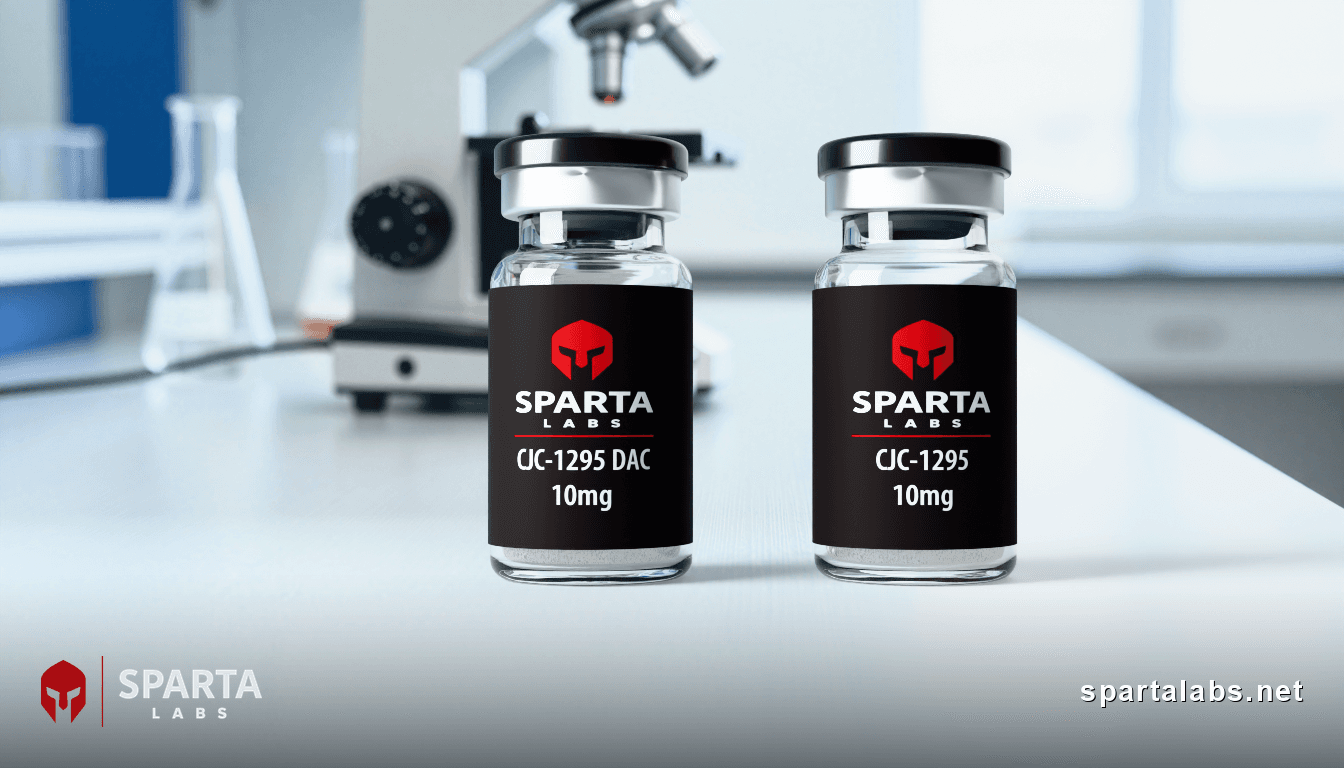
This article compares the two molecules on structure, origin, pharmacological class, regulatory status and research record. It reports what investigators and regulators have published and draws no conclusion about either compound's suitability for any purpose. Research-grade CJC-1295 with DAC and CJC-1295 without DAC are cataloged as laboratory reference materials with per-batch certificates of analysis.
CJC-1295 With DAC: An Albumin-Conjugated GHRH(1-29) Analog
CJC-1295 with DAC is a 30-residue synthetic peptide developed by ConjuChem Inc. of Montreal. Its backbone is human GHRH(1-29) amide with four substitutions at positions 2, 8, 15 and 27 (D-Ala2, Gln8, Ala15, Leu27), a set of modifications designed to resist the enzymatic cleavage that limits the native hormone. Appended to a C-terminal lysine is the DAC group: an N-epsilon-3-maleimidopropionamide derivative whose maleimide ring reacts with the free thiol on cysteine-34 of serum albumin to form a covalent thioether bond.
Jetté and colleagues described this bioconjugation strategy in Endocrinology in 2005, reporting that hGRF(1-29)-albumin bioconjugates activated the GRF receptor on the rat anterior pituitary and identifying CJC-1295 as a long-lasting GRF analog [4]. Teichman and colleagues followed in the Journal of Clinical Endocrinology and Metabolism in 2006 with a human study in healthy adults, reporting an estimated half-life of 5.8 to 8.1 days for the albumin-bound peptide and prolonged elevation of growth hormone and IGF-1 concentrations over the observation period [5]. Ionescu and Frohman reported in the same journal that the pulsatile pattern of growth hormone secretion persisted during continuous stimulation by CJC-1295 [6], and Sackmann-Sala and colleagues later described serum protein profile changes in normal adult subjects following activation of the GH/IGF-1 axis by the compound [7].
Findings from these studies were obtained in defined research settings and do not establish safety or efficacy in any other context. Sparta Labs makes no claims about the use of this compound. Receptor-level detail is covered in the CJC-1295 with DAC mechanism of action article.
CJC-1295 Without DAC: Modified GRF (1-29)
CJC-1295 without DAC is the commercial name for a compound that predates the DAC platform in the scientific literature: Modified GRF (1-29), also written Mod GRF 1-29 or tetrasubstituted GRF(1-29). It is a 29-residue peptide with an amidated C-terminus and the same four substitutions (D-Ala2, Gln8, Ala15, Leu27) that appear in the DAC version. It has no maleimide group and no C-terminal lysine extension, and it therefore does not conjugate to albumin.
The design rationale traces to the enzymology of native GHRH. Frohman and colleagues reported in the Journal of Clinical Investigation in 1989 that dipeptidyl peptidase IV (DPP-4) cleaves the Tyr1-Ala2 bond at the N-terminus of GHRH in plasma, producing an inactive GRF(3-29) fragment and limiting the hormone's circulating half-life to a matter of minutes [2]. The D-Ala2 substitution alters the geometry of that bond so DPP-4 cannot engage it productively; the Gln8, Ala15 and Leu27 substitutions were introduced to address secondary proteolysis, conformational stability and methionine oxidation respectively. The unmodified parent fragment, sermorelin, was reviewed by Prakash and Goa in BioDrugs in 1999, who documented a plasma half-life of roughly 11 to 12 minutes for GRF(1-29) amide [3].
No dedicated human pharmacokinetic study of the without-DAC compound has been published under that name. Its plasma persistence is inferred from the substitution chemistry and from the sermorelin benchmark, and the published literature describes it as measured in minutes to tens of minutes rather than days. That inferential status is one of the principal differences in the research record between the two compounds and is discussed further in the CJC-1295 without DAC research overview.
Structural Comparison
- Backbone. Identical in both compounds: human GHRH(1-29) amide with D-Ala2, Gln8, Ala15 and Leu27 substitutions. GHRH itself was isolated and sequenced in 1982 by Guillemin and colleagues from a pancreatic tumor associated with acromegaly [1].
- Chain length and mass. Without DAC: 29 residues, approximately 3,367 daltons as the free base. With DAC: 30 residues including the lysine carrying the maleimidopropionamide group, molecular formula C165H269N47O46, approximately 3,647 daltons unconjugated. Once bound to albumin the DAC form circulates at the effective mass of the carrier protein (about 66 kDa) plus the peptide [4].
- Reactive chemistry. The DAC form contains a maleimide, which is reactive toward thiols. This is the feature that produces the albumin adduct in vivo and also the feature that requires attention to reducing conditions and thiol-containing reagents in laboratory handling. The without-DAC form contains no maleimide and behaves as a conventional synthetic peptide.
- Distribution. Jetté and colleagues reported that albumin conjugation confined the DAC form largely to the vascular and interstitial compartments occupied by albumin [4]. The without-DAC form is subject to renal filtration and residual proteolysis like other small peptides.
- Half-life. Reported at 5.8 to 8.1 days for the DAC form in healthy adults [5]; inferred in minutes to tens of minutes for the without-DAC form, benchmarked against the 11 to 12 minutes reported for sermorelin [3].
- Secretory pattern studied. The DAC form has been examined specifically for whether continuous GHRH-receptor stimulation preserved pulsatile growth hormone secretion [6]. No equivalent published analysis exists for the without-DAC form.
Pharmacological Class Context
Both compounds are GHRH-receptor agonists, placing them in the same pharmacological class as sermorelin and tesamorelin. The GHRH receptor is a class B1 G-protein-coupled receptor on anterior pituitary somatotrophs, and agonists at this receptor act upstream of the pituitary rather than supplying exogenous growth hormone. This distinguishes the whole GHRH-analog class from the growth-hormone-releasing peptides (GHRP-2, GHRP-6, hexarelin, ipamorelin), which act at the ghrelin receptor GHS-R1a through a different signaling pathway.
Within the GHRH-analog class, the two CJC-1295 variants occupy different points on a stabilization spectrum. Sermorelin is the unmodified fragment; Modified GRF (1-29) adds enzymatic resistance through substitution alone; CJC-1295 with DAC adds albumin conjugation on top of the same substitutions; and tesamorelin takes a different approach again by capping the full-length 44-residue hormone. That broader comparison is set out in the tesamorelin vs CJC-1295 article.
Regulatory status
Neither CJC-1295 with DAC nor CJC-1295 without DAC holds marketing approval from the US Food and Drug Administration or any comparable authority. The regulatory record of the class is nonetheless relevant to both. Sermorelin acetate was approved in 1997 under the brand name Geref, and the FDA's 2013 Federal Register notice determined that the product was not withdrawn from sale for reasons of safety or effectiveness [8]. ConjuChem sponsored an early-phase clinical program for CJC-1295 with DAC in the mid-2000s that did not advance to approval. In December 2024, the FDA's Pharmacy Compounding Advisory Committee reviewed CJC-1295 among several GHRH analogs nominated as bulk drug substances for compounding under section 503A of the Federal Food, Drug, and Cosmetic Act [9].
The DAC form has also appeared in the doping-control literature: Henninge and colleagues reported the identification of CJC-1295 in an unlabeled pharmaceutical preparation in Drug Testing and Analysis in 2010 [10], and GHRH analogs are listed under section S2 of the World Anti-Doping Agency Prohibited List. Both compounds are sold by chemical suppliers as research-use-only reference materials, not as pharmaceutical products.
Research record
The asymmetry in the published record is the clearest practical difference between the two molecules. CJC-1295 with DAC has a preclinical characterization paper [4], a human pharmacokinetic and pharmacodynamic study [5], a pulsatility analysis [6] and a serum proteomic follow-up [7], all under its own name. CJC-1295 without DAC is supported chiefly by the enzymology of the parent hormone [2], the sermorelin clinical literature [3] and the shared substitution chemistry described in the DAC papers. Investigators reading the CJC-1295 literature should note which molecule a given paper actually studied, because most human data attach to the albumin-conjugated form.
References
- Guillemin R, Brazeau P, Böhlen P, Esch F, Ling N, Wehrenberg WB. Growth hormone-releasing factor from a human pancreatic tumor that caused acromegaly. Science. 1982;218(4572):585-587. PMID: 6812220. DOI: 10.1126/science.6812220
- Frohman LA, Downs TR, Heimer EP, Felix AM. Dipeptidylpeptidase IV and trypsin-like enzymatic degradation of human growth hormone-releasing hormone in plasma. J Clin Invest. 1989;83(5):1533-1540. PMID: 2565342. DOI: 10.1172/JCI114049
- Prakash A, Goa KL. Sermorelin: a review of its use in the diagnosis and treatment of children with idiopathic growth hormone deficiency. BioDrugs. 1999;12(2):139-157. PMID: 18031173. DOI: 10.2165/00063030-199912020-00007
- Jetté L, Léger R, Thibaudeau K, et al. Human growth hormone-releasing factor (hGRF)1-29-albumin bioconjugates activate the GRF receptor on the anterior pituitary in rats: identification of CJC-1295 as a long-lasting GRF analog. Endocrinology. 2005;146(7):3052-3058. PMID: 15817669. DOI: 10.1210/en.2004-1286
- Teichman SL, Neale A, Lawrence B, Gagnon C, Castaigne JP, Frohman LA. Prolonged stimulation of growth hormone (GH) and insulin-like growth factor I secretion by CJC-1295, a long-acting analog of GH-releasing hormone, in healthy adults. J Clin Endocrinol Metab. 2006;91(3):799-805. PMID: 16352683. DOI: 10.1210/jc.2005-1536
- Ionescu M, Frohman LA. Pulsatile secretion of growth hormone (GH) persists during continuous stimulation by CJC-1295, a long-acting GH-releasing hormone analog. J Clin Endocrinol Metab. 2006;91(12):4792-4797. PMID: 17018654. DOI: 10.1210/jc.2006-1702
- Sackmann-Sala L, Ding J, Frohman LA, Kopchick JJ. Activation of the GH/IGF-1 axis by CJC-1295, a long-acting GHRH analog, results in serum protein profile changes in normal adult subjects. Growth Horm IGF Res. 2009;19(6):471-477. PMID: 19386527. DOI: 10.1016/j.ghir.2009.03.001
- US Food and Drug Administration. Determination that GEREF (sermorelin acetate) injection was not withdrawn from sale for reasons of safety or effectiveness. Fed Regist. 2013;78(43):14201. Federal Register
- US Food and Drug Administration. Pharmacy Compounding Advisory Committee meeting briefing document, December 4, 2024. FDA
- Henninge J, Pepaj M, Hullstein I, Hemmersbach P. Identification of CJC-1295, a growth-hormone-releasing peptide, in an unknown pharmaceutical preparation. Drug Test Anal. 2010;2(11-12):647-650. PMID: 21204297. DOI: 10.1002/dta.233
Frequently asked questions
What is the difference between CJC-1295 with DAC and CJC-1295 without DAC?
Both compounds are built on the same tetra-substituted GHRH(1-29) backbone, carrying D-Ala2, Gln8, Ala15 and Leu27 in place of the native residues. The only structural difference is the Drug Affinity Complex (DAC), a maleimidopropionic acid group attached to a C-terminal lysine in the DAC version. Jetté and colleagues reported in 2005 that this group forms a covalent bond with serum albumin, which is why the two molecules have very different circulating half-lives.
Is CJC-1295 without DAC the same as Modified GRF 1-29?
Yes. CJC-1295 without DAC is the name commonly applied in commerce to Modified GRF (1-29), also written Mod GRF 1-29 or tetrasubstituted GRF(1-29). All of these names refer to the 29-residue GHRH fragment carrying the four stabilizing substitutions and lacking the albumin-binding DAC group.
What is the DAC in CJC-1295?
DAC stands for Drug Affinity Complex, a technology developed by ConjuChem Inc. It is an N-epsilon-3-maleimidopropionamide derivative of lysine appended at the peptide's C-terminus. The maleimide reacts with the free thiol on cysteine-34 of circulating serum albumin, so the peptide travels through the bloodstream attached to a 66 kDa carrier protein.
How do the half-lives of CJC-1295 with DAC and without DAC compare?
Teichman and colleagues reported in 2006 that the albumin-conjugated DAC form had an estimated half-life of 5.8 to 8.1 days in healthy adults. The without-DAC form does not bind albumin and has not been characterized in a dedicated human pharmacokinetic study; its plasma persistence is inferred from the DPP-4 resistance conferred by the D-Ala2 substitution and is described in the literature as a matter of minutes rather than days.
Is CJC-1295 FDA approved?
No. Neither CJC-1295 with DAC nor CJC-1295 without DAC has been approved by the FDA or any comparable regulator for any use. The unmodified parent fragment, sermorelin, was approved as Geref in 1997 and later discontinued for commercial reasons. In December 2024 the FDA's Pharmacy Compounding Advisory Committee reviewed CJC-1295 as a candidate bulk substance for compounding. Both forms are sold as research-use-only materials.