
Hexarelin vs GHRP-2: A Structural and Regulatory Comparison
A structural and regulatory comparison of hexarelin (examorelin) and GHRP-2 (pralmorelin), two synthetic hexapeptide growth hormone secretagogues from the same Bowers lineage that differ at a single amino-acid position and in their regulatory histories. Educational reference.
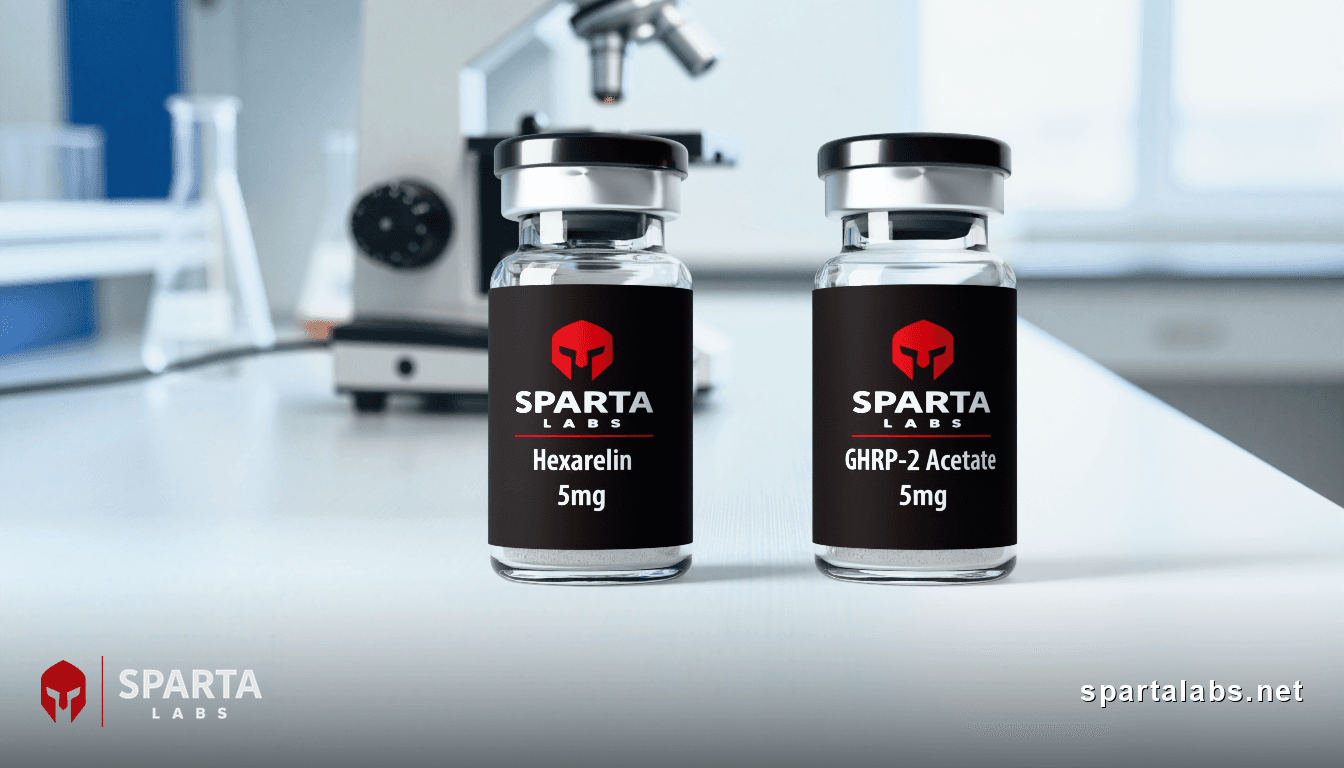
Introduction
Hexarelin and GHRP-2 are two synthetic hexapeptides that sit side by side in the growth-hormone-releasing peptide (GHRP) family. Both descend from GHRP-6, the first hexapeptide shown to release growth hormone in vitro and in vivo, and both are agonists at the growth hormone secretagogue receptor subtype 1a (GHS-R1a), the G-protein-coupled receptor later identified as the target of the endogenous hormone ghrelin. They are separated by a single substitution at position 2 of the peptide chain, by a second substitution at position 1 in GHRP-2, and by regulatory histories that diverged sharply in the 2000s: GHRP-2 became the first growth hormone secretagogue to receive a national regulatory approval, while hexarelin's development stopped at Phase II.
This article compares the two compounds on structure, origin, pharmacological class, regulatory status and research record. It reports what investigators and regulators have published and makes no comparative statement about efficacy or suitability for any purpose. Research-grade hexarelin and GHRP-2 are cataloged as laboratory reference materials with per-batch certificates of analysis.
Hexarelin: A 2-Methyltryptophan Analog of GHRP-6
Hexarelin (International Nonproprietary Name examorelin; development code EP-23905; CAS 140703-51-1) is a six-residue peptide with the sequence His-D-2-methyl-Trp-Ala-Trp-D-Phe-Lys-NH2, molecular formula C47H58N12O6 and a molecular weight of approximately 887 daltons. Its defining structural feature relative to GHRP-6 is the replacement of D-tryptophan at position 2 with D-2-methyltryptophan. Deghenghi and colleagues at Europeptides (Argenteuil, France) reported the compound's growth-hormone-releasing activity in infant and adult rats in Life Sciences in 1994, attributing greater metabolic stability and receptor potency to the methylated tryptophan [3].
Hexarelin's clinical pharmacology was characterized extensively in the mid-1990s by groups at the University of Turin and elsewhere. Arvat and colleagues published a comparative human study of GHRP-2 and hexarelin in Peptides in 1997, reporting the growth hormone, prolactin, ACTH and cortisol responses to each compound alongside GHRH, TRH and human CRH in healthy volunteers [7]. Findings from that study describe hormone responses in a defined research setting and do not establish safety or efficacy in any other context. Sparta Labs makes no claims about the use of this compound.
A distinctive feature of the hexarelin literature is its second binding site. Demers and colleagues reported in the Biochemical Journal in 2004 that photoaffinity cross-linking localized a GHRP binding site on CD36, a class B scavenger receptor expressed on cardiomyocytes, macrophages and microvascular endothelium [8]. This dual-receptor pharmacology, examined in the hexarelin mechanism of action article, has shaped much of the preclinical hexarelin research published since.
GHRP-2: A 2-Naphthylalanine Analog With a Diagnostic Approval
GHRP-2 (INN pralmorelin; development code KP-102; CAS 158861-67-7) is a six-residue peptide with the sequence D-Ala-D-2Nal-Ala-Trp-D-Phe-Lys-NH2, molecular formula C45H55N9O6 and a free-base molecular weight of approximately 817 daltons. It is commonly supplied as the acetate or dihydrochloride salt. Relative to GHRP-6, GHRP-2 carries two changes: D-2-naphthylalanine replaces D-tryptophan at position 2, and D-alanine replaces L-histidine at position 1. Both D-amino acids, together with D-phenylalanine at position 5, contribute to resistance against proteolysis.
The compound emerged from structure-activity optimization of the Bowers hexapeptide scaffold and was developed clinically by Kaken Pharmaceutical in Japan. Doi and colleagues published the preclinical pharmacological characterization of KP-102 in Arzneimittelforschung in 2004 [4], the same year the compound's development profile was summarized in Drugs in R&D [9]. Doping-control laboratories later developed liquid chromatography-tandem mass spectrometry methods for pralmorelin and its metabolite in human urine, as reported by Okano and colleagues in 2010 [10].
Additional published work on the compound is summarized in the GHRP-2 research overview.
Structural Comparison
- Scaffold. Both are hexapeptides on the GHRP-6 template (His-D-Trp-Ala-Trp-D-Phe-Lys-NH2) first reported by Bowers, Momany, Reynolds and Hong in 1984 [2], which itself grew out of structure-activity work on a growth-hormone-releasing pentapeptide published in 1980 [1].
- Position 1. Hexarelin retains L-histidine. GHRP-2 substitutes D-alanine.
- Position 2. Hexarelin: D-2-methyltryptophan, a methylated indole. GHRP-2: D-2-naphthylalanine, a bicyclic aromatic that is not an indole. In both cases the substitution at this position is the modification credited in the primary literature with altering potency and stability relative to the parent [3, 4].
- Positions 3 to 6. Identical in both: Ala-Trp-D-Phe-Lys-NH2.
- Mass and formula. Hexarelin C47H58N12O6, about 887 Da; GHRP-2 C45H55N9O6, about 817 Da. Neither carries a lipid, polymer or albumin-binding modification.
- Receptor. Both are GHS-R1a agonists [5]. The hexarelin literature additionally documents CD36 binding [8]; an equivalent CD36 literature does not exist for GHRP-2, which is a difference in the research record rather than a demonstrated structural difference.
- Relationship to GHRH. Neither peptide has sequence homology with GHRH, and neither acts at the GHRH receptor.
Pharmacological Class Context
Hexarelin and GHRP-2 belong to the peptidyl growth hormone secretagogue class, whose defining receptor was cloned by Howard and colleagues in Science in 1996 [5] and whose endogenous ligand, ghrelin, was isolated by Kojima and colleagues in Nature in 1999 [6]. Ghrelin's discovery established retrospectively that the synthetic GHRPs developed from the late 1970s onward had been mimicking a natural hormone. Berlanga-Acosta and colleagues reviewed the family's development and the preclinical literature on its cytoprotective observations in 2017 [11].
The GHRP class is pharmacologically distinct from the GHRH-analog class (sermorelin, CJC-1295, tesamorelin), which acts at the GHRH receptor through a different signaling pathway. Arvat and colleagues' 1997 study characterized both GHRPs against GHRH in the same subjects, and this two-receptor framework is the basis on which the secretagogue literature is usually organized [7]. Within the GHRP family, the closest structural relatives are GHRP-6 (the parent), hexarelin and GHRP-2 (position-2 analogs of the parent), and ipamorelin, a pentapeptide developed later with a different N-terminal design. The GHRP-6 relationship is examined in the GHRP-2 vs GHRP-6 comparison and the pentapeptide in the ipamorelin research overview.
Regulatory status
The regulatory histories of the two compounds diverge more than their structures do. Hexarelin advanced to Phase II clinical investigation under the Europeptides program and received the INN examorelin from the World Health Organization, but development did not continue to Phase III. It holds no marketing authorization from the FDA, the European Medicines Agency or any comparable authority.
GHRP-2 was approved by Japan's Pharmaceuticals and Medical Devices Agency in 2004 under the brand name GHRP Kaken as a diagnostic agent for the assessment of growth hormone deficiency [9]. It was the first growth hormone secretagogue to receive a national regulatory approval. GHRP-2 has not been approved by the FDA, and its status outside Japan remains investigational; a Wyeth-Ayerst Phase II program in the United States did not advance to submission.
Both compounds are listed by the World Anti-Doping Agency under the peptide hormones, growth factors, related substances and mimetics category, and detection methods for both have been published in the analytical literature [10]. Research-grade hexarelin and GHRP-2 sold by chemical suppliers are research-use-only reference materials and are distinct from any pharmaceutical product.
Research record
The two literatures have different centers of gravity. Hexarelin's published record is weighted toward preclinical cardiovascular and cytoprotection models, driven by the CD36 finding and the observation that some effects persisted in preparations where GHS-R1a signaling had been removed [8, 11]. GHRP-2's record is weighted toward neuroendocrine characterization and diagnostic use, reflecting its Japanese approval and the preclinical work published in support of it [4, 9]. The compounds were compared directly in human neuroendocrine studies in the 1990s [7], but no published trial has compared them for any clinical outcome, and this article accordingly makes no comparative efficacy statement.
References
- Bowers CY, Momany F, Reynolds GA, Chang D, Hong A, Chang K. Structure-activity relationships of a synthetic pentapeptide that specifically releases growth hormone in vitro. Endocrinology. 1980;106(3):663-667. PMID: 7353536. DOI: 10.1210/endo-106-3-663
- Bowers CY, Momany FA, Reynolds GA, Hong A. On the in vitro and in vivo activity of a new synthetic hexapeptide that acts on the pituitary to specifically release growth hormone. Endocrinology. 1984;114(5):1537-1545. PMID: 6714155. DOI: 10.1210/endo-114-5-1537
- Deghenghi R, Cananzi MM, Torsello A, Battisti C, Müller EE, Locatelli V. GH-releasing activity of hexarelin, a new growth hormone releasing peptide, in infant and adult rats. Life Sci. 1994;54(18):1321-1328. PMID: 7910650. DOI: 10.1016/0024-3205(94)00845-X
- Doi N, Hirotani C, Ukai K, Shimada O, et al. Pharmacological characteristics of KP-102 (GHRP-2), a potent growth hormone-releasing peptide. Arzneimittelforschung. 2004;54(12):857-867. PMID: 15646370. DOI: 10.1055/s-0031-1297041
- Howard AD, Feighner SD, Cully DF, et al. A receptor in pituitary and hypothalamus that functions in growth hormone release. Science. 1996;273(5277):974-977. PMID: 8688086. DOI: 10.1126/science.273.5277.974
- Kojima M, Hosoda H, Date Y, Nakazato M, Matsuo H, Kangawa K. Ghrelin is a growth-hormone-releasing acylated peptide from stomach. Nature. 1999;402(6762):656-660. PMID: 10604470. DOI: 10.1038/45230
- Arvat E, Di Vito L, Maccagno B, et al. Effects of GHRP-2 and hexarelin, two synthetic GH-releasing peptides, on GH, prolactin, ACTH and cortisol levels in man. Comparison with the effects of GHRH, TRH and hCRH. Peptides. 1997;18(6):885-891. PMID: 9285939. DOI: 10.1016/s0196-9781(97)00016-8
- Demers A, McNicoll N, Febbraio M, et al. Identification of the growth hormone-releasing peptide binding site in CD36: a photoaffinity cross-linking study. Biochem J. 2004;382(Pt 2):417-424. PMID: 15176951. DOI: 10.1042/BJ20040036
- Pralmorelin: GHRP 2, GPA 748, growth hormone-releasing peptide 2, KP-102 D, KP-102 LN. Drugs R D. 2004;5(4):236-239. PMID: 15230633. DOI: 10.2165/00126839-200405040-00011
- Okano M, Sato M, Ikekita A, Kageyama S. Determination of growth hormone secretagogue pralmorelin (GHRP-2) and its metabolite in human urine by liquid chromatography/electrospray ionization tandem mass spectrometry. Rapid Commun Mass Spectrom. 2010;24(14):2046-2056. PMID: 20552695. DOI: 10.1002/rcm.4619
- Berlanga-Acosta J, Abreu-Cruz A, Herrera DGB, et al. Synthetic growth hormone-releasing peptides (GHRPs): a historical appraisal of the evidences supporting their cytoprotective effects. Clin Med Insights Cardiol. 2017;11:1179546817694558. PMID: 28469491. DOI: 10.1177/1179546817694558
Frequently asked questions
What is the difference between hexarelin and GHRP-2?
Both are synthetic hexapeptides derived from the GHRP-6 scaffold developed in Cyril Bowers' laboratory, and both act as agonists at the ghrelin receptor GHS-R1a. They differ mainly at position 2 of the sequence: hexarelin carries D-2-methyltryptophan, while GHRP-2 carries D-2-naphthylalanine and also substitutes D-alanine at position 1. GHRP-2 additionally holds a national diagnostic approval in Japan that hexarelin does not.
What is GHRP-2 acetate?
GHRP-2 acetate is the acetate salt form in which the GHRP-2 peptide (INN pralmorelin, development code KP-102) is commonly supplied as a research material. The peptide itself has the sequence D-Ala-D-2Nal-Ala-Trp-D-Phe-Lys-NH2 and a free-base molecular weight of approximately 817 daltons. The salt form affects handling and solubility but not the peptide sequence.
Is hexarelin FDA approved?
No. Hexarelin advanced to Phase II clinical investigation under the Europeptides program in the 1990s and was assigned the International Nonproprietary Name examorelin, but it did not progress to Phase III and holds no marketing authorization from the FDA, EMA or any comparable authority. It is supplied as a research-use-only material.
Is GHRP-2 an approved drug?
GHRP-2 (pralmorelin) was approved by Japan's Pharmaceuticals and Medical Devices Agency in 2004 as a diagnostic agent for assessing growth hormone deficiency, marketed by Kaken Pharmaceutical. It is not approved by the FDA or in Europe, and outside Japan its status remains investigational. Research-grade GHRP-2 is a research-use-only material distinct from the Japanese pharmaceutical product.
Does hexarelin bind a receptor that GHRP-2 does not?
Both peptides act at GHS-R1a, the receptor cloned by Howard and colleagues in 1996 and later identified as the ghrelin receptor. Demers and colleagues reported in 2004 that hexarelin and structurally related GHRPs also bind CD36, a class B scavenger receptor, identified by photoaffinity cross-linking. The hexarelin literature has examined this second binding site far more extensively than the GHRP-2 literature has.