
NAD+ vs Glutathione: A Structural and Regulatory Comparison
A structural and regulatory comparison of NAD+, a dinucleotide coenzyme, and glutathione, a gamma-linked tripeptide. Neither is a peptide in the usual sense, and the article explains why. Educational reference.
Introduction
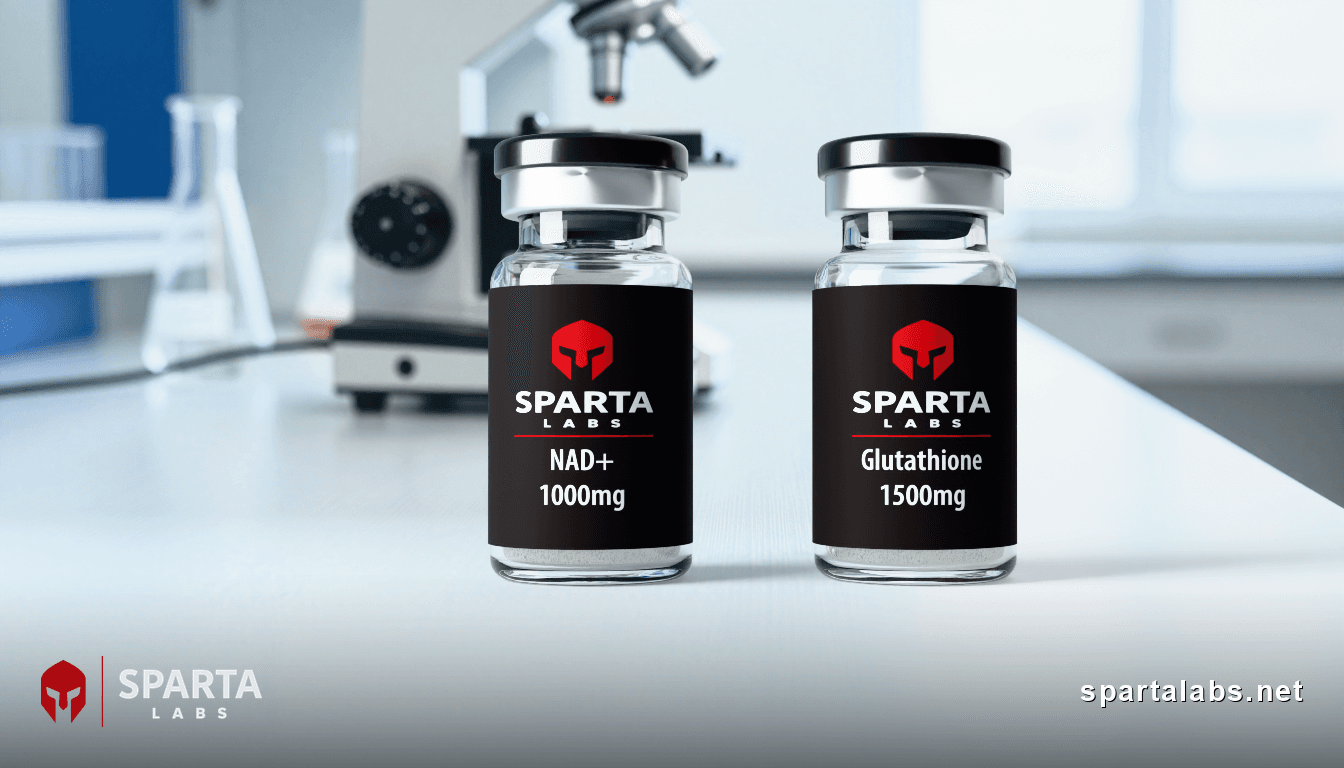
The search phrase "NAD+ vs glutathione" implies two members of the same category, and the implication is wrong in an instructive way. Neither is a peptide in the sense used across most of this library. Glutathione is a tripeptide: three amino acids joined by two amide bonds, one of them unusual. NAD+ (nicotinamide adenine dinucleotide) is not a peptide at all. It is a dinucleotide coenzyme built from two nucleotides joined through a pyrophosphate bridge, and it contains no amino acids. The two molecules are frequently discussed together because both participate in cellular redox chemistry, but they do so through different mechanisms, are made by different biosynthetic routes, and belong to different chemical classes. This article compares them on chemistry, biosynthesis, discovery history, classification, and regulatory status, reporting what has been published without drawing conclusions about the suitability of either for any purpose. Research-grade NAD+ and glutathione reference materials are cataloged with per-batch certificates of analysis.
Glutathione: A Gamma-Linked Tripeptide
Glutathione (GSH) is gamma-L-glutamyl-L-cysteinyl-glycine, with the molecular formula C10H17N3O6S and a mass of approximately 307.3 daltons. By the definition set out in the what are peptides article, it qualifies as a peptide: amino acids joined by amide bonds. What makes it atypical is the first of those bonds. Instead of linking the alpha-carboxyl of glutamate to the alpha-amine of cysteine, as a ribosome would, the bond runs from the side-chain gamma-carboxyl of glutamate. Meister and Anderson, reviewing the molecule in the Annual Review of Biochemistry in 1983, described this gamma linkage as the reason glutathione resists hydrolysis by most conventional peptidases, which recognize alpha-peptide bonds [1]. The second bond, cysteine to glycine, is an ordinary alpha-peptide bond.
The gamma linkage is possible because glutathione is not made by the ribosome. Meister and Anderson described a two-step, ATP-dependent cytosolic pathway: glutamate-cysteine ligase forms gamma-glutamylcysteine, and glutathione synthetase then adds glycine [1]. Forman, Zhang, and Rinna reviewed the same biosynthetic route and its regulation in Molecular Aspects of Medicine in 2009 [2]. The molecule's reactive center is the free thiol on the cysteine residue. Two glutathione molecules can be oxidized to the disulfide-linked dimer glutathione disulfide (GSSG), and glutathione reductase regenerates GSH from GSSG using NADPH as the electron donor [2]. Baty, Hampton, and Winterbourn reported in Redox Biology in 2014 that intracellular glutathione is distributed among compartmental pools that are not in equilibrium with one another [3].
Findings from research models do not establish safety or efficacy in humans. Sparta Labs makes no claims about the use of this compound.
The discovery record begins with Frederick Gowland Hopkins, who reported in the Biochemical Journal in 1921 the isolation of an autoxidisable, thiol-containing substance from yeast, liver, and muscle and named it glutathione [4]. Hopkins initially described the substance as a dipeptide of glutamate and cysteine; the glycine residue and the tripeptide structure were established over the following decade, a sequence of events Meister recounted in Trends in Biochemical Sciences in 1988 [5]. The glutathione research overview and the glutathione mechanism of action article cover the biochemistry in more depth.
Glutathione is an endogenous biomolecule and holds no FDA approval as a drug for any indication. Human studies exist: Richie and colleagues, for example, reported a randomized controlled trial of oral glutathione in the European Journal of Nutrition in 2015 that measured body stores of the compound [6]. Such studies describe the scientific record and do not confer regulatory status. Research-grade glutathione is supplied as a laboratory reference material for research use only.
NAD+: A Dinucleotide Coenzyme
NAD+ (CAS 53-84-9) has the molecular formula C21H27N7O14P2 and a mass of approximately 663.4 daltons. Structurally it is two nucleotides, adenosine monophosphate (AMP) and nicotinamide mononucleotide (NMN), joined through a pyrophosphate bridge between their 5'-phosphate groups. There are no amino acids and no amide bonds between amino acids anywhere in the molecule. The "+" in the name refers to the positive charge on the pyridinium nitrogen of the nicotinamide ring, which is the chemically reactive site: it accepts a hydride ion to form the reduced form, NADH.
Cantó, Menzies, and Auwerx, reviewing the field in Cell Metabolism in 2015, distinguished two biochemically separate roles [7]. In oxidoreductase reactions NAD+ serves as a hydride carrier and is regenerated by reoxidation, so it is not net-consumed. In a second role it is a substrate that is consumed: enzymes such as the sirtuins and the poly(ADP-ribose) polymerases cleave the glycosidic bond between nicotinamide and ribose, releasing nicotinamide and depleting the cellular pool [7]. Imai, Armstrong, Kaeberlein, and Guarente reported in Nature in 2000 that the yeast protein Sir2 is an NAD+-dependent histone deacetylase, the finding that opened the modern era of NAD+ signaling research [8].
NAD+ biosynthesis is a multi-route affair with none of glutathione's simplicity. Preiss and Handler characterized in 1958 the route from nicotinic acid through nicotinic acid mononucleotide and nicotinic acid adenine dinucleotide, now called the Preiss-Handler pathway [9]. Bieganowski and Brenner reported in Cell in 2004 that nicotinamide riboside is a nutrient and that conserved nicotinamide riboside kinase genes establish a Preiss-Handler-independent route to NAD+ in fungi and humans [10]. Cantó and colleagues summarized the full set: de novo synthesis from tryptophan, the Preiss-Handler route from nicotinic acid, and salvage of nicotinamide through NMN [7].
The discovery record is older than glutathione's. Arthur Harden and William John Young reported in the Proceedings of the Royal Society in 1906 that yeast juice contained a heat-stable, dialysable cofactor, which they called cozymase, that was required for fermentation [11, 12]. Structural identification of that cofactor as a dinucleotide followed in the 1930s, a history traced in the NAD+ history article; the NAD+ research overview covers classification and chemistry.
NAD+ holds no FDA approval as a drug for any indication. Its precursor nicotinamide riboside is marketed in the United States as a dietary supplement ingredient, and Trammell and colleagues documented in Nature Communications in 2016 that oral nicotinamide riboside produced measurable changes in the blood NAD+ metabolome of human volunteers [13]. Those observations concern a precursor compound under a different regulatory framework; they do not alter the status of NAD+ itself. Research-grade NAD+ is supplied as a laboratory reference material for research use only.
Structural Comparison
- Chemical class. Glutathione: tripeptide (a gamma-glutamyl thiol). NAD+: pyridine dinucleotide (a coenzyme). Only one of the two is a peptide.
- Building blocks. Glutathione is assembled from three amino acids. NAD+ is assembled from adenine, nicotinamide, two ribose units, and two phosphates.
- Bond types. Glutathione: one gamma-amide bond and one alpha-amide bond [1]. NAD+: two N-glycosidic bonds, two phosphoester bonds, and a phosphoanhydride (pyrophosphate) bridge.
- Mass. Approximately 307 daltons for glutathione against approximately 663 daltons for NAD+.
- Redox chemistry. Glutathione's chemistry runs through a thiol that forms a disulfide (GSH to GSSG) [2]. NAD+'s chemistry runs through a pyridinium ring that accepts a hydride (NAD+ to NADH) [7]. The molecules are not interchangeable in any reaction.
- Biosynthesis. Glutathione: two dedicated cytosolic enzymes acting on free amino acids [1]. NAD+: at least three convergent routes from tryptophan, nicotinic acid, nicotinamide, or nicotinamide riboside [7, 9, 10].
- Point of contact. Glutathione reductase uses NADPH, the 2'-phosphorylated relative of NAD+, to regenerate GSH from GSSG [2]. The two molecules therefore sit in one redox network without sharing a mechanism.
- Regulatory status. Neither is an FDA-approved drug. Both are endogenous molecules that are also sold outside the research-chemical channel.
Pharmacological Class Context
Neither molecule fits the receptor-ligand categories that organize most of this library. Glutathione is classified in the biochemical literature as a low-molecular-mass thiol and the principal substrate of the glutathione peroxidase, glutathione S-transferase, and glutaredoxin enzyme systems [2]. NAD+ is classified as a coenzyme and, in its second role, as a substrate for signaling enzymes [7]. Neither is a hormone, growth factor, or receptor agonist, and neither was designed; both are products of ordinary cellular metabolism that happen to be available as isolated chemicals.
The research records are among the deepest in biochemistry, each spanning more than a century, and each includes controlled human studies of exogenous administration or precursor supplementation [6, 13]. Those studies were designed to answer questions about each molecule on its own terms, and no published work has compared the two head to head. This article accordingly makes no comparative statement about activity or efficacy.
Both compounds are also widely marketed outside the research-chemical channel, as dietary supplement ingredients and in compounded pharmacy preparations. Those channels operate under rules that differ from those governing drugs and are outside the scope of this article. Research-grade NAD+ and glutathione sold by chemical suppliers are laboratory reference materials, not pharmaceutical or dietary products, and are strictly for research use only.
References
- Meister A, Anderson ME. Glutathione. Annu Rev Biochem. 1983;52:711-760. PMID: 6137189. DOI: 10.1146/annurev.bi.52.070183.003431
- Forman HJ, Zhang H, Rinna A. Glutathione: overview of its protective roles, measurement, and biosynthesis. Mol Aspects Med. 2009;30(1-2):1-12. PMID: 18796312. DOI: 10.1016/j.mam.2008.08.006
- Baty JW, Hampton MB, Winterbourn CC. Intracellular glutathione pools are heterogeneously concentrated. Redox Biol. 2014;1(1):508-513. PMID: 24251119. DOI: 10.1016/j.redox.2013.10.005
- Hopkins FG. On an autoxidisable constituent of the cell. Biochem J. 1921;15(2):286-305. PMID: 16742989. PMCID: PMC1258982. DOI: 10.1042/bj0150286
- Meister A. On the discovery of glutathione. Trends Biochem Sci. 1988;13(5):185-188. PMID: 3076280. DOI: 10.1016/0968-0004(88)90148-X
- Richie JP Jr, Nichenametla S, Neidig W, Calcagnotto A, Haley JS, Schell TD, et al. Randomized controlled trial of oral glutathione supplementation on body stores of glutathione. Eur J Nutr. 2015;54(2):251-263. PMID: 24791752. DOI: 10.1007/s00394-014-0706-z
- Cantó C, Menzies KJ, Auwerx J. NAD+ metabolism and the control of energy homeostasis: a balancing act between mitochondria and the nucleus. Cell Metab. 2015;22(1):31-53. PMCID: PMC4487780. PMC4487780
- Imai S, Armstrong CM, Kaeberlein M, Guarente L. Transcriptional silencing and longevity protein Sir2 is an NAD-dependent histone deacetylase. Nature. 2000;403(6771):795-800. PMID: 10693811. DOI: 10.1038/35001622
- Preiss J, Handler P. Biosynthesis of diphosphopyridine nucleotide. I. Identification of intermediates. J Biol Chem. 1958;233(2):488-492. PMID: 13563526. PubMed
- Bieganowski P, Brenner C. Discoveries of nicotinamide riboside as a nutrient and conserved NRK genes establish a Preiss-Handler independent route to NAD+ in fungi and humans. Cell. 2004;117(4):495-502. PMID: 15137942. DOI: 10.1016/S0092-8674(04)00416-7
- Harden A, Young WJ. The alcoholic ferment of yeast-juice. Proc R Soc Lond B. 1906;77(519):405-420. DOI: 10.1098/rspb.1906.0029
- Harden A, Young WJ. The alcoholic ferment of yeast-juice. Part II. The coferment of yeast-juice. Proc R Soc Lond B. 1906;78(526):369-375. DOI: 10.1098/rspb.1906.0070
- Trammell SA, Schmidt MS, Weidemann BJ, Redpath P, Jaksch F, Dellinger RW, et al. Nicotinamide riboside is uniquely and orally bioavailable in mice and humans. Nat Commun. 2016;7:12948. DOI: 10.1038/ncomms12948
Frequently asked questions
What is the difference between NAD+ and glutathione?
Glutathione is a tripeptide, three amino acids (glutamate, cysteine, glycine) joined by two amide bonds, one of which is an unusual gamma linkage. NAD+ is not a peptide at all but a dinucleotide coenzyme built from adenosine monophosphate and nicotinamide mononucleotide joined by a pyrophosphate bridge. They belong to different chemical classes, are made by different biosynthetic routes, and participate in redox chemistry through different mechanisms.
Is NAD+ a peptide?
No. NAD+ (nicotinamide adenine dinucleotide) contains no amino acids and no peptide bonds. It is a pyridine dinucleotide with the formula C21H27N7O14P2 and a mass of about 663 daltons, and it is classified as a coenzyme.
Is glutathione a peptide?
Yes, strictly speaking. Glutathione is gamma-L-glutamyl-L-cysteinyl-glycine, a tripeptide of about 307 daltons. It is unusual because its first amide bond runs through the side-chain gamma-carboxyl of glutamate rather than the alpha-carboxyl, and because it is assembled by two dedicated enzymes rather than by the ribosome.
Who discovered NAD+ and glutathione?
Arthur Harden and William John Young reported in 1906 that a heat-stable, dialysable cofactor they called cozymase was required for yeast-juice fermentation, the observation that led to NAD+. Frederick Gowland Hopkins reported the isolation of glutathione from yeast and animal tissues in the Biochemical Journal in 1921 and gave the compound its name.
Is NAD+ or glutathione FDA approved?
Neither holds FDA approval as a drug for any indication. Both are endogenous molecules that are also marketed outside the research-chemical channel, as dietary supplement ingredients and in compounded pharmacy preparations, under rules that differ from those governing drugs. Research-grade NAD+ and glutathione are supplied strictly for laboratory research use.
How are NAD+ and glutathione connected biochemically?
Glutathione reductase, the enzyme that regenerates reduced glutathione from its disulfide, uses NADPH as its electron donor. NADPH is the phosphorylated relative of NAD+, so the two molecules sit in one redox network without being interchangeable or performing the same chemistry.