
Glutathione: A Research Overview
An educational overview of glutathione (GSH): the atypical gamma-glutamyl bond, cysteine thiol reactivity, the GSH/GSSG couple, two-step ATP-dependent biosynthesis, and how the tripeptide was characterized. Educational reference.
For research use only. Not for human consumption. This article is educational reference material. It is not medical advice and is not a recommendation to use any substance.
Introduction
Glutathione (GSH; gamma-L-glutamyl-L-cysteinyl-glycine) is a small tripeptide found in the cytosol of virtually all mammalian cells, as well as in plants, fungi, and most bacteria. It is unusual among biological peptides on two counts: it is assembled enzymatically rather than on the ribosome, and it is joined by a non-standard peptide bond. This overview approaches glutathione from its molecular architecture outward, examining the two structural features that define its chemistry, the redox couple it forms, the enzymatic route by which cells build it, and the historical work that established its identity.
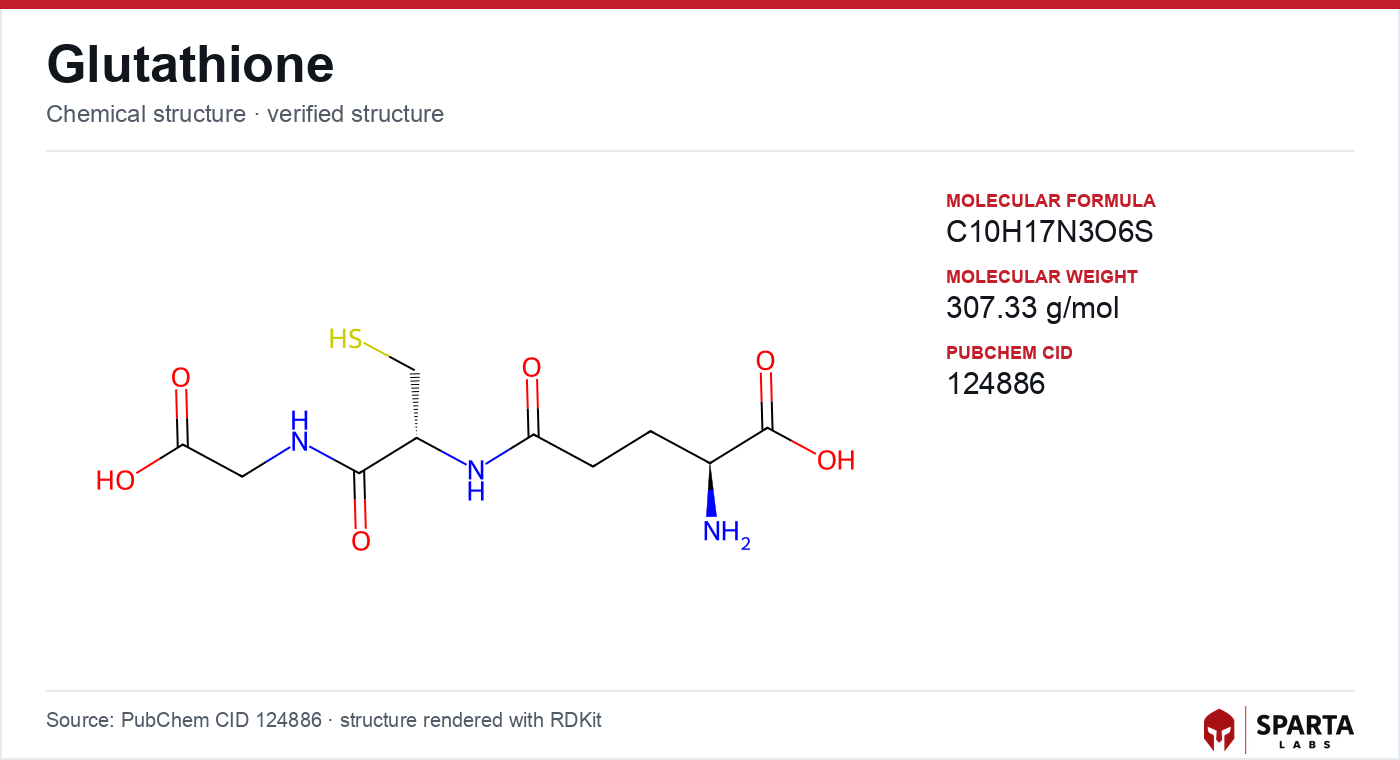
Figure: chemical structure of Glutathione.
The two structural features that define glutathione
Glutathione has the molecular formula C10H17N3O6S and a monoisotopic mass of approximately 307.3 daltons. Its three residues, glutamate, cysteine, and glycine, are conventional amino acids, yet two features of how they are assembled account for nearly all of the molecule's distinctive behavior.
The gamma-glutamyl bond
In an ordinary peptide the bond forms between the alpha-carboxyl group of one amino acid and the alpha-amino group of the next. Glutathione departs from this pattern at its first linkage: the bond connects the side-chain gamma-carboxyl of glutamate to the amino group of cysteine. This gamma-glutamyl arrangement is the reason glutathione cannot be produced by ribosomal translation, which forms only alpha-peptide bonds, and instead requires dedicated ligase enzymes [1].
The gamma bond also has a functional consequence. General intracellular peptidases recognize alpha-peptide bonds and do not readily hydrolyze the gamma linkage, so glutathione is comparatively stable inside the cell. Its turnover is controlled instead by a specific enzyme, gamma-glutamyl transpeptidase, positioned on the external surface of certain cell types, which initiates degradation as part of the gamma-glutamyl cycle first articulated by Alton Meister and colleagues [1][2].
The cysteine thiol
The second defining feature is the free sulfhydryl (-SH) group carried by the central cysteine residue. This thiol is the chemically reactive center of the molecule. It participates in reversible oxidation, conjugation to electrophiles, and thiol-disulfide exchange with protein cysteines, the reactions that place glutathione at the heart of cellular redox chemistry. The glycine residue at the C-terminus contributes to solubility and to recognition by glutathione-utilizing enzymes [3].
The GSH/GSSG redox couple
Because the cysteine thiol can be oxidized, glutathione exists in a reduced form (GSH) and an oxidized form (GSSG). In the oxidized form, the thiols of two glutathione molecules are joined by a disulfide bond to yield glutathione disulfide.
Under most cellular conditions the reduced form predominates heavily, and the enzyme glutathione reductase continuously regenerates GSH from GSSG using NADPH supplied largely by the pentose phosphate pathway [3]. The ratio between the two forms is one of the most cited indices of intracellular redox state in the experimental literature, and the couple functions as a major cytosolic redox buffer [2].
Findings from research models do not establish safety or efficacy in humans. Sparta Labs makes no claims about the use of this compound.
Reported research has further characterized glutathione pools as compartmentalized rather than uniform: distinct pools in the cytosol, mitochondria, nucleus, and endoplasmic reticulum have been described as maintaining different redox environments [3]. This compartmentalization parallels the metabolic-cofactor research landscape discussed in the NAD+ research overview, another endogenous redox-active molecule whose subcellular pools are studied separately.
Enzymatic biosynthesis
Glutathione is synthesized de novo in the cytosol through two consecutive ATP-dependent reactions, a route that distinguishes it from gene-encoded peptides [4].
The first and rate-limiting step is catalyzed by glutamate cysteine ligase (GCL, historically gamma-glutamylcysteine synthetase), which joins glutamate and cysteine to form the dipeptide gamma-glutamylcysteine. This step is subject to feedback inhibition by the end product GSH, a regulatory feature characterized in detail by Meister, Griffith, and later investigators [4][5]. Cysteine availability is generally the limiting substrate.
The second step is carried out by glutathione synthetase, which adds glycine to gamma-glutamylcysteine to complete the tripeptide [4]. The pathway's dependence on these two enzymes, and on cysteine supply, has made both the subject of extensive biochemical study. The molecular details of how the finished tripeptide then participates in enzymatic reactions are treated separately in the glutathione mechanism of action article, and questions of synthesis and material characterization are covered in the glutathione sourcing and quality article.
Biochemical classification
Glutathione is not a synthetic pharmaceutical but a naturally occurring, endogenously produced biomolecule. Within biochemistry it is classified as a low-molecular-mass thiol and as the principal small-molecule substrate of the glutathione-dependent enzyme systems.
The published literature situates glutathione as a co-substrate and reducing agent across several enzyme families, including the glutathione peroxidases, which reduce hydrogen peroxide and lipid hydroperoxides, and the glutathione S-transferases, which catalyze conjugation of GSH to electrophilic compounds during phase-II metabolism [1][2]. Reviews have also described broad dysregulation of glutathione homeostasis as a recurring observation across a range of experimental disease models, without establishing therapeutic conclusions [5].
Regulatory status
Glutathione is an endogenous biomolecule rather than a regulated pharmaceutical drug, and in the United States it does not carry an FDA approval for any therapeutic indication. Its regulatory treatment depends on intended-use context: as an active ingredient in a drug product, standard IND and NDA requirements would apply, whereas material characterized and offered for laboratory research is handled in a research-use-only context. The historical and regulatory arc is described further in the glutathione discovery and research history article.
Historical characterization
The identification of glutathione took shape in the early decades of the 20th century. Frederick Gowland Hopkins, working at Cambridge, reported the isolation of a thiol-bearing reducing substance from yeast and animal tissue in the early 1920s and gave it the name glutathione. Hopkins was awarded the Nobel Prize in Physiology or Medicine in 1929 for his broader contributions to biochemistry [2].
The full tripeptide structure, including confirmation of the glycine residue and the gamma-glutamyl linkage, was clarified through chemical synthesis and characterization during the 1920s and 1930s. The mid-20th century then brought systematic study of the enzymes that use glutathione, and Alton Meister's proposal of the gamma-glutamyl cycle in the 1970s provided a durable framework for the molecule's transport and turnover [1][2]. That framework continues to organize contemporary redox research.
References
-
Meister A, Anderson ME. Glutathione. Annu Rev Biochem. 1983;52:711-760. PMID: 6137189. DOI: 10.1146/annurev.bi.52.070183.003431. PubMed
-
Meister A. On the discovery of glutathione. Trends Biochem Sci. 1988;13(5):185-188. PMID: 3076280. DOI: 10.1016/0968-0004(88)90148-X. PubMed
-
Forman HJ, Zhang H, Rinna A. Glutathione: overview of its protective roles, measurement, and biosynthesis. Mol Aspects Med. 2009;30(1-2):1-12. PMID: 18796312. DOI: 10.1016/j.mam.2008.08.006. PubMed
-
Lu SC. Glutathione synthesis. Biochim Biophys Acta. 2013;1830(5):3143-3153. PMID: 22995213. DOI: 10.1016/j.bbagen.2012.09.008. PubMed
-
Ballatori N, Krance SM, Notenboom S, Shi S, Tieu K, Hammond CL. Glutathione dysregulation and the etiology and progression of human diseases. Biol Chem. 2009;390(3):191-214. PMID: 19166318. DOI: 10.1515/BC.2009.033. PubMed
Disclaimer. Statements in this article have not been evaluated by the Food and Drug Administration. This compound is not intended to diagnose, treat, cure, or prevent any disease. Sparta Labs sells research-use-only materials. Content is provided for educational and informational purposes only and does not constitute medical advice. Consult a qualified medical professional for any health concerns.
Frequently asked questions
What is glutathione?
Glutathione is a tripeptide made of three amino acids: glutamate, cysteine, and glycine. It occurs naturally inside the cells of most living organisms, where the biochemical literature describes it as one of the most abundant intracellular thiol compounds. Researchers study it as a model antioxidant molecule.
Is glutathione a peptide?
Yes. Glutathione is classified as a tripeptide, meaning it is built from three amino acid residues, glutamate, cysteine, and glycine. It is distinguished by an unusual gamma peptide bond linking glutamate to cysteine, which biochemistry texts note differs from the standard alpha peptide bonds found in most proteins.
What is L-glutathione?
L-glutathione refers to the naturally occurring, biologically relevant stereoisomer of glutathione, named for the L-configuration of its cysteine residue. It is the form described in the biochemistry literature as present in living cells, distinguishing it from synthetic D-isomer variants that do not occur naturally.
What is liposomal glutathione?
Liposomal glutathione is a formulation in which glutathione molecules are encapsulated within liposomes, microscopic spheres made of phospholipid layers. Published pharmaceutical-formulation research describes liposomal encapsulation as a delivery approach studied across many compounds; it does not change glutathione's underlying tripeptide chemistry.
What does research describe glutathione doing in the body?
Published biochemistry research describes glutathione as a participant in cellular redox reactions, cycling between reduced (GSH) and oxidized (GSSG) forms. The literature characterizes it as an intracellular antioxidant thiol involved in electron transfer. These are descriptions of reported biochemical roles, not statements of any health effect in humans.
What foods contain glutathione?
According to food-composition research, glutathione occurs naturally in a range of foods, with fresh fruits, vegetables, and uncooked meats reported among the higher sources. Analytical studies note that concentrations vary and that cooking and processing can reduce measured glutathione content in foods.