
Glutathione Mechanism of Action
A mechanism-focused account of glutathione (GSH): how its central cysteine thiol drives the GSH/GSSG couple, powers glutathione peroxidase and transferase catalysis, and forms reversible protein mixed disulfides in redox signaling. Educational reference.
For research use only. Not for human consumption. This article is educational reference material. It is not medical advice and is not a recommendation to use any substance.
Introduction
Glutathione (GSH) is the tripeptide gamma-L-glutamyl-L-cysteinyl-glycine, the most abundant low-molecular-weight thiol in most mammalian cells. Its mechanistic chemistry is unusual among peptides because nearly every reaction it participates in can be traced to a single functional group: the sulfhydryl (-SH) on its central cysteine residue. This article summarizes the reported molecular mechanisms of glutathione, organized around that reactive thiol rather than around a receptor, since GSH acts primarily as a diffusible chemical reagent and enzyme co-substrate rather than as a ligand. Research-grade glutathione from Sparta Labs is verified by independent third-party analytical testing. Readers seeking a broader introduction to its classification and history may consult the glutathione research overview.
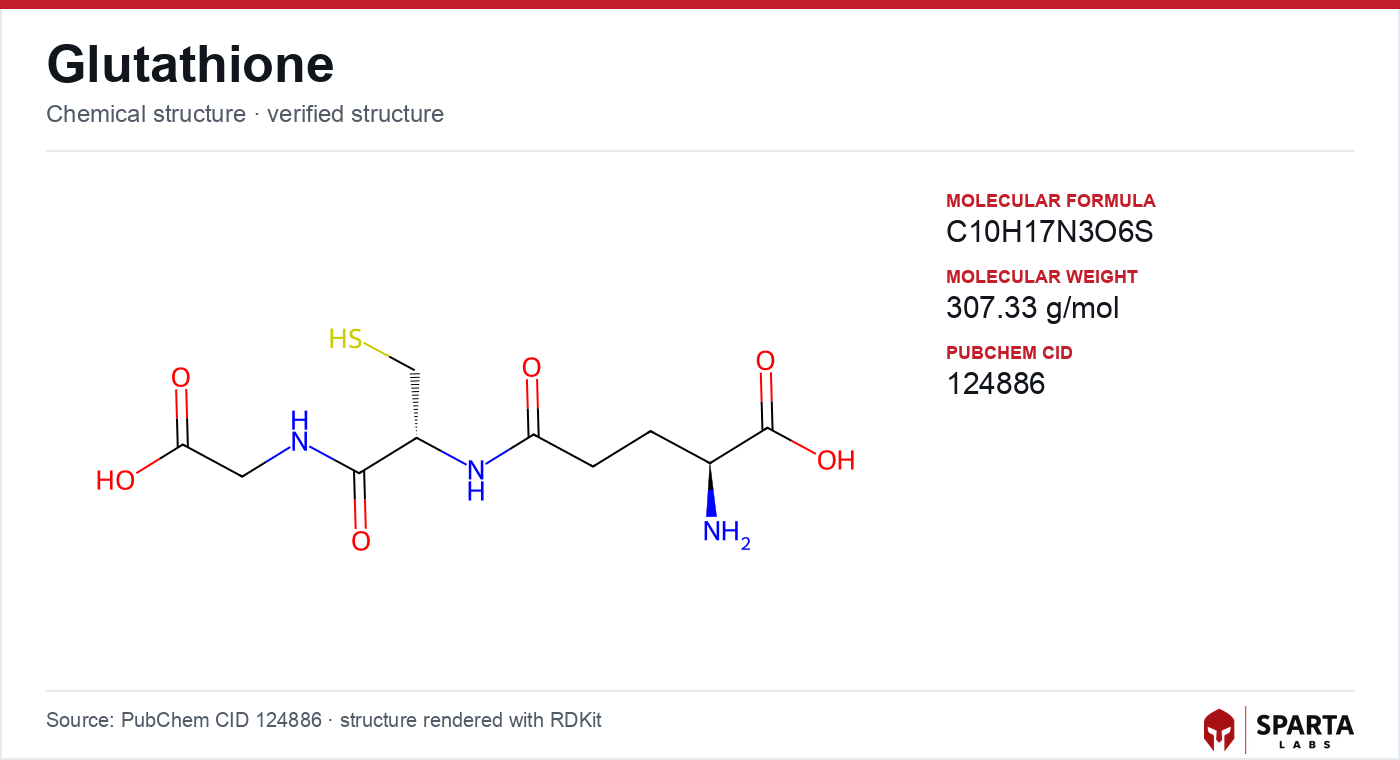
Figure: chemical structure of glutathione.
The Reactive Thiol and the Gamma-Glutamyl Bond
Two structural features distinguish glutathione from an ordinary tripeptide, and both are mechanistically consequential. First, the peptide bond linking glutamate to cysteine forms through the glutamate side-chain (gamma) carboxyl rather than its alpha-carboxyl. Meister and Anderson, in a foundational review of glutathione metabolism, described this gamma-glutamyl linkage as conferring resistance to the intracellular peptidases that would otherwise degrade the molecule, allowing millimolar cytosolic concentrations to accumulate [1].
Second, the cysteine sulfhydryl is the chemically active center. The sulfur atom can donate electrons, coordinate metals, undergo reversible oxidation to a disulfide, and form mixed disulfides with protein cysteines. Lu, reviewing the regulation of glutathione synthesis, described the rate-limiting biosynthetic step as the ATP-dependent ligation of glutamate and cysteine by glutamate-cysteine ligase, followed by addition of glycine by glutathione synthetase, and noted that cysteine availability typically governs the pace of the pathway [2]. The glycine and glutamate residues are not merely structural filler; they provide the recognition handles by which glutathione-dependent enzymes distinguish GSH from other cellular thiols.
Findings from research models do not establish safety or efficacy in humans. Sparta Labs makes no claims about the use of this compound.
GSH and GSSG: the Central Redox Couple
Under oxidizing conditions the cysteine thiols of two glutathione molecules join through a disulfide bond, producing glutathione disulfide (GSSG). The reverse reaction is catalyzed by glutathione reductase, an NADPH-dependent flavoenzyme. Deponte, in a detailed review of glutathione-dependent enzyme mechanisms, described glutathione reductase as operating through the FAD and a redox-active cysteine pair, transferring electrons from NADPH to the GSSG disulfide to regenerate two GSH molecules [3].
Because the cell holds glutathione predominantly in its reduced form, the ratio of GSH to GSSG is widely treated in the literature as a quantitative index of the intracellular redox environment. The NADPH that sustains this ratio is supplied in large part by the pentose phosphate pathway, linking glutathione redox status to central carbon metabolism. This coupling is one reason glutathione is discussed alongside other cofactor-dependent redox systems such as NAD+ and its mechanism of action, which draws on an overlapping pool of pyridine-nucleotide chemistry.
Enzymatic Peroxide Reduction: the Glutathione Peroxidases
The glutathione peroxidase (GPx) family provides the principal enzymatic route by which GSH reduces hydrogen peroxide and organic hydroperoxides. Several human isoforms carry a rare selenocysteine residue in the active site. Deponte summarized the catalytic cycle of these selenoenzymes as proceeding through three steps: the reduced selenol attacks the peroxide substrate to form a selenenic acid intermediate, a first GSH molecule reduces that intermediate to a selenylsulfide, and a second GSH molecule regenerates the selenol while releasing GSSG [3].
One isoform, GPx4, is mechanistically distinct because it reduces hydroperoxides of complex lipids while they remain esterified within membranes. Ursini and colleagues originally isolated and characterized this activity as a "phospholipid hydroperoxide glutathione peroxidase," establishing that the enzyme could act on peroxidized membrane lipids that other GPx isoforms cannot reach [4]. Subsequent work placed GPx4 at the center of ferroptosis, a form of regulated cell death driven by unchecked lipid peroxidation; Yang and Stockwell reported that loss of GPx4 activity permitted the accumulation of lipid hydroperoxides that triggered this death pathway [5]. This positioned glutathione, as the electron donor for GPx4, within one of the more actively investigated areas of contemporary cell biology.
Conjugation Chemistry: the Glutathione S-Transferases
Beyond peroxide reduction, glutathione serves as the nucleophile in a large family of conjugation reactions catalyzed by the glutathione S-transferases (GSTs). Mannervik and Danielson described the cytosolic GST superfamily as sharing a conserved glutathione-binding site (the G-site) paired with a variable hydrophobic substrate site (the H-site), the latter conferring each class its distinct selectivity [6]. Within the active site the enzyme lowers the pKa of the bound GSH thiol, generating a reactive thiolate anion.
That activated thiolate attacks electrophilic centers on a wide range of substrates, forming a thioether bond and yielding a more water-soluble glutathione conjugate. This reaction is a canonical phase II detoxification step, and the conjugates it produces are routed toward mercapturic acid formation and excretion. The GPx and GST systems therefore divide labor over reactive species: peroxidases act preferentially on peroxides, while transferases act on electrophilic carbon centers such as the reactive aldehyde products of lipid peroxidation.
S-Glutathionylation as Reversible Protein Regulation
Glutathione also modifies proteins directly by forming mixed disulfides with specific protein cysteine residues, a modification termed S-glutathionylation. Dalle-Donne and colleagues reviewed this process as both a protective mechanism, shielding susceptible cysteines from irreversible over-oxidation, and a dynamic regulatory switch capable of altering protein activity [7]. The modification can form through thiol-disulfide exchange with GSSG, through reaction of protein thiyl radicals with GSH, or through enzyme-assisted routes.
The reversal of S-glutathionylation is catalyzed chiefly by glutaredoxins, small thiol-disulfide oxidoreductases that use GSH as their reducing substrate to remove the attached glutathione and restore the free protein thiol. Because this cycle is reversible and responsive to the ambient GSH/GSSG ratio, it is described in the literature as a mechanism by which cells couple protein function to their redox state. Comparable redox-coupled protective mechanisms at the inner mitochondrial membrane are discussed in the article on SS-31 mechanism of action.
Limits of Current Understanding
Several mechanistic questions remain open. The relative contribution of enzymatic versus non-enzymatic glutathione oxidation to total cellular thiol turnover has not been firmly quantified across most cell types, and newer redox-proteomic tools are only beginning to address it. The subcellular compartmentalization of glutathione, and how distinct organelle pools are maintained and sensed, is likewise an active area of investigation now aided by genetically encoded fluorescent glutathione sensors. Readers interested in how these mechanisms have been probed experimentally may consult the glutathione published research summary.
References
-
Meister A, Anderson ME. Glutathione. Annu Rev Biochem. 1983;52:711-760. PMID: 6137189. DOI: 10.1146/annurev.bi.52.070183.003431
-
Lu SC. Regulation of glutathione synthesis. Mol Aspects Med. 2009;30(1-2):42-59. PMID: 18601945. DOI: 10.1016/j.mam.2008.05.005
-
Deponte M. Glutathione catalysis and the reaction mechanisms of glutathione-dependent enzymes. Biochim Biophys Acta. 2013;1830(5):3217-3266. PMID: 23036594. DOI: 10.1016/j.bbagen.2012.09.018
-
Ursini F, Maiorino M, Gregolin C. The selenoenzyme phospholipid hydroperoxide glutathione peroxidase. Biochim Biophys Acta. 1985;839(1):62-70. PMID: 3978121. DOI: 10.1016/0304-4165(85)90182-5
-
Yang WS, Stockwell BR. Ferroptosis: death by lipid peroxidation. Trends Cell Biol. 2016;26(3):165-176. PMID: 26653790. DOI: 10.1016/j.tcb.2015.10.014
-
Mannervik B, Danielson UH. Glutathione transferases: structure and catalytic activity. CRC Crit Rev Biochem. 1988;23(3):283-337. PMID: 3069329. DOI: 10.3109/10409238809088226
-
Dalle-Donne I, Rossi R, Colombo G, Giustarini D, Milzani A. Protein S-glutathionylation: a regulatory device from bacteria to humans. Trends Biochem Sci. 2009;34(2):85-96. PMID: 19135374. DOI: 10.1016/j.tibs.2008.11.002
Disclaimer
Disclaimer. Statements in this article have not been evaluated by the Food and Drug Administration. This compound is not intended to diagnose, treat, cure, or prevent any disease. Sparta Labs sells research-use-only materials. Content is provided for educational and informational purposes only and does not constitute medical advice. Consult a qualified medical professional for any health concerns.
Frequently asked questions
Why is the cysteine thiol the key to glutathione's chemistry?
In the tripeptide gamma-L-glutamyl-L-cysteinyl-glycine, the reactive group is the sulfhydryl (-SH) on the central cysteine residue. Published biochemistry describes this thiol as the site of electron donation, metal coordination, and mixed-disulfide formation, while the unusual gamma-glutamyl peptide bond confers resistance to standard peptidases. The glycine and glutamate residues position and stabilize this reactive sulfur within enzyme active sites.
What is the GSH/GSSG redox couple?
When glutathione is oxidized, two GSH molecules join through a disulfide bond to form glutathione disulfide (GSSG). Reviews describe glutathione reductase, an NADPH-dependent flavoenzyme, as catalyzing the reduction of GSSG back to GSH, so the cellular ratio of the two forms is a widely used index of redox state in the research literature.
How do glutathione peroxidases use GSH?
Selenocysteine-containing glutathione peroxidases were characterized as reducing hydrogen peroxide and hydroperoxides through a catalytic cycle in which the active-site selenol is oxidized to a selenenic acid, then returned to the reduced state by two successive GSH molecules, releasing GSSG. GPx4 was reported to act on lipid hydroperoxides within membranes and is studied in the ferroptosis literature.
What is S-glutathionylation?
S-glutathionylation is the reversible formation of a mixed disulfide between a protein cysteine and glutathione. Reviews describe it as a post-translational modification that can shield cysteines from irreversible oxidation and modulate protein function, with glutaredoxin enzymes catalyzing its reversal using GSH as the electron donor.