
NAD+: Sourcing, Purity, and Verification Standards
Nicotinamide adenine dinucleotide is a labile dinucleotide, and that chemistry shapes how it is synthesized, purified, and verified for research. A look at the analytical standards behind each batch. Educational reference.
For research use only. Not for human consumption. This article is educational reference material. It is not medical advice and is not a recommendation to use any substance.
Why NAD+ Sourcing Is a Chemistry Problem First
Nicotinamide adenine dinucleotide (NAD+) is not a peptide, and the sourcing questions it raises differ from those that apply to the amino-acid chains that dominate the research-compound catalog. NAD+ is a dinucleotide of modest size (molecular formula C21H27N7O14P2, molecular weight 663.4 g/mol) built from two nucleotide halves: an adenosine monophosphate unit and a nicotinamide mononucleotide unit, joined through a pyrophosphate bridge. Berger, Ramírez-Hernández, and Ziegler, in a review of NAD(P) signaling functions, described this architecture and the coenzyme's central place in redox and non-redox biochemistry [1].
That structure is the reason sourcing NAD+ well is largely an analytical-chemistry exercise. The pyrophosphate linkage and the N-glycosidic bond that attaches nicotinamide are both hydrolytically labile, so the identity and purity that a certificate records for a given lot are properties of a molecule that can change during synthesis workup, drying, storage, and reconstitution. This article describes how research-grade NAD+ is made, why its chemistry complicates verification, and the batch-level records Sparta Labs uses to document identity and purity. For the biochemical classification and research context of the molecule, the NAD+ research overview provides the upstream framing.
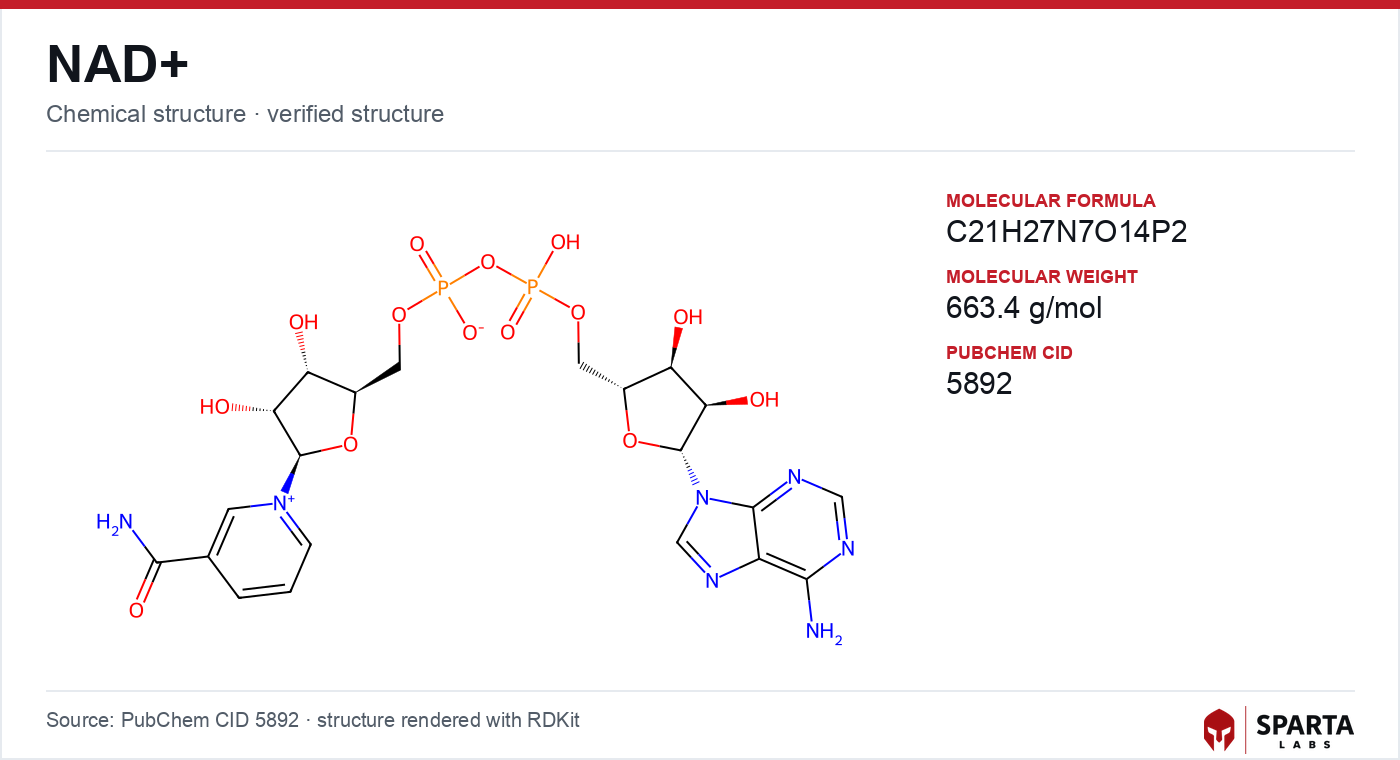
Figure: chemical structure of NAD+.
Synthesis Routes: Chemical Coupling and Enzymatic Condensation
Two general strategies produce NAD+ at research scale. Chemical synthesis assembles the dinucleotide by activating and coupling the two mononucleotide halves, forming the pyrophosphate bridge through established phosphorylation and condensation chemistry. Enzymatic synthesis uses nicotinamide mononucleotide adenylyltransferase (NMNAT), the same enzyme family that performs the final step of NAD+ biosynthesis in cells, to catalyze the condensation of nicotinamide mononucleotide with ATP in a cell-free system. Belenky, Bogan, and Brenner, reviewing NAD+ metabolism, laid out the biosynthetic reactions that the enzymatic route recapitulates, including the adenylyltransferase step that closes the pyrophosphate bond [2].
The practical difference between the two routes is where the impurity burden comes from. Chemical coupling can leave unreacted mononucleotide precursors, activation reagents, and regiochemical or stereochemical byproducts. Enzymatic routes tend to offer cleaner stereochemistry because the enzyme enforces the natural configuration, but they introduce protein, buffer, and cofactor components that downstream purification must remove. Either way, the reaction mixture is not the product; a defined purification and characterization sequence stands between synthesis and a material a researcher can rely on. The same principle of a fixed route feeding fixed analytics governs the way Sparta Labs treats other endogenous small molecules, as described in the glutathione sourcing and quality article.
Purity by HPLC, Identity by Mass Spectrometry
Reversed-phase high-performance liquid chromatography (HPLC) is the standard method for purity assessment of research-grade NAD+. The sample is separated on a stationary phase so that the target molecule resolves from synthetic byproducts, precursor nucleotides, and degradation products; the target peak's area, expressed as a percentage of total peak area, is the reported purity figure. An HPLC purity of ≥98% is the commonly cited threshold for characterizing a small molecule as research-grade, and Sparta Labs applies that internal standard to NAD+ while reporting the actual measured value for each lot.
Purity chromatography alone cannot confirm what a peak is. NAD+ shares a nucleotide backbone and UV chromophore profile with several of its own precursors and breakdown fragments, so a co-eluting impurity of similar retention could inflate an apparent purity figure. Mass spectrometry (MS) supplies the orthogonal identity check: it confirms that the resolved peak carries the expected molecular mass near 663.4 g/mol rather than that of ADP-ribose, nicotinamide mononucleotide, or another related species. NAD+ also has a characteristic ultraviolet absorbance near 259 nm arising from its adenine and nicotinamide rings, and the loss or shift of that signal is a further identity cue documented across the pyridine-nucleotide literature [1].
Findings from research models do not establish safety or efficacy in humans. Sparta Labs makes no claims about the use of this compound.
Impurity and Residual-Solvent Control
Because NAD+ is synthesized in solution and purified with organic-aqueous mobile phases, residual solvents and process-related impurities form a category distinct from the target-purity number. The International Council for Harmonisation (ICH) publishes the reference frameworks that analytical laboratories use to classify and limit such residues: ICH Q3C addresses residual solvents and sorts common solvents by toxicity class with corresponding concentration limits [3], while ICH Q3A defines how organic impurities in a substance are reported, identified, and qualified against thresholds [4]. These are official regulatory-science documents rather than vendor conventions, which is why they are cited here in place of unverifiable industry-audit claims.
For research material intended for cell-culture or in-vitro biological work, endotoxin content is a separate concern because bacterial endotoxin can confound cellular assays independent of chemical purity. The bacterial endotoxin (limulus amebocyte lysate, LAL) test is the compendial method for this measurement and is described in the United States Pharmacopeia general chapter on bacterial endotoxins [5]. Whether an endotoxin figure appears on a given NAD+ certificate depends on the intended analytical application of the lot.
The Lability Problem: Storage and Solution Stability
The most compound-specific sourcing consideration for NAD+ is its instability, which distinguishes it from the more robust cyclic and disulfide-stabilized peptides in the catalog. Rajman, Chwalek, and Sinclair, in a review of NAD-precursor chemistry and biology, noted that NAD+ and its immediate precursors are chemically fragile and that this fragility shapes how the molecules are handled and studied [6]. The two labile bonds identified earlier, the pyrophosphate bridge and the nicotinamide N-glycosidic bond, are the sites where degradation begins.
Sparta Labs supplies NAD+ in lyophilized (freeze-dried) form, the appropriate format for a molecule susceptible to hydrolytic and oxidative decomposition, because removing water suppresses the hydrolysis pathways. In the dry, desiccated state and stored cold and protected from light, the material is far more stable than it is in aqueous solution. The general stability behavior of pyridine nucleotides, including their sensitivity to alkaline pH, elevated temperature, and repeated freeze-thaw cycling, is a well-established property of the chemical class documented in standard biochemistry references [7]. These are handling parameters for the material as a research reagent, not usage guidance.
Batch-Level Certificates and Independent Verification
Because NAD+ can change between lots and over time, purity measured on one batch does not automatically transfer to the next, and a certificate tied to the exact lot in hand carries more information than a generic product specification. Sparta Labs publishes a batch-specific certificate of analysis (COA) for every lot of NAD+ containing:
- Reversed-phase HPLC purity result, expressed as a percentage of total peak area
- Mass spectrometry confirmation of molecular mass against the theoretical 663.4 g/mol
- Batch number and manufacturing date
- Recommended storage conditions
- The name of the independent laboratory that performed the testing
Independent testing matters because when the facility that produced a compound is also the only party attesting to its quality, undisclosed process changes or confirmation bias can go unchecked. Testing by a laboratory with no stake in the manufacturing output provides a structurally separate verification of the identity and purity a lot claims. The COA is accessible from the product page, and retaining the batch record alongside experimental data supports the lot-level traceability that reproducible research depends on. NAD+ from Sparta Labs is supplied with independently generated, batch-specific certificate documentation, and researchers extending this reasoning to related endogenous-metabolite compounds may find the MOTS-c sourcing and quality article a useful point of comparison.
References
-
Berger F, Ramírez-Hernández MH, Ziegler M. The new life of a centenarian: signalling functions of NAD(P). Trends Biochem Sci. 2004;29(3):111–118. DOI: 10.1016/j.tibs.2004.01.007. View on PubMed
-
Belenky P, Bogan KL, Brenner C. NAD+ metabolism in health and disease. Trends Biochem Sci. 2007;32(1):12–19. DOI: 10.1016/j.tibs.2006.11.006. View on PubMed
-
International Council for Harmonisation. ICH Q3C(R8): Impurities: Guideline for Residual Solvents. Geneva: ICH; 2021. Source: ich.org
-
International Council for Harmonisation. ICH Q3A(R2): Impurities in New Drug Substances. Geneva: ICH; 2006. Source: ich.org
-
United States Pharmacopeial Convention. General Chapter <85> Bacterial Endotoxins Test. United States Pharmacopeia. Rockville (MD): USP. Source: usp.org
-
Rajman L, Chwalek K, Sinclair DA. Therapeutic potential of NAD-boosting molecules: the in vivo evidence. Cell Metab. 2018;27(3):529–547. DOI: 10.1016/j.cmet.2018.02.011. View on PubMed
-
Berg JM, Tymoczko JL, Stryer L. Biochemistry. 5th ed. New York: W.H. Freeman; 2002. Chapter 14: Metabolism: Basic Concepts and Design.
Disclaimer. Statements in this article have not been evaluated by the Food and Drug Administration. This compound is not intended to diagnose, treat, cure, or prevent any disease. Sparta Labs sells research-use-only materials. Content is provided for educational and informational purposes only and does not constitute medical advice. Consult a qualified medical professional for any health concerns.
Frequently asked questions
Why is NAD+ harder to verify analytically than a typical peptide?
NAD+ is a dinucleotide joined by a pyrophosphate bridge and an N-glycosidic bond to nicotinamide, both of which are hydrolytically labile. Reviews of NAD biochemistry describe the molecule as sensitive to alkaline pH, heat, and repeated freeze-thaw. Because degradation products such as ADP-ribose and nicotinamide can appear during handling, analysts must confirm that a chromatographic peak reflects intact NAD+ rather than a breakdown fragment, which is why orthogonal identity confirmation by mass spectrometry is used alongside purity chromatography.
How is research-grade NAD+ produced?
NAD+ is manufactured at research scale by chemical synthesis, which joins a nicotinamide mononucleotide unit and an adenosine monophosphate unit through a pyrophosphate linkage, and by enzymatic routes that use NMN adenylyltransferase to catalyze the same condensation from NMN and ATP in cell-free systems. Enzymatic routes offer stereochemical control, while chemical routes rely on established phosphorylation and condensation chemistry. Both approaches require downstream purification because coupling reactions leave process-related byproducts.
What analytical methods appear on an NAD+ certificate of analysis?
A batch certificate typically reports reversed-phase HPLC purity as a percentage of total peak area, mass spectrometry confirmation that the target peak corresponds to the expected molecular mass near 663.4 g/mol, and identity data. Certificates may also reference residual-solvent and impurity controls framed by ICH guidance. Sparta Labs publishes a batch-specific certificate generated by an independent laboratory on the NAD+ product page.
Why does independent, batch-level testing matter for reproducible research?
Linking experimental data to a specific, characterized material lot is a basic element of reproducible research practice. Because NAD+ can degrade in storage and solution, purity measured on one lot does not automatically transfer to another, so a certificate tied to the exact batch in hand carries more information than a generic specification. Independent testing by a laboratory without a stake in the manufacturing output provides a structurally separate check on identity and purity claims.