
MOTS-c: Sourcing, Purity, and Verification Standards
A sourcing reference for MOTS-c: why a mitochondrial-genome peptide is made by chemical synthesis, how identity and purity are characterized, and which residues shape storage. Educational reference.
For research use only. Not for human consumption. This article is educational reference material. It is not medical advice and is not a recommendation to use any substance.
Introduction
MOTS-c (mitochondrial open reading frame of the twelve-S ribosomal RNA type-c) is a 16-amino-acid mitochondrial-derived peptide with the sequence MRWQEMGYIFYPRKLR and an average molecular weight of approximately 2,174.6 g/mol. What makes its sourcing distinctive is where its coding sequence lives: unlike most research peptides, MOTS-c is encoded not in nuclear DNA but within the 12S ribosomal RNA region of the mitochondrial genome, first described by Lee and colleagues in 2015 [1]. That origin, together with the peptide's specific residue composition, shapes how the compound is manufactured, how its identity is confirmed, and which impurities analysts watch for. This article describes the synthesis route, the characterization methods, and the batch documentation Sparta Labs applies to MOTS-c. Current batch documentation and ordering information is available on the MOTS-c product page.
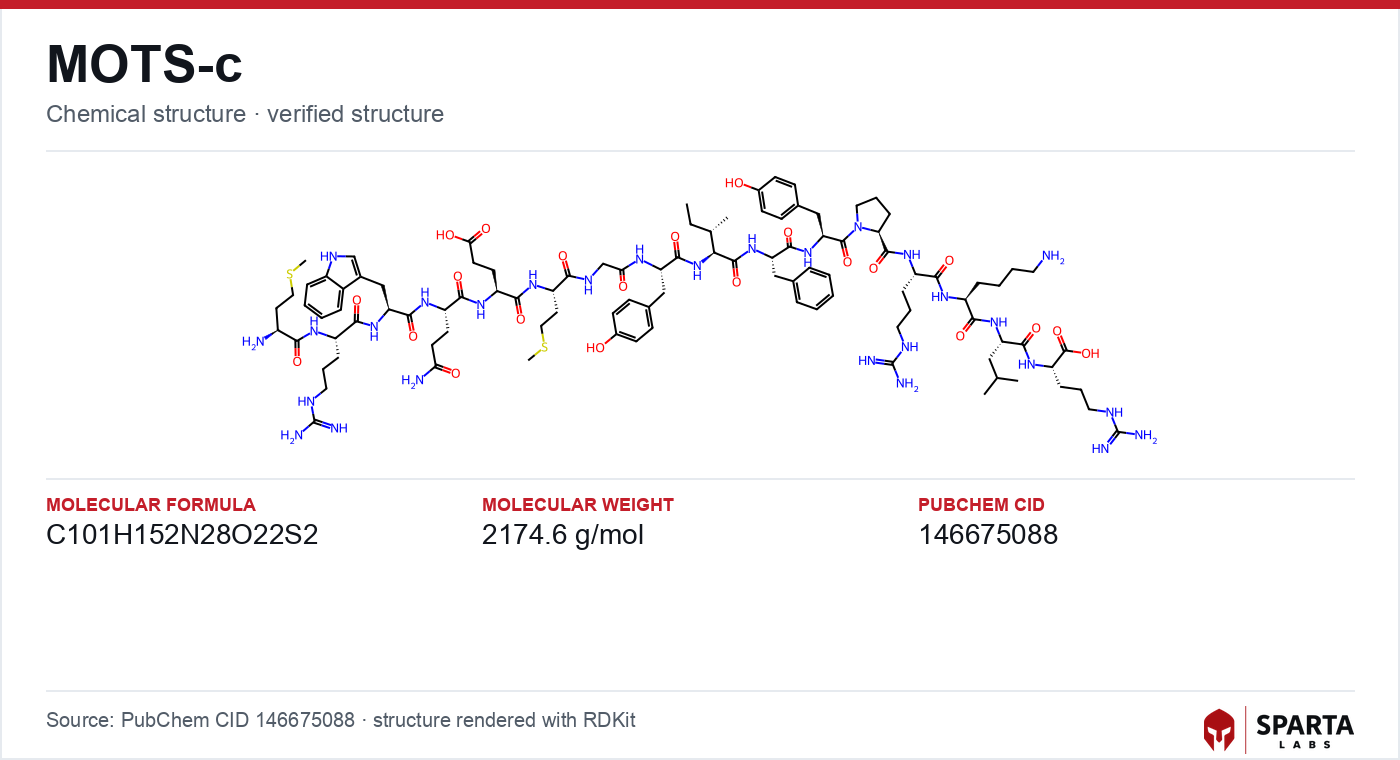
Figure: chemical structure of MOTS-c.
Findings from research models do not establish safety or efficacy in humans. Sparta Labs makes no claims about the use of this compound.
Why a Mitochondrial Peptide Is Made by Chemical Synthesis
The gene for MOTS-c sits inside mitochondrial DNA, and the mitochondrial translation system reads several codons differently from the standard nuclear genetic code. Because of these codon differences and the compound's short length, biological expression in a conventional host is an impractical route; instead, MOTS-c is assembled directly from protected amino-acid building blocks by solid-phase peptide synthesis (SPPS). SPPS, introduced by R. Bruce Merrifield in 1963 and later recognized with the Nobel Prize in Chemistry, builds a peptide chain one residue at a time on an insoluble resin support, so the exact MRWQEMGYIFYPRKLR sequence can be specified without depending on any organism's translation machinery [2].
In practice, the chain is assembled in a defined order, then cleaved from the resin while the side-chain protecting groups are removed. This yields a crude linear peptide that still contains truncated chains, deletion sequences, and other synthesis by-products. For sequences of this length, the coupling chemistry, resin selection, and cleavage conditions are the levers manufacturers use to control the crude quality that downstream purification must resolve [3]. Sparta Labs sources MOTS-c from synthesis facilities operating under documented quality-management systems.
Purification and the Residues That Complicate It
Crude MOTS-c is purified by preparative reversed-phase high-performance liquid chromatography (HPLC), which separates the target sequence from closely related impurities on the basis of hydrophobicity [3]. Two features of the MOTS-c sequence make this step worth examining in detail. First, the peptide carries two methionine residues and one tryptophan, all of which are prone to oxidation; oxidation of a methionine sulfur adds roughly 16 daltons and shifts a molecule's retention time, producing satellite peaks the purification must separate from the intended product [4]. Second, the sequence includes basic arginine and lysine residues that influence how the peptide behaves in acidic mobile phases and during salt exchange.
After purification, the material is lyophilized (freeze-dried from a defined solvent system) to a stable powder. A residual counter-ion and solvent profile is part of the picture here: trifluoroacetic acid used during cleavage and HPLC can persist as a TFA salt unless exchanged, and residual organic solvents such as acetonitrile are monitored against international guidance because they can confound sensitive cell-based work [5]. For research on the broader mitochondrial-peptide class, the parallel considerations for a related compound are outlined in the SS-31 sourcing and quality article.
Confirming Identity: HPLC and Mass Spectrometry
Two orthogonal analytical methods anchor MOTS-c characterization. Reversed-phase HPLC expresses purity as the area percentage of the main peak relative to all detected peaks at a peptide-bond-absorbing wavelength, typically near 214 or 220 nm. This answers how pure a batch is, but not whether the correct sequence was made.
Mass spectrometry answers the identity question. Electrospray-ionization or matrix-assisted laser desorption/ionization measurement establishes whether the observed mass matches the theoretical average mass of approximately 2,174.6 Da calculated from MRWQEMGYIFYPRKLR [3]. Because the oxidation-prone methionine and tryptophan residues each produce characteristic mass shifts, mass spectrometry is also the tool that flags oxidized species when they are present, complementing what HPLC resolves chromatographically [4]. A batch that meets a chromatographic-purity threshold and returns the expected mass has been characterized on both axes that matter for a synthetic peptide. Readers seeking the biological context of the sequence itself may consult the MOTS-c research overview and the MOTS-c mechanism of action articles.
Independent Verification and Certificates of Analysis
Analytical data generated by the manufacturer establishes a baseline, and independent third-party testing provides a check performed outside that relationship. When a separate laboratory runs HPLC and mass spectrometry on a sample drawn from the released batch, the resulting numbers do not share the same origin as the manufacturer's own figures. Sparta Labs incorporates such results into the batch Certificate of Analysis (COA).
A Sparta Labs Certificate of Analysis for MOTS-c documents the following for each batch:
- Reversed-phase HPLC purity reported as main-peak area percentage, with the chromatogram
- Mass spectrometry result stated as measured mass versus the theoretical average mass, with the spectrum
- Batch number linking the document to the manufacturing record
- Manufacturing and expiry dates for shelf-life tracking
- Storage conditions under which the batch was held before dispatch
The COA is available on the product page and can be requested by batch number. Retaining the COA in supplementary materials or a methods section gives a research record a documented, traceable description of the specific material used.
Storage Considerations Driven by the Sequence
Storage guidance for a synthetic peptide follows from its chemistry, and MOTS-c is a useful case study because its oxidation-sensitive residues are the same ones that complicate purification. Published work on protein and peptide pharmaceutical stability identifies oxidation of methionine and tryptophan, along with hydrolysis and aggregation, as principal degradation pathways whose rates depend on temperature, moisture, pH, and light exposure [4]. For a lyophilized powder, low-temperature storage with protection from light and moisture is the general strategy that slows these pathways; minimizing repeated freeze-thaw exposure is consistent with the same reasoning.
Once a peptide is returned to aqueous solution, oxidation and hydrolysis proceed faster than in the dry state, which is why sequence-specific handling literature is relevant to any experimental system. For MOTS-c specifically, the two methionines and single tryptophan make oxidation the degradation pathway most worth monitoring analytically over a batch's lifetime. Characterizing identity and purity at release, and being able to re-check them against the COA, is what keeps material quality from becoming an unmeasured variable in a study design.
References
-
Lee C, Zeng J, Drew BG, Sallam T, Martin-Montalvo A, Wan J, et al. The mitochondrial-derived peptide MOTS-c promotes metabolic homeostasis and reduces obesity and insulin resistance. Cell Metab. 2015 Mar 3;21(3):443–454. doi: 10.1016/j.cmet.2015.02.009. PMID: 25738459. View on PubMed
-
Merrifield RB. Solid phase peptide synthesis. I. The synthesis of a tetrapeptide. J Am Chem Soc. 1963 Jul;85(14):2149–2154. doi: 10.1021/ja00897a025.
-
Andersson L, Blomberg L, Flegel M, Lepsa L, Nilsson B, Verlander M. Large-scale synthesis of peptides. Biopolymers. 2000;55(3):227–250. doi: 10.1002/1097-0282(2000)55:3<227::AID-BIP50>3.0.CO;2-7. PMID: 10880970. View on PubMed
-
Manning MC, Chou DK, Murphy BM, Payne RW, Katayama DS. Stability of protein pharmaceuticals: an update. Pharm Res. 2010 Apr;27(4):544–575. doi: 10.1007/s11095-009-0045-6. PMID: 20143256. View on PubMed
-
International Council for Harmonisation of Technical Requirements for Pharmaceuticals for Human Use (ICH). ICH Q3C(R8): Guideline for residual solvents. 2021. Source: ich.org
Disclaimer. Statements in this article have not been evaluated by the Food and Drug Administration. This compound is not intended to diagnose, treat, cure, or prevent any disease. Sparta Labs sells research-use-only materials. Content is provided for educational and informational purposes only and does not constitute medical advice. Consult a qualified medical professional for any health concerns.
Frequently asked questions
Why is MOTS-c made by chemical synthesis rather than expressed biologically?
MOTS-c is encoded within the mitochondrial 12S ribosomal RNA region of mitochondrial DNA, which uses a genetic code that differs from the standard nuclear code. Because of these codon differences and the peptide's short 16-residue length, solid-phase peptide synthesis (SPPS) is the practical route: it assembles the defined MRWQEMGYIFYPRKLR sequence directly from protected amino acids without relying on a host organism's translation machinery.
Which residues in MOTS-c matter most for purity and stability?
MOTS-c contains two methionine residues and one tryptophan, all of which are susceptible to oxidation. Oxidized methionine adds roughly 16 Da per site and can be resolved by reversed-phase HPLC and detected by mass spectrometry, making these residues a primary focus of identity and purity characterization for the sequence.
How is MOTS-c identity confirmed analytically?
Reversed-phase HPLC establishes chromatographic purity as the main-peak area percentage, while mass spectrometry confirms that the measured mass matches the theoretical average mass of approximately 2,174.6 Da calculated from the sequence. Together these orthogonal methods document both how pure a batch is and that the intended sequence is present.
What does a Certificate of Analysis for MOTS-c document?
A batch Certificate of Analysis records the reversed-phase HPLC purity with chromatogram, the mass spectrometry result versus the theoretical mass, the batch number, manufacturing and expiry dates, and storage conditions. It links a specific documented batch to the material supplied so the characterization can be retained in experimental records.