
MOTS-c vs SS-31: A Structural and Regulatory Comparison
A structural and regulatory comparison of MOTS-c, a 16-residue peptide encoded by mitochondrial DNA, and SS-31 (elamipretide), a synthetic cardiolipin-binding tetrapeptide from the Szeto-Schiller series. Educational reference.
Introduction
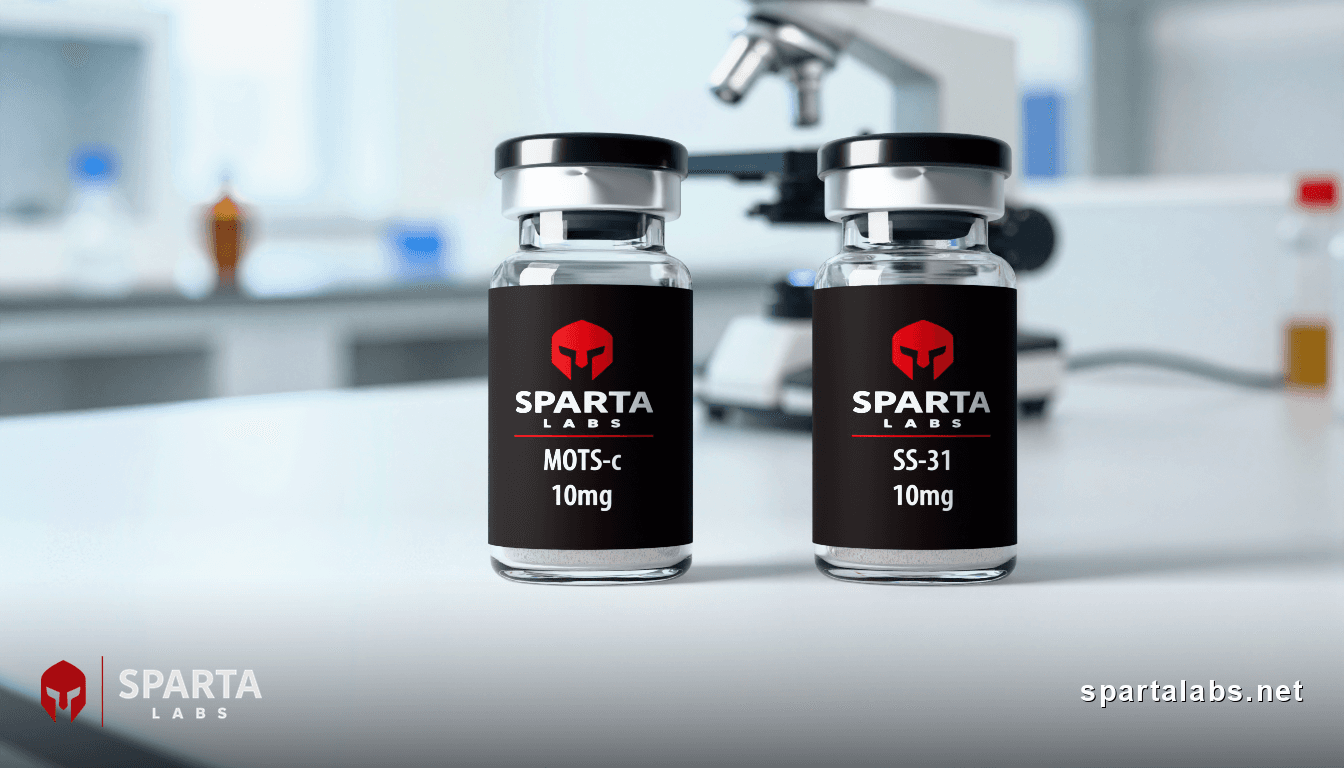
MOTS-c and SS-31 are both discussed under the heading of "mitochondrial peptides," and the shared label obscures how little the two molecules have in common. MOTS-c is a 16-residue peptide that the mitochondrial genome itself encodes, identified in 2015 within the 12S ribosomal RNA gene of mitochondrial DNA. SS-31, also known as elamipretide, MTP-131, and Bendavia, is a synthetic four-residue peptide designed in a medicinal chemistry program and reported to bind cardiolipin at the inner mitochondrial membrane. One is a product of the organelle; the other is a molecule built to target it. This article compares the two compounds on origin, primary structure, reported molecular targets, and regulatory status, reporting what investigators and regulators have published without drawing conclusions about the suitability of either compound for any purpose. Research-grade MOTS-c and SS-31 reference materials are cataloged with per-batch certificates of analysis.
MOTS-c: A Mitochondrial-Encoded Peptide
MOTS-c (mitochondrial open reading frame of the 12S rRNA type-c) was described by Lee and colleagues in Cell Metabolism in 2015. The group identified a short open reading frame within the 12S rRNA region of mitochondrial DNA and reported that it encodes a 16-amino-acid peptide detectable in mouse and human tissues and in circulation [1]. The reported human sequence is Met-Arg-Trp-Gln-Glu-Met-Gly-Tyr-Ile-Phe-Tyr-Pro-Arg-Lys-Leu-Arg (MRWQEMGYIFYPRKLR), with a calculated mass of roughly 2,174 daltons. The sequence is built entirely from proteinogenic L-amino acids and carries a free amino terminus and a free carboxyl terminus, which is to say it looks like an ordinary short peptide; what is unusual is its genomic address.
In that first report, MOTS-c was placed within a small family of mitochondrial-derived peptides (MDPs), a category that also includes humanin, encoded in the 16S rRNA region [1]. The authors described the peptide's reported association with folate-methionine (one-carbon) metabolism and with AMP-activated protein kinase (AMPK) signaling in cell culture and mouse models [1]. Findings from research models do not establish safety or efficacy in humans. Sparta Labs makes no claims about the use of this compound.
Later work from the same laboratory extended the picture. Kim and colleagues reported in Cell Metabolism in 2018 that MOTS-c translocated to the nucleus of cultured cells under metabolic stress and was associated with changes in nuclear gene expression [2]. Reynolds and colleagues reported in Nature Communications in 2021 that circulating MOTS-c levels in human volunteers changed with exercise and that the peptide was associated with age-dependent physical measures in mice [3]. Zhu and colleagues reported in iScience in 2024 that MOTS-c bound and activated casein kinase 2 (CK2) in skeletal muscle models [4]. Fuku and colleagues, writing in Aging Cell in 2015, drew attention to a naturally occurring mitochondrial DNA variant (m.1382A>C) that alters one MOTS-c residue and is enriched in certain East Asian populations [5]. The MOTS-c research overview and the MOTS-c mechanism of action article cover this literature in more depth.
MOTS-c holds no regulatory approval in any jurisdiction. The published record consists of preclinical and observational studies; no registered clinical development program has been described in the peer-reviewed literature cited here.
SS-31 (Elamipretide): A Synthetic Cardiolipin-Binding Tetrapeptide
SS-31 belongs to the Szeto-Schiller (SS) peptide series, developed by Hazel Szeto at Weill Cornell Medical College and Peter Schiller at the Institut de Recherches Cliniques de Montréal. The series began as a program to design opioid-receptor-selective peptides; Szeto and Birk described in a 2014 review how the observation that certain members concentrated at mitochondria redirected the work [6]. Zhao and colleagues reported the foundational characterization of the class in the Journal of Biological Chemistry in 2004, describing cell-permeable peptides that localized to the inner mitochondrial membrane in cultured cells and isolated mitochondria [7].
The compound is a tetrapeptide with the sequence D-Arg-2',6'-dimethyltyrosine-Lys-Phe-NH2, mass approximately 640 daltons. Three design features distinguish it from a conventional peptide: a D-configured arginine at the N-terminus, a non-proteinogenic dimethyltyrosine (Dmt) residue at position 2, and a C-terminal amide in place of a free carboxylate. The alternating pattern of basic residues (D-Arg, Lys) and aromatic residues (Dmt, Phe) gives the molecule a formal charge of +3 at physiological pH, a property Zhao and colleagues identified as the structural basis for its membrane association [7].
Birk and colleagues reported in the Journal of the American Society of Nephrology in 2013 that SS-31 interacted selectively with cardiolipin, the anionic phospholipid concentrated at the inner mitochondrial membrane, in isolated mitochondria and in a rat model of renal ischemia [8]. Mitchell and colleagues reported in 2020, using biophysical methods, that SS-31 partitioned into the interfacial region of cardiolipin-containing lipid bilayers and altered membrane surface electrostatics in a charge-density-dependent manner [9]. The SS-31 mechanism of action article discusses these reports in detail.
Unlike MOTS-c, SS-31 has a substantial clinical trial record under the name elamipretide, sponsored by Stealth BioTherapeutics. Thompson and colleagues reported a phase 2/3 randomized trial followed by an open-label extension in Barth syndrome, a genetic disorder of cardiolipin metabolism (the TAZPOWER trial), in Genetics in Medicine in 2021 [10]. Karaa and colleagues reported the MMPOWER-3 randomized trial in primary mitochondrial myopathy in Neurology in 2023; the trial did not meet its co-primary endpoints at 24 weeks [11]. The SS-31 published research article summarizes the wider trial program.
In September 2025 the FDA granted accelerated approval to elamipretide under the brand name Forzinity, for improvement of muscle strength in patients with Barth syndrome weighing at least 30 kg, as listed in the agency's Novel Drug Approvals for 2025 [12]. Accelerated approval is contingent on confirmatory evidence of clinical benefit. That approval attaches to the sponsor's pharmaceutical product and its labeled indication; research-grade SS-31 sold as a laboratory chemical is not that product and carries no approval.
Structural Comparison
- Origin. MOTS-c is encoded by mitochondrial DNA and produced endogenously [1]. SS-31 is a wholly synthetic molecule with no natural counterpart [6, 7].
- Length and composition. MOTS-c is 16 residues, all proteinogenic L-amino acids, with free N- and C-termini. SS-31 is four residues and contains a D-amino acid, a non-proteinogenic Dmt residue, and a C-terminal amide.
- Mass. Approximately 2,174 daltons for MOTS-c against roughly 640 daltons for SS-31.
- Charge. The MOTS-c sequence contains three arginines and one lysine against a single glutamate. SS-31 carries two basic residues and no acidic residues, giving the +3 net charge reported as central to its membrane targeting [7, 9].
- Reported molecular associations. MOTS-c: AMPK signaling and folate-methionine metabolism [1], nuclear translocation under stress [2], and CK2 binding [4]. SS-31: cardiolipin at the inner mitochondrial membrane [8, 9]. No published study has examined the two compounds side by side.
- Regulatory status. MOTS-c: no approval anywhere. SS-31: FDA accelerated approval (2025) as elamipretide for one rare-disease indication [12]; research-grade material is research use only.
Pharmacological Class Context
The two compounds are placed in different pharmacological categories. MOTS-c is classified as a mitochondrial-derived peptide, a signaling molecule of endogenous origin studied alongside humanin and the small humanin-like peptides [1]. SS-31 is described in the literature as an aromatic-cationic, mitochondria-targeted peptide, a class Szeto and Birk distinguished from earlier triphenylphosphonium-conjugated compounds that rely on membrane potential for uptake [6]. The shared word "mitochondrial" describes, in one case, where the peptide comes from and, in the other, where the peptide goes.
The research records differ in kind as well as in size. The MOTS-c literature is predominantly preclinical, consisting of cell-culture and mouse studies together with human observational data on circulating levels and genetic variants [1, 3, 5]. The SS-31 literature runs from membrane biophysics through randomized controlled trials and a regulatory approval [7-12]. Neither body of work was designed to compare the compounds, and this article accordingly makes no comparative statement about activity or efficacy.
Research-grade MOTS-c and SS-31 sold by chemical suppliers are laboratory reference materials, not pharmaceutical products, and are strictly for research use only.
References
- Lee C, Zeng J, Drew BG, Sallam T, Martin-Montalvo A, Wan J, Kim SJ, Mehta H, Hevener AL, de Cabo R, Cohen P. The mitochondrial-derived peptide MOTS-c promotes metabolic homeostasis and reduces obesity and insulin resistance. Cell Metab. 2015;21(3):443-454. PMID: 25738459. DOI: 10.1016/j.cmet.2015.02.009
- Kim KH, Son JM, Benayoun BA, Lee C. The mitochondrial-encoded peptide MOTS-c translocates to the nucleus to regulate nuclear gene expression in response to metabolic stress. Cell Metab. 2018;28(3):516-524.e7. PMID: 29983246. DOI: 10.1016/j.cmet.2018.06.015
- Reynolds JC, Lai RW, Woodhead JST, Joly JH, Mitchell CJ, Cameron-Smith D, Lu R, Cohen P, Graham NA, Benayoun BA, Merry TL, Lee C. MOTS-c is an exercise-induced mitochondrial-encoded regulator of age-dependent physical decline and muscle homeostasis. Nat Commun. 2021;12(1):470. PMID: 33473109. DOI: 10.1038/s41467-020-20790-0
- Zhu Z, Qian M, Joly JH, Lu R, Mehta HH, Cohen P, Lee C. MOTS-c modulates skeletal muscle function by directly binding and activating CK2. iScience. 2024;27(11):111215. PMID: 39559755. DOI: 10.1016/j.isci.2024.111215
- Fuku N, Pareja-Galeano H, Zempo H, Alis R, Arai Y, Lucia A, Hirose N. The mitochondrial-derived peptide MOTS-c: a player in exceptional longevity? Aging Cell. 2015;14(6):921-923. PMID: 26332820. DOI: 10.1111/acel.12389
- Szeto HH, Birk AV. Serendipity and the discovery of novel compounds that restore mitochondrial plasticity. Clin Pharmacol Ther. 2014;96(6):672-683. PMID: 25188726. DOI: 10.1038/clpt.2014.174
- Zhao K, Zhao GM, Wu D, Soong Y, Birk AV, Schiller PW, Szeto HH. Cell-permeable peptide antioxidants targeted to inner mitochondrial membrane inhibit mitochondrial swelling, oxidative cell death, and reperfusion injury. J Biol Chem. 2004;279(33):34682-34690. PMID: 15178689. DOI: 10.1074/jbc.M402999200
- Birk AV, Liu S, Soong Y, Mills W, Singh P, Warren JD, et al. The mitochondrial-targeted compound SS-31 re-energizes ischemic mitochondria by interacting with cardiolipin. J Am Soc Nephrol. 2013;24(8):1250-1261. PMID: 23813215. DOI: 10.1681/ASN.2012121216
- Mitchell W, Ng EA, Tamucci JD, Boyd KJ, Sathappa M, Coscia A, et al. The mitochondria-targeted peptide SS-31 binds lipid bilayers and modulates surface electrostatics as a key component of its mechanism of action. J Biol Chem. 2020;295(21):7452-7469. PMID: 32321821. DOI: 10.1074/jbc.RA119.012094
- Thompson WR, Hornby B, Manuel R, Bradley E, Laux J, Carr J, Vernon HJ. A phase 2/3 randomized clinical trial followed by an open-label extension to evaluate the effectiveness of elamipretide in Barth syndrome, a genetic disorder of mitochondrial cardiolipin metabolism. Genet Med. 2021;23(3):471-478. DOI: 10.1038/s41436-020-01006-8
- Karaa A, Bertini E, Carelli V, Cohen BH, Enns GM, Falk MJ, et al. Efficacy and safety of elamipretide in individuals with primary mitochondrial myopathy: the MMPOWER-3 randomized clinical trial. Neurology. 2023;101(1):e42-e54. PMCID: PMC10382259. DOI: 10.1212/WNL.0000000000207402
- US Food and Drug Administration. Novel Drug Approvals for 2025: Forzinity (elamipretide), NDA 215244, approved September 19, 2025. FDA Novel Drug Approvals 2025; Prescribing information (PDF)
Frequently asked questions
What is the difference between MOTS-c and SS-31?
MOTS-c is a 16-amino-acid peptide encoded within the 12S ribosomal RNA gene of mitochondrial DNA and produced endogenously, as reported by Lee and colleagues in 2015. SS-31, also called elamipretide, is a wholly synthetic four-residue peptide containing a D-arginine, a dimethyltyrosine residue, and a C-terminal amide, reported to bind cardiolipin at the inner mitochondrial membrane. One is a product of the mitochondrion; the other is a molecule designed to target it.
What is the MOTS-c peptide?
MOTS-c (mitochondrial open reading frame of the 12S rRNA type-c) is a 16-residue peptide with the reported human sequence MRWQEMGYIFYPRKLR and a mass of roughly 2,174 daltons. It belongs to the mitochondrial-derived peptide family alongside humanin, and its published literature is largely preclinical, with human observational data on circulating levels.
What is the SS-31 peptide?
SS-31 is a synthetic tetrapeptide with the sequence D-Arg-Dmt-Lys-Phe-NH2 and a mass of approximately 640 daltons, developed in the Szeto-Schiller peptide program. Birk and colleagues reported in 2013 that it interacts selectively with cardiolipin, an anionic phospholipid concentrated at the inner mitochondrial membrane. It has been studied clinically under the name elamipretide.
Is elamipretide FDA approved?
In September 2025 the FDA granted accelerated approval to elamipretide under the brand name Forzinity for a single rare-disease indication in Barth syndrome, as listed in the agency's Novel Drug Approvals for 2025. That approval attaches to the sponsor's pharmaceutical product and its labeled indication. Research-grade SS-31 sold as a laboratory chemical is not that product and carries no approval.
Is MOTS-c FDA approved?
No. MOTS-c holds no regulatory approval in any jurisdiction, and no registered clinical development program has been described in the peer-reviewed literature cited in this article. Research-grade MOTS-c is supplied strictly for laboratory research use.
Do MOTS-c and SS-31 act on the same target?
No published study has compared the two head to head, and the reported targets differ. MOTS-c has been associated in preclinical work with AMPK signaling, nuclear translocation under metabolic stress, and binding to casein kinase 2. SS-31 has been characterized biophysically as partitioning into cardiolipin-containing membranes. The shared word "mitochondrial" describes where MOTS-c comes from and where SS-31 goes.