
SS-31 (Elamipretide): Published Research
Published SS-31 (elamipretide) research traced from its founding inner-membrane biophysics through the cardiolipin hypothesis, mitochondrial interactome mapping, ex vivo human cardiac tissue, and rare-disease clinical programs, with citations to primary literature.
For research use only. Not for human consumption. This article is educational reference material. It is not medical advice and is not a recommendation to use any substance.
Introduction
SS-31 (elamipretide) is an aromatic-cationic tetrapeptide (D-Arg-2',6'-dimethyl-Tyr-Lys-Phe-NH2) studied for its reported concentration at the inner mitochondrial membrane and its association with the phospholipid cardiolipin. Because a single molecular interaction has been proposed as the entry point to a broad range of disease models, the published SS-31 literature is unusually cross-disciplinary: biophysics of lipid binding on one end, and rare-disease clinical trials on the other. This article organizes that literature around the questions each research phase set out to answer rather than a generic study list. For the biochemical detail behind these programs, see the SS-31 mechanism of action article; for classification and regulatory context, see the SS-31 research overview.
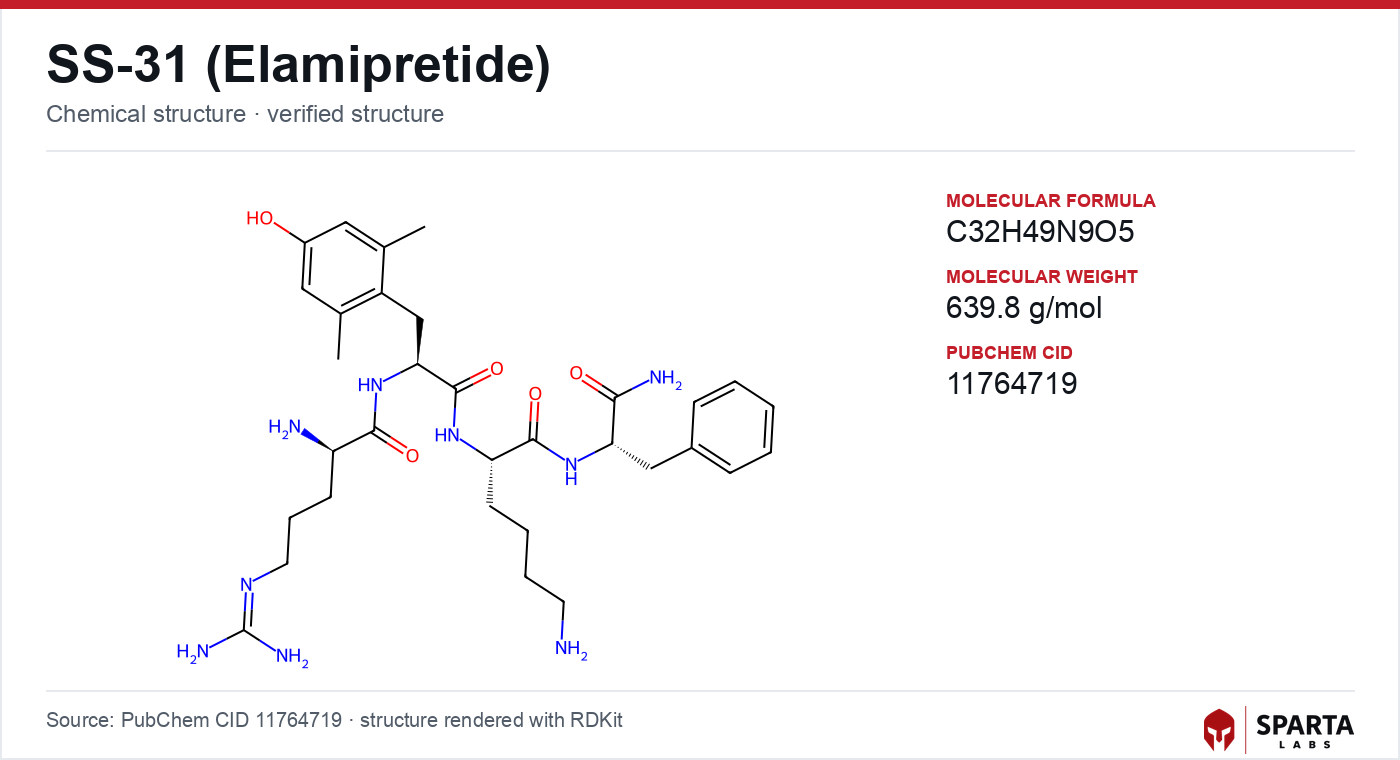
Figure: chemical structure of SS-31 (elamipretide).
The Founding Observation: A Peptide That Reaches the Inner Membrane
The SS-peptide research line began with a biophysical puzzle rather than a disease target. Zhao and colleagues reported in 2004 that a family of small aromatic-cationic peptides accumulated several-fold at the inner mitochondrial membrane and did so in a manner reported to be independent of the membrane potential, distinguishing them from most cationic mitochondrial probes that depend on the potential gradient to enter. In cell-culture systems under induced oxidative stress, the peptides were associated with reduced reactive oxygen species and reduced oxidative cell death at low concentrations. [1]
Findings from research models do not establish safety or efficacy in humans. Sparta Labs makes no claims about the use of this compound.
This report framed the design logic for everything that followed: rather than dosing an antioxidant into the cytosol and hoping it reached the organelle, the peptide's own physicochemistry was reported to localize it where mitochondrial oxidative chemistry occurs. The nomenclature "SS" derives from the surnames of the two chemists, Szeto and Schiller, whose collaboration produced the series.
Anchoring the Mechanism to Cardiolipin
A recurring difficulty in the field was explaining why localization to the inner membrane would matter functionally. Birk and colleagues addressed this in a 2013 study in the Journal of the American Society of Nephrology, using a model of renal ischemia-reperfusion. The authors reported that SS-31 associated with cardiolipin, the signature phospholipid of the inner mitochondrial membrane, and that this interaction was associated with preservation of cristae architecture and of the electron-transport organization during the ischemic insult. [2]
The study used electron microscopy to assess cristae morphology and chromatographic methods to track cardiolipin species, tying an ultrastructural readout to a specific lipid. This cardiolipin hypothesis became the mechanistic spine of the later clinical rationale, because several of the human conditions eventually studied are themselves defined by disturbed cardiolipin biology.
Mapping What the Peptide Actually Touches
By 2020 the field had a proposed binding partner (cardiolipin) but not a full picture of the protein neighborhood affected. Chavez and colleagues, publishing in the Proceedings of the National Academy of Sciences, applied chemical cross-linking coupled to mass spectrometry to isolated cardiac mitochondria to map the protein interaction landscape around SS-31. The authors reported that the interaction network clustered around ATP synthase and adjacent metabolic machinery, and interpreted this as consistent with the peptide stabilizing the local protein-lipid environment of oxidative phosphorylation. [3]
This work is methodologically distinct from the earlier studies: rather than a functional outcome in a disease model, it is a systems-level interactome intended to constrain the space of plausible mechanisms. It is frequently cited as the bridge between the lipid-binding biophysics and the bioenergetic readouts reported in tissue.
From Rodent Organelles to Human Cardiac Tissue
A distinctive feature of the SS-31 literature is a study that used freshly explanted human cardiac tissue rather than an animal surrogate. Chatfield and colleagues, in a 2019 report in JACC: Basic to Translational Science, treated mitochondria from failing and non-failing human hearts with elamipretide ex vivo and measured respiratory function and electron-transport complex activities. The authors reported improved mitochondrial oxygen flux and complex activities in treated preparations from failing hearts relative to paired untreated tissue. [4]
Because the tissue came from human hearts and each failing sample served as its own comparator, this ex vivo design reduced species-translation and inter-subject confounders that limit inference from rodent models. It is one reason the heart-failure indication was pursued in humans before some others.
The Rare-Disease Clinical Pivot: Primary Mitochondrial Myopathy
The first registered clinical program moved into primary mitochondrial myopathy, a group of inherited disorders of oxidative phosphorylation. Karaa and colleagues reported a randomized dose-escalation phase 1/2 study in Neurology in 2018, evaluating short-course intravenous elamipretide in adults with genetically confirmed primary mitochondrial myopathy. In this cited trial the compound was administered by intravenous infusion across ascending dose cohorts; the study's stated purpose was to characterize tolerability and pharmacodynamic signal rather than to establish efficacy, and the authors reported the infusions were generally tolerated over the study period. [5]
This program is notable methodologically for confronting the endpoint problem in mitochondrial disease head-on. Walking-distance and fatigue measures are heterogeneous across mitochondrial genotypes, and the phase 1/2 design was structured to inform which functional endpoints and patient subgroups a larger trial should target rather than to declare a result.
Barth Syndrome: Matching the Drug to the Lesion
The clinical thread most tightly aligned with the cardiolipin hypothesis is Barth syndrome, an X-linked disorder caused by mutations in the tafazzin gene that impair cardiolipin remodeling. Because the disease is defined by defective cardiolipin, a compound reported to bind cardiolipin represented an unusually direct mechanistic match. Reid Thompson and colleagues reported the TAZPOWER trial in Genetics in Medicine in 2021: a randomized, double-blind, placebo-controlled crossover study in a small cohort of patients with Barth syndrome, followed by an open-label extension. [6]
TAZPOWER illustrates the methodology of ultra-rare-disease research, where total eligible populations are measured in the dozens worldwide. The crossover design, in which each participant receives both placebo and active treatment periods, is a deliberate response to that constraint, extracting maximal statistical information from a very small enrollment. The trial's placebo-controlled and open-label-extension data later formed the primary evidence base considered in the compound's US regulatory review for Barth syndrome.
How the Individual Studies Fit Together
Read as a sequence, the SS-31 literature is a single hypothesis being tested at successively higher levels of biological organization. A biophysical claim about membrane localization [1] was linked to a specific lipid [2], situated within a protein interaction network [3], shown to alter function in human tissue ex vivo [4], and then tested in whole patients in disease programs chosen partly for how directly their biology matched the proposed mechanism [5][6]. Reviews by Szeto have synthesized this progression and articulated the cardiolipin-centric framework that connects the preclinical and clinical arms. [7]
Knowledge Gaps and Open Questions
Several methodological limitations recur across the corpus and mark where future work is anticipated. Endpoint selection in mitochondrial disease remains unresolved: functional measures such as walking distance capture only part of a systemic bioenergetic disorder, and genotype heterogeneity complicates pooled analysis. The rarity of conditions like Barth syndrome limits sample sizes to levels where subgroup and crossover designs, rather than large parallel-group trials, dominate the evidence.
No published work directly compares SS-31 head-to-head with other mitochondria-directed compounds under matched experimental conditions, leaving relative characterization an open area. A thematically adjacent but mechanistically separate line of investigation concerns mitochondria-derived peptides; the MOTS-c published research summary covers one such peptide studied in metabolic contexts. Researchers evaluating reference material for SS-31 studies can review lot-specific analytical documentation on the SS-31 product page.
References
-
Zhao K, Zhao GM, Wu D, Soong Y, Birk AV, Schiller PW, Szeto HH. Cell-permeable peptide antioxidants targeted to inner mitochondrial membrane inhibit mitochondrial swelling, oxidative cell death, and reperfusion injury. J Biol Chem. 2004;279(33):34682-34690. PMID: 15178689. DOI: 10.1074/jbc.M402999200. View on PubMed
-
Birk AV, Liu S, Soong Y, Mills W, Singh P, Warren JD, et al. The mitochondrial-targeted compound SS-31 re-energizes ischemic mitochondria by interacting with cardiolipin. J Am Soc Nephrol. 2013;24(8):1250-1261. PMID: 23813215. DOI: 10.1681/ASN.2012121216. View on PubMed
-
Chavez JD, Tang X, Campbell MD, Reyes D, Kramer PA, Stuart R, et al. Mitochondrial protein interaction landscape of SS-31. Proc Natl Acad Sci USA. 2020;117(26):15363-15373. PMID: 32554501. DOI: 10.1073/pnas.2002250117. View on PubMed
-
Chatfield KC, Sparagna GC, Chau S, Phillips EK, Ambardekar AV, Aftab M, et al. Elamipretide improves mitochondrial function in the failing human heart. JACC Basic Transl Sci. 2019;4(2):147-157. PMID: 31061916. DOI: 10.1016/j.jacbts.2018.12.005. View on PubMed
-
Karaa A, Haas R, Goldstein A, Vockley J, Weaver WD, Cohen BH. Randomized dose-escalation trial of elamipretide in adults with primary mitochondrial myopathy. Neurology. 2018;90(14):e1212-e1221. PMID: 29500292. DOI: 10.1212/WNL.0000000000005255. View on PubMed
-
Reid Thompson W, Hornby B, Manuel R, Bradley E, Laux J, Carr J, Vernon HJ. A phase 2/3 randomized clinical trial followed by an open-label extension to evaluate the effectiveness of elamipretide in Barth syndrome, a genetic disorder of mitochondrial cardiolipin metabolism. Genet Med. 2021;23(3):471-478. PMID: 33077894. DOI: 10.1038/s41436-020-01006-8. View on PubMed
-
Szeto HH. First-in-class cardiolipin-protective compound as a therapeutic agent to restore mitochondrial bioenergetics. Br J Pharmacol. 2014;171(8):2029-2050. PMID: 24117165. DOI: 10.1111/bph.12461. View on PubMed
Disclaimer. Statements in this article have not been evaluated by the Food and Drug Administration. This compound is not intended to diagnose, treat, cure, or prevent any disease. Sparta Labs sells research-use-only materials. Content is provided for educational and informational purposes only and does not constitute medical advice. Consult a qualified medical professional for any health concerns.
Frequently asked questions
How did SS-31 (elamipretide) research begin?
The line began with a biophysical observation rather than a disease target. Zhao and colleagues reported in 2004 that aromatic-cationic SS-peptides accumulated at the inner mitochondrial membrane in a manner described as independent of membrane potential, and were associated with reduced reactive oxygen species in cell-culture models of oxidative stress. This localization logic shaped the studies that followed.
Why is cardiolipin central to the SS-31 literature?
Cardiolipin is the signature phospholipid of the inner mitochondrial membrane. Birk and colleagues reported in 2013 that SS-31 associated with cardiolipin and that this interaction tracked with preservation of cristae architecture in an ischemia-reperfusion model. This cardiolipin hypothesis became the mechanistic framework connecting the preclinical and clinical arms of the research.
What is notable about the human cardiac tissue study of elamipretide?
Chatfield and colleagues (2019) treated mitochondria from explanted failing and non-failing human hearts with elamipretide ex vivo, using each failing sample as its own comparator. The authors reported improved mitochondrial oxygen flux and electron-transport complex activities in treated failing tissue. The design reduced species-translation confounders common to rodent models.
Why was Barth syndrome studied in the elamipretide program?
Barth syndrome is an X-linked disorder caused by tafazzin mutations that impair cardiolipin remodeling, so a compound reported to bind cardiolipin represented an unusually direct mechanistic match. The TAZPOWER crossover trial reported by Reid Thompson and colleagues (2021) was designed around the very small worldwide patient population characteristic of this ultra-rare disease.
What are the main knowledge gaps in SS-31 research?
Endpoint selection in mitochondrial disease remains unresolved because functional measures capture only part of a systemic disorder and genotypes are heterogeneous. Rarity limits trials to crossover and subgroup designs rather than large parallel-group studies. No published work directly compares SS-31 head-to-head with other mitochondria-directed compounds under matched conditions.