
KLOW Blend: A Research Overview
A research-library overview of the KLOW blend, a four-component research material co-lyophilizing GHK-Cu, TB-500, BPC-157, and KPV: chemistry, classification, and regulatory context. Educational reference.
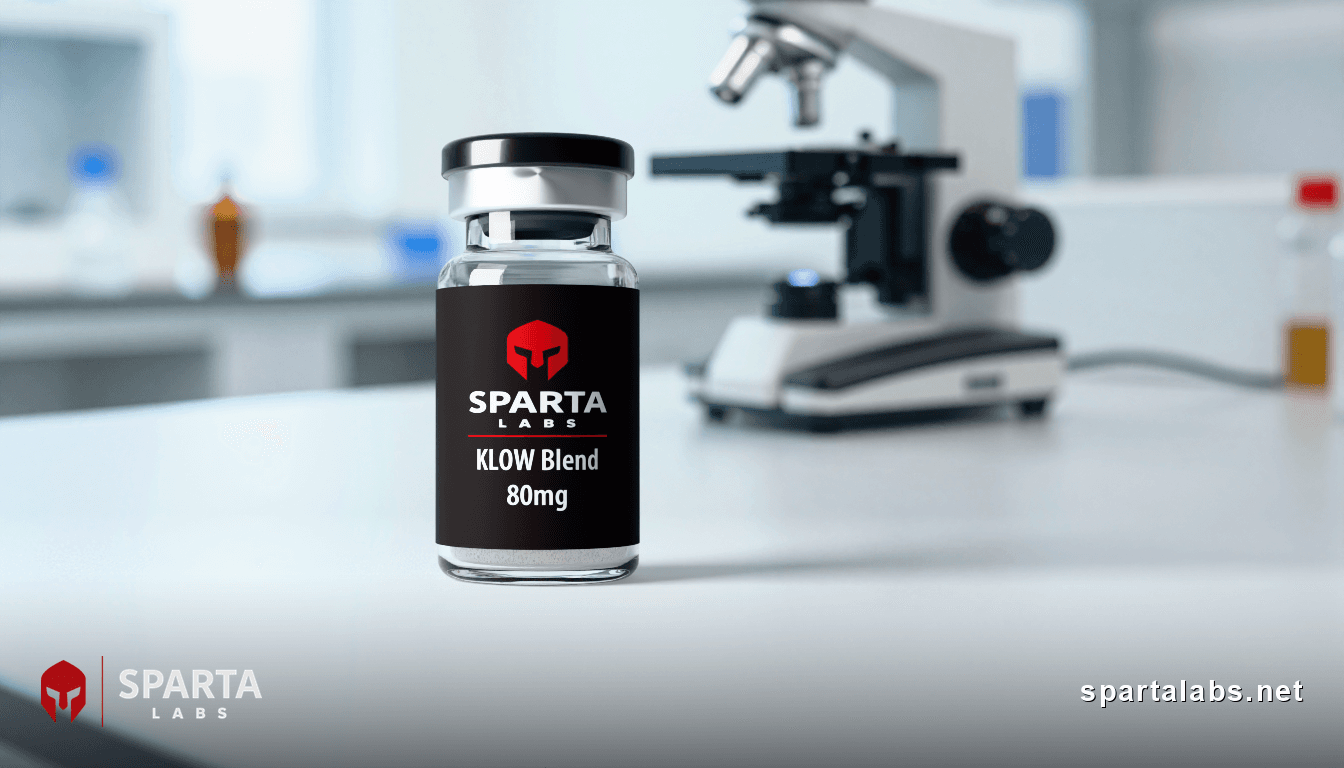
For research use only. Not for human consumption. This article is educational reference material. It is not medical advice and is not a recommendation to use any substance.
Introduction
The KLOW blend is a research-use-only combination material that co-lyophilizes four separately characterized peptides in a single vial: GHK-Cu, TB-500, BPC-157, and KPV. The initialism KLOW derives from this component set. Each of the four constituents is an established subject of independent peer-reviewed literature spanning copper biochemistry, actin regulation, gastric-derived peptide research, and melanocortin pharmacology. This article provides an educational reference overview of what the KLOW blend is: the identity and pharmacological classification of each component peptide, the rationale reported for grouping them, and the regulatory context in which the material is supplied. It does not describe use, administration, or outcomes.
Because KLOW is a composite of four distinct molecules rather than a single defined chemical entity, this overview summarizes each component in turn and directs the reader to the dedicated research-library article for each peptide, where the primary literature is examined in greater depth.
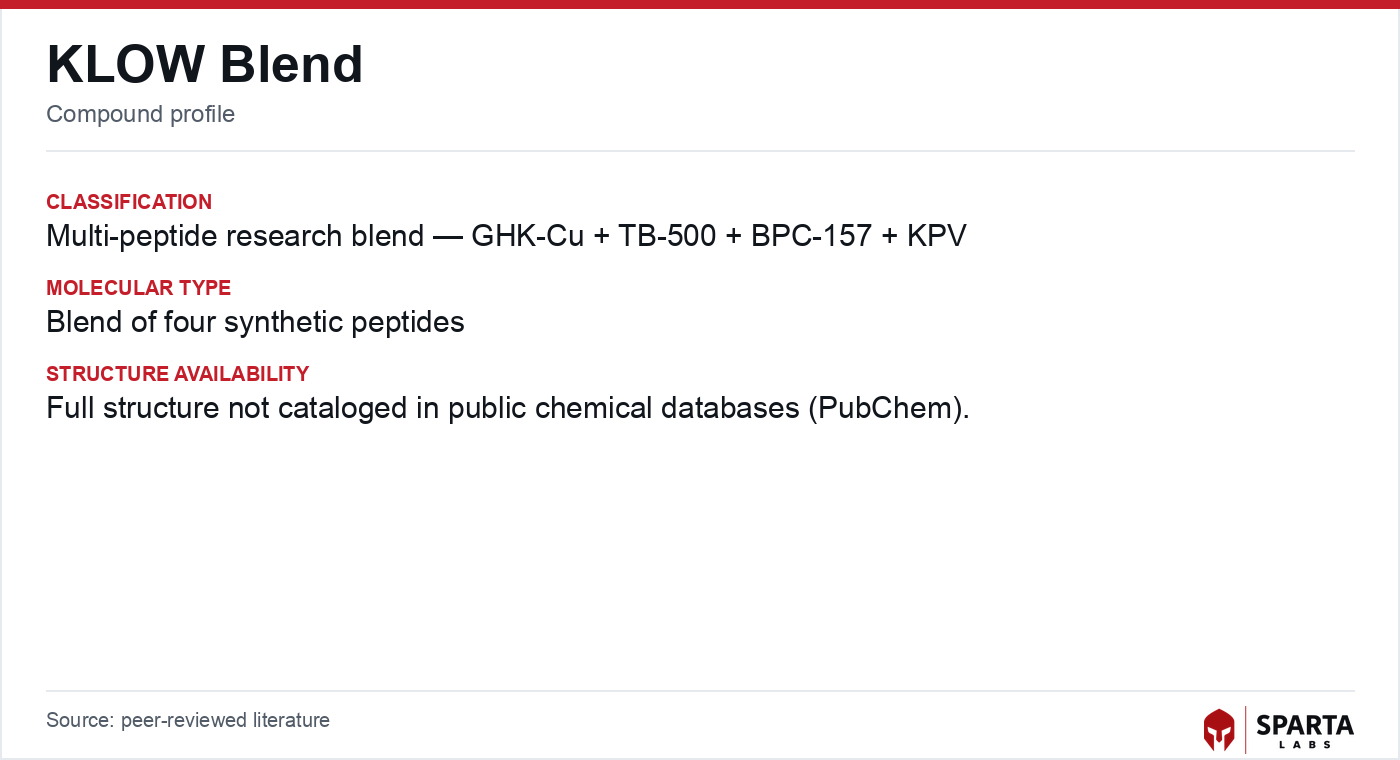
Figure: KLOW blend composition (GHK-Cu, TB-500, BPC-157, KPV).
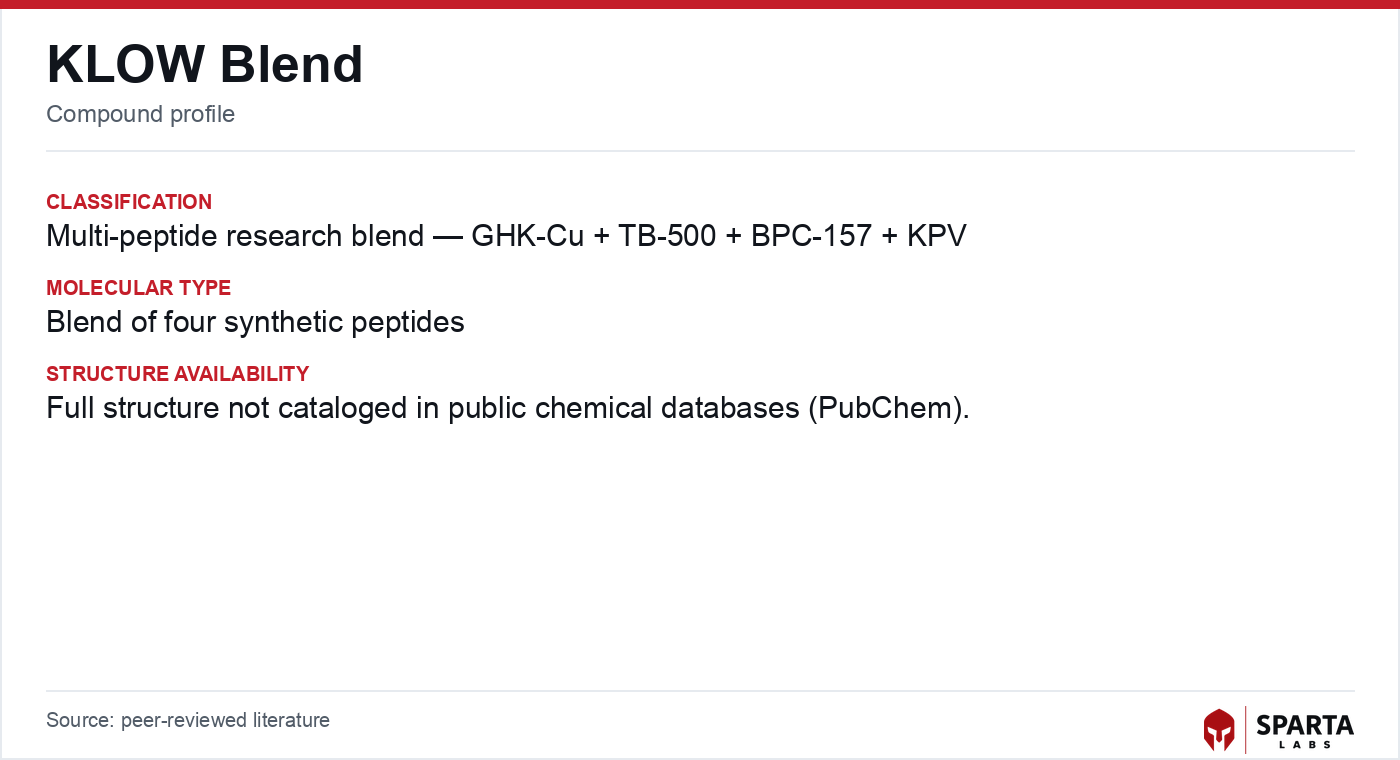
Figure: KLOW blend component peptides (GHK-Cu, TB-500, BPC-157, KPV).
Background
Combination or "blended" peptide materials group multiple individually studied peptides into a single preparation. In a research setting, such blends allow investigators to work with a defined mixture under a single reconstitution rather than combining separately sourced materials. The KLOW blend assembles four peptides that have each accumulated preclinical literature in overlapping areas of cell-signaling and tissue-biology research: two are peptide fragments of larger endogenous proteins (TB-500 from thymosin beta-4, KPV from alpha-melanocyte-stimulating hormone), one is a naturally occurring plasma tripeptide-metal complex (GHK-Cu), and one is a synthetic pentadecapeptide derived from a gastric protein sequence (BPC-157).
Findings from research models do not establish safety or efficacy in humans. Sparta Labs makes no claims about the use of this compound.
It is important to note that the great majority of the published research base pertains to the individual peptides studied in isolation. Controlled investigation of the specific four-component KLOW combination is limited in the peer-reviewed record. The sections below therefore describe each component according to its own literature and do not attribute combination-specific findings that the literature does not support.
Component Chemistry and Structure
GHK-Cu. GHK-Cu (glycyl-L-histidyl-L-lysine–copper(II) complex) is a naturally occurring tripeptide-metal complex first isolated from human serum albumin in 1973 by Pickart and Thaler [1]. The tripeptide has the molecular formula C₁₄H₂₄N₆O₄ and a molecular weight of approximately 340.4 daltons in its free form, and it coordinates a copper(II) ion in a stable 1:1 complex [2]. The sequence Gly-His-Lys occurs within the alpha-2(I) chain of type I collagen, a structural relationship noted in the connective-tissue literature [1]. Further detail is available in the GHK-Cu research overview.
TB-500. TB-500 is a synthetic peptide corresponding to the actin-binding region of thymosin beta-4 (Tβ4), a 43-amino-acid actin-sequestering protein present in a wide range of mammalian tissues [3]. The Tβ4 molecule and its fragments have been studied for their role in G-actin binding and cytoskeletal dynamics. The relationship between TB-500 and full-length thymosin beta-4 is examined in the TB-500 research overview.
BPC-157. BPC-157 is a synthetic pentadecapeptide (15 amino acids) whose sequence derives from a partial fragment of a protein identified in gastric juice, described in the literature as body protection compound [4]. It has been studied predominantly in rodent injury models. Its chemistry and reported signaling associations are covered in the BPC-157 research overview.
KPV. KPV is the tripeptide Lys-Pro-Val, corresponding to the carboxy-terminal three residues (positions 11–13) of alpha-melanocyte-stimulating hormone (α-MSH) [5]. In research form it is commonly encountered as the N-acetylated, C-terminally amidated tripeptide Ac-KPV-NH₂ [6]. The melanocortin context of KPV is discussed in the KPV research overview.
Pharmacological Classification
The four components of KLOW fall into distinct pharmacological categories and do not share a single receptor target or mechanism class:
- GHK-Cu is classified as a copper-binding peptide (CBP) within the broader category of metallopeptides. Its reported activities in the literature have been associated with copper coordination and extracellular-matrix biology rather than with a single defined receptor [2].
- TB-500 / thymosin beta-4 is classified as an actin-sequestering peptide; the parent protein is characterized primarily through its G-actin-binding function rather than classical receptor agonism [3].
- BPC-157 does not map cleanly to a single receptor subtype in the published record; research has described associations with multiple intracellular signaling pathways in animal models [4].
- KPV is derived from the melanocortin system but has been characterized in the literature as pharmacologically distinct from direct melanocortin-receptor agonism. Getting, Schiöth, and Perretti reported in 2003 that KPV's anti-inflammatory profile was mechanistically separable from canonical melanocortin-receptor agonism in a peritonitis model [5].
Because these classifications differ, the KLOW blend is best understood as a co-formulation of four separately classified research peptides rather than as a member of any single pharmacological class.
Regulatory Status
None of the four component peptides in the KLOW blend is approved by the United States Food and Drug Administration for any therapeutic indication in humans, and the blend itself is not an FDA-approved product. In the United States, the material is offered as research-use-only. GHK-Cu has additionally been used as a cosmetic ingredient in certain topical formulations, a separate regulatory classification under the FDA's definition of cosmetics that does not constitute or imply any drug approval. The other three components have no approved human indication.
The KLOW blend is classified as a research-use-only material at Sparta Labs and is not intended for human administration. The KLOW blend product page provides the composition and third-party analytical documentation applicable to the constituent peptides. Researchers evaluating individual components may also consult the BPC-157 and TB-500 blend research overview for context on multi-peptide preparations in the healing-research literature.
Discovery and Research Context
The four component peptides entered the scientific literature across different decades and research traditions. GHK was isolated from albumin fractions in 1973 [1]. Thymosin beta-4, the parent of TB-500, was characterized through actin-binding research in the following decades [3]. BPC-157 emerged from gastric-peptide research programs [4]. KPV was investigated as an independent fragment after researchers recognized that the C-terminal domain of α-MSH retained distinct pharmacological activity [5], with its distinct profile most clearly defined in 2003 [5].
The KLOW blend combines these four independently discovered peptides into a single research material. As noted above, the peer-reviewed literature predominantly concerns each peptide studied in isolation; the discovery history and study record of each component are detailed in their respective research-library articles. The combination itself is a formulation choice for laboratory research contexts and is not, in the published record, an independently validated pharmacological entity.
References
-
Pickart L, Thaler MM. Tripeptide in human serum which prolongs survival of normal liver cells and stimulates growth in neoplastic liver. Nat New Biol. 1973;243(124):85–87. PMID: 4349963. View on PubMed
-
Pickart L, Lovejoy S. Biological activity of human plasma copper-binding growth factor glycyl-L-histidyl-L-lysine. Methods Enzymol. 1987;147:314–328. PMID: 7453802. View on PubMed
-
Goldstein AL, Hannappel E, Kleinman HK. Thymosin beta4: actin-sequestering protein moonlights to repair injured tissues. Trends Mol Med. 2005;11(9):421–429. PMID: 16099219. DOI: 10.1016/j.molmed.2005.07.004. View on PubMed
-
Sikiric P, Rucman R, Turkovic B, et al. Novel cytoprotective mediator, stable gastric pentadecapeptide BPC 157. Vascular and epithelial regeneration, healing and prophylaxis. Curr Med Chem. 2013;20(35):4360–4380. PMID: 24102570. View on PubMed
-
Getting SJ, Schiöth HB, Perretti M. Dissection of the anti-inflammatory effect of the core and C-terminal (KPV) alpha-melanocyte-stimulating hormone peptides. J Pharmacol Exp Ther. 2003;306(2):631–637. PMID: 12750433. DOI: 10.1124/jpet.103.051623. View on PubMed
-
Songok AC, Panta P, Doerrler WT, Macnaughtan MA, Taylor CM. Structural modification of the tripeptide KPV by reductive "glycoalkylation" of the lysine residue. PLoS One. 2018;13(6):e0199686. PMID: 29953505. DOI: 10.1371/journal.pone.0199686. View on PubMed
Disclaimer. Statements in this article have not been evaluated by the Food and Drug Administration. This compound is not intended to diagnose, treat, cure, or prevent any disease. Sparta Labs sells research-use-only materials. Content is provided for educational and informational purposes only and does not constitute medical advice. Consult a qualified medical professional for any health concerns.
Frequently asked questions
What is the KLOW blend?
KLOW is a research-use-only combination material that co-lyophilizes four separately characterized peptides in a single vial: GHK-Cu, TB-500 (a thymosin beta-4 fragment), BPC-157, and KPV. The initialism KLOW is derived from the component set, and the material is prepared as a fixed-ratio blend for laboratory research contexts.
What peptides are in KLOW?
The KLOW blend contains four peptides: GHK-Cu (a copper-binding tripeptide), TB-500 (a synthetic fragment corresponding to the actin-binding region of thymosin beta-4), BPC-157 (a synthetic pentadecapeptide), and KPV (the C-terminal tripeptide of alpha-melanocyte-stimulating hormone). Each component has its own independent body of published literature.
Is the KLOW blend FDA approved?
No. None of the four component peptides in the KLOW blend is approved by the United States Food and Drug Administration for any therapeutic indication, and the blend itself is not an approved product. In the United States, KLOW is sold as a research-use-only material and is not intended for human administration.
Why are the KLOW peptides combined into one blend?
The four peptides are studied in overlapping preclinical research contexts, and a fixed-ratio blend allows laboratory protocols to evaluate the components together under a single reconstitution. Published research on each individual peptide is discussed in that peptide's dedicated research-library article; controlled study of the specific four-component combination remains limited.
How is the KLOW blend supplied?
KLOW is supplied lyophilized (freeze-dried) in a sealed glass vial under an inert atmosphere, consistent with standard handling for multi-peptide research materials. Certificate of Analysis documentation and third-party analytical verification apply to the constituent peptides as described in each component's sourcing article.