
GHK-Cu: A Research Overview
GHK-Cu is the copper(II) complex of the plasma tripeptide glycyl-histidyl-lysine. This reference examines its coordination chemistry, its origin as a collagen fragment, how it is classified in the literature, and its regulatory standing. Educational reference.
For research use only. Not for human consumption. This article is educational reference material. It is not medical advice and is not a recommendation to use any substance.
GHK-Cu is one of the smallest metal-binding molecules in human biochemistry to have accumulated a research literature of its own. It is the copper(II) complex of the tripeptide glycyl-L-histidyl-L-lysine (GHK): three amino acids and a single copper ion. What makes it a subject of study is not size but coordination: the sequence is arranged so that it clamps a copper atom almost as tightly as the dedicated copper site on serum albumin. This overview traces where GHK-Cu comes from, why its chemistry is distinctive, how it is classified, and what its regulatory standing is. The reported downstream biology is examined separately in the GHK-Cu mechanism of action article.
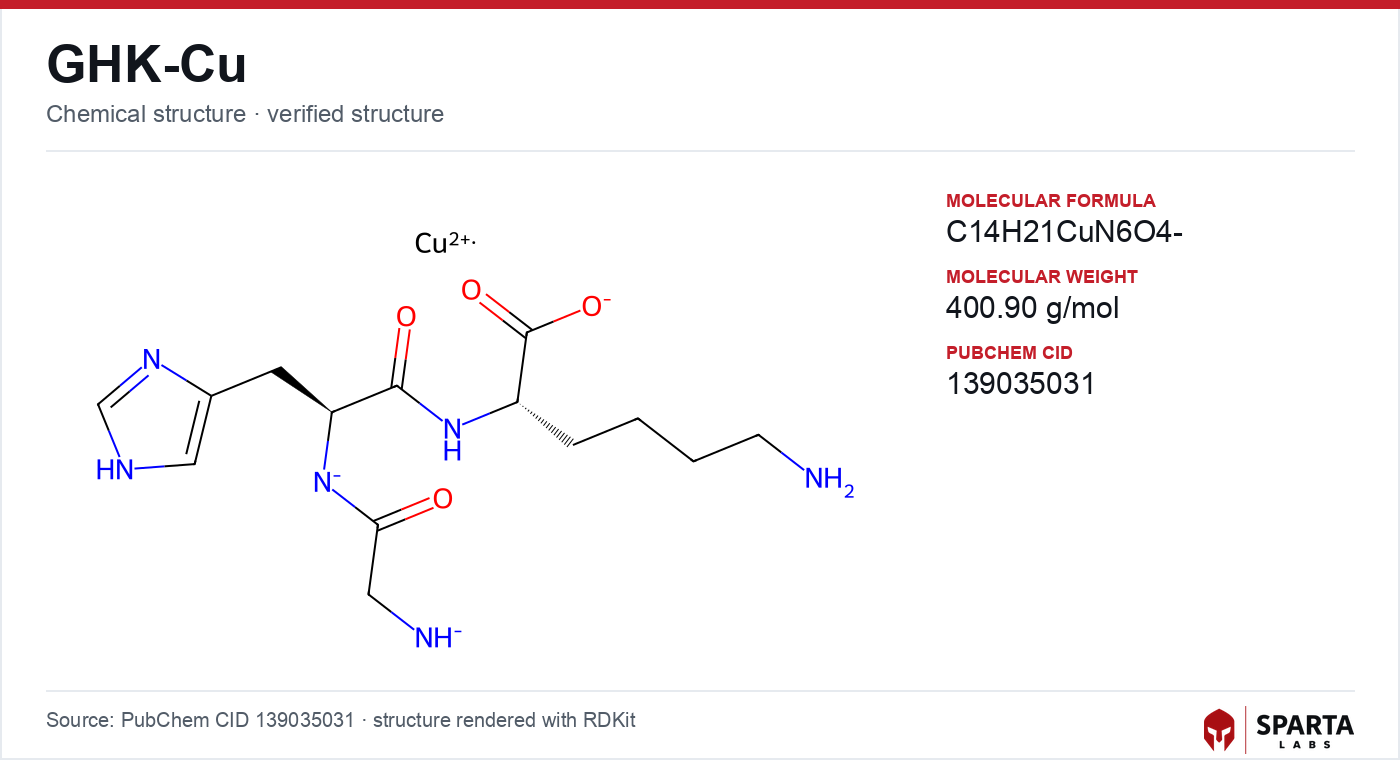
Figure: chemical structure of GHK-Cu.
A copper complex first, a peptide second
The defining feature of GHK-Cu is the metal, not just the peptide. Free GHK is glycyl-L-histidyl-L-lysine, molecular formula C₁₄H₂₄N₆O₄ and a molecular weight near 340.4 daltons. Its identity in solution, however, is dominated by copper. The tripeptide binds Cu(II) to form a stable 1:1 complex, and the published affinity for that binding is in the nanomolar range, comparable to the copper-transport site on albumin, the principal copper carrier in plasma [3].
The geometry of the bound copper has been characterized structurally. Coordination is described as involving the alpha-amino nitrogen of the N-terminal glycine, the deprotonated amide nitrogen of the intervening peptide bond, and the imidazole nitrogen of the histidine side chain, with the lysine residue contributing to the overall environment, a square-planar or distorted-square-planar arrangement under physiological conditions [3]. The histidine is the pivot: its imidazole ring sits close enough to the free N-terminus to close a compact chelate ring around the metal, which is why the specific Gly-His-Lys order matters and why the copper affinity is so high [10].
Findings from research models do not establish safety or efficacy in humans. Sparta Labs makes no claims about the use of this compound.
Copper itself is an essential trace element that serves as a catalytic cofactor for a family of cuproenzymes, including cytochrome c oxidase, copper-zinc superoxide dismutase, and lysyl oxidase [11]. Small copper-binding ligands like GHK sit within the broader system of copper handling in plasma that also involves albumin and ceruloplasmin. This places GHK-Cu at the intersection of peptide chemistry and trace-metal biology, a position that distinguishes it from the copper-free peptides in the research library such as BPC-157.
A fragment hidden inside collagen
GHK is not only a plasma molecule; the same three-residue sequence is embedded in a structural protein. Gly-His-Lys occurs within the alpha-2(I) chain of type I collagen, the most abundant protein in the extracellular matrix. Research has proposed that GHK can be liberated at sites of tissue injury when proteases act on collagen, releasing the tripeptide locally where it may then coordinate available copper [4].
This "cryptic peptide" framing, a signaling fragment concealed inside a larger structural protein until proteolysis exposes it, has shaped much of the investigation into GHK-Cu. It is the reason a large share of the peer-reviewed work sits in connective-tissue and matrix-biology journals rather than in classical receptor pharmacology. Studies in fibroblast culture reported that the copper complex was associated with changes in collagen and glycosaminoglycan production [4], and later work described modulation of matrix metalloproteinases and their tissue inhibitors [5]. These reports are neutral observations from research models; they are examined in more depth in the GHK-Cu published research summary.
Detection across human biofluids
Because GHK is endogenous, part of the overview literature concerns where and at what levels it is found. The tripeptide has been reported in human plasma, and its presence has been discussed across biological compartments including saliva and urine [8]. Reported plasma concentrations have been placed in the high-nanomolar to low-micromolar range, with variation across biological contexts and analytical methods [8].
The endogenous status carries an interpretive point that recurs in the source material: because GHK is a natural constituent of human fluids, much of the copper-binding characterization was performed to understand a molecule the body already produces, not to design a new drug. That framing is a feature of the historical record and is discussed further in the GHK-Cu discovery and research history article.
Where it sits in the classification scheme
In the research literature GHK-Cu is described as a copper-chelating tripeptide, or more broadly a copper-binding peptide, within the metallopeptide category. It is worth separating from two adjacent classes it is sometimes grouped with.
First, it is not a copper-chaperone protein. Intracellular chaperones such as ATOX1 and CCS are folded proteins that hand copper to specific enzyme partners; GHK is a three-residue peptide with no tertiary structure [11]. Second, it does not map to a single receptor subtype in the way a G-protein-coupled-receptor ligand does. A 2018 analysis using the Broad Institute Connectivity Map reported associations between GHK and expression changes across a broad set of human genes, an observation the authors described as consistent with a wide transcriptional footprint rather than a single defined receptor axis [7]. Reported antioxidant behavior has likewise been attributed to the copper-binding geometry of the complex itself [6].
Research-grade GHK-Cu from Sparta Labs is supplied as a research-use-only material and is characterized by analytical methods appropriate to a copper-peptide complex, including chromatographic purity assessment and mass-spectrometric identity confirmation. Analytical considerations specific to copper peptides are covered in the GHK-Cu sourcing and quality reference.
Regulatory status: two separate tracks
GHK-Cu has an unusual regulatory footprint because it appears in two distinct legal contexts. It is not approved by the United States Food and Drug Administration for any therapeutic indication in humans; in that setting it is handled as a research-use-only material. Separately, GHK-Cu has been used as an ingredient in certain topical cosmetic formulations under the FDA's statutory definition of a cosmetic (21 U.S.C. § 321(i)).
These two tracks are independent. Cosmetic-ingredient use is a regulatory classification tied to intended purpose and labeling; it does not constitute, imply, or substitute for a drug approval, and it carries no determination of therapeutic efficacy. GHK-Cu has additionally been examined in wound-dressing contexts within animal research models [9]. At Sparta Labs the compound is classified strictly as a research-use-only material and is not intended for human administration.
Discovery in brief
The isolation of GHK from albumin fractions was first reported in 1973 in Nature New Biology, where an activity in serum albumin was described as prolonging the survival of normal liver cells [1]. The amino-acid sequence of that active fraction was confirmed as glycyl-histidyl-lysine in 1977 [2]. The copper connection followed: a 1980 report in Nature proposed that the plasma tripeptide may function by facilitating copper uptake into cells, establishing the metal as central to its activity [9]. Systematic study of connective-tissue and matrix effects then developed across the 1980s and 1990s [4][5], with gene-expression profiling arriving in the following decades [7]. The full timeline is covered in the companion history article.
References
-
Pickart L, Thaler MM. Tripeptide in human serum which prolongs survival of normal liver cells and stimulates growth in neoplastic liver. Nat New Biol. 1973;243(124):85–87. PMID: 4349963. View on PubMed
-
Schlesinger DH, Pickart L, Thaler MM. Growth-modulating serum tripeptide is glycyl-histidyl-lysine. Experientia. 1977;33(3):324–325. PMID: 858356. View on PubMed
-
Pickart L, Lovejoy S. Biological activity of human plasma copper-binding growth factor glycyl-L-histidyl-L-lysine. Methods Enzymol. 1987;147:314–328. PMID: 3320434. View on PubMed
-
Maquart FX, Pickart L, Laurent M, Gillery P, Monboisse JC, Borel JP. Stimulation of collagen synthesis in fibroblast cultures by the tripeptide-copper complex glycyl-L-histidyl-L-lysine-Cu2+. FEBS Lett. 1988;238(2):343–346. PMID: 3169264. View on PubMed
-
Simeon A, Wegrowski Y, Bontemps Y, Maquart FX. Expression of glycosaminoglycans and small proteoglycans in wounds: modulation by the tripeptide-copper complex glycyl-L-histidyl-L-lysine-Cu2+. J Invest Dermatol. 2000;115(6):962–968. PMID: 11045606. View on PubMed
-
Pickart L, Vasquez-Soltero JM, Margolina A. GHK-Cu may prevent oxidative stress in skin by regulating copper and modifying expression of numerous antioxidant genes. Cosmetics. 2015;2(3):236–247. DOI: 10.3390/cosmetics2030236. Full text via DOI
-
Pickart L, Vasquez-Soltero JM, Margolina A. The effect of the human peptide GHK on gene expression relevant to nervous system function and cognitive decline. Brain Sci. 2017;7(2):20. PMID: 28212278. View on PubMed
-
Pickart L. The human tri-peptide GHK and tissue remodeling. J Biomater Sci Polym Ed. 2008;19(8):969–988. PMID: 18644225. View on PubMed
-
Pickart L, Freedman JH, Loker WJ, Peisach J, Perkins CM, Stenkamp RE, Weinstein B. Growth-modulating plasma tripeptide may function by facilitating copper uptake into cells. Nature. 1980;288(5792):715–717. PMID: 7453802. View on PubMed
-
Sagripanti JL, Kraemer KH. Site-specific oxidative DNA damage at polyguanosines produced by copper plus hydrogen peroxide. J Biol Chem. 1989;264(3):1729–1734. PMID: 2536366. View on PubMed
-
Kim BE, Nevitt T, Thiele DJ. Mechanisms for copper acquisition, distribution and regulation. Nat Chem Biol. 2008;4(3):176–185. PMID: 18277979. View on PubMed
Disclaimer. Statements in this article have not been evaluated by the Food and Drug Administration. This compound is not intended to diagnose, treat, cure, or prevent any disease. Sparta Labs sells research-use-only materials. Content is provided for educational and informational purposes only and does not constitute medical advice. Consult a qualified medical professional for any health concerns.
Frequently asked questions
What is GHK-Cu?
GHK-Cu is a naturally occurring tripeptide made of glycine, L-histidine, and L-lysine bound to a copper(II) ion, giving it the name copper tripeptide-1. It was first identified in human plasma in the 1970s and is studied in laboratory research. It is a research-use-only compound, not an approved therapeutic.
What is GHK-Cu peptide?
GHK-Cu peptide refers to the copper complex of the tripeptide glycyl-L-histidyl-L-lysine (GHK), a short three-amino-acid sequence. The GHK peptide has a high affinity for copper(II) ions, and the resulting complex is the form most commonly referenced in the published literature and in research materials.
Is GHK-Cu a copper peptide?
Yes. GHK-Cu is classified as a copper peptide because the GHK tripeptide is chemically bound to a copper(II) ion. In the scientific literature it is described as a copper-binding peptide, and it is one of the most frequently studied members of that class.
Is GHK-Cu FDA approved?
No. GHK-Cu is not approved by the FDA as a drug for any human use. It has appeared as an ingredient in some cosmetic formulations, but as a standalone peptide it is offered only as a research-use-only material and carries no FDA-approved therapeutic indication.
What does GHK-Cu do in published research?
In published research, GHK-Cu has been studied primarily for its copper-binding chemistry and its reported activity in in-vitro and animal models. Investigators have described interactions with cellular signaling in laboratory settings; these findings come from research models and do not establish any effect in humans.
Who discovered GHK-Cu?
GHK-Cu traces to work by Loriane Pickart, who isolated the GHK tripeptide from human plasma in the early 1970s and later characterized its copper-binding behavior. Subsequent research by Pickart and other groups examined the chemistry of the copper complex, which is documented across peer-reviewed literature.