
BPC-157: A Research Overview
An educational overview of BPC-157, the proline-rich pentadecapeptide derived from a human gastric-juice protein: its sequence, acid-stable chemistry, pharmacokinetic profile, and the Zagreb research lineage that characterized it. Educational reference.
For research use only. Not for human consumption. This article is educational reference material. It is not medical advice and is not a recommendation to use any substance.
Introduction
BPC-157 (Body Protection Compound-157) is a synthetic pentadecapeptide corresponding to a partial sequence of a larger protein originally isolated from human gastric juice. In the peer-reviewed literature it is described as a stable gastric pentadecapeptide, a phrase that captures both its tissue of origin and the acid-resistant behavior that distinguishes it from most short peptides. This overview assembles what the primary literature records about its molecular identity, its origin in gastroenterological research at the University of Zagreb, its reported pharmacokinetic handling, and its regulatory position, without extending beyond what the cited sources describe.
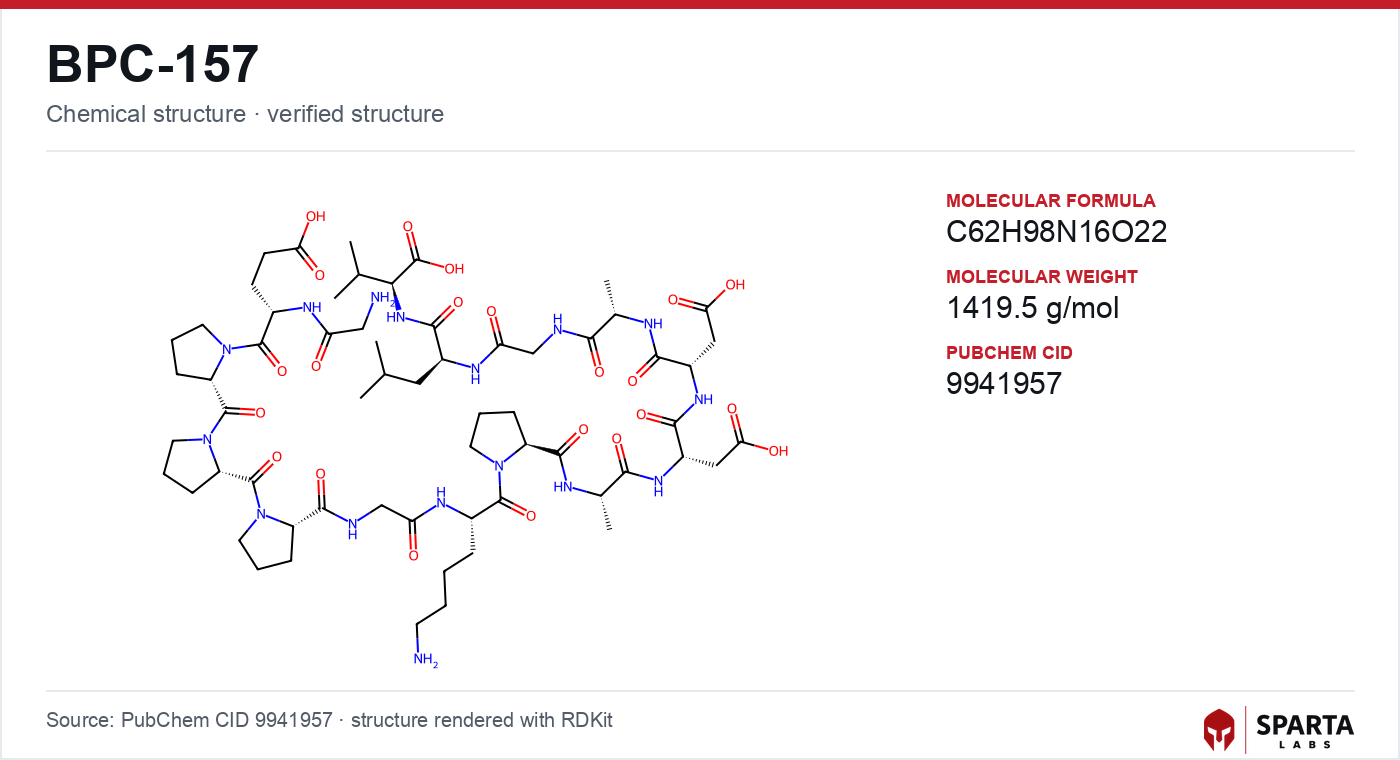
Figure: chemical structure of BPC-157.
A Sequence Read Out of Gastric Juice
Unlike many research peptides that were rationally designed at a bench, BPC-157 was read out of a biological source. The Zagreb group led by Predrag Sikirić isolated a protein they termed Body Protection Compound from human gastric juice and, from its sequence, identified shorter partial fragments for experimental study. BPC-157 is one such fragment: the "157" is a sequence identifier carried over from the original characterization of the parent protein [1].
This provenance matters for how the molecule is classified. Because it derives from a naturally occurring gastric protein rather than from a designed scaffold, the early literature framed BPC-157 within a gastroenterological hypothesis, the "stomach-stress-organoprotection" framework, in which gastric-derived peptides were proposed to participate in systemic responses to stress [1]. The compound entered the literature as a candidate of interest for gastrointestinal research before its study broadened into other tissue systems.
Findings from research models do not establish safety or efficacy in humans. Sparta Labs makes no claims about the use of this compound.
Why Proline Dominates the Structure
BPC-157 has the reported sequence Gly-Glu-Pro-Pro-Pro-Gly-Lys-Pro-Ala-Asp-Asp-Ala-Gly-Leu-Val and a molecular weight near 1,419 daltons. The most structurally distinctive feature of this fifteen-residue chain is its proline density: four residues are proline, and three of them sit consecutively (Pro-Pro-Pro) close to the N-terminus [1].
Proline is chemically unusual among the standard amino acids because its side chain loops back to bond with the backbone nitrogen, forming a rigid five-membered ring. This constraint removes the backbone rotational freedom that other residues enjoy, so proline-rich stretches adopt limited, well-defined conformations rather than folding into typical helices or sheets. A consecutive triple-proline segment therefore imposes a rigid, extended local geometry on this region of the molecule. Proline-adjacent bonds are also poor substrates for many common endopeptidases, which cleave less readily next to the cyclic residue.
These structural facts are frequently cited alongside the empirical observation that BPC-157 remains intact under gastric-acid conditions that rapidly degrade most peptides [1]. The molecule is short enough to be produced by standard solid-phase peptide synthesis, and the synthetic material used in research is chemically identical to the partial gastric sequence. The molecular-weight and sequence data underpin the analytical identity checks discussed in the BPC-157 sourcing and verification standards article.
Pharmacokinetic Characterization
A 2022 study in Frontiers in Pharmacology by He and colleagues examined the pharmacokinetics, tissue distribution, metabolism, and excretion of BPC-157 in rats and dogs following parenteral administration [2]. The authors reported that the peptide was metabolized into smaller fragments and constituent amino acids, and they characterized its distribution and clearance behavior across the two species. This work provides one of the more systematic descriptions of how the intact molecule is handled and broken down in an animal model, complementing the largely mechanism-oriented body of earlier research.
Pharmacokinetic data of this kind are the bridge between a molecule's static chemistry and its behavior in a living system. They describe how quickly the compound is distributed and eliminated, and into what breakdown products, in the specific models studied. As with all findings referenced here, these observations are confined to the animal systems examined and are not statements about human handling.
Reported Pharmacological Interactions
Across the published literature, BPC-157 has been described as a cytoprotective peptide and, in the context of its early clinical framing, as an antiulcer candidate. The pharmacological picture that has emerged from preclinical work is described as multisystem rather than tied to a single receptor.
Individual studies have examined discrete signaling contexts. A 2020 report in Scientific Reports by Hsieh and colleagues described effects of BPC-157 on vasomotor tone through the Src-Caveolin-1-endothelial nitric oxide synthase pathway in a preclinical model [3]. Separately, a 2014 study in Molecules by Chang and colleagues reported changes in growth hormone receptor expression in cultured tendon fibroblasts exposed to the peptide [4]. Each of these describes a distinct interaction characterized in a specific in vitro or animal system; they are not evidence of a unified mechanism, and the molecular details are treated more fully in the BPC-157 mechanism of action article.
BPC-157 is frequently grouped with other peptides studied in regenerative and vascular model systems. Among compounds investigated in overlapping musculoskeletal contexts during the same period is TB-500, which sits alongside BPC-157 in the broader tissue-repair research cluster.
The Zagreb Research Lineage
The sustained experimental program behind BPC-157 is closely associated with Sikirić's laboratory at the University of Zagreb, Croatia, which produced the foundational 1993 description and much of the subsequent preclinical characterization [1]. The name records this lineage directly: Body Protection Compound denotes the parent gastric protein, and the numeric suffix marks the position of the fragment in the original sequence.
During the early 2000s, the Croatian pharmaceutical company Pliva pursued formulations of the peptide, designated PL-10, PLD-116, and PL14736, in early-stage investigations related to inflammatory bowel research. A 2007 paper in the Journal of Pharmacological Sciences documented work under this program in a rat anastomosis model and is representative of the translational framing of that era [5]. Over the following decade, independent groups outside Zagreb began publishing with the compound, broadening the geographic and disciplinary base of the literature.
Regulatory Status
Research-grade BPC-157 from Sparta Labs is supplied for laboratory research use and is accompanied by third-party analytical documentation for each batch. As of the preparation of this article, BPC-157 holds no marketing authorization from the FDA, the EMA, or comparable regulatory bodies for any therapeutic indication. The published record remains preclinical or early-phase in character, and the compound is classified as a research-use-only (RUO) material in the United States.
For the fuller timeline of how the compound moved from a gastric-juice isolate to a widely studied research peptide, see the BPC-157 discovery and regulatory history article.
References
-
Sikirić P, Petek M, Rucman R, Seiwerth S, Grabarević Z, Rotkvić I, et al. A new gastric juice peptide, BPC. An overview of the stomach-stress-organoprotection hypothesis and beneficial effects of BPC. J Physiol Paris. 1993;87(5):313–327. PMID: 8298609. View on PubMed
-
He Y, Chang R, Han B, Shi C, Li Y, Wang H, et al. Pharmacokinetics, distribution, metabolism, and excretion of body-protective compound 157, in rats and dogs. Front Pharmacol. 2022;13:1086885. PMC9794587. Full text on PMC
-
Hsieh MJ, Lee CH, Chueh HY, Ho TY, Lin CY, Chen KB, et al. Modulatory effects of BPC 157 on vasomotor tone and the activation of Src-Caveolin-1-endothelial nitric oxide synthase pathway. Sci Rep. 2020;10(1):17078. PMID: 33051481. DOI: 10.1038/s41598-020-74064-0. View on PubMed
-
Chang CH, Tsai WC, Hsu YH, Pang JH. Pentadecapeptide BPC 157 enhances the growth hormone receptor expression in tendon fibroblasts. Molecules. 2014;19(11):19066–19077. PMC6271067. DOI: 10.3390/molecules191119066. Full text on PMC
-
Sikirić P, Seiwerth S, Grabarević Z, Rucman R, Petek M, Jagić V, et al. Stable gastric pentadecapeptide BPC 157 in trials for inflammatory bowel disease (PL-10, PLD-116, PL14736, Pliva, Croatia) heals ileoileal anastomosis in the rat. J Pharmacol Sci. 2007;104(1):7–17. PMID: 17713731. View on PubMed
Disclaimer. Statements in this article have not been evaluated by the Food and Drug Administration. This compound is not intended to diagnose, treat, cure, or prevent any disease. Sparta Labs sells research-use-only materials. Content is provided for educational and informational purposes only and does not constitute medical advice. Consult a qualified medical professional for any health concerns.
Frequently asked questions
What is BPC-157?
BPC-157 is a synthetic peptide made up of 15 amino acids, whose sequence was derived from a protein found in human gastric juice. It is used as a research compound and is not an approved drug. Published studies to date have been conducted in preclinical laboratory and animal models.
What is BPC-157 peptide?
BPC-157 is a stable peptide fragment consisting of 15 amino acids, sometimes referred to in the literature as a "body protection compound" derived from gastric juice. Chemically it is a short single-chain peptide, and it is handled as a research-use-only material rather than a therapeutic product.
Is BPC-157 FDA approved?
No. BPC-157 is not approved by the FDA for any human use and has not completed the clinical-trial process required for drug approval. In 2023 the FDA placed BPC-157 in a category of substances that raised safety concerns for use in compounded preparations. It is offered for research use only.
Is BPC-157 legal?
BPC-157 is not a controlled substance under U.S. federal law, but it is not an FDA-approved drug or dietary ingredient, and it is sold only as a research-use-only material not intended for human consumption. Its regulatory status can differ by jurisdiction, so applicable local and national regulations should be reviewed.
Is BPC-157 banned?
The World Anti-Doping Agency (WADA) lists BPC-157 among prohibited substances for athletes under its category of non-approved agents. Separately, in 2023 the FDA identified BPC-157 as a substance it did not consider suitable for use in compounded drug products. It remains available as a research chemical.
How does BPC-157 work in research studies?
Published preclinical research has reported that BPC-157 interacts with pathways involved in tissue and vascular processes in animal models, though its precise mechanism remains under investigation. These findings come from laboratory and animal studies and do not establish any mechanism, safety, or effect in humans.