
BPC-157: Discovery and Regulatory History
How BPC-157 traveled from a 1993 gastric-cytoprotection hypothesis at the University of Zagreb, through Pliva's PL14736 clinical program, to research-use-only status and a 2022 WADA Monitoring Program listing. Educational reference.
For research use only. Not for human consumption. This article is educational reference material. It is not medical advice and is not a recommendation to use any substance.
BPC-157: Discovery and Regulatory History
BPC-157 is a synthetic pentadecapeptide whose documented history begins with Croatian gastric-physiology research in the early 1990s and extends, through a Pliva-sponsored clinical program and a large preclinical literature, to the anti-doping monitoring status it holds today. This article reconstructs that timeline from published, peer-reviewed sources and public regulatory records, and confines itself to what those sources report.
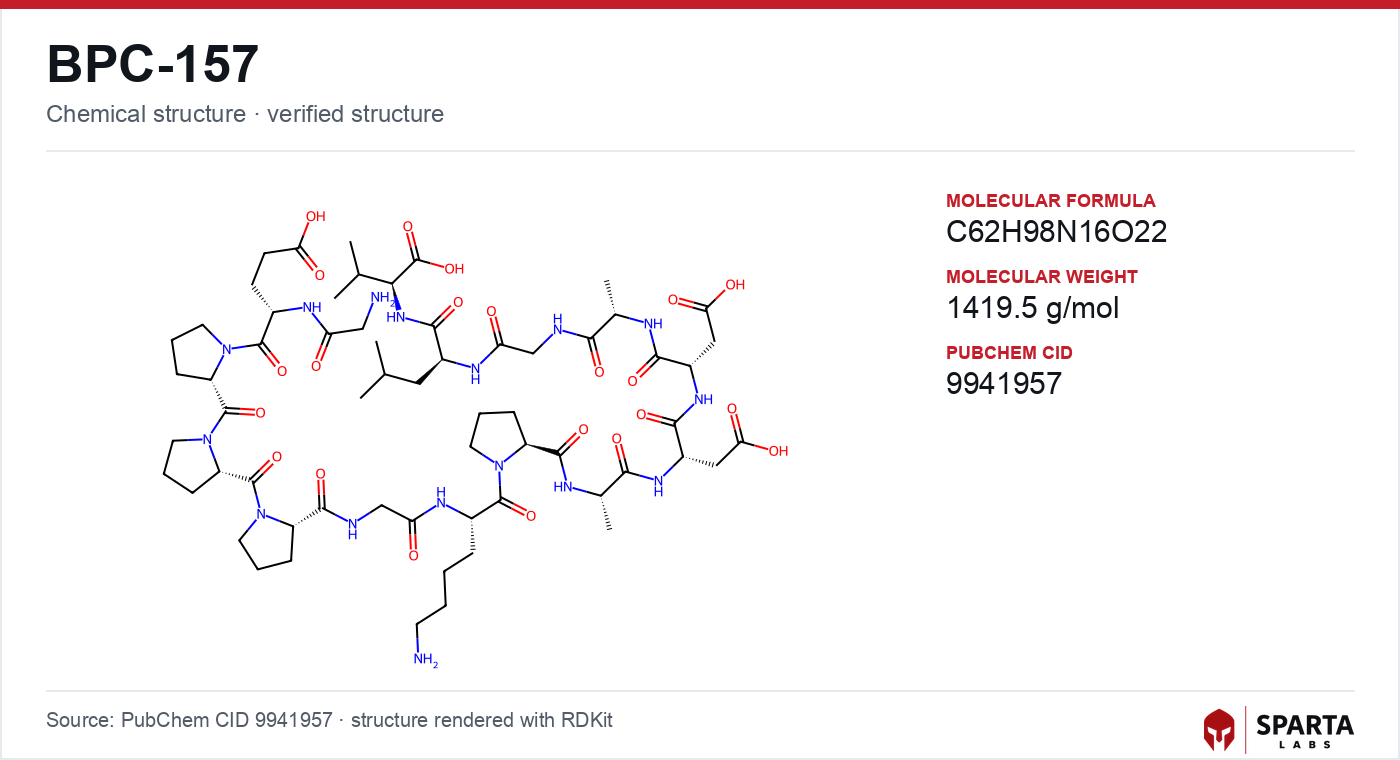
Figure: chemical structure of BPC-157.
The gastric-juice hypothesis that produced the sequence
BPC-157 did not arise from a drug-design campaign; it emerged from a specific hypothesis about the stomach. Through the 1970s and 1980s, gastric-physiology research had established the concept of "cytoprotection", the observation by André Robert and others that certain agents could protect gastric mucosa against injury without reducing acid secretion [1]. Working within that intellectual tradition at the University of Zagreb School of Medicine, a group led by Predrag Sikirić proposed that human gastric juice itself contained protein mediators of this protective response.
Their 1993 report in Journal of Physiology (Paris) described a protein preparation isolated from human gastric juice, which they designated BPC (Body Protection Compound) and characterized partial peptide sequences derived from it [2]. The 15-amino-acid sequence subsequently designated BPC-157 was defined from that work. Two properties of the sequence were emphasized as unusual for a peptide of that length: its reported stability in human gastric juice and its solubility in water, both of which distinguished it from peptides expected to be rapidly degraded in an acidic proteolytic environment [2].
Findings from research models do not establish safety or efficacy in humans. Sparta Labs makes no claims about the use of this compound.
It is worth noting a point of ongoing scholarly discussion around this origin story: BPC-157, as studied, is a fully synthetic sequence, and its status as a naturally occurring fragment of a larger native protein has been questioned in later reviews. The discovery narrative and the molecule's present identity as a defined synthetic peptide are treated separately in the BPC-157 research overview.
From gastric model to a broadening preclinical program (1990s–2000s)
After the 1993 paper, the Zagreb group published a sustained series of rodent studies. The initial models stayed close to the gastric-cytoprotection premise (cysteamine-induced duodenal injury and reflux-esophagitis models), but the program soon widened. A 1997 study in Journal of Physiology (Paris) reported effects of the pentadecapeptide in non-steroidal anti-inflammatory-agent gastrointestinal-lesion and adjuvant-arthritis models in rats, an early signal that the group intended to characterize the compound well beyond the gastrointestinal tract [3].
Across this period the research expanded into models of soft-tissue, tendon, and bone injury. This expansion is the structural reason BPC-157 is often grouped with other tissue-repair research peptides; readers tracing that cluster may compare the parallel timeline of TB-500, a thymosin-derived peptide studied in overlapping injury models. How the reported findings connect to proposed molecular pathways is treated in the BPC-157 mechanism of action article rather than here.
The Pliva clinical program: PL-10, PLD-116, PL14736
The most concrete regulatory chapter in BPC-157's history is its advancement into human clinical investigation by the Croatian pharmaceutical company Pliva. Under successive internal designations (PL-10, PLD-116, and PL14736), Pliva sponsored early-phase clinical work directed principally at inflammatory bowel disease, including ulcerative colitis, and at wound-healing applications.
These clinical activities are referenced within the peer-reviewed preclinical literature rather than reported as standalone pivotal-trial publications. A 2008 paper in the Journal of Pharmacological Sciences, for example, carries the PL14736 / Pliva designation in its title while describing fistula-healing experiments in rats, and situates the peptide explicitly within that trial program [4]. The published record therefore establishes that a defined human-directed program existed under a named pharmaceutical sponsor; it does not, in the openly available literature, extend to registration-quality Phase III trial reports.
Regulatory status: unapproved and research-use-only
As of the preparation of this article, BPC-157 has not received marketing authorization from the US Food and Drug Administration, the European Medicines Agency, or equivalent national regulators for any therapeutic indication. It is classified and sold in the United States as a research-use-only (RUO) material. Verification and analytical-standards questions relevant to research-grade material are addressed in the BPC-157 sourcing and quality article, and catalog details appear on the BPC-157 product page.
BPC-157 sits within a group of well-studied but unapproved research peptides. A regulatory neighbor within the same tissue-response research area is KPV, a tripeptide that has likewise not received marketing authorization for any therapeutic use. In the United States, the compound's unapproved status also intersects with compounding policy: the FDA has publicly categorized BPC-157 among substances it has flagged for pharmacy compounding review, reflecting the agency's position that available data are insufficient to support that use.
Anti-doping: the 2022 WADA Monitoring Program listing
A distinct regulatory milestone comes from sport rather than medicine. The World Anti-Doping Agency (WADA) added BPC-157 to its Monitoring Program in 2022. The Monitoring Program is legally separate from the Prohibited List: substances placed on it are subject to detection and data collection in competitive athletes so that WADA can assess patterns of use, but they are not prohibited under the World Anti-Doping Code by virtue of monitoring alone.
The listing is historically significant because it marks the point at which BPC-157's diffusion beyond the laboratory became visible to an international regulatory body. The analytical side kept pace: mass-spectrometry methods for detecting BPC-157 and its metabolites in human urine have been published in the anti-doping literature, giving testing authorities the tools that monitoring presupposes [5]. As of the most recent available WADA documentation, BPC-157 remains monitored rather than prohibited.
The current research landscape
By the mid-2020s the BPC-157 corpus had grown to several hundred publications. The largest share still originates from the Zagreb group, but independent contributions have accumulated, notably a body of in vitro tendon-fibroblast work from investigators at Chang Gung University in Taiwan beginning in the 2010s [6], and, more recently, systematic pharmacokinetic characterization. A 2022 study in Frontiers in Pharmacology reported absorption, distribution, metabolism, and excretion data for the compound in rats and dogs, providing one of the first structured pharmacokinetic profiles in the peer-reviewed record [7].
The literature has also matured to the point of supporting formal evidence synthesis. A 2025 systematic review in HSS Journal applied systematic-review methodology to the orthopaedic and sports-medicine literature on BPC-157, cataloguing the published animal and human studies in that domain and identifying well-designed human randomized controlled trials as the field's outstanding requirement [8]. That framing captures the compound's present historical position: a molecule with three decades of preclinical characterization, a documented but incomplete clinical program, no marketing approval, and an active anti-doping monitoring status. The breadth of that literature by subtopic is summarized in the BPC-157 published research article.
References
-
Robert A, Nezamis JE, Lancaster C, Hanchar AJ. Cytoprotection by prostaglandins in rats. Prevention of gastric necrosis produced by alcohol, HCl, NaOH, hypertonic NaCl, and thermal injury. Gastroenterology. 1979;77(3):433–443. PMID: 456839. View on PubMed
-
Sikirić P, Petek M, Rucman R, Seiwerth S, Grabarević Z, Rotkvić I, et al. A new gastric juice peptide, BPC. An overview of the stomach-stress-organoprotection hypothesis and beneficial effects of BPC. J Physiol Paris. 1993;87(5):313–327. PMID: 8298609. View on PubMed
-
Sikirić P, Seiwerth S, Grabarević Z, Rucman R, Petek M, Jagić V, et al. Pentadecapeptide BPC 157 positively affects both non-steroidal anti-inflammatory agent-induced gastrointestinal lesions and adjuvant arthritis in rats. J Physiol Paris. 1997;91(3–5):113–122. PMID: 9403785. View on PubMed
-
Klicek R, Sever M, Radic B, Drmic D, Kocman I, Zoricic I, et al. Pentadecapeptide BPC 157, in clinical trials as a therapy for inflammatory bowel disease (PL14736), is effective in the healing of colocutaneous fistula in rats. J Pharmacol Sci. 2008;108(1):7–17. PMID: 18763991. View on PubMed
-
Martinez-Brito D, de la Torre X, Botrè F. BPC-157, a growth-factor-modulating peptide: analytical strategy for its detection in urine for doping-control purposes. Drug Test Anal. 2023. PMID: 36269069. View on PubMed
-
Chang CH, Tsai WC, Lin MS, Hsu YH, Pang JH. The promoting effect of pentadecapeptide BPC 157 on tendon healing involves tendon outgrowth, cell survival, and cell migration. J Appl Physiol. 2011;110(3):774–780. PMID: 21030672. View on PubMed
-
He Y, Chang R, Han B, Shi C, Li Y, Wang H, et al. Pharmacokinetics, distribution, metabolism, and excretion of body-protective compound 157, a potential drug for treating various wounds, in rats and dogs. Front Pharmacol. 2022;13:1086885. PMID: 36569311. View on PubMed
-
Vasireddi N, Vasireddi N, Shukla AJ, Nho SJ, Salata MJ, Voos JE, et al. Emerging use of BPC-157 in orthopaedic sports medicine: a systematic review. HSS J. 2025. PMID: 40756949. View on PubMed
Disclaimer. Statements in this article have not been evaluated by the Food and Drug Administration. This compound is not intended to diagnose, treat, cure, or prevent any disease. Sparta Labs sells research-use-only materials. Content is provided for educational and informational purposes only and does not constitute medical advice. Consult a qualified medical professional for any health concerns.
Frequently asked questions
When and where was BPC-157 discovered?
BPC-157 traces to a 1993 report in Journal of Physiology (Paris) by Predrag Sikirić and colleagues at the University of Zagreb School of Medicine, Croatia. That work isolated a protein from human gastric juice, named it Body Protection Compound (BPC), and defined partial sequences including the 15-amino-acid sequence later designated BPC-157.
What was the Pliva clinical program for BPC-157?
The Croatian pharmaceutical company Pliva sponsored early-phase human clinical investigation of BPC-157 under the designations PL-10, PLD-116, and PL14736, directed mainly at inflammatory bowel disease and wound healing. These activities are referenced within the peer-reviewed preclinical literature rather than as standalone pivotal-trial publications.
Is BPC-157 an approved drug?
As of the preparation of this article, BPC-157 has not received marketing authorization from the FDA, the EMA, or equivalent regulators for any therapeutic indication. In the United States it is classified and sold as a research-use-only material, and the FDA has flagged it among substances under compounding review.
Is BPC-157 banned by WADA?
The World Anti-Doping Agency added BPC-157 to its Monitoring Program in 2022, which is legally distinct from the Prohibited List. Monitored substances are tracked for use patterns in competitive athletes but are not prohibited under the World Anti-Doping Code by virtue of monitoring alone; as of the most recent WADA documentation BPC-157 remains monitored rather than prohibited.