
GHK-Cu Mechanism of Action
A mechanism-focused review of GHK-Cu built around its copper(II) coordination chemistry: the tripeptide binding site, the copper-shuttle hypothesis, reported extracellular-matrix effects, and transcriptomic profiling in the peer-reviewed literature. Educational reference.
For research use only. Not for human consumption. This article is educational reference material. It is not medical advice and is not a recommendation to use any substance.
Why GHK-Cu Is Studied as a Coordination Complex, Not a Receptor Ligand
GHK-Cu (glycyl-L-histidyl-L-lysine coordinated to copper(II)) occupies an unusual position in the peptide research literature. Most bioactive peptides are studied as ligands for a defined membrane receptor, and their mechanism is described in terms of a single binding event and its downstream signaling cascade. GHK-Cu is different: the tripeptide is a copper-binding motif, and much of the mechanistic work treats the intact metal complex, rather than the free peptide, as the species of interest. This article organizes the reported mechanisms around that coordination-chemistry starting point, moving from the metal-binding site outward to cellular and transcriptional observations. The bibliographic detail behind these studies is collected in the companion GHK-Cu published research article, and the discovery timeline is covered in the GHK-Cu discovery and research history article.
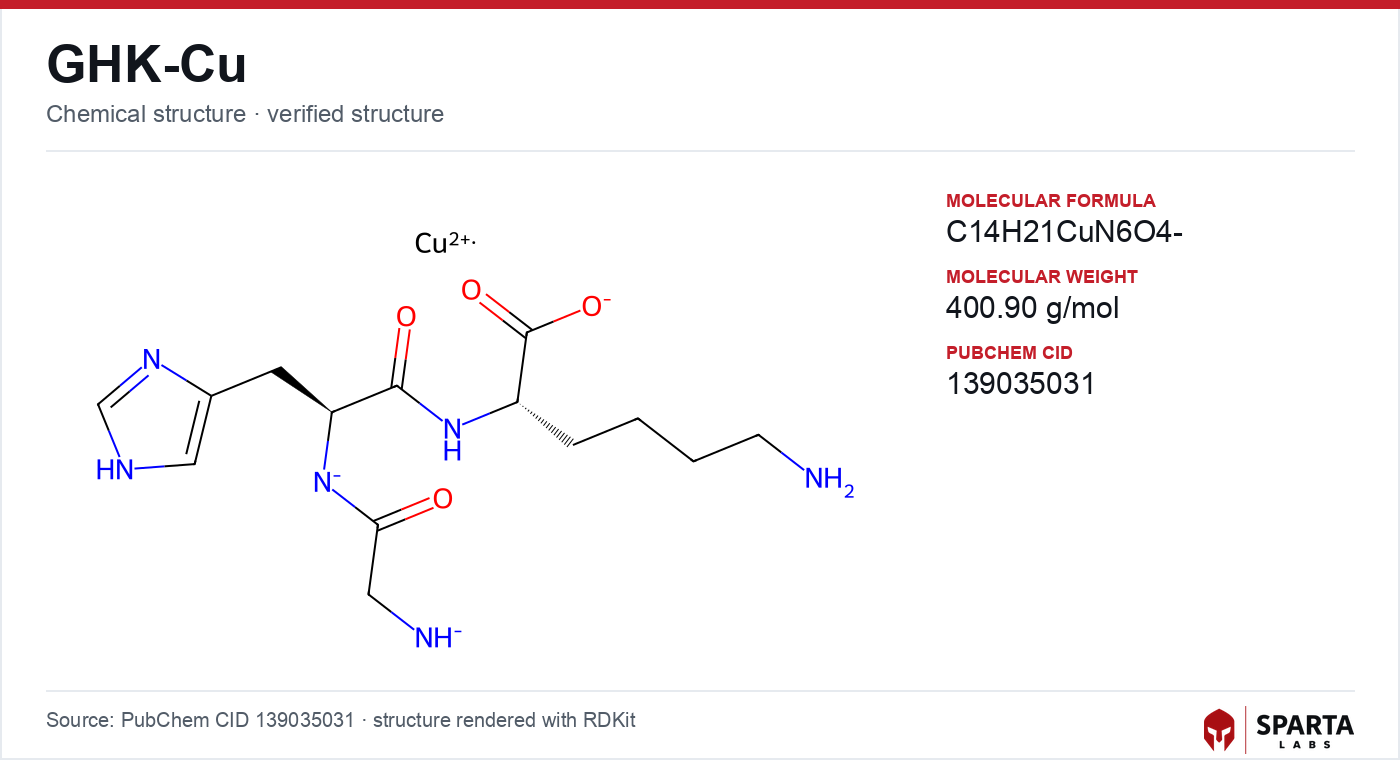
Figure: chemical structure of GHK-Cu.
The Copper(II) Binding Site: Nitrogen-Donor Coordination
The mechanistic foundation of GHK-Cu is the geometry with which the tripeptide binds Cu(II). The glycyl-histidyl-lysine sequence presents a set of nitrogen donor atoms that together form a chelate around the copper ion, a coordination pattern described in the early spectroscopic literature on GHK and on structurally related copper-transport peptides. The arrangement is frequently likened to the amino-terminal copper-binding site of human serum albumin, which coordinates Cu(II) through the peptide backbone and a histidine imidazole. This resemblance is why GHK is often framed as an albumin-like copper carrier rather than as a simple chelator.
Two features of this binding site matter mechanistically. First, the complex is described as having high copper affinity, which allows GHK to compete for Cu(II) in biological fluids where copper is otherwise bound to carrier proteins. Second, the coordination geometry sequesters the copper ion, which is relevant to the antioxidant discussion below because tightly coordinated copper is less able to participate in uncontrolled redox cycling than loosely bound or free copper.
The Copper-Shuttle Hypothesis
The single most cited mechanistic model for GHK-Cu is the copper-shuttle hypothesis. Pickart and colleagues proposed in a 1980 paper in Nature that the growth-modulating plasma tripeptide GHK may function by facilitating copper uptake into cells, rather than by acting on a dedicated cell-surface receptor [1]. Under this framing, GHK is not the effector; it is a delivery vehicle that presents Cu(II) in a coordination state that cells can assimilate, after which the metal is released to intracellular copper-handling systems.
Findings from research models do not establish safety or efficacy in humans. Sparta Labs makes no claims about the use of this compound.
This model reframes many downstream observations. If GHK-Cu makes copper bioavailable, then effects attributed to the complex could in principle be effects of copper delivered by the complex. Copper is a required cofactor for a family of cuproenzymes, and the availability of copper to those enzymes is a plausible node through which a copper carrier could exert broad influence without a single dedicated receptor. The copper-shuttle hypothesis remains the most mechanistically grounded explanation in the literature reviewed here, though it does not exclude additional, copper-independent activities of the peptide backbone.
Reported Effects on Extracellular-Matrix Biology
The most extensively documented cellular observations for GHK-Cu concern connective-tissue matrix. Maquart and colleagues reported in a 1988 FEBS Letters paper that the glycyl-histidyl-lysine copper complex produced a concentration-dependent stimulation of collagen synthesis in cultured human fibroblasts, with the effect emerging at very low complex concentrations [2]. The authors noted that the response did not simply track with fibroblast cell number, which they interpreted as pointing to an effect on the biosynthetic machinery rather than a general proliferative one. This distinction is mechanistically informative because it separates a matrix-synthesis signal from a mitogenic one.
Broader synthesis of the connective-tissue and matrix observations appears in a 2015 review by Pickart and Margolina, which collected reports of GHK-associated changes in matrix components and remodeling enzymes across multiple experimental systems [3]. The mechanistic relevance of these matrix observations is often tied back to copper coordination: several cuproenzymes participate in the maturation and cross-linking of connective-tissue proteins, so a copper carrier that improves the availability of the metal to those enzymes offers one internally consistent link between the coordination chemistry and the reported matrix effects. As with all in vitro and animal-model work, species differences in copper metabolism and tissue architecture limit direct extrapolation.
Antioxidant Framing from Copper Sequestration
A second mechanistic theme concerns redox behavior, and here the coordination geometry is central. Free or loosely coordinated Cu(II) can catalyze the generation of reactive oxygen species through Fenton-type chemistry. Because GHK binds copper in a defined, high-affinity geometry, the intact complex is often discussed as sequestering copper away from that uncontrolled redox chemistry, which is a coordination-chemistry argument rather than a claim about a signaling pathway. This framing is complementary to the copper-shuttle hypothesis: the same tight binding that allows controlled delivery also constrains indiscriminate redox cycling of the metal in transit. Direct experimental attribution of specific antioxidant outcomes to GHK-Cu, as opposed to inferences from its coordination chemistry, remains an area where the literature is still developing.
Transcriptomic Associations and Gene-Expression Profiling
Beyond individual pathways, GHK has been characterized at the level of broad gene-expression signatures. Pickart, Vasquez-Soltero, and Margolina used the Broad Institute Connectivity Map (CMap), a database that correlates small-molecule exposures with transcriptional signatures across human cell lines, to describe GHK's gene-expression footprint. Their analyses reported that GHK's signature was associated with expression changes across a large number of human genes, including genes related to extracellular-matrix homeostasis, inflammation, and DNA repair, and they framed these associations as consistent with a broad, multi-gene profile rather than a single-pathway effect [4]. A related analysis focused on genes relevant to nervous-system function [5].
The mechanistic status of this evidence should be stated plainly. CMap is a correlational, pharmacogenomic method: it identifies expression signatures that resemble one another, which is powerful for generating hypotheses but does not by itself establish that GHK directly regulates any given gene. Causal attribution requires targeted experiments in defined systems. The transcriptomic work is therefore best read as mapping the breadth of GHK's associations, not as demonstrating a mechanism at the level of individual gene regulation.
Fibrosis-Model Signaling Observations
One line of animal work extends GHK into signaling relevant to tissue remodeling. Zhou and colleagues reported in a 2017 study that, in a bleomycin-induced pulmonary fibrosis mouse model, GHK administration was associated with reduced transforming growth factor-beta-1 (TGF-beta-1) levels and with altered markers of epithelial-to-mesenchymal transition in lung tissue [6]. The authors proposed involvement of the TGF-beta-1/Smad axis. This observation is mechanistically interesting because TGF-beta signaling sits at a control point for matrix deposition, tying a signaling readout back to the matrix themes discussed above. TGF-beta pathway involvement in tissue-repair contexts has also been described for other regenerative peptides studied in the library, including TB-500, which is reported to act through distinct molecular targets centered on actin dynamics.
Limits of Current Mechanistic Understanding
Several mechanistic questions remain open in the peer-reviewed literature reviewed here. No dedicated membrane receptor or intracellular binding protein for GHK-Cu has been definitively identified and pharmacologically characterized, which is why the copper-shuttle model, rather than a receptor-occupancy model, dominates mechanistic discussion. The copper-dependence of specific effects is not uniform across reports; some observations require the intact complex while others are attributed to copper or to the peptide alone, and resolving which species is proximal in a given assay is an active question.
Most of the data derive from in vitro systems and rodent models, and species differences in copper handling, matrix biology, and peptide bioavailability constrain extrapolation. The transcriptomic evidence is correlational and awaits mechanistic confirmation in defined systems. Researchers evaluating material for mechanistic studies can review purity and identity specifications on the GHK-Cu product page, with wider context in the GHK-Cu research overview and analytical detail in the GHK-Cu sourcing and verification article.
References
-
Pickart L, Freedman JH, Loker WJ, Peisach J, Perkins CM, Stenkamp RE, Weinstein B. Growth-modulating plasma tripeptide may function by facilitating copper uptake into cells. Nature. 1980;288(5792):715–717. PMID: 7453802. View on PubMed
-
Maquart FX, Pickart L, Laurent M, Gillery P, Monboisse JC, Borel JP. Stimulation of collagen synthesis in fibroblast cultures by the tripeptide-copper complex glycyl-L-histidyl-L-lysine-Cu2+. FEBS Lett. 1988;238(2):343–346. PMID: 3169264. View on PubMed
-
Pickart L, Margolina A. Regenerative and protective actions of the GHK-Cu peptide in the light of the new gene data. (See also: Pickart L, Vasquez-Soltero JM, Margolina A. GHK peptide as a natural modulator of multiple cellular pathways in skin regeneration.) Biomed Res Int. 2015;2015:648108. PMID: 26236730. View on PubMed
-
Pickart L, Vasquez-Soltero JM, Margolina A. Regenerative and protective actions of the GHK-Cu peptide in the light of the new gene data. Int J Mol Sci. 2018;19(7):1987. PMID: 29986520. View on PubMed
-
Pickart L, Vasquez-Soltero JM, Margolina A. The effect of the human peptide GHK on gene expression relevant to nervous system function and cognitive decline. Brain Sci. 2017;7(2):20. PMID: 28212278. View on PubMed
-
Zhou XM, Wang GL, Wang XB, Liu L, Zhang Q, Yin Y, Wang QY, Kang J, Hou G. GHK peptide inhibits bleomycin-induced pulmonary fibrosis in mice by suppressing TGFβ1/Smad-mediated epithelial-to-mesenchymal transition. Front Pharmacol. 2017;8:904. PMID: 29311914. View on PubMed
Disclaimer. Statements in this article have not been evaluated by the Food and Drug Administration. This compound is not intended to diagnose, treat, cure, or prevent any disease. Sparta Labs sells research-use-only materials. Content is provided for educational and informational purposes only and does not constitute medical advice. Consult a qualified medical professional for any health concerns.
Frequently asked questions
Why is copper central to how GHK-Cu is described mechanistically?
GHK is a copper-binding tripeptide, and much of the mechanistic literature treats the intact copper(II) complex, rather than the free peptide, as the species of interest. The glycyl-histidyl-lysine sequence coordinates Cu(II) through nitrogen donor atoms in a geometry that resembles the copper-transport site of human serum albumin. Because of this, researchers have studied GHK-Cu less as a receptor ligand and more as a copper-coordination system.
What is the copper-shuttle hypothesis for GHK-Cu?
Pickart and colleagues proposed in a 1980 Nature paper that GHK may act by facilitating copper uptake into cells rather than by binding a dedicated membrane receptor. Under this framing, the tripeptide presents Cu(II) in a coordination form that cells can assimilate, after which copper becomes available to copper-dependent enzymes. It remains the most frequently cited mechanistic model in the literature reviewed here.
Does GHK-Cu act through a single identified receptor?
No dedicated membrane receptor or intracellular binding protein for GHK-Cu has been definitively identified and pharmacologically characterized in the peer-reviewed sources reviewed here. Reported activities appear multifactorial, spanning copper coordination, matrix-related effects, and broad transcriptional associations. This distinguishes GHK-Cu from compounds that act through a defined single-receptor axis.
What do gene-expression analyses report about GHK?
Analyses drawing on the Broad Institute Connectivity Map have reported that GHK's gene-expression signature is associated with changes across a large set of human genes, including genes related to matrix homeostasis, inflammation, and DNA repair. These are pharmacogenomic correlations useful for generating hypotheses. Causal attribution of specific expression changes to GHK-Cu requires independent experimental validation.
Is GHK-Cu's mechanism established in humans?
The mechanistic data summarized here derive largely from in vitro cell-culture systems and rodent models. Findings from research models do not establish safety or efficacy in humans, and species differences in copper metabolism and peptide handling remain active research questions. GHK-Cu is a research-use-only material and Sparta Labs makes no claims about its use.