
KLOW Peptide Blend: A Four-Compound Structural Comparison
A structural comparison of KLOW blend peptides GHK-Cu, TB-500, BPC-157, and KPV, covering origin, amino-acid composition, molecular class, and the published-research and regulatory status of each. Educational reference.
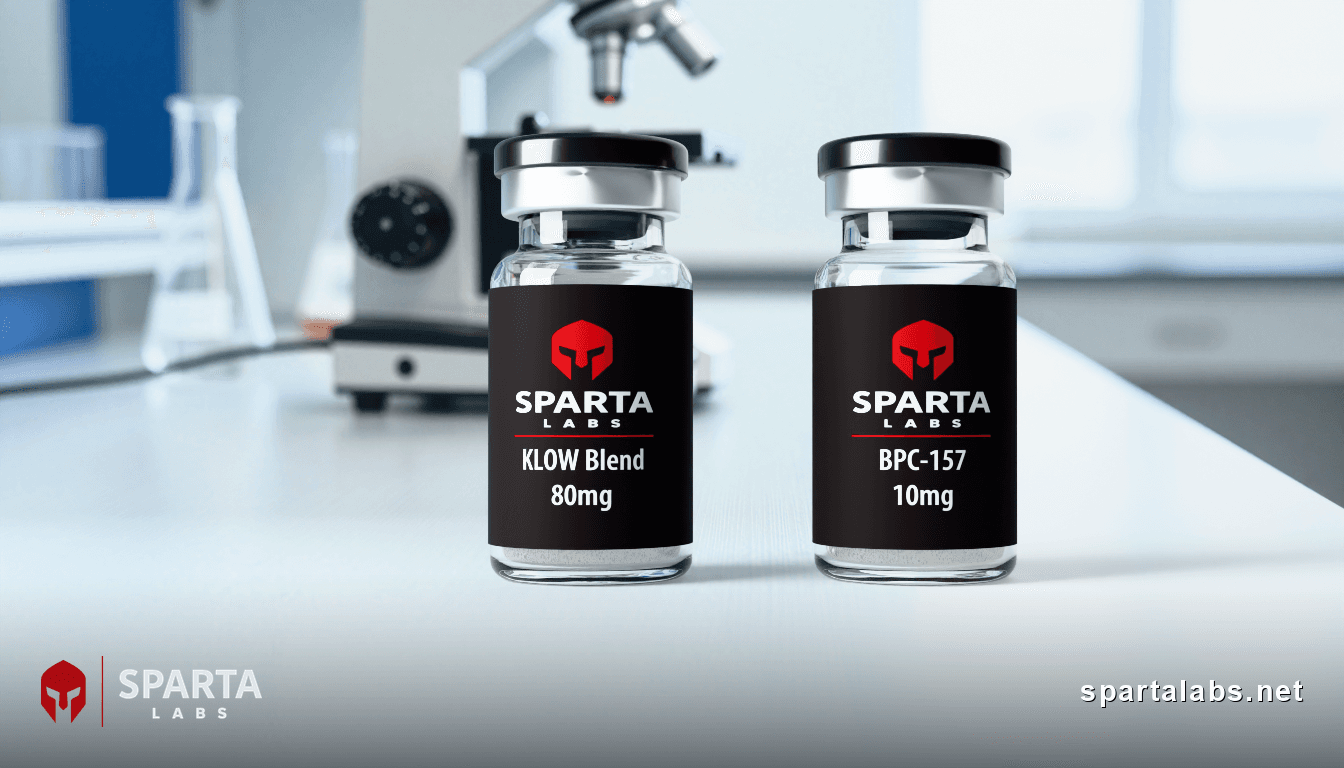
The search phrase "klow peptide" and its variants ("klow blend," "klow peptide blend") refer to a combined research material sold under the name KLOW, containing four individually studied synthetic peptides: GHK-Cu, TB-500, BPC-157, and KPV. These four peptides are frequently discussed together in the research-peptide community and are sold as a combined research reference material under the name "KLOW." This article compares the four compounds strictly along the dimensions permitted for a structural comparison: their origin and derivation, amino-acid composition and sequence length, molecular classification, and the type and regulatory status of the published research associated with each. It does not describe why the four compounds are combined, does not compare their relative activity, and does not make any claim about combined or synergistic effects among them. For purposes of this article, each compound is treated as an independent research reference material with its own published record, most of which sits in preclinical models. None of GHK-Cu, TB-500, BPC-157, KPV, or the combined KLOW Blend material is approved by the U.S. Food and Drug Administration (FDA) for any human use.
GHK-Cu profile
Origin and derivation
GHK-Cu (glycyl-L-histidyl-L-lysine-copper(II) complex) is a naturally occurring tripeptide-metal complex found in human plasma, saliva, and urine. It was first isolated from human albumin in 1973 by Pickart and Thaler at the University of California, San Francisco, during research on hepatocyte growth regulation. [1] The full amino acid sequence, glycyl-L-histidyl-L-lysine, was confirmed in 1977. [2]
Amino-acid composition and molecular class
GHK is a tripeptide composed of glycine, L-histidine, and L-lysine, with a molecular formula of C14H24N6O4 and a molecular weight of approximately 340.4 daltons for the free tripeptide. Its copper(II) complex, GHK-Cu, is formed by coordination of Cu2+ through the alpha-amino nitrogen of glycine, the amide nitrogen of the peptide bond, and the imidazole nitrogen of histidine. [3] By molecular class, GHK-Cu is classified in the research literature as a copper-chelating tripeptide, or more broadly as a copper-binding peptide, within the category of metallopeptides. This copper-binding chemistry distinguishes it structurally from the other three compounds discussed in this article, none of which is described in its primary literature as a metal-binding peptide.
Published research and regulatory status
The published research associated with GHK-Cu is predominantly preclinical, spanning in vitro fibroblast studies and in vivo rodent wound-chamber models. A 1994 study published in the Proceedings of the National Academy of Sciences reported concentration-dependent increases in connective tissue accumulation in rat subcutaneous wound chambers administered GHK-Cu. [4]
Findings from research models do not establish safety or efficacy in humans. Sparta Labs makes no claims about the use of this compound.
GHK-Cu is not approved by the FDA for any therapeutic indication in humans. In the United States it is sold as a research-use-only material, and in certain topical formulations it has additionally been used as a cosmetic ingredient, a separate regulatory classification that does not constitute or imply drug approval. For a fuller review of its chemistry and discovery history, see the GHK-Cu research overview.
TB-500 profile
Origin and derivation
TB-500 is the name commonly applied in the research-peptide market to a synthetic peptide related to thymosin beta-4 (T-beta-4), a naturally occurring 43-amino-acid protein described in the literature as an actin-binding protein, first isolated from calf thymus in 1981. [5] TB-500 corresponds to a synthetic, N-terminally acetylated form of the sequence Ac-LKKTETQ, spanning residues 17 through 23 of the parent protein. Analytical work has confirmed that the active content of commercial TB-500 preparations matches this N-acetyl-LKKTETQ sequence. [6]
Amino-acid composition and molecular class
TB-500's parent molecule, thymosin beta-4, is 43 amino acids in length; TB-500 itself is described as a shorter heptapeptide fragment (7 residues) with a molecular weight of approximately 839 daltons, corresponding to the central actin-binding domain of the parent protein. [7] By molecular class, thymosin beta-4 and its derived fragments are grouped within the beta-thymosin family of actin-sequestering proteins. TB-500 is a peptide rather than a small-molecule compound, and its lineage as a fragment of a defined endogenous actin-binding protein distinguishes its classification from the other three compounds in this comparison.
Published research and regulatory status
Thymosin beta-4 and TB-500-type fragments appear in a preclinical literature spanning in vitro biochemical assays and animal-model studies, and the full-length thymosin beta-4 peptide has additionally been examined in early-phase human clinical trials as the investigational compounds RGN-259 (ophthalmic) and RGN-352 (systemic formulation), conducted by RegeneRx Biopharmaceuticals. [8] Those trials evaluated the intact 43-residue peptide, not the LKKTETQ fragment sold as TB-500. The research-market compound TB-500 is not FDA-approved for any human use, and thymosin beta-4 and its derivatives, including TB-500, are classified under the S2 category of the World Anti-Doping Agency Prohibited List. [9] For a fuller review of its chemistry and discovery history, see the TB-500 research overview.
BPC-157 profile
Origin and derivation
BPC-157 is a synthetic peptide corresponding to a fragment of a larger protein described in the research literature as a "body protection compound," reportedly isolated from, or associated with, human gastric juice. The compound was first described by Sikiric and colleagues at the University of Zagreb in a 1993 publication in the Journal of Physiology, Paris. [10] Because it is produced by solid-phase peptide synthesis rather than extraction, the material studied under the name BPC-157 is a defined synthetic molecule rather than a naturally circulating peptide.
Amino-acid composition and molecular class
BPC-157 is commonly described as a pentadecapeptide, a peptide 15 amino acids in length, with the sequence Gly-Glu-Pro-Pro-Pro-Gly-Lys-Pro-Ala-Asp-Asp-Ala-Gly-Leu-Val and a molecular weight of approximately 1,419 daltons. [11] By molecular class, BPC-157 is a synthetic oligopeptide. It is not a glycoprotein, not a large structured protein, and is not classified as a hormone. In the research literature it is generally grouped among short synthetic peptides studied in preclinical models rather than within an established pharmacological receptor class, and it is not described as a metal-binding peptide.
Published research and regulatory status
The published research associated with BPC-157 is predominantly preclinical, encompassing rodent-model studies across gastrointestinal, musculoskeletal, vascular, and neurological contexts, alongside early-phase human investigations conducted by the Croatian pharmaceutical company Pliva during the 2000s and 2010s under the designations PL-10, PLD-116, and PL14736. [12] BPC-157 is not approved by the FDA, the EMA, or equivalent regulatory bodies for any therapeutic indication and appears on the FDA's Section 503A interim compounding-bulks list rather than as an approved product. [13] For a fuller review of its chemistry and discovery history, see the BPC-157 research overview.
KPV profile
Origin and derivation
KPV is a tripeptide corresponding to the carboxy-terminal three amino acids, lysine, proline, and valine, of alpha-melanocyte-stimulating hormone (alpha-MSH), a 13-amino-acid neuropeptide derived from the precursor protein proopiomelanocortin (POMC). The pharmacological dissection of the C-terminal fragment from the core alpha-MSH pharmacophore was formalized by Getting, Schiöth, and Perretti in a 2003 publication. [14]
Amino-acid composition and molecular class
In its research form, KPV is typically encountered as the N-acetylated, C-terminally amidated tripeptide Ac-Lys-Pro-Val-NH2, with a mass spectrometric study reporting a calculated (M+H)+ of 384.26 for the acetylated amide form. [15] By molecular class, KPV occupies a distinctive position within melanocortin pharmacology. Published research has characterized its profile as distinct from direct melanocortin-receptor agonism, noting that it does not measurably bind MC1R or increase cyclic adenosine monophosphate levels the way the core alpha-MSH pharmacophore does. [16] KPV is not described in its primary literature as a metal-binding peptide.
Published research and regulatory status
Published preclinical research on KPV spans in vitro receptor-pharmacology studies, cell-culture experiments in epithelial and macrophage lines, and murine in vivo models including crystal-induced peritonitis and intestinal-inflammation models. [14] KPV is not approved by the United States Food and Drug Administration for any therapeutic indication; no IND filing or NDA for KPV as a drug substance is referenced in publicly available FDA databases, and the published literature on the molecule derives from preclinical and in vitro research settings. For a fuller review of its chemistry and discovery history, see the KPV research overview.
Structural comparison
Placed side by side, the four compounds differ along several structural and classificatory axes while sharing the broad category of "short synthetic research peptide."
Derivation. GHK-Cu is a naturally occurring tripeptide isolated from human plasma. TB-500 is described as a synthetic fragment of thymosin beta-4, an endogenous actin-binding protein. BPC-157 is described as a fragment derived from a gastric-juice-associated protein. KPV is the C-terminal tripeptide fragment of the endogenous neuropeptide alpha-MSH. All four therefore trace to different parent contexts in the published literature, though two (TB-500 and KPV) are explicitly described as fragments of larger, independently characterized parent proteins.
Sequence length. GHK-Cu and KPV are both tripeptides (3 residues). BPC-157 is a pentadecapeptide (15 residues). TB-500 is described as a synthetic heptapeptide (7 residues) derived from a 43-residue parent protein. Exact residue counts for any specific commercial preparation should be verified against the primary literature. [3,7,11,15]
Molecular class. All four are short-chain synthetic peptides rather than small-molecule compounds or large structured proteins. GHK-Cu is distinguished from the other three by its defined copper(II)-coordination chemistry, placing it within the metallopeptide class. TB-500 sits within the beta-thymosin, actin-binding-protein lineage by virtue of its relationship to thymosin beta-4. BPC-157 is generally treated as a stand-alone synthetic oligopeptide not assigned to an established endogenous protein family. KPV is a melanocortin-derived tripeptide whose published pharmacology is described as distinct from conventional melanocortin-receptor agonism.
Structural character. As short peptides, none of the four is defined by the complex tertiary folding of a large globular protein; each is characterized primarily by its amino-acid sequence (and, for GHK-Cu, by its copper-coordination geometry). The salient structural distinctions among them are differences in sequence identity, parent-molecule lineage, and, for GHK-Cu alone, metal-binding chemistry, rather than differences in gross molecular architecture.
Pharmacological class context
None of the four compounds is classified within a conventional receptor-agonist pharmacological class in the way that, for instance, a GLP-1 receptor agonist is. All four are described in the literature as short synthetic peptides studied predominantly in preclinical (in vitro and animal-model) research settings, with published human clinical data available for the parent molecules of TB-500 (thymosin beta-4, via the RegeneRx trials) and BPC-157 (early-phase Pliva studies) but not for GHK-Cu or KPV as investigational drug candidates.
The clearest classificatory distinction within the group is GHK-Cu's status as a copper-binding metallopeptide: it forms a defined 1:1 complex with Cu(II) through a tridentate coordination geometry, a chemistry not shared by TB-500, BPC-157, or KPV. [3] TB-500 and BPC-157 are further distinguished from one another by parent-protein lineage: TB-500 traces to a well-characterized endogenous actin-binding protein, while BPC-157 traces to a gastric-juice-associated protein whose full physiological role is less thoroughly mapped in the literature. KPV is distinguished by its origin within the melanocortin neuropeptide system and by published findings that its anti-inflammatory research profile does not depend on canonical melanocortin-receptor binding. [16] These are descriptions of molecular lineage and reported classification drawn from primary sources, not statements of clinical pharmacological effect, and any mechanistic detail should be attributed to the specific study reporting it.
References
The following references were verified against primary and official sources. No authors, years, journals, or DOIs were fabricated.
- Pickart L, Thaler MM. Tripeptide in human serum which prolongs survival of normal liver cells and stimulates growth in neoplastic liver. Nat New Biol. 1973;243(124):85-87. PMID: 4349963. View on PubMed
- Schlesinger DH, Pickart L, Thaler MM. Growth-modulating serum tripeptide is glycyl-histidyl-lysine. Experientia. 1977;33(3):324-325. PMID: 858356. View on PubMed
- Pickart L, Lovejoy S. Biological activity of human plasma copper-binding growth factor glycyl-L-histidyl-L-lysine. Methods Enzymol. 1987;147:314-328. [See also: Growth-modulating plasma tripeptide may function by facilitating copper uptake into cells. Nature. 1980;288(5792):715-717. PMID: 7453802.] View on PubMed
- Pickart L, Freedman JH, Loker WJ, Peisach J, Perkins CM, Stenkamp RE, Weinstein B. In vivo stimulation of connective tissue accumulation by the tripeptide-copper complex glycyl-L-histidyl-L-lysine-Cu2+ in rat experimental wounds. Proc Natl Acad Sci USA. 1994;91(24):11069-11073. PMC: PMC288419. Full text on PMC
- Low TL, Hu SK, Goldstein AL. Complete amino acid sequence of bovine thymosin beta 4: a thymic hormone that induces terminal deoxynucleotidyl transferase activity in thymocyte populations. Proc Natl Acad Sci USA. 1981;78(2):1162-1166. PMID: 6940133. View on PubMed
- Görgens C, Guddat S, Schänzer W, Thevis M. Synthesis and characterization of the N-terminal acetylated 17-23 fragment of thymosin beta 4 identified in TB-500, a product suspected to possess doping potential. Drug Test Anal. 2012;4(11):871-876. PMID: 22962027. View on PubMed
- Irobi E, Bhatt DM, et al. Structural basis of actin sequestration by thymosin-beta4: implications for WH2 proteins. EMBO J. 2004;23(18):3599-3608. PMC: PMC517612. Full text on PMC
- Sosne G, Dunn SP, Kim C. Thymosin beta4 significantly improves signs and symptoms of severe dry eye in a phase 2 randomized trial. Cornea. 2015;34(5):491-496. PMID: 25826322. View on PubMed
- World Anti-Doping Agency. The Prohibited List 2024. Montreal: WADA; 2024. Source: wada-ama.org
- Sikirić P, Petek M, Rucman R, Seiwerth S, Grabarević Z, Rotkvić I, et al. A new gastric juice peptide, BPC. An overview of the stomach-stress-organoprotection hypothesis and beneficial effects of BPC. J Physiol Paris. 1993;87(5):313-327. PMID: 8298609. View on PubMed
- Sikiric P, Seiwerth S, Rucman R, Turkovic B, Rokotov DS, Brcic L, et al. Stable gastric pentadecapeptide BPC 157: novel therapy in gastrointestinal tract. Curr Pharm Des. 2011;17(16):1612-1632. PMID: 21548867. View on PubMed
- Sikirić P, Seiwerth S, Grabarević Z, Rucman R, Petek M, Jagić V, et al. Stable gastric pentadecapeptide BPC 157 in trials for inflammatory bowel disease (PL-10, PLD-116, PL14736, Pliva, Croatia) heals ileoileal anastomosis in the rat. J Pharmacol Sci. 2007;104(1):7-17. PMID: 17713731. View on PubMed
- U.S. Food and Drug Administration. Certain Bulk Drug Substances for Use in Compounding That May Present Significant Safety Risks (Section 503A interim bulk drug substances list). Source: fda.gov
- Getting SJ, Schiöth HB, Perretti M. Dissection of the anti-inflammatory effect of the core and C-terminal (KPV) alpha-melanocyte-stimulating hormone peptides. J Pharmacol Exp Ther. 2003;306(2):631-637. PMID: 12750433. DOI: 10.1124/jpet.103.051623
- Songok AC, Panta P, Doerrler WT, Macnaughtan MA, Taylor CM. Structural modification of the tripeptide KPV by reductive "glycoalkylation" of the lysine residue. PLoS One. 2018;13(6):e0199686. PMID: 29953505. DOI: 10.1371/journal.pone.0199686
- Luger TA, Brzoska T. Alpha-MSH related peptides: a new class of anti-inflammatory and immunomodulating drugs. Ann Rheum Dis. 2007;66(Suppl 3):iii52-iii55. PMID: 17934097. DOI: 10.1136/ard.2007.079780
Frequently asked questions
What is the KLOW peptide blend?
KLOW is the name applied in the research-peptide market to a combined reference material containing four individually characterized synthetic peptides: GHK-Cu, TB-500, BPC-157, and KPV. These four peptides are frequently discussed together in the research-peptide community and are sold as a combined research reference material under the name "KLOW." This article compares the four compounds along structural and classificatory dimensions only.
What is the difference between GHK-Cu, TB-500, BPC-157, and KPV?
The four peptides trace to different origins and parent structures. GHK-Cu is a naturally occurring copper-binding tripeptide isolated from human plasma. TB-500 is a synthetic fragment of the actin-binding protein thymosin beta-4. BPC-157 is a synthetic fragment associated with a gastric-juice protein. KPV is the C-terminal tripeptide fragment of alpha-melanocyte-stimulating hormone (alpha-MSH). Each is a distinct molecule with its own published research record.
Which of the KLOW peptides binds copper?
Of the four compounds, only GHK-Cu is described in the literature as a copper-binding (copper-chelating) peptide, forming a defined 1:1 complex with Cu(II). TB-500, BPC-157, and KPV are not described in their respective primary literature as metal-binding peptides.
How long are the sequences of the four KLOW blend compounds?
GHK-Cu is a tripeptide (3 residues). KPV is also a tripeptide (3 residues), corresponding to the C-terminal 3 residues of the 13-residue alpha-MSH. BPC-157 is a pentadecapeptide (15 residues). TB-500 is described as a synthetic heptapeptide (7 residues, Ac-LKKTETQ) corresponding to a central region of the 43-residue parent protein thymosin beta-4. Exact residue counts for any specific preparation should be verified against the primary literature.
Are GHK-Cu, TB-500, BPC-157, and KPV FDA-approved?
No individual compound in the KLOW blend, nor the combined blend itself, is approved by the U.S. Food and Drug Administration for any human therapeutic use. The published research associated with all four compounds sits predominantly in preclinical (in vitro and animal-model) literature, with limited early-phase human investigation reported for some of the parent molecules.
What molecular class do the KLOW blend peptides belong to?
All four are short synthetic peptides studied in preclinical research models rather than compounds within an established receptor-agonist pharmacological class. GHK-Cu is additionally classified as a metallopeptide by virtue of its copper-binding chemistry, a classification not shared by TB-500, BPC-157, or KPV.