
Copper Peptides Explained: GHK-Cu, AHK-Cu and What the Term Means
A chemistry-first explanation of what a copper peptide is, why GHK-Cu is the canonical example, which other copper-binding peptides appear in the literature, and how identity and copper content are confirmed analytically. Educational reference.
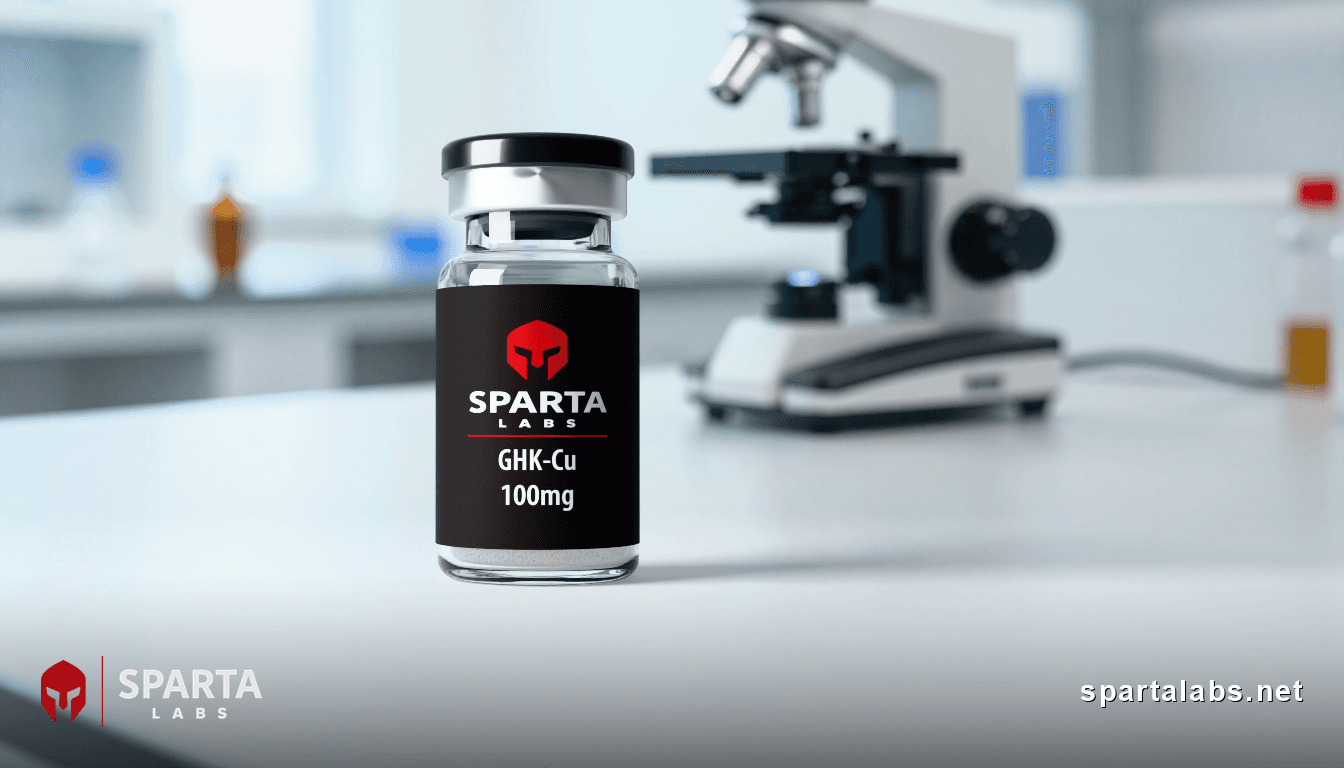
Introduction
The phrase "copper peptide" is searched far more often than it is defined. In chemistry it has a precise meaning: a coordination complex in which a short peptide serves as a ligand for a copper(II) ion. The best-known member of the class is GHK-Cu, the copper complex of the tripeptide glycyl-L-histidyl-L-lysine, isolated from human plasma in the 1970s and since then the reference compound for the category. This article explains what the term means at the level of structure, describes GHK-Cu and the other copper-binding peptides in the peer-reviewed literature, sets out why copper peptides fall into more than one regulatory category, and summarizes how identity and copper content are confirmed analytically. It is a chemistry reference and makes no claims about biological effects.
What "copper peptide" means
A peptide is a short chain of amino acids joined by peptide bonds, as described in the library's overview of what peptides are. A copper peptide is such a chain combined with a copper ion so that the two form a single, defined chemical entity rather than a mixture. The peptide provides donor atoms, usually nitrogens from the terminal amino group, deprotonated backbone amides and the imidazole ring of histidine, and the copper(II) ion accepts electron density from them to form coordination bonds.
Three consequences follow. First, a copper peptide is a metal complex whose properties are governed by coordination chemistry, not only by sequence. Second, the same peptide can exist as a copper-free ligand and as a copper-bound complex, and the two are different substances with different molecular weights. Third, "copper peptide" is a structural category, like "cyclic peptide" or "peptide fragment"; the label says nothing about what the molecule does.
Not every peptide binds copper strongly. Sequences with a histidine at the third position from a free N-terminus are well documented as high-affinity copper(II) ligands, because the terminal amine, backbone amide nitrogens and the histidine imidazole can together enclose the metal in a square-planar arrangement. The N-terminal sequence of human serum albumin, Asp-Ala-His-Lys (DAHK), is the classic example, and Laussac and Sarkar characterized its copper(II) and nickel(II) binding by NMR spectroscopy in 1984 [1]. GHK shares the pattern but, at three residues, presents a related yet distinct coordination environment.
GHK-Cu: the canonical copper peptide
Discovery and sequence
GHK was first reported by Pickart and Thaler in Nature New Biology in 1973, isolated from human serum albumin fractions during research on hepatocyte cultures [2]. The sequence glycyl-L-histidyl-L-lysine was confirmed by Schlesinger, Pickart and Thaler in Experientia in 1977 [3]. The free tripeptide has the molecular formula C14H24N6O4 and a molecular weight of approximately 340.4 daltons; the copper(II) complex is heavier by the mass of the metal ion.
In 1980, Pickart and colleagues proposed in Nature that the tripeptide's activity in their cell-culture systems was linked to its capacity to bind copper and make the metal available to cells, establishing GHK-Cu, rather than free GHK, as the species of primary interest [4]. Research-grade GHK-Cu is therefore supplied as the pre-formed copper complex rather than as the free peptide.
Coordination chemistry
The GHK-copper(II) complex has been examined by several groups with complementary techniques. Freedman and colleagues reported a solution structure in Biochemistry in 1982 from electron paramagnetic resonance and related measurements [5]. Hureau and colleagues published X-ray crystal structures with solution data for both Cu(II)-GHK and Cu(II)-DAHK in 2011, allowing the two motifs to be compared directly [6]. Trapaidze and colleagues used isothermal titration calorimetry in 2012 to quantify copper(II) binding to GHK and DAHK, reporting a high-affinity 1:1 interaction for each [7].
The picture is consistent. At physiological pH, GHK coordinates a single copper(II) ion through three donor atoms: the alpha-amino nitrogen of glycine, the deprotonated amide nitrogen of the glycine-histidine peptide bond, and the imidazole nitrogen of histidine. This tridentate arrangement, with a fourth position occupied by water or a carboxylate oxygen, gives a square-planar or distorted square-planar geometry around the metal [5,6]. The lysine side chain is protonated and does not take part in copper binding at neutral pH [8]. A more detailed account of the reported chemistry is given in the GHK-Cu mechanism of action article, and the broader discovery history in the GHK-Cu research overview.
Other copper-binding peptides in the literature
GHK-Cu dominates the published record but is not the only copper peptide described. The compounds below have verifiable primary literature; the list is illustrative rather than exhaustive.
AHK-Cu
AHK-Cu is the copper(II) complex of L-alanyl-L-histidyl-L-lysine. Structurally it is GHK with the N-terminal glycine replaced by alanine, adding a single methyl group to the first residue while leaving the histidine, lysine and copper-binding motif unchanged. The peptide is synthetic. Its published record is small: Pyo and colleagues reported results for AHK-Cu in an ex vivo human hair-follicle organ-culture model and in cultured dermal papilla cells in Archives of Pharmacal Research in 2007 [9]. No clinical-trial literature for AHK-Cu was identified, and it holds no regulatory approval.
Synthetic GHK analogues
Several groups have prepared GHK analogues to test which residues govern copper binding. Conato and colleagues, in Biochimica et Biophysica Acta in 2001, replaced the histidine of GHK with two unnatural amino acids and characterized the resulting copper complexes by potentiometry, calorimetry, optical spectroscopy and EPR. They reported that complex formation was driven primarily by the N-terminal glycine and that the free lysine side chain remained available at physiological pH [8]. Earlier, Buffoni and colleagues had compared Gly-His-Lys-Cu with three synthetic analogue-copper complexes in an in vivo guinea-pig skin model and in cultured fibroblasts, reporting no significant difference between the parent complex and the analogue they tested in vivo [10].
Findings from research models do not establish safety or efficacy in humans. Sparta Labs makes no claims about the use of any compound discussed in this article.
DAHK
The albumin N-terminal tetrapeptide DAHK is studied alongside GHK as a copper-binding reference sequence in the crystallographic and calorimetric work cited above [6,7]. It is a protein fragment rather than a marketed research peptide, and the DAHK-GHK comparison underlies much of what is known about how short peptides coordinate copper.
Why copper peptides sit in more than one regulatory category
Copper peptides, and GHK-Cu in particular, appear under three regulatory descriptions at once. Under the Federal Food, Drug, and Cosmetic Act, the FDA classifies a product by intended use: an article intended to cleanse, beautify or alter the appearance is a cosmetic, while an article intended to affect the structure or function of the body or to treat disease is a drug, and the same substance can fall on either side of that line depending on how it is marketed [11].
GHK-Cu appears in cosmetic ingredient nomenclature under the INCI name Copper Tripeptide-1, the designation used in the European Commission's CosIng database [12]. An ingredient listing is not a safety or efficacy determination and is not a drug approval. Separately, GHK-Cu is sold in the United States as research-use-only (RUO) reference material for laboratory investigation, a category the FDA distinguishes from products intended for human use [13]. Finally, no copper peptide, including GHK-Cu and AHK-Cu, holds FDA approval as a drug for any indication. Cosmetic ingredient status describes one type of finished product, RUO status describes laboratory reagents, and the absence of a drug approval applies across the board.
How identity and copper content are confirmed
Because a copper peptide is a defined complex rather than a mixture, its characterization must answer two questions: is the peptide the correct sequence, and is the copper present in the correct amount? Synthetic GHK is assembled by solid-phase peptide synthesis, the resin-based method introduced by Merrifield in 1963 [14], purified, and then complexed with copper.
- Mass spectrometry. Electrospray or MALDI mass spectrometry detects the intact species at its expected mass-to-charge ratio. Because the complex is heavier than the free tripeptide, the spectrum distinguishes GHK-Cu from uncomplexed GHK, and the two-isotope pattern of copper (63Cu and 65Cu) provides an additional identity signature.
- Reversed-phase HPLC. Chromatography with UV detection reports the fraction of UV-absorbing material eluting as the target compound, the basis of the purity figure on a certificate of analysis.
- Elemental analysis. Direct measurement of copper by inductively coupled plasma mass spectrometry (ICP-MS) or a related technique confirms that the copper-to-peptide ratio matches the intended 1:1 stoichiometry. Zajda and colleagues described a capillary electrophoresis method coupled to ICP-MS/MS for monitoring GHK-Cu in 2024, illustrating how speciation methods resolve the complex from free copper [15].
Stoichiometry is where copper peptides differ from ordinary synthetic peptides. Free GHK with no copper, or a batch with excess copper salt, would each pass a sequence check while being a different substance from GHK-Cu, so identity confirmation has to cover the metal as well as the peptide. The general principles of certificates of analysis are covered in the library's guide to COAs and third-party peptide testing.
GHK-Cu and the compounds it is confused with
Because GHK-Cu is often sold and discussed alongside other short peptides, the term "copper peptide" is sometimes applied loosely to compounds that contain no copper. Two cases account for most of the confusion, both arising from the four-compound research material known as the KLOW blend.
KPV. KPV is the tripeptide Lys-Pro-Val, corresponding to the C-terminal three residues of alpha-melanocyte-stimulating hormone. It is the same length as GHK, but it contains no histidine, is not described in its primary literature as a metal-binding peptide, and belongs to the melanocortin lineage rather than the copper-peptide class [16].
TB-500. TB-500 is a synthetic, N-terminally acetylated heptapeptide (Ac-LKKTETQ) corresponding to residues 17 through 23 of the actin-binding protein thymosin beta-4, as confirmed analytically by Görgens and colleagues in 2012 [17]. It is more than twice the length of GHK and has no copper component.
The KLOW blend structural comparison sets the four constituent compounds side by side; the relevant point here is that GHK-Cu is the only copper peptide among them, so describing KLOW as a "copper peptide blend" is chemically inaccurate.
Summary
A copper peptide is a peptide-copper(II) coordination complex, defined by structure rather than by any effect. GHK-Cu, first isolated by Pickart and Thaler in 1973, is the canonical example: it binds a single copper(II) ion in a tridentate, square-planar arrangement characterized by EPR, NMR, calorimetry and X-ray crystallography. AHK-Cu is a synthetic analogue with alanine in place of glycine and a much thinner published record; other GHK analogues and DAHK serve as reference sequences in the coordination-chemistry literature. Copper peptides sit in three regulatory categories (cosmetic ingredient nomenclature, research-use-only reference material, and no FDA drug approval), and confirming their identity requires mass spectrometry and elemental analysis alongside HPLC purity because copper content is part of the identity. KPV and TB-500, which share a research blend with GHK-Cu, are not copper peptides.
References
- Laussac JP, Sarkar B. Characterization of the copper(II)- and nickel(II)-transport site of human serum albumin. Studies of copper(II) and nickel(II) binding to peptide 1-24 of human serum albumin by 13C and 1H NMR spectroscopy. Biochemistry. 1984;23(12):2832-2838. PMID: 6547847. DOI: 10.1021/bi00307a046
- Pickart L, Thaler MM. Tripeptide in human serum which prolongs survival of normal liver cells and stimulates growth in neoplastic liver. Nat New Biol. 1973;243(124):85-87. PMID: 4349963. View on PubMed
- Schlesinger DH, Pickart L, Thaler MM. Growth-modulating serum tripeptide is glycyl-histidyl-lysine. Experientia. 1977;33(3):324-325. PMID: 858356. View on PubMed
- Pickart L, Freedman JH, Loker WJ, Peisach J, Perkins CM, Stenkamp RE, Weinstein B. Growth-modulating plasma tripeptide may function by facilitating copper uptake into cells. Nature. 1980;288(5792):715-717. PMID: 7453802. View on PubMed
- Freedman JH, Pickart L, Weinstein B, Mims WB, Peisach J. Structure of the glycyl-L-histidyl-L-lysine-copper(II) complex in solution. Biochemistry. 1982;21(19):4540-4544. PMID: 6291585. DOI: 10.1021/bi00262a004
- Hureau C, Eury H, Guillot R, Bijani C, Sayen S, Solari PL, Guillon E, Faller P, Dorlet P. X-ray and solution structures of Cu(II) GHK and Cu(II) DAHK complexes: influence on their redox properties. Chemistry. 2011;17(36):10151-10160. PMID: 21780203. DOI: 10.1002/chem.201100751
- Trapaidze A, Hureau C, Bal W, Winterhalter M, Faller P. Thermodynamic study of Cu2+ binding to the DAHK and GHK peptides by isothermal titration calorimetry (ITC) with the weaker competitor glycine. J Biol Inorg Chem. 2012;17(1):37-47. PMID: 21898044. DOI: 10.1007/s00775-011-0824-5
- Conato C, Gavioli R, Guerrini R, Kozlowski H, Mlynarz P, Pasti C, Pulidori F, Remelli M. Copper complexes of glycyl-histidyl-lysine and two of its synthetic analogues: chemical behaviour and biological activity. Biochim Biophys Acta. 2001;1526(2):199-210. PMID: 11325542. DOI: 10.1016/s0304-4165(01)00127-1
- Pyo HK, Yoo HG, Won CH, Lee SH, Kang YJ, Eun HC, Cho KH, Kim KH. The effect of tripeptide-copper complex on human hair growth in vitro. Arch Pharm Res. 2007;30(7):834-839. PMID: 17703734. DOI: 10.1007/BF02978833
- Buffoni F, Pino R, Dal Pozzo A. Effect of tripeptide-copper complexes on the process of skin wound healing and on cultured fibroblasts. Arch Int Pharmacodyn Ther. 1995;330(3):345-360. PMID: 8836453. View on PubMed
- U.S. Food and Drug Administration. Is It a Cosmetic, a Drug, or Both? (Or Is It Soap?). Source: fda.gov
- European Commission. CosIng: Cosmetic Ingredient Database (entry: Copper Tripeptide-1). Source: ec.europa.eu
- U.S. Food and Drug Administration. Distribution of In Vitro Diagnostic Products Labeled for Research Use Only or Investigational Use Only: Guidance for Industry and Food and Drug Administration Staff. November 2013. Source: fda.gov
- Merrifield RB. Solid Phase Peptide Synthesis. I. The Synthesis of a Tetrapeptide. J Am Chem Soc. 1963;85(14):2149-2154. DOI: 10.1021/ja00897a025
- Zajda J, Wadych E, Ogórek K, Drozd M, Ruzik L, Matczuk M. Novel Applications of CE-ICP-MS/MS: Monitoring of Antiaging GHK-Cu Cosmetic Component Encapsulation in Liposomes. Electrophoresis. 2024;45(21-22):1946-1954. PMID: 39451062. DOI: 10.1002/elps.202400047
- Getting SJ, Schiöth HB, Perretti M. Dissection of the anti-inflammatory effect of the core and C-terminal (KPV) alpha-melanocyte-stimulating hormone peptides. J Pharmacol Exp Ther. 2003;306(2):631-637. PMID: 12750433. DOI: 10.1124/jpet.103.051623
- Esposito S, Deventer K, Goeman J, Van der Eycken J, Van Eenoo P. Synthesis and characterization of the N-terminal acetylated 17-23 fragment of thymosin beta 4 identified in TB-500, a product suspected to possess doping potential. Drug Test Anal. 2012;4(9):733-738. PMID: 22962027. View on PubMed
Frequently asked questions
What is a copper peptide?
In chemical terms, a copper peptide is a coordination complex in which a short peptide binds a copper(II) ion through nitrogen and oxygen donor atoms on its backbone and side chains. The peptide acts as a ligand and the copper ion as the metal center. The term describes a class of molecular structure, not a biological effect.
What is GHK-Cu and why is it called the canonical copper peptide?
GHK-Cu is the copper(II) complex of the tripeptide glycyl-L-histidyl-L-lysine. It was first isolated from human plasma by Pickart and Thaler in 1973, and its 1:1 copper complex was characterized by spectroscopic and crystallographic studies in the following decades. Because it was the first copper-binding peptide of its kind to be sequenced and structurally characterized, it is the reference compound against which other copper peptides are described.
What is AHK-Cu and how does it differ from GHK-Cu?
AHK-Cu is the copper(II) complex of L-alanyl-L-histidyl-L-lysine, a synthetic tripeptide in which the N-terminal glycine of GHK is replaced by alanine. The histidine and lysine residues are retained, so the copper-binding motif is preserved while the first residue carries a methyl side chain. AHK-Cu has a much smaller published record than GHK-Cu, consisting mainly of in vitro and ex vivo work.
Is GHK-Cu FDA approved?
No. GHK-Cu is not approved by the U.S. Food and Drug Administration as a drug for any human indication. It appears in cosmetic ingredient nomenclature as Copper Tripeptide-1, a listing that carries no drug approval, and it is separately supplied as research-use-only reference material for laboratory work. These are three distinct regulatory categories.
How is the identity of a copper peptide confirmed?
Identity is normally confirmed by mass spectrometry, which detects the intact peptide-copper complex at its expected mass-to-charge value, and by reversed-phase HPLC, which reports chromatographic purity. Copper content can be measured directly by elemental methods such as inductively coupled plasma mass spectrometry. Together these methods distinguish a correctly formed 1:1 complex from free peptide or excess copper salt.
What is the difference between GHK-Cu, KPV and TB-500?
GHK-Cu is a copper-binding tripeptide isolated from human plasma. KPV is a tripeptide fragment of alpha-melanocyte-stimulating hormone and is not described as a metal-binding peptide. TB-500 is a synthetic seven-residue fragment of the actin-binding protein thymosin beta-4. The three are grouped together in the KLOW research blend but are chemically unrelated, and only GHK-Cu contains copper.