
Selank vs N-Acetyl Selank Amidate: A Structural and Regulatory Comparison
A structural and regulatory comparison of Selank and N-Acetyl Selank Amidate, two forms of the same tuftsin-derived heptapeptide that differ only in their N-terminal and C-terminal chemistry. Educational reference.
Introduction
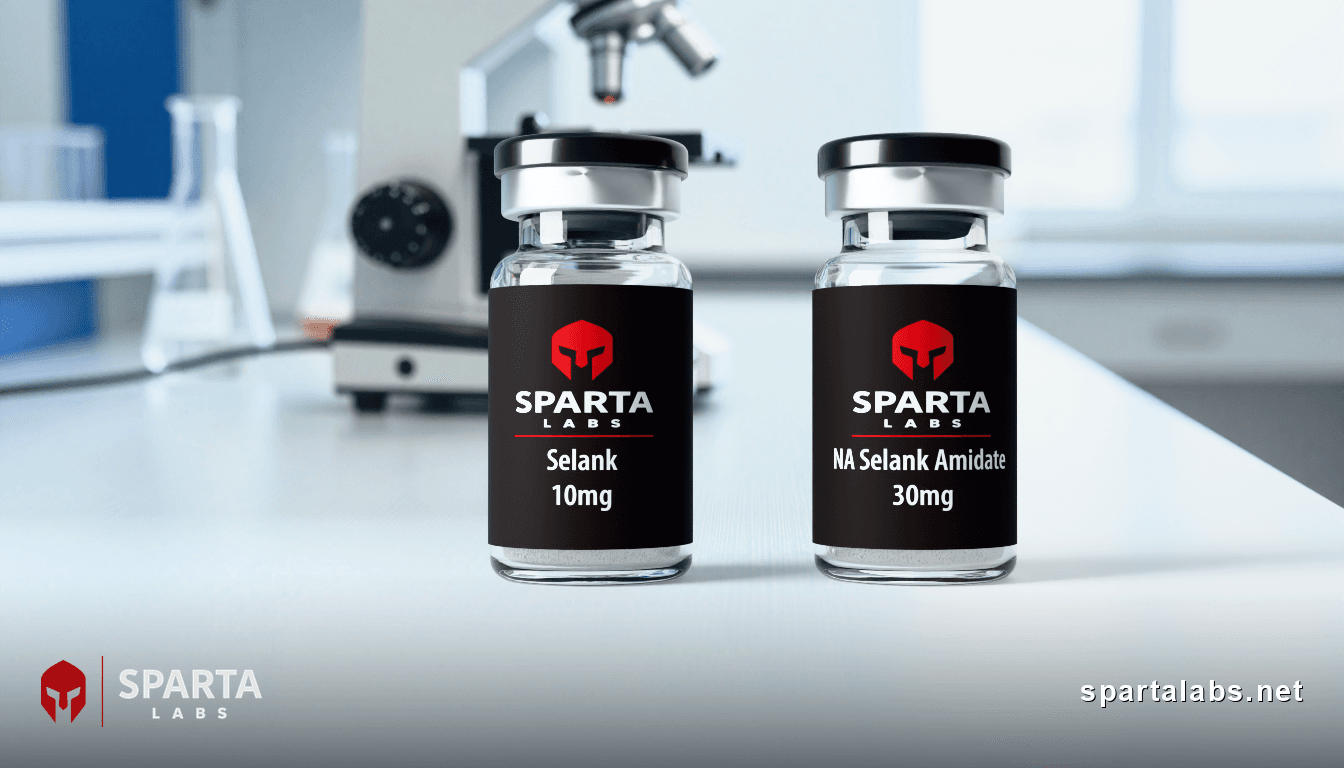
Selank and N-Acetyl Selank Amidate are two forms of one heptapeptide. Both carry the sequence Thr-Lys-Pro-Arg-Pro-Gly-Pro, which combines the naturally occurring tetrapeptide tuftsin with a synthetic Pro-Gly-Pro extension. What separates them is confined to the two ends of the chain: the amidate form carries an acetyl group at the N-terminus and an amide at the C-terminus, while Selank retains a free amine and a free carboxylic acid. This article compares the two compounds on structure, origin, terminal chemistry, and regulatory status, reporting what the peptide chemistry and pharmacology literature has published without drawing any conclusion about the suitability of either compound for any purpose. Research-grade Selank and N-Acetyl Selank Amidate reference materials are cataloged with per-batch certificates of analysis.
Selank: A Tuftsin Analog With a Pro-Gly-Pro Tail
Selank's parent molecule is tuftsin, the tetrapeptide Thr-Lys-Pro-Arg. Najjar and Nishioka described tuftsin in Nature in 1970 as a phagocytosis-stimulating fragment released from the Fc region of immunoglobulin G [1]. Tuftsin is rapidly cleaved in plasma, and that instability defined the design problem taken up by researchers at the Institute of Molecular Genetics of the Russian Academy of Sciences, working in the regulatory-peptide tradition associated with Igor Ashmarin and Nikolai Myasoedov. Their solution was to append the tripeptide Pro-Gly-Pro to the C-terminus of tuftsin, producing the heptapeptide Thr-Lys-Pro-Arg-Pro-Gly-Pro [2]. Proline-rich sequences of this kind are resistant to cleavage by many endopeptidases, and the same Pro-Gly-Pro tail appears on Semax, the institute's other well-known heptapeptide, as discussed in the Selank vs Semax comparison.
The Selank research record is largely Russian in origin. Kozlovskii and Danchev reported on the peptide in a conditioned active-avoidance model in rats in Neuroscience and Behavioral Physiology in 2003 [3], and Semenova and colleagues placed Selank among related tuftsin-family peptides in rodent stress paradigms in the same journal that year [4]. A comparative clinical study by Zozulia, Neznamov, and colleagues was published in Zhurnal Nevrologii i Psikhiatrii in 2008 [5], and Andreeva and Myasoedov reviewed the structure-activity relationships of the intact heptapeptide and its fragments in Biology Bulletin in 2019 [6].
Findings from research models and from clinical studies conducted under another country's regulatory system do not establish safety or efficacy under US standards. Sparta Labs makes no claims about the use of this compound.
Deigin and colleagues, reviewing the development of peptide biopharmaceuticals in Russia in Pharmaceutics in 2022, listed Selank among the synthetic regulatory peptides that reached registration in the Russian Federation [2]. Selank has never been reviewed or approved by the U.S. Food and Drug Administration. A fuller account of its chemistry and classification appears in the Selank research overview.
N-Acetyl Selank Amidate: The Same Sequence With Capped Termini
N-Acetyl Selank Amidate takes the Selank sequence unchanged and modifies its two ends. At the N-terminus, the alpha-amino group of the first residue, threonine, is acetylated: a two-carbon acetyl group (CH3CO-) is attached to the nitrogen, converting the free primary amine into an acetamide. At the C-terminus, the carboxylic acid of the final proline is converted to a primary amide (-CONH2). The intervening backbone, all seven residues, and every side chain are identical to Selank.
The two modifications can be tracked in the molecular formula. PubChem lists Selank (CID 11765600) as C33H57N11O9 with a molecular weight of about 751.9 Da, and N-acetyl Selank (CID 133082488) as C35H59N11O10 at about 793.9 Da, the difference being the C2H2O added by acetylation [7]. Amidating the C-terminus in turn replaces a hydroxyl group with an amino group, so the fully modified amidate form has a formula of C35H60N12O9 and a molecular weight close to that of the acetylated intermediate. These are arithmetic consequences of the two capping reactions rather than independent measurements, and any batch of the amidate form is identified in practice by mass spectrometry against the theoretical mass of the intended structure.
Unlike Selank, the amidate form has no registration history in any jurisdiction and very little compound-specific published research. Its characterization in the literature rests mainly on the general chemistry of terminal capping, which is summarized in the next section, and on the Selank literature from which it derives. The N-Acetyl Selank Amidate research overview sets out what is and is not documented for the derivative.
The Chemistry of Acetylation and Amidation
The two terminal modifications are among the oldest and most widely used tools in peptide chemistry. Vlieghe and colleagues, reviewing synthetic therapeutic peptides in Drug Discovery Today in 2010, described N-terminal acetylation and C-terminal amidation as standard strategies for reducing susceptibility to exopeptidases, the enzymes that remove residues one at a time from the ends of a chain [8]. Gentilucci and colleagues, in a 2010 review of chemical modifications designed to improve peptide stability, placed terminal capping alongside non-natural amino acids, pseudo-peptide bonds, and cyclization as the principal means by which chemists reduce the "peptide character" that makes native sequences short-lived in biological fluids [9].
Three consequences of capping are reported consistently in that literature:
- Enzyme recognition. Aminopeptidases generally require a free N-terminal alpha-amine and carboxypeptidases a free C-terminal carboxylate to bind their substrate. Capping removes both recognition features, which is the basis of the reported resistance to exopeptidase cleavage [8, 9].
- Charge. At physiological pH a free N-terminal amine is protonated (positive) and a free C-terminal carboxylate is deprotonated (negative). Acetylation and amidation remove both charges, making the termini neutral and altering the molecule's overall charge, polarity, and hydrogen-bonding pattern [9].
- Natural precedent. Both modifications occur in nature. Eipper, Stoffers, and Mains reviewed peptide alpha-amidation in the Annual Review of Neuroscience in 1992, describing how peptidylglycine alpha-amidating monooxygenase converts a C-terminal glycine-extended precursor into an amidated peptide in many endogenous neuropeptides and hormones [10]. Ree, Varland, and Arnesen reviewed N-terminal acetylation in Experimental and Molecular Medicine in 2018, noting that it is among the most common protein modifications in eukaryotic cells [11].
In synthetic practice, both groups are introduced during or immediately after solid-phase peptide synthesis, the stepwise method Merrifield described in 1963 [12]. The C-terminal amide is typically set by the choice of resin at the start of the synthesis, and the N-terminal acetyl group is added as a final capping step before the peptide is cleaved from the support. The Selank-specific literature does not report head-to-head stability measurements of the two forms; the statements above describe the general chemistry of capped peptides as published for the class, not data generated on Selank itself.
Structural Comparison
- Sequence. Identical: Thr-Lys-Pro-Arg-Pro-Gly-Pro, seven residues, all in the L-configuration [6, 7].
- Parent lineage. Identical: the tuftsin tetrapeptide of Najjar and Nishioka [1] with the Pro-Gly-Pro extension designed at the Institute of Molecular Genetics [2].
- N-terminus. Selank: free alpha-amine on threonine. N-Acetyl Selank Amidate: acetylated amine (acetamide).
- C-terminus. Selank: free carboxylic acid on proline. N-Acetyl Selank Amidate: primary amide.
- Molecular formula and mass. Selank: C33H57N11O9, about 751.9 Da. Amidate form: C35H60N12O9, about 793 Da, derived from the PubChem entries for the parent and the acetylated intermediate [7].
- Net terminal charge. Selank carries one positive and one negative charge at its termini at physiological pH; the amidate form carries neither. The lysine and arginine side chains, which are positively charged in both molecules, are unaffected.
- Reported stability rationale. The Pro-Gly-Pro tail addresses endopeptidase cleavage in both molecules [2, 6]; terminal capping in the amidate form additionally addresses exopeptidase cleavage, according to the general capped-peptide literature [8, 9].
- Research record. Selank: several decades of Russian preclinical and clinical publications [3, 4, 5, 6]. Amidate form: essentially no compound-specific primary literature.
- Regulatory status. Selank: registered in the Russian Federation [2]; not FDA-approved. N-Acetyl Selank Amidate: not registered or approved anywhere. Both are research-use-only materials in the United States.
Pharmacological Class Context
Both compounds sit within what the Russian literature calls regulatory peptides: short synthetic sequences modeled on endogenous fragments and developed at the Institute of Molecular Genetics as a family that also includes Semax [2]. Within that family, Selank belongs to the tuftsin lineage. The amidate form does not constitute a separate pharmacological class; it is a chemically modified version of the same molecule, and any classification applied to it is inherited from Selank rather than established independently.
That inheritance has a limit worth stating plainly. The published pharmacology of Selank was generated on the unmodified peptide, and the capped derivative differs from it in mass, charge, and terminal chemistry. Whether those differences alter receptor interaction, distribution, or metabolism has not been reported in the peer-reviewed literature for this specific molecule. The comparison in this article is therefore structural and regulatory, and it makes no statement about the relative activity of the two forms. Neither Selank nor N-Acetyl Selank Amidate is an FDA-approved drug, and both are sold strictly as research-use-only reference materials.
References
- Najjar VA, Nishioka K. "Tuftsin": a natural phagocytosis stimulating peptide. Nature. 1970;228(5272):672-673. DOI: 10.1038/228672a0 (PMID: 4116440)
- Deigin VI, Poluektova EA, Beniashvili AG, Kozin SA, Poluektov YM. Development of Peptide Biopharmaceuticals in Russia. Pharmaceutics. 2022;14(4):716. DOI: 10.3390/pharmaceutics14040716 (PMID: 35456550)
- Kozlovskii II, Danchev ND. The optimizing action of the synthetic peptide Selank on a conditioned active avoidance reflex in rats. Neurosci Behav Physiol. 2003;33(7):639-643. DOI: 10.1023/A:1024444321191 (PMID: 14552529)
- Semenova TP, Kozlovskaya MM, Zuikov AV, Kozlovskiy II, Myasoedov NF. Selank and short peptides of the tuftsin family in the regulation of adaptive behavior in stress. Neurosci Behav Physiol. 2003;33(9):853-860. DOI: 10.1023/A:1025988519919 (PMID: 12154572)
- Zozulia AA, Neznamov GG, Syunyakov TS, et al. Efficacy and possible mechanisms of action of a new peptide anxiolytic selank in the therapy of generalized anxiety disorders and neurasthenia. Zh Nevrol Psikhiatr Im S S Korsakova. 2008;108(4):38-48. PubMed (PMID: 18454096)
- Andreeva LA, Myasoedov NF. Physiological effects of Selank and its fragments. Biol Bull. 2019;46(4):390-400. DOI: 10.1134/S1062359019040071
- National Center for Biotechnology Information. PubChem Compound Summaries: Selank, CID 11765600; N-Acetyl Selank, CID 133082488. PubChem CID 11765600; PubChem CID 133082488
- Vlieghe P, Lisowski V, Martinez J, Khrestchatisky M. Synthetic therapeutic peptides: science and market. Drug Discov Today. 2010;15(1-2):40-56. DOI: 10.1016/j.drudis.2009.10.009 (PMID: 19879957)
- Gentilucci L, De Marco R, Cerisoli L. Chemical modifications designed to improve peptide stability: incorporation of non-natural amino acids, pseudo-peptide bonds, and cyclization. Curr Pharm Des. 2010;16(28):3185-3203. DOI: 10.2174/138161210793292555 (PMID: 20687878)
- Eipper BA, Stoffers DA, Mains RE. The biosynthesis of neuropeptides: peptide alpha-amidation. Annu Rev Neurosci. 1992;15:57-85. DOI: 10.1146/annurev.ne.15.030192.000421 (PMID: 1575450)
- Ree R, Varland S, Arnesen T. Spotlight on protein N-terminal acetylation. Exp Mol Med. 2018;50(7):1-13. DOI: 10.1038/s12276-018-0116-z (PMID: 30054468)
- Merrifield RB. Solid Phase Peptide Synthesis. I. The Synthesis of a Tetrapeptide. J Am Chem Soc. 1963;85(14):2149-2154. DOI: 10.1021/ja00897a025
Frequently asked questions
What is the difference between Selank and N-Acetyl Selank Amidate?
The two compounds share the same seven-residue sequence, Thr-Lys-Pro-Arg-Pro-Gly-Pro. N-Acetyl Selank Amidate carries two additional terminal modifications, an acetyl group on the N-terminal threonine amine and an amide in place of the C-terminal proline carboxylic acid. The peptide backbone and side chains are otherwise identical.
What is Selank?
Selank is a synthetic heptapeptide developed at the Institute of Molecular Genetics of the Russian Academy of Sciences. It consists of the tuftsin tetrapeptide Thr-Lys-Pro-Arg, a fragment of immunoglobulin G first described in 1970, extended at the C-terminus with the tripeptide Pro-Gly-Pro. Its published research record dates from Russian-language pharmacology literature of the 1990s and 2000s.
What does N-terminal acetylation and C-terminal amidation do to a peptide?
Acetylation caps the free alpha-amino group at the N-terminus and amidation replaces the C-terminal carboxylate with a neutral amide. The peptide chemistry literature reports that these capped termini are no longer recognized in the usual way by aminopeptidases and carboxypeptidases, and that the modifications remove one positive and one negative charge from the molecule. Both modifications also occur naturally in many endogenous peptides.
Is Selank FDA approved?
No. Selank holds a registration in the Russian Federation, where it was developed, but it has not been approved by the U.S. Food and Drug Administration for any use. N-Acetyl Selank Amidate has no registration in any jurisdiction. In the United States both are supplied strictly as research-use-only reference materials.
Is N-Acetyl Selank Amidate the same as Selank?
They are not the same molecule. N-Acetyl Selank Amidate is a derivative of Selank with a different molecular formula and molecular weight because of its two capped termini. Published pharmacological data concern Selank itself; the amidate form has very little compound-specific literature and is characterized mainly by inference from the general chemistry of terminal capping.