
Selank vs Semax: A Structural and Research-History Comparison
A structural and research-history comparison of Selank and Semax, two short regulatory peptides developed at the Russian Academy of Sciences from different endogenous parent sequences. Educational reference.
Introduction
Selank and Semax are the two best-known products of the Russian regulatory-peptide research tradition, and because they share an institutional origin (the Institute of Molecular Genetics of the Russian Academy of Sciences) and a stabilization strategy, they are often mentioned together. Chemically, however, they descend from unrelated parent molecules: Selank from the immunomodulatory tetrapeptide tuftsin, Semax from a fragment of adrenocorticotropic hormone (ACTH). This article compares the two compounds on parent-sequence chemistry, structure, and published research history. It reports what investigators have published, much of it in Russian-language journals, and makes no comparative efficacy assessment. Research-grade Selank and N-Acetyl Selank Amidate reference materials are cataloged with per-batch certificates of analysis, as is N-Acetyl Semax Amidate.
Selank: A Stabilized Tuftsin Analog
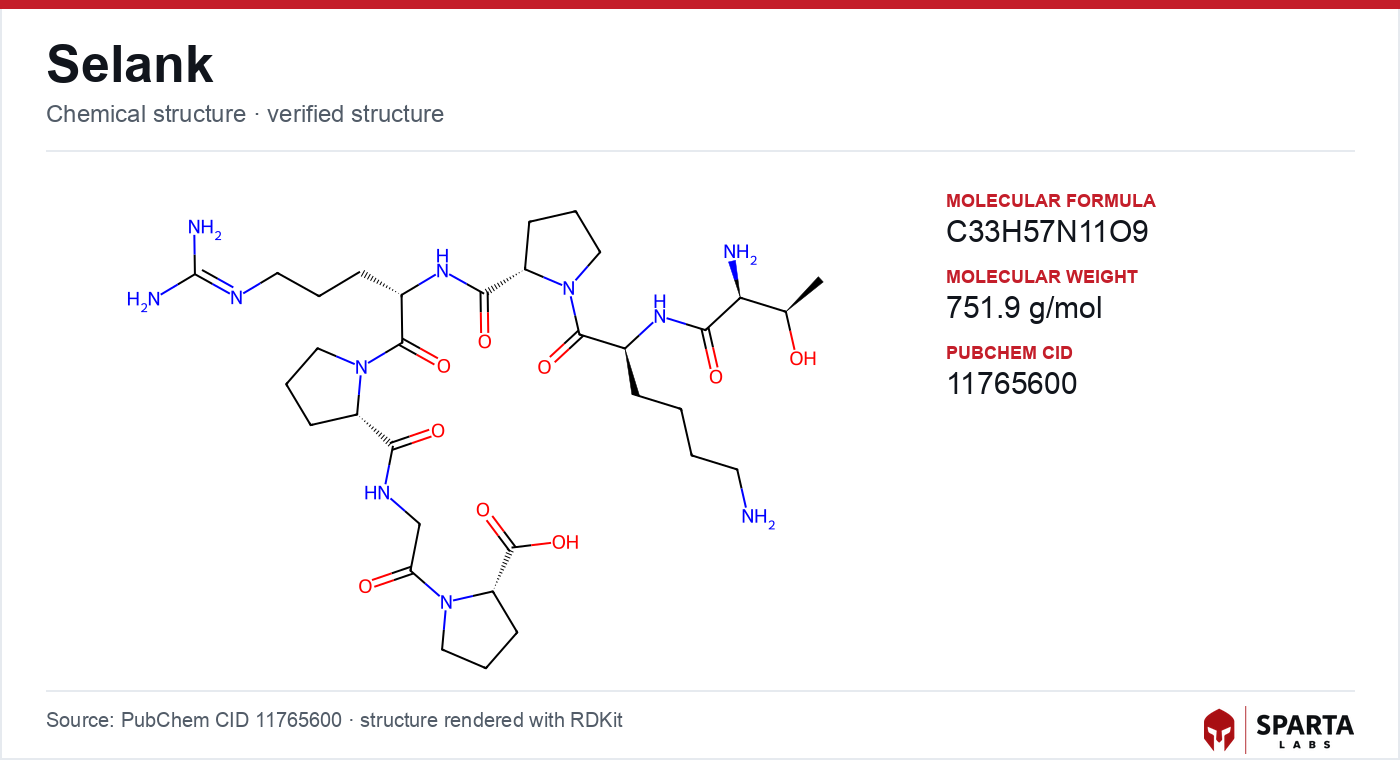
Selank's parent molecule is tuftsin, a tetrapeptide (Thr-Lys-Pro-Arg) first described by Najjar and Nishioka in Nature in 1970 as a naturally occurring phagocytosis-stimulating fragment of immunoglobulin G [1]. Selank extends the tuftsin sequence with a C-terminal Pro-Gly-Pro tripeptide, giving the heptapeptide Thr-Lys-Pro-Arg-Pro-Gly-Pro; the PGP tail was reported by the developers to protect the labile parent fragment from rapid enzymatic cleavage.
The compound was developed in the laboratories of the Institute of Molecular Genetics (Russian Academy of Sciences) in collaboration with the Zakusov Institute of Pharmacology. Kozlovskaya and colleagues reported on Selank and related tuftsin-family peptides in the regulation of adaptive behavior under stress in rodent models [2], and later Russian clinical literature, including work by Medvedev and colleagues in Zhurnal Nevrologii i Psikhiatrii, reported controlled studies of Selank in anxiety-spectrum populations in Russia [3].
Findings from research models and from clinical studies conducted under other countries' regulatory systems do not establish safety or efficacy under US standards. Sparta Labs makes no claims about the use of this compound.
Transcriptomic studies by Kolomin and colleagues additionally reported gene-expression changes in rodent hippocampus and spleen following Selank administration, part of a broader research program on how short regulatory peptides influence expression profiles [4]. Additional published work is summarized in the Selank published research article.
Semax: A Stabilized ACTH Fragment
Semax takes the opposite parent: the N-terminal region of adrenocorticotropic hormone. It consists of the ACTH(4-7) fragment (Met-Glu-His-Phe) fused to the same Pro-Gly-Pro tail, giving Met-Glu-His-Phe-Pro-Gly-Pro. The design came from Igor Ashmarin's regulatory-peptide school; Ashmarin and colleagues described the multi-year design and study program behind the "nootropic ACTH(4-10) analog" family in the Russian physiology literature [5]. A notable property reported by the developers was that the ACTH-fragment design retains no meaningful corticotropic (hormonal) activity: the fragment engages central mechanisms distinct from the parent hormone's adrenal signaling.
Semax's clinical research history in Russia includes work in acute neurological settings: Gusev, Skvortsova, and colleagues reported on Semax studied during the acute period of ischemic stroke in Russian clinical journals [6]. Like Selank, Semax has a Russian registration history but no FDA approval; in the US it exists solely as a research compound. Its research record is covered further in the Semax history article.
Structural Comparison
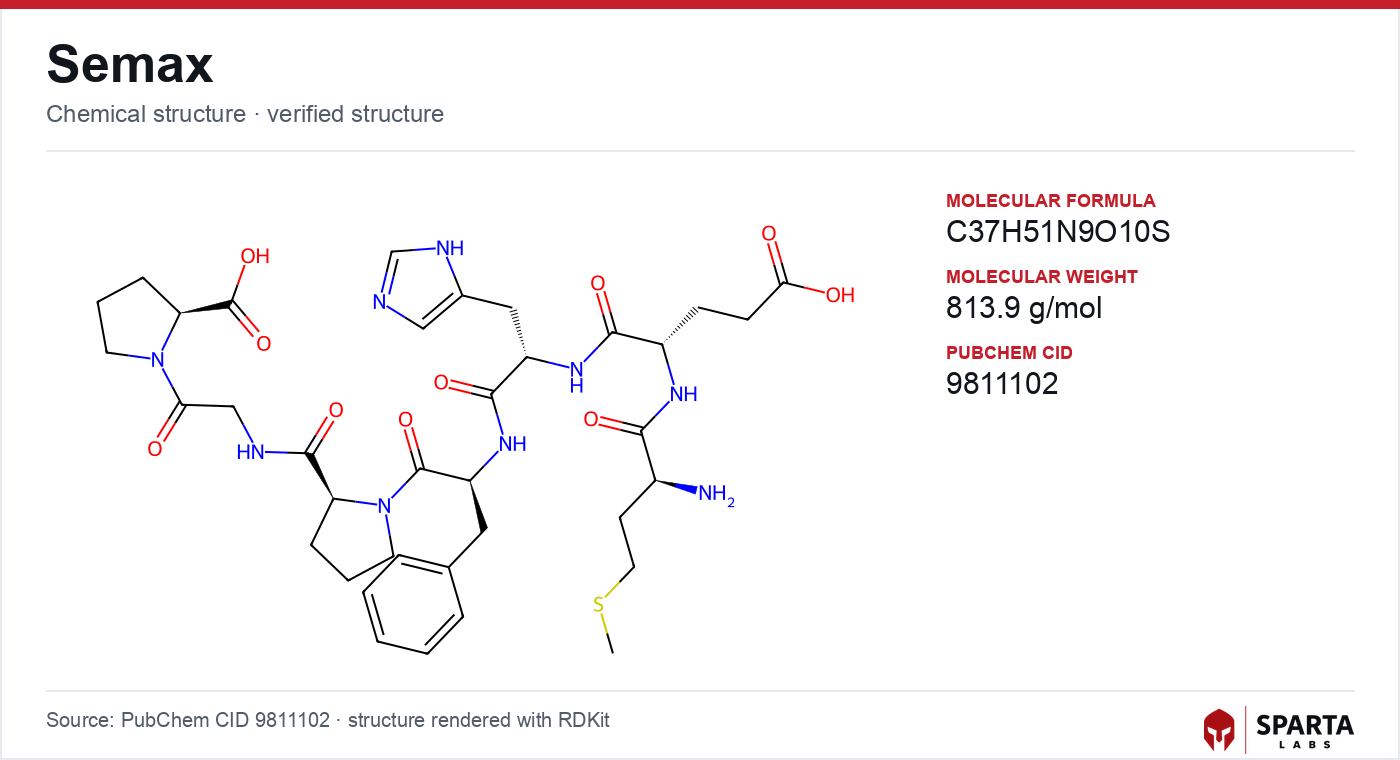
- Parent sequence. Selank: tuftsin (Thr-Lys-Pro-Arg), an IgG-derived immunopeptide [1]. Semax: ACTH(4-7) (Met-Glu-His-Phe), a melanocortin-family hormone fragment.
- Full sequence. Selank: Thr-Lys-Pro-Arg-Pro-Gly-Pro (7 residues). Semax: Met-Glu-His-Phe-Pro-Gly-Pro (7 residues).
- Shared engineering. Both append the Pro-Gly-Pro tripeptide for enzymatic stabilization, the signature of their common institutional origin rather than any pharmacological kinship.
- Derivative forms. Both compounds circulate in research catalogs in N-acetylated, C-amidated variants (N-Acetyl Selank Amidate; N-Acetyl Semax Amidate), modifications generally reported in the peptide-chemistry literature to further slow exopeptidase degradation.
- Research literatures. The two literatures barely overlap: Selank's primary record concerns anxiety-related behavioral models and immune/transcriptomic endpoints [2, 3, 4], while Semax's centers on neuroprotection-oriented and cognitive research contexts, including the stroke studies [5, 6]. The compounds were not developed as alternatives to one another.
Pharmacological Class Context
Both peptides belong to what the Russian literature calls regulatory peptides: short endogenous-sequence fragments studied for signaling roles beyond their parent molecules' classical endocrine functions. Within that tradition, Selank is classed with the immunopeptide (tuftsin) lineage and Semax with the melanocortin-fragment lineage. Neither peptide has an FDA-reviewed dataset, and the majority of the primary literature for both was published in Russian-language journals with varying availability of full-text translations, a practical constraint that any bibliographic review of these compounds inherits, and one reason English-language systematic characterization of both peptides remains limited. This article accordingly reports provenance and structure, not comparative merit.
Neither Selank nor Semax is an FDA-approved drug. Both are sold strictly as research-use-only reference materials.
References
- Najjar VA, Nishioka K. "Tuftsin": a natural phagocytosis stimulating peptide. Nature. 1970;228(5272):672-673. DOI: 10.1038/228672a0
- Kozlovskaya MM, Kozlovskii II, Val'dman EA, Seredenin SB. Selank and short peptides of the tuftsin family in the regulation of adaptive behavior in stress. Neuroscience and Behavioral Physiology / Rossiiskii Fiziologicheskii Zhurnal. 2003.
- Medvedev VE, Tereshchenko ON, et al. Controlled comparative study of Selank in anxiety disorders. Zhurnal Nevrologii i Psikhiatrii imeni S.S. Korsakova. 2015.
- Kolomin TA, Shadrina MI, Slominsky PA, Limborska SA, Myasoedov NF. Transcriptomic studies of the peptide Selank in rat hippocampus and spleen. Doklady Biochemistry and Biophysics / related Russian Academy of Sciences publications. 2010–2013.
- Ashmarin IP, Nezavibatko VN, Myasoedov NF, et al. A nootropic adrenocorticotropin analog 4-10-Semax: 15 years of design and study. Zhurnal Vysshei Nervnoi Deiatelnosti imeni I.P. Pavlova. 1997.
- Gusev EI, Skvortsova VI, Miasoedov NF, et al. Effectiveness of Semax studied in the acute period of hemispheric ischemic stroke. Zhurnal Nevrologii i Psikhiatrii imeni S.S. Korsakova. 1997.
Frequently asked questions
What is the difference between Selank and Semax?
The two peptides derive from different endogenous parent molecules. Selank is a synthetic analog of tuftsin, a naturally occurring immunomodulatory tetrapeptide, extended with a Pro-Gly-Pro stabilizing tail. Semax is a synthetic fragment of adrenocorticotropic hormone, ACTH(4-7), carrying the same Pro-Gly-Pro tail. They share the stabilization strategy but not the parent sequence or the primary research literature.
Where were Selank and Semax developed?
Both peptides were developed at the Institute of Molecular Genetics of the Russian Academy of Sciences, in programs associated with the regulatory-peptide research school of Igor Ashmarin and Nikolai Myasoedov. Most of the primary literature on both compounds was published in Russian-language journals.
Are Selank and Semax approved drugs in the United States?
No. Neither peptide is FDA-approved. Both have registration histories in Russia, where they have been studied and used clinically, but in the United States they are research compounds only, sold strictly for laboratory research use.
What does the Pro-Gly-Pro tail on both peptides do?
The C-terminal Pro-Gly-Pro (PGP) tripeptide was reported by the developers to slow enzymatic degradation and extend the biological activity of the short parent fragments, which are otherwise cleaved rapidly. The same PGP strategy appearing in both molecules reflects their shared institutional origin.