
Selank: Sourcing, Purity, and Verification Standards
A sourcing-focused look at Selank as a tuftsin-derived heptapeptide: solid-phase synthesis of its proline-rich sequence, the analytical methods that confirm identity and purity, counter-ion considerations, and certificate-of-analysis documentation. Educational reference.
For research use only. Not for human consumption. This article is educational reference material. It is not medical advice and is not a recommendation to use any substance.
Introduction
Selank is a synthetic heptapeptide with the sequence Thr-Lys-Pro-Arg-Pro-Gly-Pro. Its structure is derived from tuftsin, the endogenous immunomodulatory tetrapeptide Thr-Lys-Pro-Arg, to which a Pro-Gly-Pro tripeptide has been appended at the carboxyl terminus. That lineage is the organizing fact of this article: nearly every sourcing and analytical decision for Selank follows from the properties of a short, proline-rich, arginine-bearing sequence built on a tuftsin core. This article describes how such a compound is synthesized and how its identity and purity are verified, and how Sparta Labs documents those verification steps for each batch. Researchers seeking chemistry and regulatory context should first consult the Selank research overview.
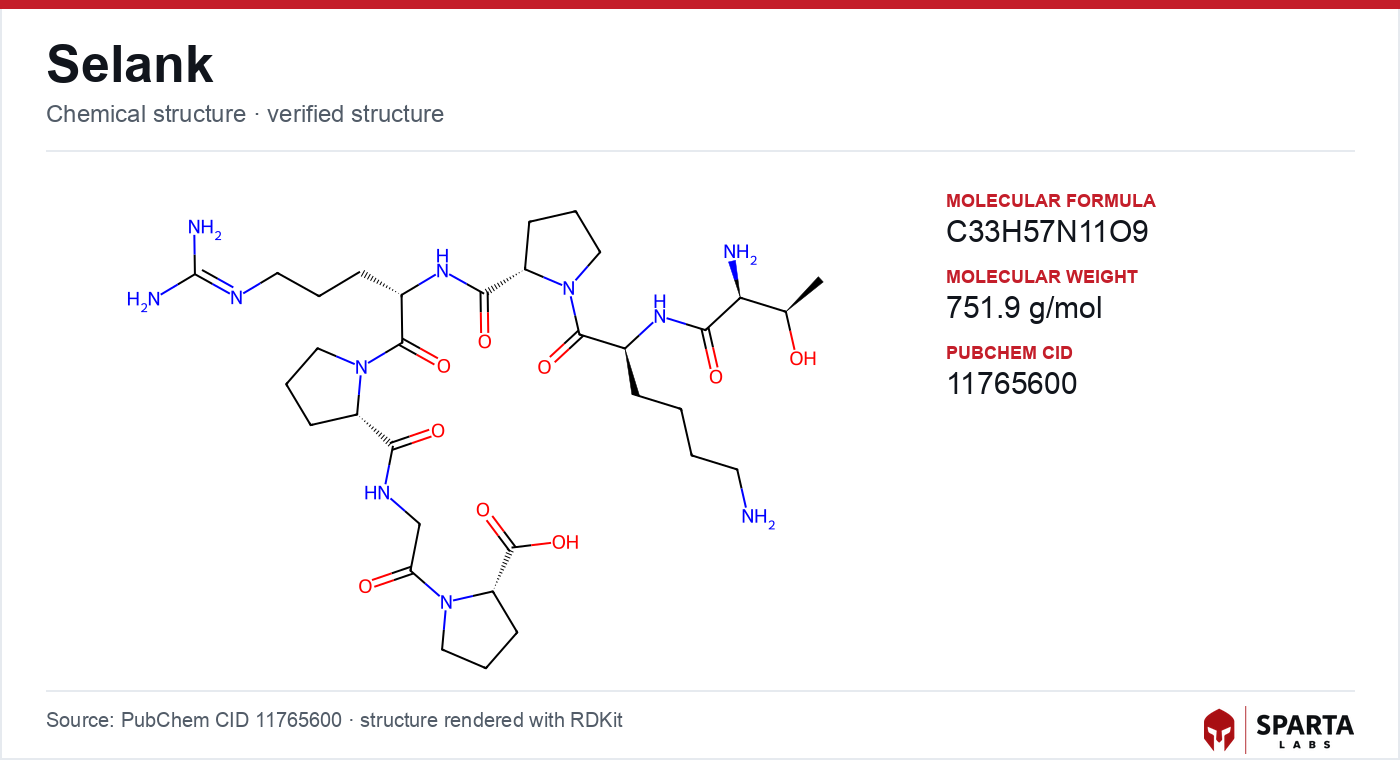
Figure: chemical structure of Selank.
The Selank sequence and what it means for synthesis
Selank is a linear seven-residue peptide with the molecular formula C33H57N11O9 and a monoisotopic mass corresponding to a molecular weight of approximately 751.9 daltons. Three of its seven residues are proline, and the carboxyl terminus carries a Pro-Gly-Pro extension not present in the tuftsin parent fragment.
Peptides of this length are produced by solid-phase peptide synthesis (SPPS), the approach introduced by Robert B. Merrifield in 1963, in which a growing peptide chain is assembled on an insoluble resin support one residue at a time [1]. Merrifield's development of the method was recognized with the 1984 Nobel Prize in Chemistry. In SPPS, each incoming amino acid carries protecting groups that are removed stepwise so that couplings occur in a defined order; after the full sequence is assembled, the chain is cleaved from the resin and the side-chain protecting groups are removed to yield the crude peptide.
Andersson and colleagues, in a 2000 review of large-scale peptide manufacture, described the coupling, cleavage, and chromatographic purification stages that characterize industrial SPPS and noted that reverse-phase HPLC purification is the standard final step for reaching research-grade quality [2]. For a compound like Selank, the multiple proline residues are worth noting on their own terms: proline is a secondary amine and its incorporation can slow certain coupling steps, but its presence is routine in modern SPPS and does not present unusual difficulty for a sequence of this length. The completed crude peptide is purified and then lyophilized to a dry powder.
Reverse-phase HPLC and the proline-rich profile
Reverse-phase high-performance liquid chromatography (HPLC) is the primary method for assessing the relative purity of a research-grade peptide. It separates the target peptide from closely related impurities such as deletion sequences, truncated fragments, and protecting-group byproducts on the basis of hydrophobicity, with detection typically by ultraviolet absorbance at 220 nanometers, where the peptide bond absorbs.
HPLC purity is reported as the percentage of total integrated peak area attributable to the main compound peak. This is a relative measure, not an absolute one: it describes what fraction of the detected material is the intended peptide. Selank's proline-rich composition gives the molecule a characteristic retention behavior on a reverse-phase column, and consistency of that chromatographic profile from batch to batch is itself part of the identity picture.
Sparta Labs applies an internal reverse-phase HPLC purity standard for Selank and reports the batch-specific percentage rather than a representative or nominal figure. Because HPLC purity is defined by peak area under UV detection, it is always paired with an orthogonal identity method, discussed next, so that the main peak is confirmed to be the intended molecule and not a co-eluting species.
Confirming molecular identity by mass spectrometry
HPLC quantifies purity but does not, by itself, prove that the main peak is the correct molecule. Mass spectrometry (MS) provides that orthogonal confirmation by measuring the mass-to-charge ratio of the ionized peptide. For a defined sequence such as Selank, the observed molecular ion is compared with the mass calculated from the molecular formula C33H57N11O9.
Two soft-ionization techniques are standard for intact peptides: electrospray ionization (ESI-MS) and matrix-assisted laser desorption/ionization time-of-flight (MALDI-TOF). Either can confirm that the principal HPLC peak corresponds to the expected molecular weight. Where sequence-level confirmation is warranted, tandem mass spectrometry fragments the peptide and reads the resulting product ions; the nomenclature for peptide fragment ions used across this literature was established by Roepstorff and Fohlman in 1984 [3]. Mass-spectrometric identity is what distinguishes the correct compound from an impurity of different mass that might co-elute at a similar retention time.
Findings from research models do not establish safety or efficacy in humans. Sparta Labs makes no claims about the use of this compound.
Sparta Labs includes mass-spectrometric identity confirmation in the certificate of analysis for every Selank batch. The same combination of reverse-phase HPLC and mass spectrometry underlies verification for the related N-Acetyl Selank Amidate material, where terminal modifications shift the expected mass and make MS confirmation especially informative.
Counter-ion and residual-solvent analysis
An aspect of peptide sourcing that is specific to sequences like Selank is counter-ion identity. Peptides purified by reverse-phase HPLC are commonly isolated as trifluoroacetate (TFA) salts, because TFA is a standard mobile-phase additive. Selank carries a basic guanidinium side chain on its arginine residue and a lysine side chain, both of which are protonated at typical handling pH and readily associate with a counter-ion. As a result, residual TFA is a meaningful analytical parameter for arginine- and lysine-containing peptides.
Batch documentation therefore addresses several residual quantities: residual TFA carried over from cleavage and from the HPLC mobile phase, residual acetate where a salt exchange to the acetate form has been performed, and residual organic solvents from the purification and lyophilization steps. For research applications involving cultured cells, endotoxin content measured by the limulus amebocyte lysate (LAL) assay is an additional parameter that may be assessed. These values are recorded per batch and reported in the certificate of analysis, because the salt form and residual content affect the effective peptide content of a weighed sample.
Batch documentation in the certificate of analysis
A certificate of analysis (COA) is the batch-specific record of the analytical results above. Every Sparta Labs Selank batch is accompanied by a COA that reports:
- Reverse-phase HPLC purity as a batch-specific percentage
- Mass-spectrometric confirmation of molecular weight against the calculated mass for the sequence
- Counter-ion and residual-solvent findings where applicable
- Batch number and manufacturing date
- Expiry date based on stability considerations for lyophilized peptides
- The analytical report reference for the batch
The value of per-batch documentation is tied to research reproducibility. A widely discussed 2016 survey of researchers reported by Baker in Nature found that a large share of respondents had failed to reproduce published experiments, and identified variability in reagents and materials among the contributing factors [4]. Documented, batch-specific characterization allows a laboratory to record exactly which material was used in a given experiment, supporting retrospective review and reproducibility reporting. The COA for each Selank batch is accessible from the product page.
Stability of a lyophilized proline-rich peptide
Lyophilized peptides are, as a class, substantially more stable than the same peptides held in solution. The general principles governing peptide and protein stability, including the roles of temperature, moisture, and physical state, are set out in the pharmaceutical stability literature reviewed by Manning and colleagues [5]. Standard practice for a lyophilized short peptide is cold, desiccated, light-protected storage over the stated shelf life.
Selank's sequence bears directly on its degradation behavior. The proline-rich composition, and in particular the carboxyl-terminal Pro-Gly-Pro segment, is associated with resistance to enzymatic cleavage in biological matrices; Semenova and colleagues characterized Selank in the context of enkephalin-degrading enzyme activity, work that speaks to the peptide's metabolic robustness in that setting [6]. Proline-containing sequences also tend to be less susceptible to the deamidation and oxidation pathways that affect certain other residues, which is consistent with favorable dry-state stability under appropriate storage. Reconstituted solutions have reduced stability relative to the lyophilized powder, and repeated freeze-thaw cycling is generally minimized; Sparta Labs COAs document the recommended storage conditions for the material.
Why verified sourcing supports interpretable research
The interpretability of a peptide experiment depends on knowing what was actually in the vial. Undocumented batch-to-batch variability in identity, purity, salt form, or residual content introduces experimental noise that is difficult to diagnose after the fact, particularly when results are compared across laboratories or across time. Batch-specific analytical documentation is the mechanism by which that variability is made visible rather than left hidden.
The standards described here, reverse-phase HPLC purity reporting, mass-spectrometric identity confirmation, counter-ion and residual-solvent analysis, and COA publication with every batch, are applied to Selank and to related compounds in the catalog. The same analytical framework governs the closely related Russian neuropeptide N-Acetyl Semax Amidate, and the reported pharmacology that motivates interest in Selank is discussed in the Selank mechanism of action article. Research-grade Selank from Sparta Labs carries batch-specific COA documentation with every order.
References
-
Merrifield RB. Solid phase peptide synthesis. I. The synthesis of a tetrapeptide. Journal of the American Chemical Society. 1963;85(14):2149–2154. Full text via DOI
-
Andersson L, Blomberg L, Flegel M, Lepsa L, Nilsson B, Verlander M. Large-scale synthesis of peptides. Biopolymers. 2000;55(3):227–250. PMID: 11255825. View on PubMed
-
Roepstorff P, Fohlman J. Proposal for a common nomenclature for sequence ions in mass spectra of peptides. Biomedical Mass Spectrometry. 1984;11(11):601. PMID: 6525415. View on PubMed
-
Baker M. 1,500 scientists lift the lid on reproducibility. Nature. 2016;533(7604):452–454. PMID: 27225100. Full text via DOI
-
Manning MC, Chou DK, Murphy BM, Payne RW, Katayama DS. Stability of protein pharmaceuticals: an update. Pharmaceutical Research. 2010;27(4):544–575. PMID: 20143256. Full text via DOI
-
Semenova TP, Kozlovskaya MM, Zakharova NM. The inhibitory effect of Selank on enkephalin-degrading enzymes as a possible mechanism of its anxiolytic activity. Eksperimental'naia i Klinicheskaia Farmakologiia. 2001;64(2):3–6. PMID: 11550013. View on PubMed
Disclaimer. Statements in this article have not been evaluated by the Food and Drug Administration. This compound is not intended to diagnose, treat, cure, or prevent any disease. Sparta Labs sells research-use-only materials. Content is provided for educational and informational purposes only and does not constitute medical advice. Consult a qualified medical professional for any health concerns.
Frequently asked questions
Why is solid-phase peptide synthesis used to produce Selank?
Selank is a linear heptapeptide of about 751.9 daltons. Peptides in this short size range are routinely assembled by solid-phase peptide synthesis (SPPS), the method Robert Merrifield introduced in 1963, in which residues are coupled one at a time onto a resin support and the finished chain is cleaved and purified. Selank's sequence contains no residues that pose unusual coupling difficulties for modern SPPS, so the chemistry is well characterized.
How is the identity of a Selank batch confirmed analytically?
Identity is confirmed by mass spectrometry, which measures the molecular ion of the purified material and checks it against the calculated mass for the Thr-Lys-Pro-Arg-Pro-Gly-Pro sequence (molecular formula C33H57N11O9). Mass-spectrometric confirmation is used together with reverse-phase HPLC, because HPLC measures relative purity by peak area while mass spectrometry verifies that the main peak is the intended molecule and not a co-eluting species of different mass.
What does the counter-ion and residual-solvent section of a Selank certificate of analysis cover?
Peptides purified by reverse-phase HPLC are commonly isolated as trifluoroacetate (TFA) salts, and arginine-containing sequences such as Selank readily form such salts at their basic side chain. Batch documentation therefore reports residual TFA, any acetate present when a salt exchange is performed, and residual organic solvents from purification and lyophilization. These parameters are recorded per batch in the certificate of analysis.
Why is Selank generally stable as a lyophilized powder?
Lyophilized peptides are, as a class, more stable than the same peptides in solution, a principle documented in the protein and peptide stability literature. Selank's proline-rich sequence, including its C-terminal Pro-Gly-Pro segment, is associated with resistance to enzymatic degradation in biological matrices as reported in the pharmacology literature. Standard practice for maintaining lyophilized peptide integrity is cold, desiccated, light-protected storage over the stated shelf life.