
N-Acetyl Semax Amidate: Sourcing, Purity, and Verification Standards
A sourcing reference for N-Acetyl Semax Amidate: SPPS assembly of its two terminal modifications, HPLC and mass-spec identity confirmation, methionine oxidation control, counterion analysis, and batch COA documentation. Educational reference.
For research use only. Not for human consumption. This article is educational reference material. It is not medical advice and is not a recommendation to use any substance.
What This Compound Is, and Why Its Chemistry Shapes Its Sourcing
N-Acetyl Semax Amidate (Ac-Met-Glu-His-Phe-Pro-Gly-Pro-NH₂) is a synthetic heptapeptide analog of Semax, itself derived from the ACTH(4-7) fragment Met-Glu-His-Phe with a C-terminal Pro-Gly-Pro extension. What sets this analog apart, and what governs how it must be manufactured and verified, is a pair of terminal modifications: an acetyl cap on the N-terminus and an amide in place of the free C-terminal carboxyl group. Chemical background and pharmacological classification are covered in the N-Acetyl Semax Amidate research overview, and the reported signaling literature is summarized in the mechanism of action article.
Those two modifications are not cosmetic from a quality-control perspective. Each removes an ionizable terminal group, altering the molecule's monoisotopic mass, net charge at a given pH, and reversed-phase retention behavior relative to unmodified Semax. A sourcing and verification program for this compound therefore has to confirm more than that the seven-residue backbone is correctly assembled; it has to confirm that both terminal modifications are present, correctly placed, and complete.
This article describes how N-Acetyl Semax Amidate is synthesized, how its identity and purity are established analytically, the degradation chemistry specific to its sequence, and what a batch certificate of analysis documents.
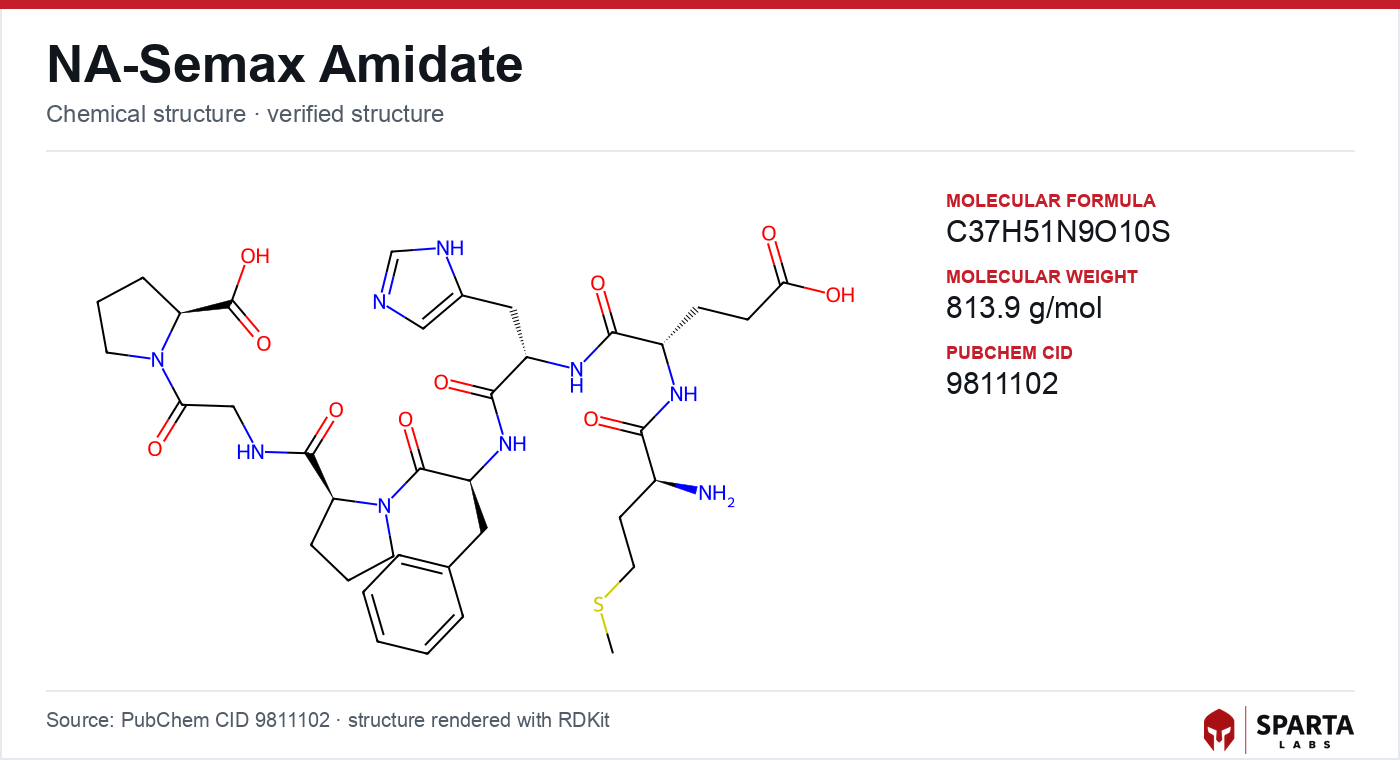
Figure: chemical structure of N-Acetyl Semax Amidate.
Solid-Phase Assembly of a Doubly Modified Heptapeptide
Peptides in this size class are assembled by solid-phase peptide synthesis (SPPS), the resin-anchored, stepwise coupling method introduced by Robert Bruce Merrifield in his 1963 report in the Journal of the American Chemical Society, work recognized with the 1984 Nobel Prize in Chemistry [1].
In contemporary Fmoc-based SPPS, protected amino acids are coupled sequentially to a polymer resin, each coupling followed by removal of the temporary Fmoc protecting group before the next residue is added; the finished chain is then cleaved from the resin with concurrent removal of side-chain protecting groups, typically using trifluoroacetic acid (TFA) cleavage cocktails.
The two terminal modifications of N-Acetyl Semax Amidate map naturally onto specific points in this workflow. The C-terminal amide is introduced by resin choice rather than by a separate reaction: assembly on a Rink amide resin yields a C-terminal primary amide directly upon TFA cleavage, so the amidation is built into the solid support before the first residue is coupled.
The N-terminal acetyl group is installed at the opposite end of the synthesis, after the final methionine residue is coupled and its Fmoc group removed, by capping the free α-amine on-resin with acetic anhydride prior to cleavage. Because both modifications are engineered into defined steps rather than performed on the crude peptide in solution, the principal purity determinants become coupling completeness at each residue, the completeness of the acetylation cap, and the rigor of downstream purification.
Findings from research models do not establish safety or efficacy in humans. Sparta Labs makes no claims about the use of this compound.
Andersson and colleagues (2000) reviewed large-scale SPPS across peptides of up to roughly 50 residues, cataloguing how coupling efficiency, resin selection, and protecting-group strategy determine the purity profile of the crude product in manufacturing contexts [2].
For a heptapeptide, per-residue coupling is generally efficient, so the characteristic impurities are deletion sequences from incomplete coupling, uncapped (des-acetyl) species from incomplete N-terminal capping, and synthetic by-products introduced during cleavage. Preparative reversed-phase HPLC on C18 or C8 stationary phases resolves these from the target on the basis of hydrophobicity and is the standard purification route for research-grade synthetic peptides.
Confirming the Modification Pattern, Not Just the Sequence
Purity for research-grade peptides is conventionally reported as analytical HPLC purity: the percentage of total UV peak area attributable to the target compound. The research-use minimum is generally ≥95%, with ≥98% recognized for higher-grade applications. Sparta Labs applies a ≥98% HPLC specification for N-Acetyl Semax Amidate, confirmed for each batch prior to release.
HPLC purity alone, however, cannot distinguish the correctly modified target from an analog that co-elutes or elutes nearby, which is where mass spectrometry becomes decisive for this particular molecule. The two terminal modifications each leave a defined mass signature: N-terminal acetylation adds approximately 42 daltons relative to the free amine, and C-terminal amidation shifts the mass relative to the free-acid heptapeptide. The observed molecular ion is compared against the calculated mass of the fully modified sequence Ac-Met-Glu-His-Phe-Pro-Gly-Pro-NH₂.
A des-acetyl impurity, an unamidated free-acid form, or an oxidized variant each carries a different mass, so mass spectrometry provides the orthogonal confirmation that the peak identified as pure by HPLC is in fact the doubly modified target rather than a structurally related synthetic relative. This orthogonality of HPLC purity and mass-spectrometric identity is the reason both analyses are run together rather than either being treated as sufficient on its own.
Sequence-Specific Degradation: Methionine and Histidine
Two residues in this sequence carry chemistry that makes them the compound's most relevant stability liabilities, and both are worth explicit attention in a sourcing and handling discussion.
The sequence begins with methionine, whose thioether side chain is among the most oxidation-susceptible functional groups in peptides. Under aerobic conditions, methionine can oxidize to methionine sulfoxide, a modification that adds roughly 16 daltons and is frequently resolved as a distinct HPLC peak and confirmed by mass spectrometry. The oxidation chemistry of methionine in peptides and proteins, including its sensitivity to atmospheric oxygen and reactive oxygen species and the analytical detection of the sulfoxide, has been reviewed in the protein-chemistry literature [3].
Practical control measures follow from that chemistry: lyophilized storage, exclusion of oxygen and moisture, and protection from light are the general principles applicable to methionine-containing peptides. The imidazole side chain of the internal histidine residue is a further reactive site relevant to characterization, though the methionine α-position is the dominant oxidation concern for this sequence.
Manning and colleagues (2010) reviewed the stability of protein and peptide pharmaceuticals, describing lyophilization as the standard means of arresting the hydrolytic and oxidative pathways that proceed in aqueous solution, and identifying storage temperature, residual moisture, and headspace oxygen as governing variables for solid-state shelf life [4]. Consistent with that framework, lyophilized peptide stored at −20°C in a desiccated, light-protected environment is expected to remain stable over the shelf life indicated on its certificate of analysis.
It is worth distinguishing this solid-state storage question from biological stability in physiological matrices: the intranasal pharmacokinetics and enzymatic turnover of Semax-class peptides studied by Shevchenko and colleagues concern the peptide's fate in vivo, a different chemistry from the storage stability of the lyophilized bulk material [5]. The terminal acetyl and amide caps of this analog are relevant to that in vivo distinction because they alter the substrate presented to exopeptidases, but they do not change the solid-state storage principles above.
Counterion and Residual Analysis
Beyond purity and identity, the salt form of a synthetic peptide is a defined attribute rather than an afterthought. TFA used in Fmoc-SPPS cleavage can persist as a counterion associated with the peptide's basic sites, and residual acetic acid, from acetylation and from lyophilization buffers, and residual synthesis solvents are additional process-related residuals.
For N-Acetyl Semax Amidate the net basicity is modest given that the N-terminus is acetylated, but the internal histidine and the acidic glutamate still define the molecule's charge state and its counterion association. General expectations for acceptable residual and impurity limits in drug substances are described in United States Pharmacopeia General Chapter <1086> on impurities [6]. Where a research application is sensitive to endotoxin, endotoxin testing is applied as an additional release check.
Independent third-party laboratory testing supports the defensibility of these analytical values. When HPLC purity and mass-spectrometric identity are confirmed by an accredited laboratory outside the production chain, the reported specification reflects an independent measurement rather than in-house self-certification alone. Sparta Labs submits each batch of N-Acetyl Semax Amidate for independent HPLC and mass-spectrometry confirmation before release. Comparable verification documentation is maintained for related peptides in this cluster, including the parent Semax sourcing and quality reference and the closely analogous N-Acetyl Selank Amidate sourcing reference.
What the Certificate of Analysis Records
A batch-specific Certificate of Analysis (COA) is the document that ties the analytical work above to a particular production lot. A Sparta Labs COA for N-Acetyl Semax Amidate records:
- HPLC purity: percentage by peak area, with the instrument method reference and chromatogram
- Mass spectrometry confirmation: observed molecular ion against the theoretical mass of the fully modified Ac-Met-Glu-His-Phe-Pro-Gly-Pro-NH₂ sequence
- Batch number: unique identifier linking the material to its manufacturing and testing record
- Manufacturing and expiry dates: supporting storage and stability planning
- Third-party laboratory identification: the independent laboratory that performed the analysis
For a peptide class where research works to attribute pharmacological differences to individual structural changes, the terminal acetyl and amide groups being confirmed present and correct is exactly the kind of detail that determines whether a reported finding rests on the intended molecule. Batch-specific COAs are accessible directly from the N-Acetyl Semax Amidate product page, where the documentation for the corresponding lot can be retrieved for institutional records or publication supplementary materials.
References
-
Merrifield RB. Solid phase peptide synthesis. I. The synthesis of a tetrapeptide. J Am Chem Soc. 1963;85(14):2149–2154. DOI: 10.1021/ja00897a025
-
Andersson L, Blomberg L, Flegel M, Lepsa L, Nilsson B, Verlander M. Large-scale synthesis of peptides. Biopolymers. 2000;55(3):227–250. PMID: 11074417. DOI: 10.1002/1097-0282(2000)55:3<227::AID-BIP50>3.0.CO;2-7
-
Vogt W. Oxidation of methionyl residues in proteins: tools, targets, and reversal. Free Radic Biol Med. 1995;18(1):93–105. PMID: 7896176. DOI: 10.1016/0891-5849(94)00158-G
-
Manning MC, Chou DK, Murphy BM, Payne RW, Katayama DS. Stability of protein pharmaceuticals: an update. Pharm Res. 2010;27(4):544–575. PMID: 20143256. DOI: 10.1007/s11095-009-0045-6
-
Shevchenko KV, Nagaev IY, Alfeeva LY, Andreeva LA, Kamenskii AA, Levitskaia NG, et al. Kinetics of Semax penetration into the brain and blood of rats after its intranasal administration. Russ J Bioorg Chem. 2006;32(1):57–62. DOI: 10.1134/S1068162006010055
-
United States Pharmacopeia. General Chapter <1086> Impurities in Drug Substances and Drug Products. USP 43. Rockville, MD: United States Pharmacopeial Convention; 2020.
Disclaimer. Statements in this article have not been evaluated by the Food and Drug Administration. This compound is not intended to diagnose, treat, cure, or prevent any disease. Sparta Labs sells research-use-only materials. Content is provided for educational and informational purposes only and does not constitute medical advice. Consult a qualified medical professional for any health concerns.
Frequently asked questions
What distinguishes N-Acetyl Semax Amidate from Semax chemically?
N-Acetyl Semax Amidate carries two terminal modifications that unmodified Semax lacks: an acetyl group capping the N-terminus and an amide replacing the free C-terminal carboxyl. Both modifications remove an ionizable terminal group, which changes the molecule's mass, net charge, and chromatographic behavior. From a sourcing standpoint, verification must confirm that both modifications are present and correctly placed, not merely that the underlying heptapeptide sequence is intact.
How is the acetyl and amide modification confirmed during quality control?
Mass spectrometry is central to confirming the modification pattern. N-terminal acetylation adds approximately 42 daltons and C-terminal amidation shifts the mass relative to the free-acid form, so the observed molecular ion is compared against the calculated mass of the fully modified sequence Ac-Met-Glu-His-Phe-Pro-Gly-Pro-NH2. HPLC establishes purity by peak area, while mass spectrometry confirms that the principal peak corresponds to the intended modified compound rather than an unmodified or partially modified analog.
Why is the methionine residue relevant to storage and handling?
The sequence begins with methionine, a residue whose thioether side chain is among the most oxidation-prone in peptides and can convert to methionine sulfoxide under aerobic conditions. Methionine sulfoxide formation adds roughly 16 daltons and is detectable by mass spectrometry and often as a resolved HPLC peak. Lyophilized storage in a desiccated, light-protected, low-oxygen environment reflects general handling principles for methionine-containing peptides described in the oxidation literature.
What does a Sparta Labs Certificate of Analysis for this peptide document?
A batch-specific Certificate of Analysis records HPLC purity by peak area with the instrument method, mass spectrometry identity confirmation against the theoretical modified mass, the batch number, manufacturing and expiry dates, and the independent laboratory that performed the analysis. It provides the traceability that supports research record-keeping and reproducibility. The COA is accessible from the product page for the corresponding batch.