
N-Acetyl Semax Amidate: Published Research
A study-by-study reading of the Semax literature centered on the doubly terminal-modified variant: the copper-coordination work on N-acetyl Semax, N-terminal structure–activity findings, neurotrophin gene-expression time courses, and ischemia-model transcriptomics. Educational reference.
For research use only. Not for human consumption. This article is educational reference material. It is not medical advice and is not a recommendation to use any substance.
From ACTH(4–10) to a doubly protected heptapeptide
N-Acetyl Semax Amidate carries the sequence Ac-Met-Glu-His-Phe-Pro-Gly-Pro-NH₂. It is the doubly terminal-modified descendant of Semax, a synthetic heptapeptide that itself derives from the ACTH(4–10) fragment Met-Glu-His-Phe-Arg-Trp-Gly through addition of the C-terminal Pro-Gly-Pro (PGP) tripeptide. Semax was developed at the Institute of Molecular Genetics and Moscow State University during the 1980s. The variant discussed here adds two chemical modifications to that scaffold: acetylation of the N-terminal methionine alpha-amino group, and amidation of the C-terminal proline carboxyl.
Both modifications belong to a well-characterized strategy in peptide chemistry: blocking the charged termini that serve as recognition sites for aminopeptidases and carboxypeptidases. Because the published research corpus is unevenly distributed across the parent peptide, the mono-acetylated analog, and the fully modified form, this article groups the literature by what each study actually examined, and states plainly which compound was tested in each case. The interpretive framework connecting these findings is treated in the N-Acetyl Semax Amidate mechanism of action article, and the chemistry and lineage are covered in the N-Acetyl Semax Amidate research overview.
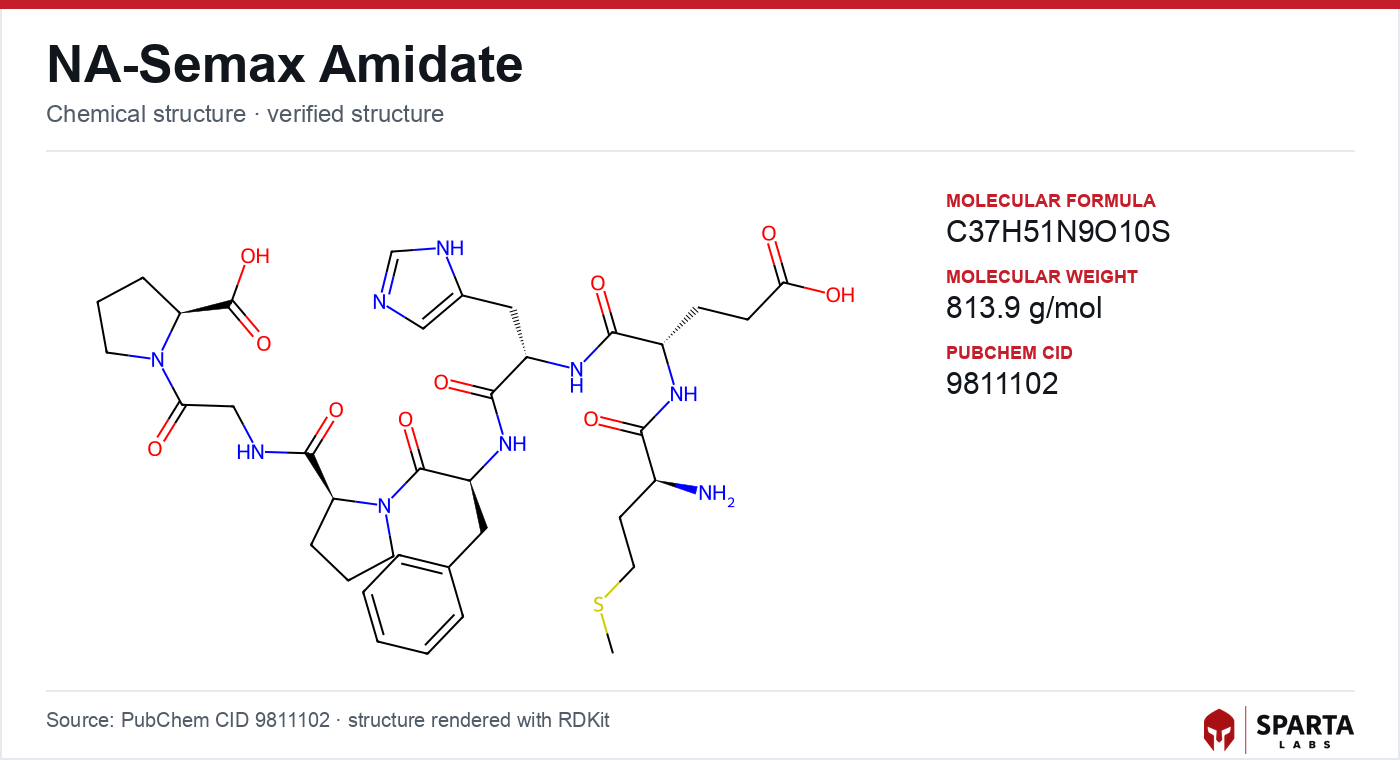
Figure: chemical structure of NA-Semax Amidate.
What "the literature" covers, and what it does not
A recurring feature of this compound class is a mismatch between the marketed variant and the tested variant. Most in vivo neurochemistry, gene-expression, and ischemia-model work was performed with unmodified Semax. Structural pharmacology addressing the acetylated N-terminus directly is narrower and centers on coordination chemistry. Studies isolating the effect of C-terminal amidation on the same neurotrophin endpoints have not, to date, been published. The reader should treat findings attributed to "Semax" as pertaining to the parent peptide unless the acetylated analog is named explicitly.
Methodologically, the corpus spans radioligand binding in brain membranes, real-time PCR of neurotrophin transcripts, in vivo microdialysis of monoamine metabolites, primary neuron culture survival assays, genome-wide transcriptomics and mass-spectrometry proteomics in stroke models, potentiometric and spectroscopic metal-coordination studies, and intranasal pharmacokinetics. Each carries the interpretive limits of its design.
The copper-coordination story: where N-acetylation matters most
The single most directly relevant published work on the acetylated variant is a coordination-chemistry study. Magrì and colleagues (2016), reporting in the Journal of Inorganic Biochemistry, synthesized N-acetyl Semax and characterized its copper(II) and zinc(II) binding across physiological pH ranges, comparing it head-to-head with unmodified Semax [1].
At pH 7.4, unmodified Semax was reported to form a CuN₄ chromophore that incorporates the free alpha-amino group of the N-terminal methionine as an anchoring donor. N-acetyl Semax, with that amino group blocked, was reported to form a CuN₃O chromophore instead, a geometrically distinct complex. Zinc(II) binding was not substantially altered by acetylation. In SH-SY5Y neuroblastoma cell assays, unmodified Semax was reported to confer partial protection against copper-induced cytotoxicity attributable to its chelation geometry, an activity the acetylated analog did not reproduce, consistent with loss of the free terminal amine.
Findings from research models do not establish safety or efficacy in humans. Sparta Labs makes no claims about the use of this compound.
The practical significance for anyone reading across the corpus is that N-terminal acetylation is not a neutral change. It removes one specific coordination mode that the parent peptide possesses. Whether receptor-mediated and neurotrophin-related activities survive the modification is a separate question addressed by other studies.
Behavioral structure–activity work on the N-terminus
Levitskaya and colleagues (2005), publishing in Biology Bulletin, systematically varied the N-terminal region of Semax and assessed the analogs in rat learning paradigms, including food-reinforced and pain-reinforced maze tasks [2]. Acetylation of the methionine alpha-amino group was reported to retain the nootropic-like activity observed in those models, whereas glycine, threonine, or alanine substitutions were reported to abolish it. The authors concluded that the identity and modification state of the first residue exert a dominant influence on the peptide's behavioral profile.
This result is the design rationale that connects the coordination-chemistry finding to the broader research program: acetylation changes metal binding but was reported to preserve activity in the behavioral assays used, which is why the modified scaffold remained a subject of interest.
Neurotrophin signaling: binding sites and gene expression
Dolotov and colleagues (2006), in the Journal of Neurochemistry, characterized specific Semax binding using tritium-labeled peptide in rat brain membrane preparations [3]. They reported saturable, reversible binding in basal forebrain membranes with a dissociation constant near 2.4 nM and a binding maximum of roughly 33.5 fmol/mg protein. In parallel in vivo experiments, intranasal Semax was reported to raise brain-derived neurotrophic factor (BDNF) protein selectively in the basal forebrain at three hours post-administration, with no analogous change in cerebellum, alongside an approximately 1.6-fold increase in hippocampal TrkB receptor phosphorylation and a roughly threefold increase in BDNF exon III mRNA.
Shadrina, Kolomin and colleagues (2010), in the Journal of Molecular Neuroscience, examined the time course of BDNF and nerve growth factor (NGF) gene expression across three brain regions and the retina after a single Semax administration to male Wistar rats, sampling from 20 minutes to 24 hours by real-time PCR [4]. The reported responses were region-specific and non-monotonic: hippocampal and retinal transcripts were lowered at 20 minutes while frontal cortex transcripts were elevated at the same time point, and retinal BDNF was elevated at 90 minutes. The authors described the pattern as multidirectional neurotrophin regulation rather than a uniform response.
Monoamine systems and pharmacological interaction
Kolomin and colleagues (2006), reporting in Neurochemical Research, measured striatal neurotransmitter and metabolite content in rats after Semax administration using microdialysis and tissue extraction [5]. They reported a roughly 25% increase in tissue 5-HIAA, the principal serotonin metabolite, at two hours, and a progressive rise in extracellular 5-HIAA to approximately 180% of baseline over one to four hours. Dopamine and its metabolites were reported to be unaltered by Semax alone. In a co-administration paradigm, Semax given before d-amphetamine was reported to amplify amphetamine's effect on extracellular dopamine and locomotor activity, which the authors interpreted as serotonergic modulation gating dopaminergic responsiveness under pharmacological challenge.
Cholinergic phenotype in culture
Grivennikov, Dolotov, Zolotarev, Andreeva, Myasoedov and colleagues (2008), in Restorative Neurology and Neuroscience, studied Semax effects on dissociated rat basal forebrain neurons [6]. At 100 nM, Semax was reported to be associated with roughly 1.5–1.7-fold greater cholinergic neuron survival relative to untreated controls, with elevated choline acetyltransferase activity. The effect was reported to be specific to the cholinergic phenotype; GABAergic and total neuron-specific enolase-positive populations were not significantly affected at the tested concentration. The study was conducted in cell culture and did not address systemic outcomes.
Ischemia models: parent peptide versus its PGP metabolite
Two features of the Semax scaffold make ischemia models informative: the peptide is metabolized to fragments that retain the C-terminal Pro-Gly-Pro, and PGP is itself biologically studied. Dmitrieva, Povarova, Skvortsova, Myasoedov and colleagues (2010), in Cellular and Molecular Neurobiology, compared Semax and Pro-Gly-Pro effects on neurotrophin gene transcription in rat cortex after permanent middle cerebral artery occlusion [7]. Semax was reported to activate BDNF, TrkC, and TrkA transcription at three hours and NGF transcription at 24 and 72 hours; PGP was reported to show a partially overlapping, partially distinct profile. The authors concluded that the intact sequence and its C-terminal metabolite are pharmacologically non-equivalent, a distinction relevant to any variant, such as the amidated form, whose modifications alter metabolic fragmentation.
Medvedeva and colleagues (2014), in the open-access journal BMC Genomics, performed genome-wide RNA sequencing in a rat permanent occlusion model with and without Semax [8]. The analysis reported broad changes in immune-response and vascular-function gene expression, more pronounced at 24 hours for immunoglobulin- and chemokine-encoding transcripts, and altered vascular-system transcripts at both three and 24 hours. Sudarkina, Filippenkov and colleagues (2021), in the International Journal of Molecular Sciences, extended this to the protein level with mass-spectrometry proteomics in a transient ischemia–reperfusion model, reporting more than 40 proteins significantly associated with Semax exposure and patterns consistent with changes in apoptotic, neuroinflammatory, antioxidant, and synaptic-plasticity-related proteins [9]. As a proteomics study, its findings describe associations between exposure and protein abundance rather than causal mechanism.
Delivery and metabolism of the parent peptide
Shevchenko, Nagaev and colleagues (2006), in the Russian Journal of Bioorganic Chemistry, tracked labeled Semax after intranasal administration to rats to characterize brain and blood penetration and metabolite profiles [10]. The study documents the rapid degradation kinetics that terminal modification is designed to counter, and provides the metabolic baseline against which claims about the acetylated, amidated variant's stability would have to be tested directly. No equivalent pharmacokinetic dataset specific to the fully modified analog has been published.
Knowledge gaps specific to the fully modified analog
Several questions remain open, and they are unusually well defined for this compound because the modifications are discrete and the parent-peptide literature is deep:
The amidation variable is untested in isolation. No published study separates the effect of C-terminal amidation on the BDNF or NGF gene-expression endpoints that Dolotov and Shadrina reported for unmodified Semax [3,4]. The existing real-time PCR methodology is well positioned to answer this directly.
Receptor subtype remains unassigned. Published binding work has not definitively attributed Semax-family pharmacology to a specific melanocortin receptor subtype (MC1R–MC5R). Subtype-selective antagonist experiments would resolve which activities are receptor-mediated.
Metabolic-stability claims lack a matched dataset. The intranasal degradation profile exists only for the parent peptide [10]. Whether dual terminal protection changes that profile is a testable but unpublished question.
For context on how terminal modification is applied to a chemically distinct neuropeptide in the same Russian research tradition, the N-Acetyl Selank Amidate published research article summarizes the parallel corpus for Selank, while the Semax published research article covers the unmodified parent in greater depth. Research-grade N-Acetyl Semax Amidate from Sparta Labs is supplied with batch-specific certificates of analysis documenting HPLC purity and mass-spectrometry identity verification; sourcing standards for this compound class are detailed in the N-Acetyl Semax Amidate sourcing and quality article.
References
-
Magrì A, Munzone A, Peana M, Medici S, Zoroddu MA, Hansson Ö, et al. Influence of the N-terminus acetylation of Semax, a synthetic analog of ACTH(4-10), on copper(II) and zinc(II) coordination and biological properties. J Inorg Biochem. 2016;164:59–69. PMID: 27586814. DOI: 10.1016/j.jinorgbio.2016.08.013
-
Levitskaya NG, Sebentsova EA, Andreeva LA, Alfeeva LY, Kamenskiy AA, Myasoedov NF. Effect of modification of the N-terminal region of Semax on the expression of nootropic effect of Semax analogs. Biol Bull. 2005;32(4):381–386. DOI: 10.1007/s10525-005-0116-0
-
Dolotov OV, Karpenko EA, Inozemtseva LS, Seredenina TS, Levitskaya NG, Rozyczka J, et al. Semax, an analogue of adrenocorticotropin (4–10), binds specifically and increases levels of brain-derived neurotrophic factor protein in rat basal forebrain. J Neurochem. 2006;97(Suppl 1):82–86. DOI: 10.1111/j.1471-4159.2006.03658.x
-
Shadrina MI, Kolomin TA, Agapova TY, Dolotov OV, Grivennikov IA, Slominsky PA, et al. Comparison of the temporary dynamics of NGF and BDNF gene expression in rat hippocampus, frontal cortex, and retina under Semax action. J Mol Neurosci. 2010;41(1):30–35. PMID: 19662538. DOI: 10.1007/s12031-009-9270-z
-
Kolomin T, Shadrina M, Slominsky P, Limborska S, Myasoedov N. Semax, an ACTH(4-10) analogue with nootropic properties, activates dopaminergic and serotoninergic brain systems in rodents. Neurochem Res. 2006;31(3):285–292. PMID: 16362768. DOI: 10.1007/s11064-005-8826-8
-
Grivennikov IA, Dolotov OV, Zolotarev YA, Andreeva LA, Myasoedov NF, et al. Effects of behaviorally active ACTH(4-10) analogue: Semax on rat basal forebrain cholinergic neurons. Restor Neurol Neurosci. 2008;26(1):35–43. PMID: 18431004
-
Dmitrieva VG, Povarova OV, Skvortsova VI, Limborska SA, Myasoedov NF, Dergunova LV. Semax and Pro-Gly-Pro activate the transcription of neurotrophins and their receptor genes after cerebral ischemia. Cell Mol Neurobiol. 2010;30(1):71–79. PMID: 19633950. DOI: 10.1007/s10571-009-9432-0
-
Medvedeva EV, Dmitrieva VG, Povarova OV, Limborska SA, Skvortsova VI, Myasoedov NF, et al. The peptide Semax affects the expression of genes related to the immune and vascular systems in rat brain focal ischemia: genome-wide transcriptional analysis. BMC Genomics. 2014;15:228. PMID: 24661604. DOI: 10.1186/1471-2164-15-228
-
Sudarkina OY, Filippenkov IB, Stavchansky VV, Denisova AE, Gubsky LV, Limborska SA, et al. Brain protein expression profile confirms the protective effect of the ACTH(4–7)PGP peptide (Semax) in a rat model of cerebral ischemia–reperfusion. Int J Mol Sci. 2021;22(12):6179. PMID: 34201112. DOI: 10.3390/ijms22126179
-
Shevchenko KV, Nagaev IY, Alfeeva LY, Andreeva LA, Kamenskii AA, Levitskaia NG, et al. Kinetics of Semax penetration into the brain and blood of rats after its intranasal administration. Russ J Bioorg Chem. 2006;32(1):57–62. DOI: 10.1134/S1068162006010055
Disclaimer. Statements in this article have not been evaluated by the Food and Drug Administration. This compound is not intended to diagnose, treat, cure, or prevent any disease. Sparta Labs sells research-use-only materials. Content is provided for educational and informational purposes only and does not constitute medical advice. Consult a qualified medical professional for any health concerns.
Frequently asked questions
What does published research say about the N-acetylated form of Semax specifically?
The most directly relevant study is Magrì and colleagues (2016) in the Journal of Inorganic Biochemistry, which synthesized N-acetyl Semax and characterized its copper(II) and zinc(II) coordination. They reported that N-terminal acetylation shifts the copper-binding geometry from a CuN4 to a CuN3O chromophore and removes the copper-dependent cytoprotective activity seen with free Semax in neuroblastoma cells, while zinc binding was largely unchanged. Levitskaya and colleagues (2005) separately reported that N-terminal acetylation retained nootropic-like activity in rat learning paradigms.
Why is most of the research on Semax rather than the fully modified variant?
The bulk of the in vivo neurochemistry, gene-expression, and ischemia-model literature was performed with unmodified Semax, which has a much longer research history dating to the 1980s. Structural work on the acetylated N-terminus is narrower and centered on coordination chemistry, and studies isolating the effect of C-terminal amidation on the same endpoints have not been published. Findings attributed to Semax should be read as pertaining to the parent peptide unless the analog is named explicitly.
What did the neurotrophin gene-expression studies report?
Dolotov and colleagues (2006) reported saturable Semax binding in rat basal forebrain membranes and a region-selective rise in BDNF protein, plus increased hippocampal TrkB phosphorylation and BDNF exon III mRNA, after intranasal administration. Shadrina and colleagues (2010) reported region-specific, non-monotonic BDNF and NGF transcript changes across brain regions and the retina over 24 hours. These are rodent findings and do not establish safety or efficacy in humans.
How do Semax and its Pro-Gly-Pro metabolite differ in the research?
Dmitrieva and colleagues (2010) compared Semax with its C-terminal Pro-Gly-Pro (PGP) metabolite on neurotrophin gene transcription after cerebral ischemia in rats and reported partially overlapping, partially distinct transcriptional profiles. The authors concluded the intact sequence and its PGP fragment are pharmacologically non-equivalent, which is relevant to any variant whose terminal modifications alter metabolic fragmentation.
Are there published human clinical trials for N-Acetyl Semax Amidate?
No published clinical trials specific to the N-acetyl amidate variant were identified in the peer-reviewed literature. The parent compound Semax has a separate Russian clinical and regulatory history, but clinical investigation of the fully terminal-modified analog has not been reported.