
N-Acetyl Selank Amidate: Published Research
A structured review of the peer-reviewed Selank literature organized by its two core mechanistic threads, enkephalin-degrading enzyme inhibition and GABAergic transcriptional modulation, with explicit notation of where findings rest on the parent compound versus the amidated analog. Educational reference.
For research use only. Not for human consumption. This article is educational reference material. It is not medical advice and is not a recommendation to use any substance.
Introduction
N-Acetyl Selank Amidate is a terminally modified analog of Selank, a synthetic heptapeptide derived from the immunopeptide tuftsin and characterized over roughly two decades by the Institute of Molecular Genetics of the Russian Academy of Sciences together with collaborating pharmacology institutes. The parent-compound literature is unusual for a peptide of this size in that it spans several distinct methodological generations: in vitro enzyme kinetics, radioligand receptor-binding assays, transcriptional profiling in neural and peripheral tissue, and behavioral pharmacology across multiple rodent strains and withdrawal paradigms. Because N-Acetyl Selank Amidate retains the seven-residue pharmacophore of Selank, the published Selank corpus forms the reference frame against which the modified analog is discussed.
This summary organizes that corpus around the two mechanistic threads that actually structure the primary literature: the enkephalin-degrading enzyme lineage that dates to the earliest work, and the later GABAergic transcriptional and receptor-binding studies. Each entry names the reporting group, the model system, and the observed measurement, and marks explicitly where a finding rests on the parent compound rather than the amidated analog. A related Russian neuropeptide developed within the same institutional program, Semax, is summarized in the N-Acetyl Semax Amidate published research article for readers comparing the two research lineages.
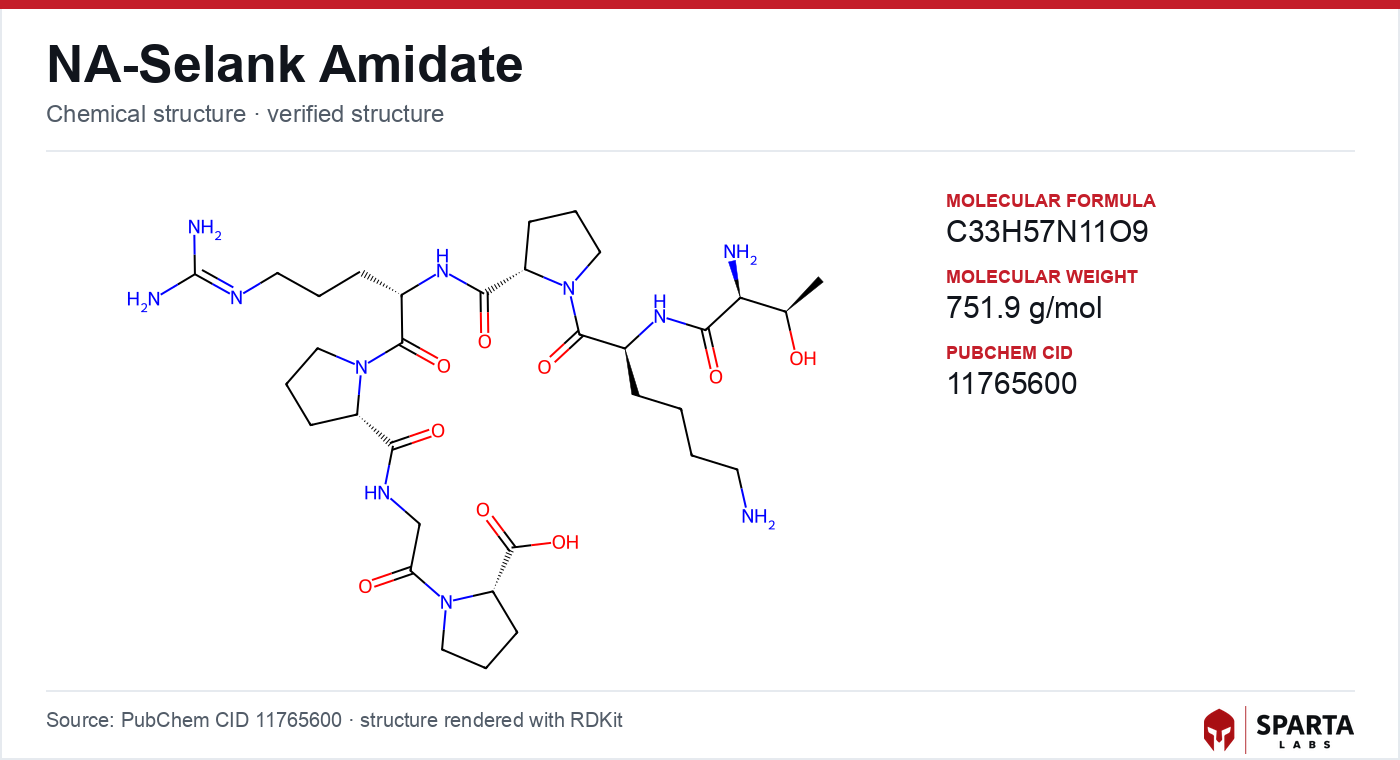
Figure: chemical structure of NA-Selank Amidate.
The Tuftsin Lineage and Why It Shaped the Research Program
Selank was designed around the tuftsin sequence Thr-Lys-Pro-Arg, a fragment of the immunoglobulin heavy chain with documented immunomodulatory activity, extended with a C-terminal stabilizing sequence to slow enzymatic degradation. This design choice is not incidental to the literature: it explains why the Selank research program pursued both a central-nervous-system line of investigation and a peripheral-immune line in parallel, rather than treating the compound as a purely neuroactive agent. The N-acetyl and C-terminal amide modifications that define N-Acetyl Selank Amidate follow a well-precedented peptide-chemistry strategy of capping both termini to reduce exopeptidase susceptibility, and the same terminal-capping logic is discussed for the sister compound in the N-Acetyl Semax Amidate mechanism of action article.
Because the amidated analog and the parent share the tuftsin-derived pharmacophore, investigators have generally treated the parent-compound pharmacology as the working hypothesis for the analog while noting that direct comparative characterization of the modified entity remains limited in the indexed literature.
Enkephalinase and the Enkephalin-Opioid Thread
The oldest and most mechanistically foundational line of Selank research concerns inhibition of enkephalin-degrading enzyme activity.
Semenova et al. (2001): enkephalin-degrading enzyme inhibition [1]. Working at the Institute of Molecular Genetics, this group reported that Selank inhibited enzymatic hydrolysis of plasma enkephalin in an in vitro assay, and framed enkephalin stabilization as a candidate mechanism underlying the compound's behavioral pharmacology. This paper established the conceptual scaffold that much subsequent behavioral work was designed to test.
Findings from research models do not establish safety or efficacy in humans. Sparta Labs makes no claims about the use of this compound.
Kolik et al. (2012): naloxone-sensitivity of behavioral effects [2]. To test whether opioid-receptor signaling contributed to Selank's behavioral profile, this study pretreated mice with the opioid antagonist naloxone before Selank administration. In the high-anxiety BALB/c strain, naloxone pretreatment attenuated the behavioral response. The authors interpreted the naloxone-sensitive component as evidence that the endogenous enkephalin-opioid system partially mediates the observed behavioral pharmacology, connecting the in vitro enzyme data of Semenova et al. to an in vivo readout.
Konstantinopolsky et al. (2022): morphine-withdrawal model [3]. Reported from the V. V. Zakusov Research Institute of Pharmacology, this study examined Selank in outbred rats undergoing naloxone-precipitated morphine withdrawal. Selank administration was associated with attenuation of several aversive withdrawal signs relative to untreated withdrawal controls. The authors attributed the effect to the peptide's reported actions on the enkephalin-opioid system, extending the enzyme-inhibition line of inquiry into a model with direct relevance to opioid pharmacology.
GABAergic Transcriptional and Receptor-Binding Studies
A second, later thread applied molecular and receptor-level tools to the GABA system, giving the compound one of the more detailed gene-expression records among small research peptides.
Filatova et al. (2016): GABAergic gene expression in rat frontal cortex [4]. Using quantitative PCR on frontal-cortex tissue collected at one and three hours after administration, this in vivo study reported time-dependent changes in the expression of genes involved in GABAergic neurotransmission, with a larger set of altered genes at the earlier timepoint. The authors interpreted the transcriptional profile as consistent with receptor-level modulation of GABAergic signaling. The paper is available open-access through PubMed Central.
Volkova et al. (2016): GABAergic gene expression profiling [5]. From the same research program, this study examined the effect of Selank administration on a panel of genes involved in GABAergic neurotransmission, characterizing the peptide as a context-dependent modulator of GABAergic gene programs rather than a direct GABA-mimetic. This work complements the in vivo rat data of Filatova et al. and reinforces the transcriptional line of investigation.
Zozulya et al. (2018): mechanistic review [6]. This peer-reviewed synthesis in Protein and Peptide Letters integrated the receptor-binding, gene-expression, and enkephalinase data into a single account, describing Selank as an allosteric modulator of GABA-A receptor function whose profile differs from that of classical benzodiazepines despite partial GABAergic overlap. As a review, it is a useful entry point to the primary sources cited above and remains one of the more complete single-source treatments of Selank pharmacology in the English-language indexed record.
Peripheral-Immune and Neurotrophic Lines
Consistent with the tuftsin origin, part of the corpus looks beyond the central nervous system.
Kolomin et al. (2010): transcriptomic response in hippocampus and spleen [7]. This study profiled the transcriptomic response of rat hippocampal and splenic tissue to single and chronic Selank administration, reporting differential gene expression across both tissues. The finding extended the compound's documented transcriptional reach from central to peripheral immune tissue and echoed its tuftsin structural lineage. Published in Doklady Biochemistry and Biophysics.
Kolomin et al. (2013): synthetic regulatory-peptide review [8]. This review of synthetic peptides based on natural regulatory sequences situated Selank within a broader class of tuftsin- and ACTH-derived research peptides, summarizing the gene-expression and behavioral literature and providing context for how the compound relates to structurally adjacent neuropeptides.
What the Literature Does and Does Not Cover for the Amidated Analog
The distinction between parent-compound and analog data is the single most important interpretive caveat for readers of this corpus. The receptor-binding, enzyme-kinetic, gene-expression, and behavioral findings summarized above were generated with Selank. Direct primary-research characterization of how the dual terminal modification of N-Acetyl Selank Amidate affects receptor affinity, plasma stability, and behavioral potency relative to the parent is comparatively sparse in the indexed literature, and comparative pharmacokinetic studies of the modified entity represent a logical next step for the research community.
For chemistry and classification of the analog, the N-Acetyl Selank Amidate research overview provides the structural background, and the institutional timeline is covered in the N-Acetyl Selank Amidate discovery and research history article. Researchers evaluating material against this literature can review batch analysis and specifications on the N-Acetyl Selank Amidate product page.
Receptor-level detail is covered in the N-Acetyl Selank Amidate mechanism of action article.
References
-
Semenova TP, Kozlovskaya MM, Zuikov AV, et al. The inhibitory effect of Selank on enkephalin-degrading enzymes as a possible mechanism of its anxiolytic activity. Eksperimentalnaya i Klinicheskaya Farmakologiya. 2001;64(4):15-17. PMID: 11550013. PubMed
-
Kolik LG, Konstantinopolsky MA, Seredenin SB. The role of the opioid system in the anti-anxiety effect of the peptide anxiolytic selank. Eksperimentalnaya i Klinicheskaya Farmakologiya. 2012;75(4):3-6. PMID: 22550852. PubMed
-
Konstantinopolsky MA, Chernyakova IV, Kolik LG. Selank, a Peptide Analog of Tuftsin, Attenuates Aversive Signs of Morphine Withdrawal in Rats. Bull Exp Biol Med. 2022;173(6):722-726. PMID: 36322304. DOI: 10.1007/s10517-022-05624-x. PubMed
-
Filatova E, Kasian A, Kolomin T, et al. Selank Affects the Expression of Some Genes Involved in GABAergic Neurotransmission. Front Pharmacol. 2016;6:317. PMID: 26793110. DOI: 10.3389/fphar.2015.00317. PMC: PMC4757669. PubMed Central
-
Volkova A, Shadrina M, Kolomin T, et al. Selank Administration Affects the Expression of Some Genes Involved in GABAergic Neurotransmission. Front Pharmacol. 2016;7:31. PMID: 26924986. DOI: 10.3389/fphar.2016.00031. PubMed
-
Zozulya AA, Neznamov GG, Siuniakov TS, et al. Peptide-based Anxiolytics: The Molecular Aspects of Heptapeptide Selank Biological Activity. Protein Pept Lett. 2018;25(10):914-923. PMID: 30255741. DOI: 10.2174/0929866525666180925143003. PubMed
-
Kolomin T, Agapova T, Agniullin Y, et al. Transcriptomic response of rat hippocampus and spleen cells to single and chronic administration of the peptide Selank. Dokl Biochem Biophys. 2010;430:37-39. PMID: 20440962. DOI: 10.1134/S1607672910010114. PubMed
-
Kolomin T, Shadrina M, Slominsky P, Limborska S, Myasoedov N. A new generation of drugs: synthetic peptides based on natural regulatory peptides. Neuroscience & Medicine. 2013;4(4):223-252. DOI: 10.4236/nm.2013.44035.
Disclaimer. Statements in this article have not been evaluated by the Food and Drug Administration. This compound is not intended to diagnose, treat, cure, or prevent any disease. Sparta Labs sells research-use-only materials. Content is provided for educational and informational purposes only and does not constitute medical advice. Consult a qualified medical professional for any health concerns.
Frequently asked questions
What research exists on N-Acetyl Selank Amidate and its parent compound Selank?
The peer-reviewed corpus is built primarily on Selank, the parent heptapeptide, and spans in vitro enzyme kinetics, radioligand receptor-binding assays, gene-expression profiling in neural and peripheral tissue, and behavioral pharmacology in rodent models. Two mechanistic threads structure the literature: inhibition of enkephalin-degrading enzyme activity and modulation of GABAergic signaling. Direct primary-research characterization of the amidated analog as a distinct entity is comparatively limited in the indexed record.
Why was Selank designed around the tuftsin sequence?
Selank incorporates the tuftsin fragment Thr-Lys-Pro-Arg, a segment of the immunoglobulin heavy chain with documented immunomodulatory activity, extended with a stabilizing C-terminal sequence. This design is reflected in the research program, which pursued both a central-nervous-system line of investigation and a peripheral-immune line in parallel, including gene-expression studies in spleen tissue.
What did the enkephalinase research on Selank report?
Semenova and colleagues (2001) reported that Selank inhibited enzymatic hydrolysis of plasma enkephalin in an in vitro assay and proposed enkephalin stabilization as a candidate mechanism. Later work using naloxone pretreatment in mice and a rat morphine-withdrawal model built on this enkephalin-opioid framework, connecting the in vitro enzyme data to in vivo behavioral readouts.
How does N-Acetyl Selank Amidate differ chemically from Selank?
N-Acetyl Selank Amidate retains the seven-residue pharmacophore of Selank but adds terminal modifications, N-acetylation and C-terminal amidation, a well-precedented peptide-chemistry strategy for reducing exopeptidase susceptibility. Because the pharmacophore is shared, investigators generally treat the parent-compound pharmacology as the working reference frame for the analog while noting that comparative characterization of the modified entity remains limited.