
N-Acetyl Selank Amidate: Discovery and Research History
How a 1970 immunopeptide discovery at Tufts University became a Russian-registered heptapeptide and, later, a terminally modified research analog: the documented lineage of N-Acetyl Selank Amidate. Educational reference.
For research use only. Not for human consumption. This article is educational reference material. It is not medical advice and is not a recommendation to use any substance.
A lineage that crosses fifty years and two continents
N-Acetyl Selank Amidate sits at the end of an unusually well-documented research chain. That chain begins in a Boston laboratory in 1970 with the identification of an immunoglobulin-derived tetrapeptide, moves to Moscow in the 1990s where systematic peptide-extension chemistry converted that tetrapeptide into a longer neuroactive sequence, and closes with the terminal-modification chemistry that produced the acetylated, amidated variant discussed here. This article reconstructs that history from primary literature and peer-reviewed reviews, keeping each milestone tied to a citation rather than to secondary commentary. Readers seeking the underlying pharmacology should consult the companion N-Acetyl Selank Amidate mechanism of action article; those seeking the study-by-study record should consult N-Acetyl Selank Amidate published research.
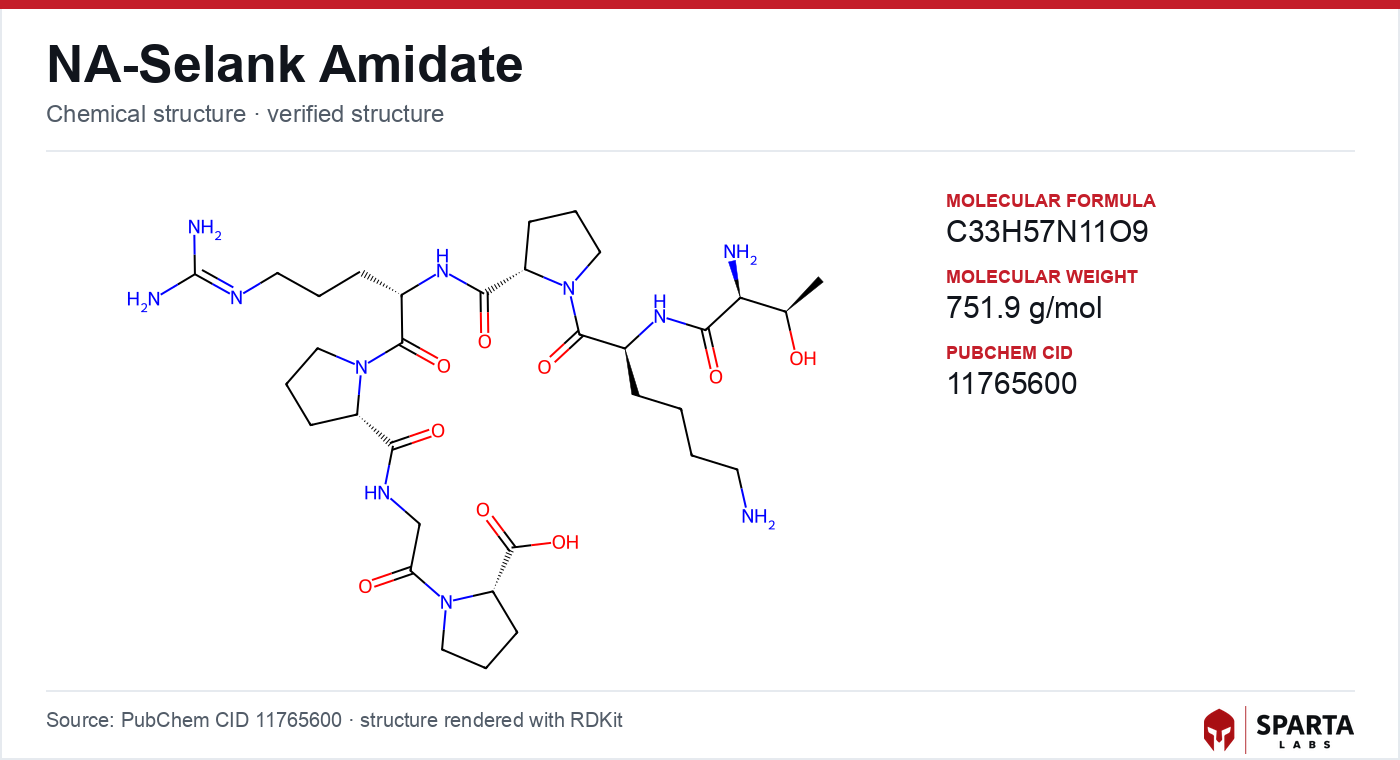
Figure: chemical structure of N-Acetyl Selank Amidate.
The tuftsin starting point (1970)
The structural ancestor of the entire family is tuftsin, the tetrapeptide Thr-Lys-Pro-Arg. Tuftsin was first described by Najjar and Nishioka in 1970 in Nature, which reported it as a phagocytosis-stimulating factor residing within the Fc domain of the immunoglobulin G heavy chain [1]. The name was coined in reference to Tufts University, where the work was carried out.
Findings from research models do not establish safety or efficacy in humans. Sparta Labs makes no claims about the use of this compound.
In its native form, tuftsin is released from its parent immunoglobulin by sequential enzymatic cleavage and was characterized in the following decade as an immunomodulatory peptide acting on mononuclear phagocytes [1]. What matters for this history is not the immunology itself but the scaffold: a short, arginine-terminated tetrapeptide whose structure-activity relationships were mapped in detail during the 1970s and 1980s, giving later groups a well-understood template to extend and derivatize.
From tetrapeptide to heptapeptide: the Moscow extension chemistry (1990s)
The transformation of the tuftsin scaffold into Selank is attributed to research groups at the Institute of Molecular Genetics of the Russian Academy of Sciences, with Nikolay Myasoedov and Lyudmila Andreeva among the principal contributors, working alongside the V. V. Zakusov Research Institute of Pharmacology.
The design problem was concrete. Native tuftsin is cleared rapidly through enzymatic hydrolysis, which limits its residence time and constrains sustained pharmacological study. The Moscow approach was to append a C-terminal Pro-Gly-Pro tripeptide to the Thr-Lys-Pro-Arg core, yielding the heptapeptide later registered under the International Nonproprietary Name "Selank." Proline-rich C-terminal extensions are a recurring motif in this institute's neuropeptide work because proline residues resist several common peptidases, a design theme that also appears in the related program that produced Semax.
Early rodent studies reported that the extended heptapeptide displayed a longer functional residence time than the native tetrapeptide, with behavioral effects observed for a period after a single administration [2]. Myasoedov, Andreeva, and colleagues framed Selank and related tuftsin-family peptides as regulators of adaptive behavior under stress in rodent models [2], establishing the behavioral pharmacology that later mechanistic work sought to explain.
Opening a second mechanistic line: the enkephalin connection (early 2000s)
A distinct thread in the Selank story emerged from Semenova and colleagues in 2001, who reported that Selank interacted with the enzymatic degradation of enkephalin in plasma-derived preparations [3]. This was significant because it moved the compound's mechanistic narrative beyond its immunological ancestry: a tuftsin-derived heptapeptide appeared to touch the endogenous opioid-peptide degradation system, seeding an enkephalinergic framework that subsequent investigators returned to repeatedly. This is one of the features that distinguishes the Selank lineage from purely GABAergic or purely immunological research peptides catalogued in the N-Acetyl Selank Amidate research overview.
Expanding the toolkit: gene-expression and immunological profiling (2000s–2010s)
Through the 2000s and 2010s the Institute of Molecular Genetics program, with investigators including Kolomin, Shadrina, Slominsky, and Limborska, applied molecular-biology methods that the first generation of peptide researchers had not had available. Quantitative PCR and transcriptional profiling allowed the group to characterize effects in neural and immune tissue at a resolution that behavioral assays alone could not reach.
Kolomin and colleagues (2008) reported that intranasal Selank administration was associated with altered Bdnf messenger RNA and BDNF protein in the rat hippocampus [4], extending the picture from receptor pharmacology toward neurotrophic signaling. A 2011 study in Regulatory Peptides examined inflammation-related gene expression in mouse spleen following Selank administration [5], and a 2016 report in Frontiers in Pharmacology examined genes involved in GABAergic neurotransmission [6]. Read together, these studies documented that the Selank research reach spanned both central-nervous-system and peripheral-immune tissue, consistent with the compound's tuftsin heritage.
The regulatory endpoint of the parent compound
The parent Selank heptapeptide reached a milestone that few basic-research neuropeptides do: pharmaceutical registration. Deigin and colleagues (2022), in a peer-reviewed review of peptide biopharmaceutical development in Russia, documented Selank's registration as a nasal-drop pharmaceutical product within the Russian Federation [7]. That review situated Selank alongside Semax and other compounds whose lineage traces to Soviet-era basic-research institutes and continued through the post-Soviet period into formal registration.
A comparable institutional trajectory characterizes Epithalon, another Russian-origin research peptide that progressed from laboratory work to a published research record without Western regulatory approval. The existence of a registered pharmaceutical product in the Selank structural class represents the deepest institutional validation the family has received, and it is documented in the peer-reviewed pharmacology literature rather than in vendor material.
N-Acetyl Selank Amidate, by contrast, is a distinct chemical entity carrying dual terminal modification. It has not been the subject of independent regulatory filings with the United States FDA, the European Medicines Agency, or other major Western authorities, and no clinical-trial registrations for the acetylated and amidated variant specifically have been identified in public registries. The regulatory record of the parent Selank program in Russia is the closest institutional precedent for the class.
The terminal-modification chemistry and where the record stands now
The defining feature of this specific compound is its two-ended modification: acetylation at the N-terminus and amidation at the C-terminus. Both are long-established peptide-chemistry strategies. Capping the amino terminus with an acetyl group and the carboxyl terminus with an amide removes the free charged ends that aminopeptidases and carboxypeptidases recognize, a rationale documented broadly across the peptide therapeutics literature [8]. Applied to Selank, this follows a clear precedent within the field; the same modification logic underlies the acetylated, amidated variant of the sibling compound described in the N-Acetyl Semax Amidate research history.
The most recent indexed English-language reporting on the parent compound continued the opioid-pharmacology thread opened two decades earlier, with work from the V. V. Zakusov Research Institute of Pharmacology examining Selank in a naloxone-precipitated morphine-withdrawal model in rats [9]. This extended the early enkephalin-degradation hypothesis into a translational context and demonstrates that the Selank research program remains an active contributor to the indexed literature.
As a discrete chemical entity, N-Acetyl Selank Amidate is registered in the NIH PubChem database (CID 133082488) with the molecular formula C₃₅H₅₉N₁₁O₁₀, confirming its structural cataloguing. Direct pharmacological characterization of the dual-modified variant specifically, including binding assays, plasma-stability measurements, and behavioral studies using the modified compound rather than the parent, represents a natural next step for investigators building on the existing record. Research-grade material with batch-level documentation is described on the N-Acetyl Selank Amidate product page. Investigators comparing analytical and handling considerations across the family may also find the N-Acetyl Selank Amidate sourcing and quality standards article relevant.
The Selank research record as a whole remains concentrated at Russian institutions, with English-language publications representing internationally reported work drawn from an original Russian-language corpus. Journals such as Eksperimentalnaya i Klinicheskaya Farmakologiya (Experimental and Clinical Pharmacology) and Zhurnal Vysshei Nervnoi Deyatelnosti (Journal of Higher Nervous Activity) remain the principal venues for that original-language reporting.
References
-
Najjar VA, Nishioka K. "Tuftsin": a natural phagocytosis stimulating peptide. Nature. 1970;228(5272):672-3. PMID: 4116440. DOI: 10.1038/228672a0.
-
Myasoedov NF, Andreeva LA, Samonina GE, Kamenskiy AA. Selank and short peptides of the tuftsin family in the regulation of adaptive behavior under stress. Zhurnal Vysshei Nervnoi Deyatelnosti Imeni I P Pavlova. 2004;54(1):76-83. PMID: 14969422.
-
Semenova TP, Kozlovskaya MM, Zuikov AV, Kozlovskiy II, Zuikov PV, Lygalov AV. Selank and the enkephalin-degrading enzyme system. Eksperimentalnaya i Klinicheskaya Farmakologiya. 2001;64(4):15-7. PMID: 11550013.
-
Kolomin T, Shadrina M, Agniullin Y, Shram S, Slominskii P, Limborska S, et al. Intranasal administration of the peptide Selank regulates BDNF expression in the rat hippocampus in vivo. Dokl Biol Sci. 2008;421:241-3. PMID: 18841804. DOI: 10.1134/S0012496608040066.
-
Kolomin T, Shadrina M, Slominsky P, Limborska S, Myasoedov N. Expression of inflammation-related genes in mouse spleen under the tuftsin analog Selank. Regul Pept. 2011;170(1-3):18-23. PMID: 21609736. DOI: 10.1016/j.regpep.2011.05.001.
-
Filatova EV, Shadrina MI, Slominsky PA, et al. Selank administration affects the expression of some genes involved in GABAergic neurotransmission. Front Pharmacol. 2016;6:317. PMID: 26793110. DOI: 10.3389/fphar.2015.00317. PMCID: PMC4757669.
-
Deigin VI, Poluektova EA, Beniashvili AG, Kozin SA, Poluektov YM. Development of peptide biopharmaceuticals in Russia. Pharmaceutics. 2022;14(4):716. PMID: 35456550. DOI: 10.3390/pharmaceutics14040716. PMCID: PMC9030433.
-
Fosgerau K, Hoffmann T. Peptide therapeutics: current status and future directions. Drug Discov Today. 2015;20(1):122-8. PMID: 25450771. DOI: 10.1016/j.drudis.2014.10.003.
-
Konstantinopolsky MA, Chernyakova IV, Kolik LG. Selank, a peptide analog of tuftsin, attenuates aversive signs of morphine withdrawal in rats. Bull Exp Biol Med. 2022;173(6):722-726. PMID: 36322304. DOI: 10.1007/s10517-022-05624-x.
Disclaimer. Statements in this article have not been evaluated by the Food and Drug Administration. This compound is not intended to diagnose, treat, cure, or prevent any disease. Sparta Labs sells research-use-only materials. Content is provided for educational and informational purposes only and does not constitute medical advice. Consult a qualified medical professional for any health concerns.
Frequently asked questions
What is the origin of the Selank peptide sequence?
The Selank sequence descends from tuftsin, the immunoglobulin-derived tetrapeptide Thr-Lys-Pro-Arg first reported by Najjar and Nishioka at Tufts University in 1970. Researchers at the Institute of Molecular Genetics of the Russian Academy of Sciences later appended a C-terminal Pro-Gly-Pro tripeptide to that scaffold, producing the heptapeptide registered under the name Selank.
How does N-Acetyl Selank Amidate differ from Selank?
N-Acetyl Selank Amidate is a terminally modified analog of the Selank heptapeptide, carrying an acetyl group at the N-terminus and an amide at the C-terminus. These modifications are a common peptide-chemistry strategy used to reduce cleavage by exopeptidases. The published pharmacology to date describes the parent Selank rather than this specific dual-modified variant.
Where was most Selank research conducted?
The bulk of the Selank research record originated at Russian institutions, principally the Institute of Molecular Genetics of the Russian Academy of Sciences in Moscow and the V. V. Zakusov Research Institute of Pharmacology. Much of the primary literature first appeared in Russian-language journals such as Eksperimentalnaya i Klinicheskaya Farmakologiya before being reported internationally.
Has N-Acetyl Selank Amidate been approved by any regulatory authority?
The parent Selank heptapeptide received pharmaceutical registration in the Russian Federation, a milestone documented in the peer-reviewed review by Deigin and colleagues in 2022. N-Acetyl Selank Amidate, as a distinct dual-modified chemical entity, has not been the subject of independent regulatory filings with the FDA, the European Medicines Agency, or comparable Western authorities.