
N-Acetyl Selank Amidate: Mechanism of Action
A mechanism-focused review of the terminally modified Selank analog, tracing the two parallel pharmacological pathways reported for the parent heptapeptide: GABA-A allosteric modulation and inhibition of enkephalin-degrading enzymes.

For research use only. Not for human consumption. This article is educational reference material. It is not medical advice and is not a recommendation to use any substance.
N-Acetyl Selank Amidate: Reported Mechanism of Action
Introduction
N-Acetyl Selank Amidate is a terminally modified analog of the heptapeptide Selank (Thr-Lys-Pro-Arg-Pro-Gly-Pro), a synthetic derivative of the immunomodulatory tetrapeptide tuftsin developed at the Institute of Molecular Genetics of the Russian Academy of Sciences. The two modifications that distinguish it from the parent peptide, an N-terminal acetyl cap and a C-terminal amide, sit at opposite ends of the seven-residue chain and flank the core sequence rather than altering it. For that reason, the mechanistic literature characterizing unmodified Selank provides the most directly applicable framework for describing this variant. This article summarizes the reported molecular targets and downstream signaling events described in peer-reviewed publications, with attribution to the experimental models in which they were observed. A closely related terminal-modification strategy applied to the Semax scaffold produces N-Acetyl Semax Amidate, whose distinct mechanism is discussed in the N-Acetyl Semax Amidate mechanism of action article.
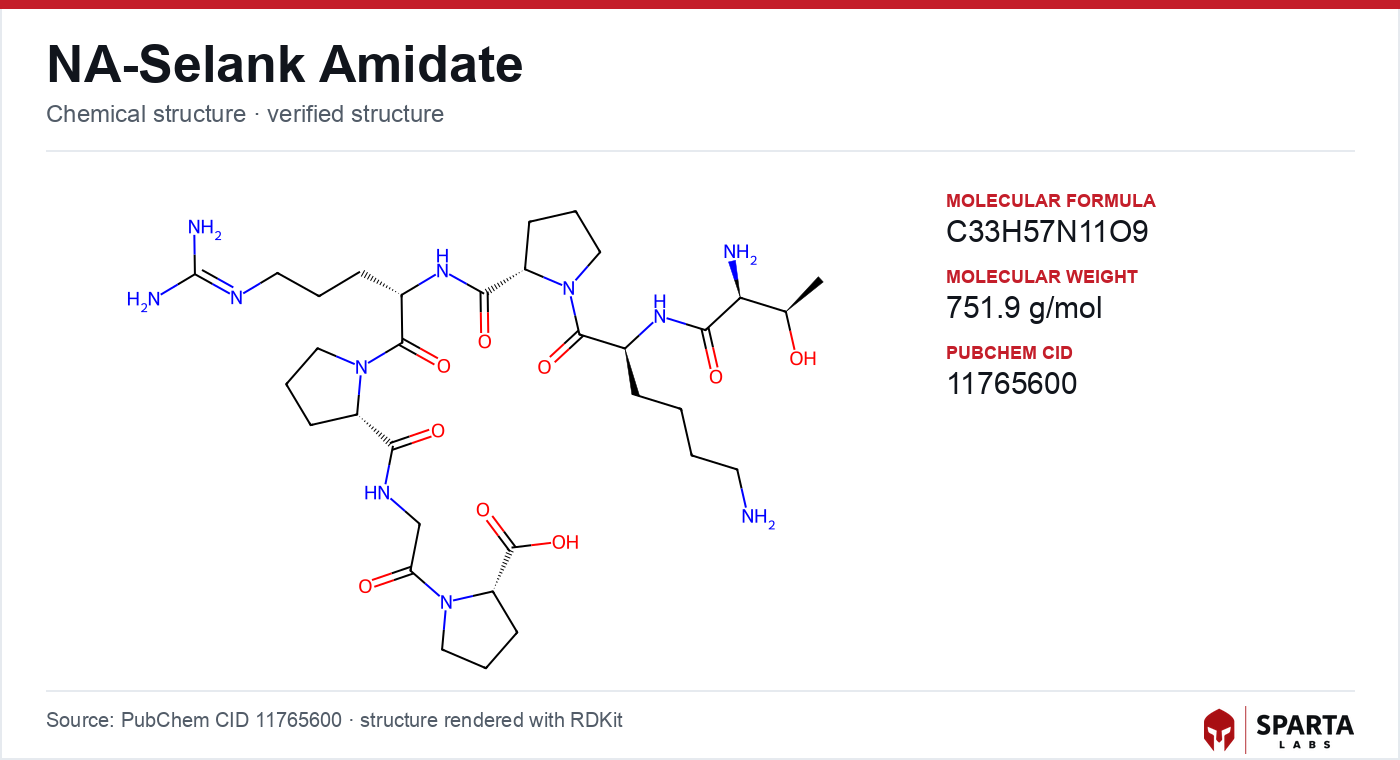
Figure: chemical structure of N-Acetyl Selank Amidate.
Why the Terminal Modifications Matter Mechanistically
Understanding the modified analog begins with the chemistry of its two caps. Acetylation replaces the free N-terminal amine of the threonine residue with an acetyl group, and amidation converts the C-terminal proline carboxyl into a primary amide. In peptide medicinal chemistry, both caps are established strategies for reducing recognition by exopeptidases: aminopeptidases cleave from the N-terminus, and carboxypeptidases cleave from the C-terminus, so capping each end removes the free termini those enzymes require.
The stated rationale for the modification is therefore metabolic stability of the peptide backbone rather than a change in target engagement. Because the acetyl and amide groups sit outside the Thr-Lys-Pro-Arg-Pro-Gly-Pro pharmacophore, the receptor-level and enzymatic interactions reviewed below, all characterized on unmodified Selank, are treated in the literature as the applicable mechanistic model. Whether the caps also shift potency, receptor selectivity, or tissue distribution is addressed as an open question later in this article. Readers seeking the broader classification and discovery context may consult the N-Acetyl Selank Amidate research overview.
Pathway One: Allosteric Modulation of GABA-A Receptors
A well-characterized aspect of the Selank pharmacological profile is its reported positive allosteric modulation of GABA-A receptors, the principal ligand-gated chloride channels of inhibitory neurotransmission. Zozulya and colleagues (2018) reviewed the molecular biology of Selank in detail and reported subtype-selective, concentration-dependent allosteric modulation of GABA-A receptor binding, with measurable effects on [³H]GABA binding in vitro [1]. The same review reported that Selank blocked the modulatory activity of diazepam and olanzapine on [³H]GABA binding under competitive assay conditions, a pattern interpreted as evidence of a binding site or conformational mechanism distinct from the classical benzodiazepine site rather than direct competition at that site [1].
Findings from research models do not establish safety or efficacy in humans. Sparta Labs makes no claims about the use of this compound.
The distinction from benzodiazepine-site pharmacology is the mechanistically salient point of this pathway and is discussed further in the Selank mechanism of action article. An allosteric modulator amplifies or dampens the response of a receptor to its endogenous ligand rather than activating the receptor directly, which is consistent with the context-dependent effects reported across the Selank literature.
Strain-Dependent Receptor Changes
Kolik and colleagues (2018) compared Selank administered by different routes in BALB/c and C57BL/6 mice, two inbred strains with differing baseline anxiety phenotypes. The study reported that intraperitoneal administration was associated with an increase in [³H]SR 95531 (gabazine) binding-site number at GABA-A receptors in the frontal cortex of the high-anxiety BALB/c strain, without corresponding changes in NMDA receptor binding in the hippocampus [2]. That the receptor-level change was strain-dependent is consistent with an allosteric mechanism that responds to existing endogenous signaling tone rather than imposing a uniform effect across genetic backgrounds.
Effects on GABAergic Gene Programs
Two transcriptional studies extend the GABA-A observations from binding to gene expression. Volkova and colleagues (2017) examined Selank in IMR-32 human neuroblastoma cells, assaying 84 genes involved in GABAergic neurotransmission by quantitative PCR. When Selank was co-applied with exogenous GABA, the combination substantially altered the gene-expression profile that GABA alone had induced; when combined with olanzapine, additional expression changes were observed relative to olanzapine alone [3]. Filatova and colleagues (2016) reported in rat frontal cortex that Selank administration altered the expression of a set of GABAergic-neurotransmission genes, with the profile of changes differing between one-hour and three-hour timepoints [4]. Both datasets characterize the GABAergic effect as context-dependent, a profile the authors read as consistent with allosteric rather than agonist-type activity.
Pathway Two: Inhibition of Enkephalin-Degrading Enzymes
A second, complementary mechanism concerns the enzymes that hydrolyze endogenous enkephalins, the pentapeptide opioids that act at delta and mu opioid receptors. Semenova and colleagues (2001) reported that Selank inhibited the enzymatic hydrolysis of enkephalin in a concentration-dependent manner, describing it as more effective than the reference inhibitors bacitracin and puromycin in that assay, and reported that both Selank and the related peptide Semax inhibited enkephalin-degrading enzymes isolated from human serum [5]. The interpretive hypothesis advanced in that work is that slowing enkephalin breakdown extends the effective half-life of these endogenous opioid peptides, establishing enkephalinase inhibition as a distinct pathway operating alongside the GABAergic activity.
The opioid-system relevance of this pathway was probed pharmacologically with naloxone, a non-selective opioid-receptor antagonist. Kolik and colleagues (2012) reported that naloxone pretreatment attenuated the behavioral response to Selank in high-anxiety BALB/c mice while producing a different pattern in C57BL/6 mice, a result read as evidence that endogenous opioid-receptor signaling partially mediates the observed activity [6]. This naloxone sensitivity links the biochemical enkephalinase-inhibition finding to a measurable behavioral readout in a rodent model.
Neurotrophic and Immunomodulatory Reporting
Beyond the two primary pathways, the Selank literature includes observations at the neurotrophic and immunological levels that reflect its tuftsin lineage.
Hippocampal BDNF
Kolomin and colleagues (2008) reported that intranasal administration of Selank was associated with elevated Bdnf messenger RNA in rat hippocampus at three hours and with elevated BDNF protein at 24 hours, and that regional analysis was consistent with local transcriptional activation in hippocampal tissue rather than transport from other regions [7]. BDNF (brain-derived neurotrophic factor) is a signaling protein studied for its roles in synaptic plasticity and neuronal survival; the association adds a neurotrophic dimension to the reported profile that is documented separately in the N-Acetyl Selank Amidate published research summary.
Cytokine Profiles Under Stress
Because Selank derives structurally from tuftsin, an immunomodulatory tetrapeptide, its effects on cytokine signaling have been examined. A study in a rodent social-stress paradigm reported that Selank administration was associated with interleukin-1β, interleukin-6, tumor necrosis factor-α, and transforming growth factor-β1 concentrations closer to unstressed control values than those of untreated stressed animals [8]. The authors characterized this as immunological reporting consistent with the tuftsin structural heritage, and it is described here strictly as an observation in a research model.
What the Modification Leaves Unresolved
The mechanistic picture above rests on studies of unmodified Selank or its acetate salt. Direct characterization of the N-acetylated, C-terminal amidated analog, including receptor-binding constants, plasma stability measurements, and behavioral studies using the modified compound specifically, remains sparse in the indexed English-language literature. The predicted consequence of the terminal caps is resistance to exopeptidase cleavage, but whether they also alter GABA-A allosteric potency, enkephalinase-inhibition constants, receptor selectivity, or tissue distribution is not settled by the available primary sources.
Related open questions carried over from the parent-compound literature include the precise GABA-A subunit configuration mediating the allosteric effect, which Zozulya and colleagues described as subtype-selective without resolving the exact subunit combination [1], and the mechanistic basis of the strain- and phenotype-dependent differences reported consistently across behavioral work [2,6]. Investigators evaluating research-grade material for such mechanistic studies can review batch documentation and purity specifications on the N-Acetyl Selank Amidate product page.
References
-
Zozulya AA, Neznamov GG, Siuniakov TS, Kost NV, Gar'kavaia ER, Siuniakov SA, et al. Peptide-based anxiolytics: the molecular aspects of heptapeptide Selank biological activity. Protein Pept Lett. 2018;25(10):914-923. PMID: 30255741. DOI: 10.2174/0929866525666180925143003. PubMed
-
Kolik LG, Nadorova AV, Konstantinopolsky MA. Comparison of pharmacological effects of heptapeptide Selank after intranasal and intraperitoneal administration to BALB/c and C57BL/6 mice. Eksp Klin Farmakol. 2018;81(3):3-8. PMID: 29787664. PubMed
-
Volkova A, Shadrina M, Kolomin T, Andreeva L, Limborska S, Myasoedov N, et al. Selank administration affects the expression of some genes involved in the GABAergic neurotransmission. Front Pharmacol. 2017;8:89. PMID: 28293190. DOI: 10.3389/fphar.2017.00089. PMCID: PMC5328971. PubMed
-
Filatova E, Kasian A, Kolomin T, Rybalkina E, Alieva A, Andreeva L, et al. GABA, Selank, and olanzapine affect the expression of genes involved in GABAergic neurotransmission in IMR-32 cells. Front Pharmacol. 2016;6:306. PMID: 26793110. DOI: 10.3389/fphar.2015.00306. PubMed
-
Semenova TP, Kozlovskaia MM, Zuĭkov AV, Kozlovskiĭ II, Zuĭkov PV, Lygalov AV. Inhibitory effect of Selank on enkephalin-degrading enzymes as a possible mechanism of its anxiolytic activity. Eksp Klin Farmakol. 2001;64(4):15-17. PMID: 11550013. PubMed
-
Kolik LG, Konstantinopolsky MA, Seredenin SB. The role of the opioid system in the specificity of the anxiolytic effect of the peptide anxiolytic Selank. Eksp Klin Farmakol. 2012;75(4):3-6. PMID: 22550852. PubMed
-
Kolomin T, Shadrina M, Agniullin Ya, Shram S, Slominsky P, Limborska S, et al. Intranasal administration of the peptide Selank regulates BDNF expression in the rat hippocampus in vivo. Dokl Biol Sci. 2008;421:241-243. PMID: 18841804. DOI: 10.1134/S0012496608040066. PubMed
-
Kolik LG, Nadorova AV, Konstantinopolsky MA. The influence of Selank on the level of cytokines under the conditions of "social" stress. Eksp Klin Farmakol. 2020;83(6):3-7. PMID: 32621722. PubMed
Disclaimer. Statements in this article have not been evaluated by the Food and Drug Administration. This compound is not intended to diagnose, treat, cure, or prevent any disease. Sparta Labs sells research-use-only materials. Content is provided for educational and informational purposes only and does not constitute medical advice. Consult a qualified medical professional for any health concerns.
Frequently asked questions
Why is N-Acetyl Selank Amidate's mechanism described using research on Selank?
N-Acetyl Selank Amidate is a terminally modified form of the heptapeptide Selank, carrying an N-terminal acetyl group and a C-terminal amide. These modifications sit at the ends of the seven-residue chain and are intended to slow degradation by exopeptidases, but they flank rather than replace the pharmacophore. Because direct receptor-binding studies of the modified analog are sparse in the indexed literature, the reported mechanistic framework is drawn from the primary research on unmodified Selank.
What two pathways have been reported for the Selank chemical class?
The literature describes two parallel mechanisms. The first is positive allosteric modulation of GABA-A receptors, reported as subtype-selective and distinct from the benzodiazepine site. The second is inhibition of enkephalin-degrading enzymes, which was proposed to extend the half-life of endogenous enkephalin peptides. These are described as complementary rather than mutually exclusive pathways.
How does Selank's GABA-A interaction differ from a benzodiazepine?
Zozulya and colleagues (2018) reported that Selank modulated GABA-A radioligand binding while also blocking the modulatory activity of diazepam and olanzapine under competitive assay conditions. That pattern was interpreted as evidence of a binding site or conformational mechanism distinct from the classical benzodiazepine site, rather than direct competition at the same site.
What does the N-acetyl and C-terminal amide modification change chemically?
Acetylation caps the N-terminal amine and amidation caps the C-terminal carboxyl group. Both terminal caps are a common medicinal-chemistry strategy for reducing recognition by aminopeptidases and carboxypeptidases. The stated rationale is improved metabolic stability of the peptide chain; whether the caps alter receptor potency or selectivity beyond that has not been fully characterized in the indexed English-language literature.