
Kisspeptin-10 vs Oxytocin Acetate: A Structural and Regulatory Comparison
A structural and regulatory comparison of kisspeptin-10, a linear RF-amide decapeptide derived from the KISS1 gene product, and oxytocin acetate, the acetate salt of a cyclic disulfide-bridged nonapeptide first synthesized by du Vigneaud in 1953. Educational reference.
Introduction
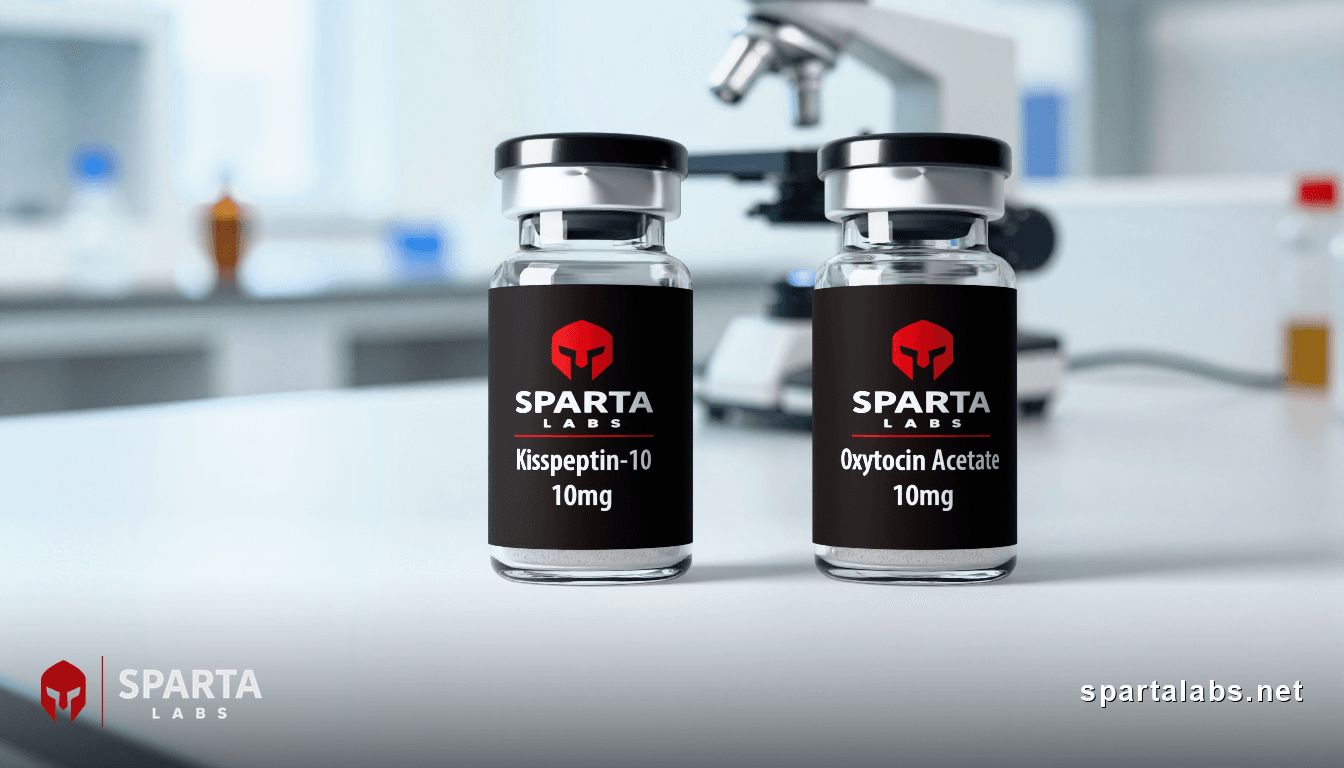
Kisspeptin-10 and oxytocin are both short amidated neuropeptides that originate in the hypothalamus and act at class A G-protein-coupled receptors, which is why searches for kisspeptin vs oxytocin are common. Beyond that, the two molecules have little in common. Kisspeptin-10 is a linear decapeptide fragment of a 145-residue precursor, discovered in 2001 as the ligand of an orphan receptor and never approved as a drug. Oxytocin is a cyclic nonapeptide sequenced and synthesized in 1953, the first peptide hormone ever made chemically, and approved in the United States for decades under the brand name Pitocin. Oxytocin acetate is the acetate salt form in which the research material is supplied. This article compares the two compounds by structure, origin, pharmacological class, discovery history and regulatory status, reporting what investigators and regulators have published without drawing conclusions about the suitability of either for any purpose. Research-grade kisspeptin-10 and oxytocin acetate reference materials are cataloged with lot-linked certificates of analysis.
Kisspeptin-10: A Linear RF-Amide Decapeptide
The KISS1 gene was cloned in 1996 by Lee and colleagues, who identified it as a metastasis-suppressor gene in human melanoma cell lines and named it partly for Hershey, Pennsylvania, where the work was done [1]. Its physiological role became clear only in 2001, when three independent groups reported in Nature and the Journal of Biological Chemistry that peptides encoded by KISS1, initially called metastin, are the endogenous ligands of the orphan receptor GPR54 [2, 3, 4]. The receptor has since been renamed KISS1R.
The KISS1 gene product is a 145-residue prepropeptide. Proteolytic processing yields kisspeptin-54 (metastin) and shorter fragments of 14, 13 and 10 residues that share a common C-terminal decapeptide with a terminal amide [5]. Kisspeptin-10 (KP-10) is that decapeptide: Tyr-Asn-Trp-Asn-Ser-Phe-Gly-Leu-Arg-Phe-NH2, with a molecular weight of approximately 1,302 daltons. Kotani and colleagues reported that KP-10 retained full agonist activity at the receptor despite being the shortest fragment [3]. The C-terminal Arg-Phe-NH2 motif places kisspeptins in the RF-amide neuropeptide family. Niida and colleagues later described downsized analogs built on the KP-10 scaffold in structure-activity work published in 2006 [6].
Two human genetics papers in 2003 established the significance of the receptor. Seminara and colleagues in the New England Journal of Medicine and de Roux and colleagues in the Proceedings of the National Academy of Sciences independently reported that loss-of-function mutations in GPR54 are associated with failure of pubertal development, placing the kisspeptin-KISS1R system within the hypothalamic-pituitary-gonadal axis literature [7, 8]. Findings from these genetic and research studies do not establish safety or efficacy in humans. Sparta Labs makes no claims about the use of this compound.
KP-10 has been administered to volunteers in ethics-approved research settings; Jayasena and colleagues, for example, reported a direct comparison of kisspeptin-10, kisspeptin-54 and GnRH on gonadotropin secretion in healthy men in Human Reproduction in 2015 [9]. Liu and colleagues characterized the peptide's LC-MS/MS quantification and its decomposition products in a 2013 analytical study [10]. Kisspeptin-10 is not approved by the FDA for any indication and is supplied as a research-use-only material. Receptor-level detail is covered in the kisspeptin-10 mechanism of action article, and background in the kisspeptin-10 research overview.
Oxytocin Acetate: A Cyclic Disulfide-Bridged Nonapeptide
Oxytocin's history is older by half a century. Camerino's 2023 review traces the lineage from Oliver and Schäfer's 1895 pituitary-extract experiments and Dale's 1906 description of uterotonic activity through the isolation work of the 1920s [11]. The decisive contributions came from Vincent du Vigneaud's laboratory at Cornell University Medical College. In 1953 du Vigneaud, Ressler and Trippett published the amino acid sequence and a proposed cyclic structure in the Journal of Biological Chemistry [12], and later that year du Vigneaud and colleagues reported the total synthesis of an octapeptide amide with the full hormonal activity of oxytocin in the Journal of the American Chemical Society [13]. It was the first polypeptide hormone to be synthesized, and du Vigneaud received the 1955 Nobel Prize in Chemistry for work on biochemically important sulfur compounds, "especially for the first synthesis of a polypeptide hormone" [14].
Oxytocin is a nonapeptide with the sequence Cys-Tyr-Ile-Gln-Asn-Cys-Pro-Leu-Gly-NH2. A disulfide bond between the cysteines at positions one and six closes a six-residue ring, leaving a three-residue tail ending in glycinamide; the molecular formula is C43H66N12O12S2 and the molecular weight approximately 1,007 daltons. The peptide is processed in vivo from a preprohormone that also encodes the carrier protein neurophysin I, and it differs from arginine vasopressin at only two positions [15]. Oxytocin is the endogenous agonist of the oxytocin receptor (OXTR), a class A G-protein-coupled receptor whose active-state structure was resolved by cryo-electron microscopy in 2022 by Waltenspühl and colleagues [16].
Oxytocin acetate is the acetic acid salt of the peptide. The salt form is a common presentation for research and pharmaceutical peptides because the solid is more stable and easier to handle than the free base; the counter-ion does not alter the sequence, the disulfide bridge or the amidated terminus.
Synthetic oxytocin is FDA-approved under the brand name Pitocin (NDA 018261). Its prescribing information lists antepartum use for the initiation or improvement of uterine contractions and postpartum use to control bleeding after expulsion of the placenta, and describes the product as identical in structure to the endogenous hormone [17]. Those statements are reported here as regulatory fact only. Oxytocin acetate sold as a research-use-only material is not the approved drug product and is not intended for human administration. Further background is in the oxytocin acetate research overview and the oxytocin acetate mechanism of action article.
Structural Comparison
- Chain length and mass. Kisspeptin-10 has ten residues and a molecular weight of about 1,302 daltons. Oxytocin has nine residues and a molecular weight of about 1,007 daltons.
- Topology. Kisspeptin-10 is linear and contains no cysteine. Oxytocin is cyclic by virtue of a Cys1-Cys6 disulfide bridge, a feature it shares with vasopressin and the wider neurohypophysial hormone family [15].
- C-terminus. Both are C-terminally amidated, which is why both are typically assembled on an amide-releasing resin in solid-phase synthesis. Kisspeptin-10 ends in Arg-Phe-NH2, the defining RF-amide motif; oxytocin ends in Pro-Leu-Gly-NH2.
- Origin. Kisspeptin-10 is the shortest processed fragment of the 145-residue KISS1 precursor, sharing its C-terminus with kisspeptin-54 [5]. Oxytocin is excised from a preprohormone alongside neurophysin I [15].
- Aromatic and oxidation-sensitive residues. Kisspeptin-10 contains tryptophan at position three, and Liu and colleagues characterized oxidation-related decomposition products by LC-MS/MS [10]. Oxytocin's principal structural liability is its disulfide, which can undergo reduction or scrambling; it contains tyrosine but no tryptophan.
- Receptor. Kisspeptin-10 is a full agonist at KISS1R [3, 5]. Oxytocin is the endogenous agonist at OXTR [15, 16]. Both receptors are class A G-protein-coupled receptors that couple predominantly through Gq/11, but they are unrelated in sequence and are not activated by each other's ligands.
- Salt form. Oxytocin is commonly supplied as the acetate salt, as its research-material name indicates. Kisspeptin-10 is typically supplied as a trifluoroacetate or acetate salt following HPLC purification; the salt form is a handling characteristic, not a structural one.
- Regulatory status. Kisspeptin-10: not approved in any jurisdiction, research-use-only. Oxytocin: FDA-approved as Pitocin (NDA 018261) for specific labeled indications [17]; the acetate research material is not that product.
Pharmacological Class Context
Kisspeptin-10 belongs to the RF-amide peptide family, a group defined by a C-terminal Arg-Phe-NH2 motif that also includes neuropeptide FF, prolactin-releasing peptide and the RFRP peptides. Within neuroendocrinology, kisspeptins are classified as hypothalamic regulators of gonadotropin-releasing hormone neurons, a role documented in Pinilla and colleagues' 2012 Physiological Reviews article [5]. The class is young: the receptor was orphaned until 2001 and the human genetics that defined its importance date from 2003.
Oxytocin belongs to the neurohypophysial hormone family, a lineage of cyclic nonapeptides that includes vasopressin and, across vertebrates, related peptides such as mesotocin and isotocin. Members are synthesized in hypothalamic neurons and released from the posterior pituitary. Gimpl and Fahrenholz's 2001 review in Physiological Reviews describes the receptor system, and its structural basis was refined by the 2022 cryo-EM work [15, 16]. The class has been studied for more than a century and includes an approved drug.
The two compounds have never been tested head-to-head in a published study, and no such comparison is implied here. The comparison in this article is one of chemistry, origin, class and regulatory record: a linear RF-amide decapeptide from a metastasis-suppressor gene versus a cyclic disulfide-bridged nonapeptide from the classical neurohypophysial family. Readers seeking a general grounding in peptide chemistry may consult the library's overview of what peptides are. Research-grade kisspeptin-10 and oxytocin acetate sold by chemical suppliers are laboratory reference materials, not pharmaceutical products, and are strictly for research use only.
References
- Lee JH, Miele ME, Hicks DJ, Phillips KK, Trent JM, Weissman BE, Welch DR. KiSS-1, a novel human malignant melanoma metastasis-suppressor gene. J Natl Cancer Inst. 1996;88(23):1731-1737. PMID: 8944003 (doi:10.1093/jnci/88.23.1731)
- Ohtaki T, Shintani Y, Honda S, Matsumoto H, Hori A, Kanehashi K, et al. Metastasis suppressor gene KiSS-1 encodes peptide ligand of a G-protein-coupled receptor. Nature. 2001;411(6837):613-617. PMID: 11385580 (doi:10.1038/35079135)
- Kotani M, Detheux M, Vandenbogaerde A, Communi D, Vanderwinden JM, Le Poul E, et al. The metastasis suppressor gene KiSS-1 encodes kisspeptins, the natural ligands of the orphan G protein-coupled receptor GPR54. J Biol Chem. 2001;276(37):34631-34636. PMID: 11457843 (doi:10.1074/jbc.M104847200)
- Muir AI, Chamberlain L, Elshourbagy NA, Michalovich D, Moore DJ, Calamari A, et al. AXOR12, a novel human G protein-coupled receptor, activated by the peptide KiSS-1. J Biol Chem. 2001;276(31):28969-28975. PMID: 11387329 (doi:10.1074/jbc.M102743200)
- Pinilla L, Aguilar E, Dieguez C, Millar RP, Tena-Sempere M. Kisspeptins and reproduction: physiological roles and regulatory mechanisms. Physiol Rev. 2012;92(3):1235-1316. PMID: 22811428 (doi:10.1152/physrev.00037.2010)
- Niida A, Wang Z, Tomita K, Oishi S, Tamamura H, Otaka A, et al. Design and synthesis of downsized metastin (45-54) analogs with maintenance of high GPR54 agonistic activity. Bioorg Med Chem Lett. 2006;16(1):134-137. PMID: 16242330 (doi:10.1016/j.bmcl.2005.09.054)
- Seminara SB, Messager S, Chatzidaki EE, Thresher RR, Acierno JS Jr, Shagoury JK, et al. The GPR54 gene as a regulator of puberty. N Engl J Med. 2003;349(17):1614-1627. PMID: 14573733 (doi:10.1056/NEJMoa035322)
- de Roux N, Genin E, Carel JC, Matsuda F, Chaussain JL, Milgrom E. Hypogonadotropic hypogonadism due to loss of function of the KiSS1-derived peptide receptor GPR54. Proc Natl Acad Sci U S A. 2003;100(19):10972-10976. PMID: 12944565 (doi:10.1073/pnas.1834399100)
- Jayasena CN, Comninos AN, Nijher GM, Abbara A, De Silva A, Veldhuis JD, et al. Direct comparison of the effects of intravenous kisspeptin-10, kisspeptin-54 and GnRH on gonadotrophin secretion in healthy men. Hum Reprod. 2015;30(8):1934-1941. PMID: 26089302 (doi:10.1093/humrep/dev143)
- Liu Z, Ren C, Jones W, Chen P, Seminara SB, Chan YM, et al. LC-MS/MS quantification of a neuropeptide fragment kisspeptin-10 (NSC 741805) and characterization of its decomposition product and pharmacokinetics in rats. J Chromatogr B Analyt Technol Biomed Life Sci. 2013;926:1-8. PMID: 23524040 (doi:10.1016/j.jchromb.2013.02.027)
- Camerino C. The long way of oxytocin from the uterus to the heart in 70 years from its discovery. Int J Mol Sci. 2023;24(3):2556. PMID: 36768879 (doi:10.3390/ijms24032556)
- du Vigneaud V, Ressler C, Trippett S. The sequence of amino acids in oxytocin, with a proposal for the structure of oxytocin. J Biol Chem. 1953;205(2):949-957. PMID: 13129273
- du Vigneaud V, Ressler C, Swan JM, Roberts CW, Katsoyannis PG, Gordon S. The synthesis of an octapeptide amide with the hormonal activity of oxytocin. J Am Chem Soc. 1953;75(19):4879-4880. doi:10.1021/ja01115a553
- The Nobel Prize in Chemistry 1955. NobelPrize.org. Nobel Prize Outreach. Source: nobelprize.org
- Gimpl G, Fahrenholz F. The oxytocin receptor system: structure, function, and regulation. Physiol Rev. 2001;81(2):629-683. PMID: 11274341 (doi:10.1152/physrev.2001.81.2.629)
- Waltenspühl Y, Ehrenmann J, Vacca S, Thom C, Medalia O, Plückthun A. Structural basis for the activation and ligand recognition of the human oxytocin receptor. Nat Commun. 2022;13(1):4153. PMID: 35851571 (doi:10.1038/s41467-022-31325-0)
- US Food and Drug Administration. Pitocin (oxytocin injection, USP) synthetic: prescribing information. NDA 018261. Source: accessdata.fda.gov
Frequently asked questions
What is the difference between kisspeptin-10 and oxytocin?
Kisspeptin-10 is a linear ten-residue fragment cut from the C-terminus of the KISS1 gene product, ending in an amidated phenylalanine, and it is the natural ligand of the receptor KISS1R (formerly GPR54). Oxytocin is a nine-residue peptide with a disulfide bridge between cysteines one and six that makes it cyclic, ending in an amidated glycine, and it is the natural ligand of the oxytocin receptor. The two belong to different peptide families and act at different receptors.
What is kisspeptin-10?
Kisspeptin-10 (KP-10) is the C-terminal decapeptide of the kisspeptins, the family of peptides encoded by the KISS1 gene and originally named metastin. Its sequence is Tyr-Asn-Trp-Asn-Ser-Phe-Gly-Leu-Arg-Phe-NH2, with a molecular weight of about 1,302 daltons. Three groups reported in 2001 that kisspeptins are the endogenous ligands of the orphan receptor GPR54, now called KISS1R.
What is oxytocin acetate?
Oxytocin acetate is the acetate salt form of oxytocin, the form in which the research material is commonly supplied as a lyophilized solid. Oxytocin itself is a cyclic nonapeptide with the sequence Cys-Tyr-Ile-Gln-Asn-Cys-Pro-Leu-Gly-NH2 and a molecular weight of about 1,007 daltons. The salt form does not change the peptide sequence or structure.
Is kisspeptin-10 FDA approved?
No. Kisspeptin-10 is not approved by the US Food and Drug Administration for any indication. It has been studied in ethics-approved research settings and is supplied as a research-use-only material. Its regulatory position is therefore different from that of oxytocin, which is an approved drug.
Is oxytocin FDA approved?
Synthetic oxytocin is FDA-approved under the brand name Pitocin (NDA 018261), with labeled obstetric indications stated in its prescribing information. Oxytocin acetate supplied as a research-use-only material is not the approved drug product and is not intended for human administration.
Who discovered kisspeptin-10 and oxytocin?
The KISS1 gene was cloned by Lee and colleagues in 1996, and kisspeptins were identified as GPR54 ligands in 2001 by Ohtaki, Kotani and Muir and their respective colleagues. Oxytocin's sequence was determined and its total synthesis achieved by Vincent du Vigneaud and colleagues in 1953, work recognized with the 1955 Nobel Prize in Chemistry.