
Kisspeptin-10: Sourcing, Purity, and Verification Standards
A sourcing reference for kisspeptin-10 (KP-10): why C-terminal amidation and Trp-3 integrity drive its synthesis, purification, and analytical verification standards. Educational reference.
For research use only. Not for human consumption. This article is educational reference material. It is not medical advice and is not a recommendation to use any substance.
Why Kisspeptin-10 Chemistry Dictates Its Sourcing
Kisspeptin-10 (KP-10) is the ten-residue C-terminal fragment of the larger KISS1 gene product, historically called metastin. Its sequence, Tyr-Asn-Trp-Asn-Ser-Phe-Gly-Leu-Arg-Phe-NH2, places it in the RF-amide peptide family, defined by a C-terminal arginine-phenylalanine-amide motif. Two features of that structure govern how the peptide must be made and verified: the amidated C-terminus, which the structure-activity literature associates with KISS1R (GPR54) agonist activity, and an oxidation-sensitive tryptophan at position 3. This article describes the synthesis, purification, and analytical verification standards that follow from that chemistry, and the documentation Sparta Labs applies to each production lot.
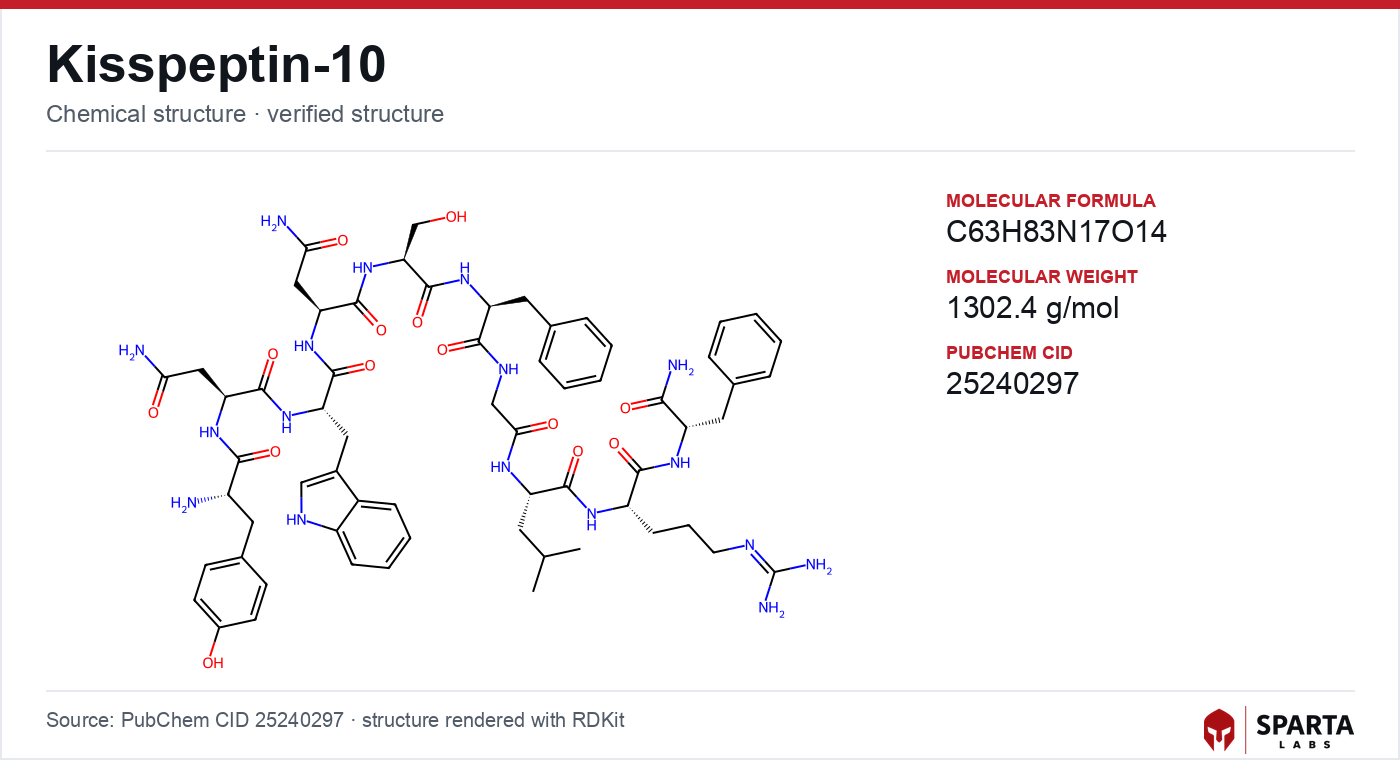
Figure: chemical structure of Kisspeptin-10.
The compound is of research interest because Kotani and colleagues identified metastin/kisspeptin as the endogenous ligand for the orphan receptor GPR54 in 2001, and Ohtaki and colleagues reported the same year that this KISS1-derived peptide activated GPR54 in the context of metastasis-suppressor research [1][2]. The pharmacology built on those reports is discussed in the kisspeptin-10 research overview and the kisspeptin-10 mechanism of action articles; this sourcing article concerns the material itself.
Findings from research models do not establish safety or efficacy in humans. Sparta Labs makes no claims about the use of this compound.
Solid-Phase Synthesis and the Amidated C-Terminus
A decapeptide of this length is assembled by solid-phase peptide synthesis (SPPS), the stepwise, resin-supported method introduced by Robert Merrifield in 1963 and recognized with the 1984 Nobel Prize in Chemistry [3]. In SPPS the chain is built one residue at a time on an insoluble support, with each coupling and deprotection step monitored before the next amino acid is added.
The choice of resin is not incidental for KP-10. Because the peptide terminates in an amide (Phe-NH2) rather than a free carboxylic acid, synthesis is carried out on an amide-forming support such as a Rink amide resin, so that cleavage releases the C-terminal amide directly. This matters for identity: Niida and colleagues, working on downsized metastin(45–54) analogs, described structure-activity relationships in which the C-terminal region and its amide were central to GPR54 agonist potency [4]. A batch synthesized as the free acid would be a different molecule with different receptor behavior, which is why the amide is treated as a verifiable identity attribute rather than an assumed one.
After chain assembly, global deprotection and cleavage from the resin release the crude peptide, which carries the deletion sequences, truncated fragments, and reagent-derived species that accumulate during any multi-step synthesis. Andersson and colleagues, in a review of large-scale peptide synthesis, described the combination of SPPS with preparative reverse-phase HPLC purification as the established route to research-grade peptides of defined identity [5]. Sparta Labs follows that route for kisspeptin-10, using preparative RP-HPLC to separate the target from synthesis-related impurities before the material is characterized.
Analytical Purity: HPLC and the Impurity Profile
The research-use peptide field conventionally reports purity as analytical reverse-phase HPLC peak-area percentage, with common specification points at 95, 98, and 99 percent. Sparta Labs specifies analytical HPLC purity of at least 98 percent for kisspeptin-10, assessed by reverse-phase HPLC with UV detection that resolves the target peak from co-eluting impurities and quantifies relative peak areas. The kisspeptin-10 product page links each lot to its analytical documentation.
Purity figures for KP-10 are interpreted against the specific impurities its synthesis tends to generate. Deletion sequences missing an internal residue, incompletely deprotected intermediates, and species differing at a single position can chromatograph close to the target under some gradient conditions, which is why HPLC purity alone is not treated as sufficient proof of identity. That limitation is the reason mass spectrometry is run in parallel rather than as an optional add-on.
Mass-Spectrometric Confirmation of Identity
Mass spectrometry is performed on each production lot to confirm molecular identity against the theoretical value for the decapeptide. Electrospray ionization (ESI-MS) or matrix-assisted laser desorption/ionization (MALDI-MS) provides the measured molecular weight, which is compared with the value calculated for the correct amidated sequence. Because the calculated masses of the amide and the free acid differ by roughly one dalton, and single-residue substitutions or incomplete deprotection shift the mass in characteristic ways, this measurement is what distinguishes the intended molecule from impurities that can comigrate with it on HPLC.
Two analyses that answer different questions therefore anchor identity and purity for KP-10: HPLC reports how much of the sample is the main species, and mass spectrometry reports whether that main species is the correct one. Neither substitutes for the other, and both appear on the batch record.
Tryptophan Oxidation and Storage Stability
Kisspeptin-10 is supplied as a lyophilized (freeze-dried) powder, the standard presentation for research peptides intended for extended shelf storage. Lyophilization removes water under vacuum and low temperature to yield a solid that is more stable than a peptide held in solution. The degradation pathways that quality control anticipates for KP-10 follow directly from its sequence.
The most sequence-specific concern is oxidation of the tryptophan residue at position 3. Manning and colleagues, reviewing the stability of protein and peptide pharmaceuticals, described oxidation of susceptible residues, deamidation at asparagine and glutamine, and hydrolytic cleavage as principal chemical degradation routes for peptides in solution [6]. Kisspeptin-10 contains one tryptophan and two asparagine residues, so both oxidation and deamidation are pathways worth monitoring, and tryptophan oxidation in particular is detectable by mass spectrometry as a characteristic mass increase. Lyophilized presentation, low-temperature storage, and protection from light and moisture are the standard countermeasures the stability literature supports for peptides of this composition.
Comparable analytical logic applies across the RF-amide and related neuropeptide families supplied for research; the same amidation-and-oxidation reasoning is discussed for a structurally distinct nonapeptide in the oxytocin acetate sourcing article.
Third-Party Verification and Certificate of Analysis
Independent testing provides a verification layer separate from the manufacturing site, using instrumentation and analysts with no stake in the outcome. For kisspeptin-10, independent runs can include analytical HPLC purity measurement, molecular-weight confirmation by mass spectrometry, and, where a batch is intended for cell-based work, endotoxin quantification by the Limulus amebocyte lysate (LAL) method, since bacterial endotoxin can confound cell-viability and signaling readouts independently of the study compound. Where third-party results are obtained, they are compared against in-house data before a lot is released.
Each production lot is documented in a Certificate of Analysis (COA). A Sparta Labs COA for kisspeptin-10 records:
- Compound identity: chemical name, peptide sequence, molecular formula, theoretical molecular weight
- Batch number: unique identifier linking the COA to the production lot
- HPLC purity: peak-area percentage, chromatographic conditions, column specification, UV wavelength
- Mass-spectrometry result: measured molecular ion versus theoretical value, ionization method
- Appearance: physical description of the lyophilized material
- Manufacturing and expiry dates
- Storage conditions
- Independent laboratory reference, where third-party testing has been performed
The COA is the record that ties analytical identity to a specific vial. Verifying the batch number on the COA against the batch number on the container is the practical step that keeps the analytical record and the physical material aligned.
References
-
Kotani M, Detheux M, Vandenbogaerde A, Communi D, Vanderwinden JM, Le Poul E, et al. The metastasis suppressor gene KiSS-1 encodes kisspeptins, the natural ligands of the orphan G protein-coupled receptor GPR54. J Biol Chem. 2001;276(37):34631-34636. PMID: 11331580. DOI: 10.1074/jbc.M104847200. PubMed
-
Ohtaki T, Shintani Y, Honda S, Matsumoto H, Hori A, Kanehashi K, et al. Metastasis suppressor gene KiSS-1 encodes peptide ligand of a G-protein-coupled receptor. Nature. 2001;411(6837):613-617. PMID: 11385580. DOI: 10.1038/35079135. PubMed
-
Merrifield RB. Solid phase peptide synthesis. I. The synthesis of a tetrapeptide. J Am Chem Soc. 1963;85(14):2149-2154. DOI: 10.1021/ja00897a025. Journal
-
Niida A, Wang Z, Tomita K, Oishi S, Tamamura H, Otaka A, et al. Design and synthesis of downsized metastin (45-54) analogs with maintenance of high GPR54 agonistic activity. Bioorg Med Chem Lett. 2006;16(1):134-137. PMID: 16242330. DOI: 10.1016/j.bmcl.2005.09.054. PubMed
-
Andersson L, Blomberg L, Flegel M, Lepsa L, Nilsson B, Verlander M. Large-scale synthesis of peptides. Biopolymers. 2000;55(3):227-250. PMID: 11074417. DOI: 10.1002/1097-0282(2000)55:3<227::AID-BIP50>3.0.CO;2-7. PubMed
-
Manning MC, Chou DK, Murphy BM, Payne RW, Katayama DS. Stability of protein pharmaceuticals: an update. Pharm Res. 2010;27(4):544-575. PMID: 20143256. DOI: 10.1007/s11095-009-0045-6. PubMed
Disclaimer. Statements in this article have not been evaluated by the Food and Drug Administration. This compound is not intended to diagnose, treat, cure, or prevent any disease. Sparta Labs sells research-use-only materials. Content is provided for educational and informational purposes only and does not constitute medical advice. Consult a qualified medical professional for any health concerns.
Frequently asked questions
Why is C-terminal amidation important when sourcing kisspeptin-10?
Kisspeptin-10 terminates in an Arg-Phe-NH2 (RF-amide) motif, and the C-terminal amide is a defining structural feature of this peptide class. Structure-activity studies of metastin/kisspeptin fragments reported that the amidated C-terminus is central to KISS1R (GPR54) agonist activity. For sourcing, this means synthesis on an amide-forming resin and analytical confirmation that the amide, rather than a free acid, is present.
What analytical methods confirm the identity and purity of kisspeptin-10?
Two complementary techniques are standard: analytical reverse-phase HPLC quantifies purity by resolving the target peak from truncation and reagent-derived impurities, and mass spectrometry (ESI-MS or MALDI-MS) confirms the measured molecular weight against the theoretical value for the decapeptide sequence. Together they distinguish the correct amidated peptide from deletion sequences and single-residue variants.
What degradation pathways affect kisspeptin-10 quality?
The principal solution-phase concerns for kisspeptin-10 are oxidation of the tryptophan residue at position 3, deamidation at asparagine residues, and peptide-bond hydrolysis. These pathways are characteristic of peptides containing oxidation-sensitive and amide-bearing residues, as summarized in the protein-stability literature. Lyophilized presentation and low-temperature, light-protected storage are used to slow them.
What information appears on a kisspeptin-10 Certificate of Analysis?
A Certificate of Analysis documents a specific production lot: chemical name, peptide sequence, molecular formula, theoretical and measured molecular weight, HPLC purity with chromatographic conditions, the mass-spectrometry method, appearance, batch number, and storage conditions. Where independent testing has been performed, the report reference is included so the analytical record can be traced to a specific batch.