
Kisspeptin-10: Published Research
A source-attributed summary of kisspeptin-10 (KP-10) research, tracing the compound from KISS1R receptor pharmacology and structure-activity mapping through KNDy-neuron circuitry to controlled human neuroendocrine studies and open questions. Educational reference.
For research use only. Not for human consumption. This article is educational reference material. It is not medical advice and is not a recommendation to use any substance.
The KP-10 Research Record at a Glance
Kisspeptin-10 (KP-10) is the C-terminal decapeptide fragment of the larger kisspeptin peptides encoded by the KISS1 gene. Interest in KP-10 in the scientific literature is largely a consequence of its role as a research tool for the G protein-coupled receptor KISS1R (historically GPR54) and the hypothalamic-pituitary-gonadal (HPG) axis. Unlike many peptides in the research catalog, KP-10 sits at the intersection of two distinct literatures: a molecular-pharmacology strand that characterized the minimal active sequence and its receptor, and a clinical-endocrinology strand centered largely on a research group at Imperial College London that administered kisspeptins to human volunteers under trial conditions. This article summarizes both strands with attribution to primary sources, organized around the questions each body of work set out to answer.
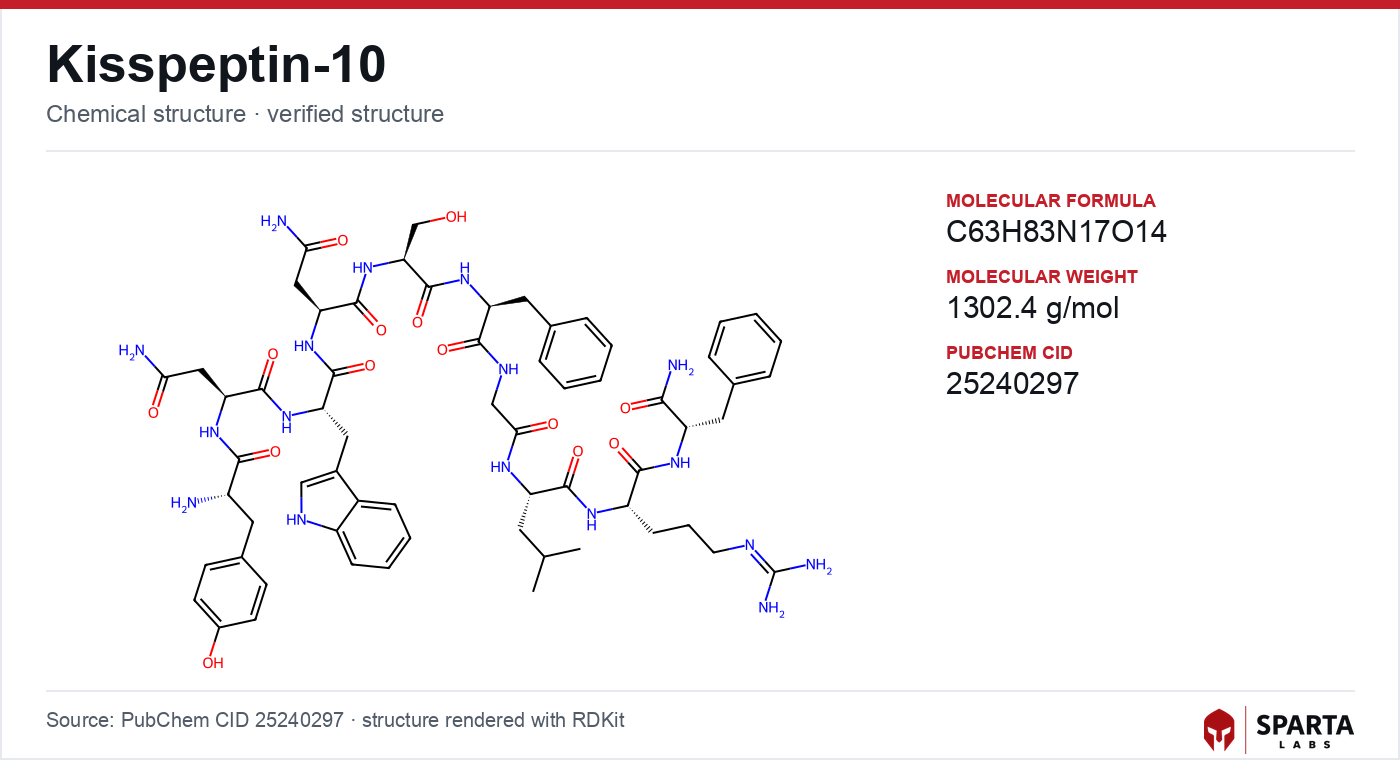
Figure: chemical structure of Kisspeptin-10.
For readers new to the compound, the research overview covers its classification and basic chemistry, while the discovery and research history traces how a metastasis-suppressor gene came to define a reproductive-axis signaling system.
Establishing the Minimal Active Sequence: In Vitro Pharmacology
The founding pharmacology of KP-10 rests on the 2001 identification of kisspeptins as endogenous ligands of the orphan receptor GPR54. Kotani and colleagues reported that the metastasis-suppressor gene KiSS-1 encoded a family of peptides and that the C-terminal fragments, including the decapeptide now designated KP-10, bound the receptor and triggered inositol phosphate accumulation in cells heterologously expressing GPR54 [1]. The observation that the short decapeptide retained the receptor-activating activity of its longer parent peptides is the reason KP-10 became a practical research reagent rather than a laboratory curiosity.
Findings from research models do not establish safety or efficacy in humans. Sparta Labs makes no claims about the use of this compound.
Structure-activity work then asked which residues within that decapeptide carry the pharmacophore. Niida and colleagues (2006) reported systematic truncation and substitution experiments on metastin (45-54)-derived analogs, work that mapped residues important for receptor agonism and highlighted the contribution of the C-terminal amide to activity [2]. This SAR foundation is what later analog-design efforts across the field built upon, and it is discussed in the context of receptor engagement in the companion mechanism of action article.
A methodological turning point came with the development of peptide antagonists derived from the kisspeptin scaffold. Roseweir and colleagues (2009) reported potent KISS1R peptide antagonists that, for the first time, let researchers block endogenous kisspeptin signaling pharmacologically rather than only through gene knockout [3]. Antagonist availability converted much of the downstream physiology from correlational to interventional, and it remains central to how the field dissects the role of KISS1R in gonadotropin-releasing hormone (GnRH) pulse generation.
From Cells to Circuits: Preclinical In Vivo Work
The transition of kisspeptin biology from receptor pharmacology to whole-animal endocrinology was marked by Dhillo and colleagues (2005), who reported that peripheral administration of kisspeptin-54 was associated with measurable changes in circulating luteinizing hormone (LH) and testosterone in male rats, and that central administration was associated with GnRH release [4]. This established the in vivo readout, plasma gonadotropins, that essentially every subsequent kisspeptin study, including those using KP-10, has relied upon.
A recurring question in the preclinical literature is why the longer isoform kisspeptin-54 (KP-54) and the shorter KP-10 differ in apparent in vivo potency despite comparable activity at the receptor in vitro. A 2017 report from d'Anglemont de Tassigny and colleagues examined this question mechanistically and attributed much of the difference to pharmacokinetic factors rather than to intrinsic differences in receptor activation between the two peptides [5]. That distinction, receptor pharmacology versus clearance and distribution, is important for interpreting comparisons between isoforms and shaped how later analog work framed the goal of extending peptide exposure.
The interpretive framework for where kisspeptin acts within the hypothalamus comes largely from the KNDy neuron model. Lehman and colleagues (2010) synthesized genetic, immunohistochemical, and pharmacological evidence that a population of arcuate-nucleus neurons co-expressing kisspeptin, neurokinin B, and dynorphin functions as a node in the control of GnRH secretion [6]. Because KP-10 has a short duration of action, it is well suited to acute-activation experiments that probe this circuit, and the KNDy model is the lens through which many KP-10 in vivo results are read.
Controlled Human Neuroendocrine Studies
The distinguishing feature of the KP-10 literature, relative to most research peptides, is a set of controlled studies in human volunteers. George and colleagues (2011) reported that intravenous KP-10 was associated with a rapid, dose-related rise in serum LH in healthy men, and that continuous administration was associated with changes in LH pulse frequency as inferred from deconvolution analysis of the secretory profile [7]. This study is frequently treated as the reference characterization of KP-10's acute neuroendocrine profile in humans.
A subsequent study by Jayasena and colleagues (2015), also from the Imperial College London group, placed intravenous KP-10, KP-54, and GnRH side by side in healthy men [8]. The report described broadly comparable gonadotropin responses to the two kisspeptin isoforms in humans, a result that fits the pharmacokinetic interpretation advanced in the preclinical isoform-comparison literature and cautions against reading rodent potency rankings directly into humans. The same body of clinical work also documented tachyphylaxis, an attenuation of the LH response during sustained administration of kisspeptins, a phenomenon reported in the setting of chronic administration by Jayasena and colleagues (2009) [9]. The molecular basis and reversibility of that desensitization remain research questions rather than settled facts.
Related sexually dimorphic and cyclic neuroendocrine responses have been characterized for other hypothalamic peptides studied in controlled human trials, and the parallels between these systems are discussed in the published research on oxytocin, another hypothalamic GPCR-targeted peptide.
Open Questions and Active Frontiers
Several threads in the published record remain genuinely unresolved. The first concerns the site of action of systemically delivered KP-10: how much of the LH response reflects access to GnRH neuron cell bodies within the hypothalamus versus engagement of KISS1R at the median eminence or on peripheral kisspeptin-responsive tissues. Evidence from species and route comparisons is consistent with a central component, but the quantitative partition is still refined by ongoing work, and the availability of antagonists [3] is central to how those experiments are designed.
A second frontier is the pharmacokinetic problem highlighted by the isoform-comparison literature [5]. Because KP-10 is cleared quickly, a recurring goal in the field has been to design analogs with extended exposure while preserving KISS1R selectivity, and this is where the SAR groundwork [2] becomes practically important.
A third area concerns KISS1R populations outside the classical HPG circuit, including receptor expression reported in reproductive and cardiovascular tissues. The physiological significance of circulating kisspeptin at these sites is less mapped than the hypothalamic literature and represents a growing research direction. Third-party-verified research-grade kisspeptin-10 intended for laboratory use is one of the reagents through which such questions continue to be studied. Because the clinical evidence base has been generated predominantly in healthy volunteers at a small number of centers, independent replication and extension across research populations remain active priorities for the field.
References
-
Kotani M, Detheux M, Vandenbogaerde A, Communi D, Vanderwinden JM, Le Poul E, et al. The metastasis suppressor gene KiSS-1 encodes kisspeptins, the natural ligands of the orphan G protein-coupled receptor GPR54. J Biol Chem. 2001;276(37):34631-34636. PMID: 11457843. DOI: 10.1074/jbc.M104847200. PubMed
-
Niida A, Wang Z, Tomita K, Oishi S, Tamamura H, Otaka A, et al. Design and synthesis of downsized metastin (45-54) analogs with maintenance of high GPR54 agonistic activity. Bioorg Med Chem Lett. 2006;16(1):134-137. PMID: 16242330. DOI: 10.1016/j.bmcl.2005.09.054. PubMed
-
Roseweir AK, Kauffman AS, Smith JT, Guerriero KA, Morgan K, Pielecka-Fortuna J, et al. Discovery of potent kisspeptin antagonists delineate physiological mechanisms of gonadotropin regulation. J Neurosci. 2009;29(12):3920-3929. PMID: 19321789. DOI: 10.1523/JNEUROSCI.5740-08.2009. PubMed
-
Dhillo WS, Chaudhri OB, Patterson M, Thompson EL, Murphy KG, Badman MK, et al. Kisspeptin-54 stimulates the hypothalamic-pituitary-gonadal axis in male rats. J Clin Endocrinol Metab. 2005;90(12):6609-6615. PMID: 16174713. DOI: 10.1210/jc.2005-1468. PubMed
-
d'Anglemont de Tassigny X, Jayasena CN, Murphy KG, Dhillo WS, Colledge WH. Mechanistic insights into the more potent effect of kisspeptin-54 compared to kisspeptin-10 in vivo. Am J Physiol Endocrinol Metab. 2017;313(2):E149-E154. PMID: 28464043. DOI: 10.1152/ajpendo.00056.2017. PubMed
-
Lehman MN, Coolen LM, Goodman RL. Minireview: kisspeptin/neurokinin B/dynorphin (KNDy) cells of the arcuate nucleus: a central node in the control of gonadotropin-releasing hormone secretion. Endocrinology. 2010;151(8):3479-3489. PMID: 20501670. DOI: 10.1210/en.2010-0022. PubMed
-
George JT, Veldhuis JD, Roseweir AK, Newton CL, Faccenda E, Millar RP, et al. Kisspeptin-10 is a potent stimulator of LH and increases pulse frequency in men. J Clin Endocrinol Metab. 2011;96(8):E1228-E1236. PMID: 21632807. DOI: 10.1210/jc.2011-0089. PubMed
-
Jayasena CN, Abbara A, Narayanaswamy S, Comninos AN, Ratnasabapathy R, Bassett P, et al. Direct comparison of the effects of intravenous kisspeptin-10, kisspeptin-54 and GnRH on gonadotrophin secretion in healthy men. Hum Reprod. 2015;30(8):1934-1942. PMID: 26089302. DOI: 10.1093/humrep/dev143. PubMed
-
Jayasena CN, Nijher GM, Chaudhri OB, Murphy KG, Ranger A, Lim A, et al. Subcutaneous injection of kisspeptin-54 acutely stimulates gonadotropin secretion in women with hypothalamic amenorrhea, but chronic administration causes tachyphylaxis. J Clin Endocrinol Metab. 2009;94(11):4315-4323. PMID: 19820026. DOI: 10.1210/jc.2009-0406. PubMed
Disclaimer. Statements in this article have not been evaluated by the Food and Drug Administration. This compound is not intended to diagnose, treat, cure, or prevent any disease. Sparta Labs sells research-use-only materials. Content is provided for educational and informational purposes only and does not constitute medical advice. Consult a qualified medical professional for any health concerns.
Frequently asked questions
What is kisspeptin-10 (KP-10) in scientific research?
KP-10 is the C-terminal decapeptide fragment of the larger kisspeptins encoded by the KISS1 gene. Kotani and colleagues (2001) reported that this short fragment retained the receptor-activating activity of its longer parent peptides at KISS1R (GPR54), which is why it became a widely used research reagent for studying the hypothalamic-pituitary-gonadal axis.
What did the human studies of kisspeptin-10 report?
Chan and colleagues (2011) reported that intravenous KP-10 was associated with a rapid rise in serum luteinizing hormone in healthy men, with changes in pulse frequency inferred from deconvolution analysis. A later study by Jayasena and colleagues (2015) placed KP-10, kisspeptin-54, and GnRH side by side and described broadly comparable gonadotropin responses to the two kisspeptin isoforms in humans.
Why do kisspeptin-10 and kisspeptin-54 differ in potency in animal studies?
A 2017 report from d'Anglemont de Tassigny and colleagues examined this question and attributed much of the difference in apparent in vivo potency to pharmacokinetic factors, such as clearance and distribution, rather than to intrinsic differences in how the two peptides activate KISS1R. Human comparison studies are consistent with this interpretation.
What is the KNDy neuron model and how does it relate to KP-10?
The KNDy model, synthesized by Lehman and colleagues (2010), describes a population of arcuate-nucleus neurons that co-express kisspeptin, neurokinin B, and dynorphin and function as a node in the control of GnRH secretion. Because KP-10 has a short duration of action, it is often used in acute-activation experiments that probe this circuit.
What questions about kisspeptin-10 remain unresolved?
Open questions in the published record include the precise site of action of systemically delivered KP-10, the design of analogs with longer exposure while preserving KISS1R selectivity, and the physiological role of KISS1R populations outside the classical reproductive-axis circuit. Because much of the human data comes from a small number of centers, independent replication is an active priority.