
Epithalon vs Pinealon: A Structural and Regulatory Comparison
A structural and regulatory comparison of epithalon (Ala-Glu-Asp-Gly) and pinealon (Glu-Asp-Arg), two short synthetic peptides from the St. Petersburg Institute of Bioregulation and Gerontology that share a pineal-extract lineage but differ in sequence, research record, and the questions their literature addresses. Educational reference.
Introduction
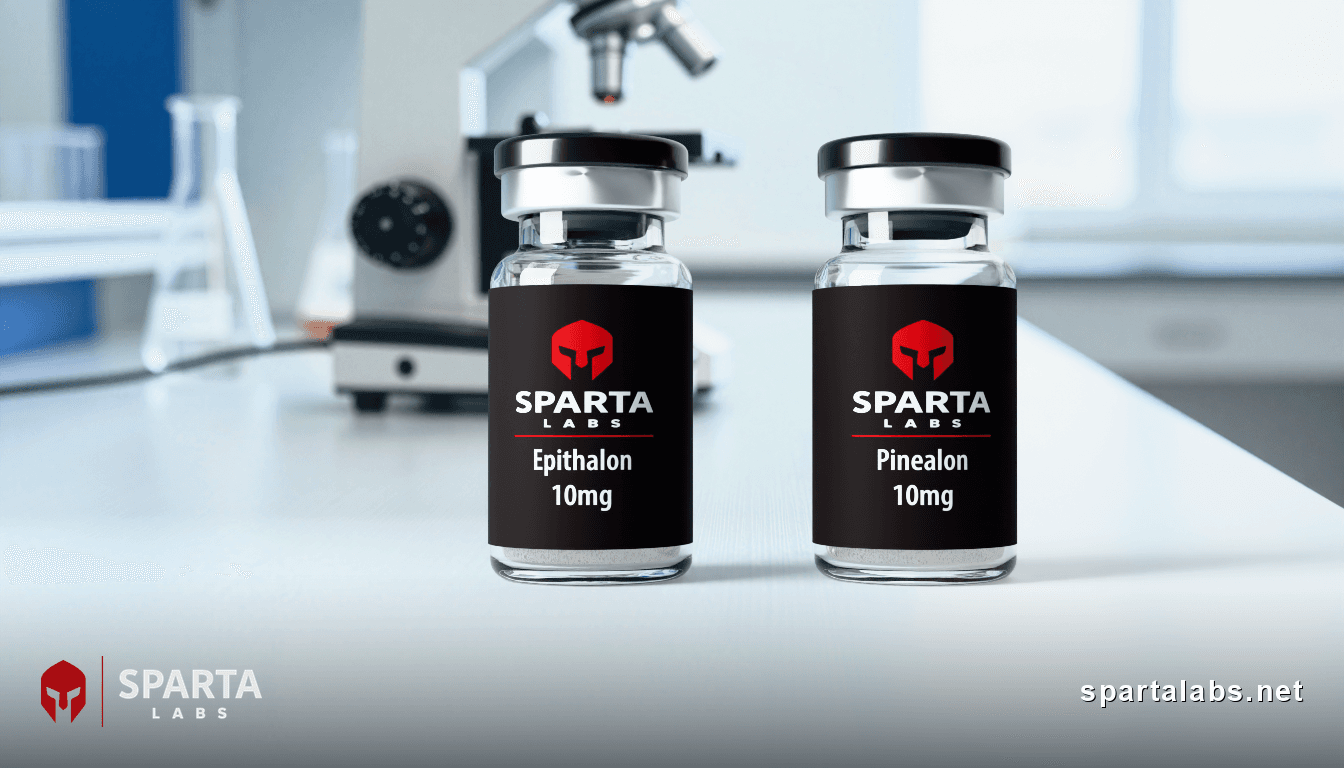
Epithalon and pinealon are two of the shortest peptides in the Sparta Labs research library and two of the most frequently confused. Both are synthetic oligopeptides from the peptide bioregulator program developed by Vladimir Kh. Khavinson and colleagues at the St. Petersburg Institute of Bioregulation and Gerontology, both are described in that program's literature as pineal-lineage compounds, and both share the dipeptide Glu-Asp. Beyond that, they diverge: epithalon is the tetrapeptide Ala-Glu-Asp-Gly with a research record built largely around telomerase and chromatin endpoints in cell culture and rodent survival studies, while pinealon is the tripeptide Glu-Asp-Arg with a later, smaller record concentrated on neural cell systems. This article compares the two by structure, origin, pharmacological class, and regulatory record, reporting what investigators have published without drawing conclusions about either compound's suitability for any purpose. Research-grade epithalon and pinealon reference materials are cataloged with per-batch certificates of analysis.
Epithalon: The AEDG Tetrapeptide
Epithalon (also spelled epitalon; Ala-Glu-Asp-Gly; molecular formula C14H22N4O9; molecular weight approximately 390 daltons) is the synthetic tetrapeptide associated with epithalamin, a polypeptide complex extracted from bovine pineal gland. Anisimov, Khavinson, and Morozov's 1994 retrospective in the Annals of the New York Academy of Sciences documented twenty years of experimental work with the parent extract in rodent and invertebrate models [2], and Anisimov and Khavinson's 2010 review in Biogerontology placed that work within the broader program of organ-extract-derived short peptides [1]. Formal analytical confirmation that the AEDG sequence is present within the epithalamin complex came later than the synthetic compound's research record: Khavinson, Kopylov, and colleagues reported the identification by mass spectrometry in the Bulletin of Experimental Biology and Medicine in 2017 [3].
The synthetic tetrapeptide's own literature began in the early 2000s. Anisimov and colleagues compared the synthetic thymic dipeptide Lys-Glu and the synthetic pineal tetrapeptide Ala-Glu-Asp-Gly in female CBA mice in Mechanisms of Ageing and Development in 2001, reporting survival and spontaneous tumor incidence endpoints over the animals' natural lifespan [5], and reported a parallel study in female SHR mice in Biogerontology in 2003 [6]. In the same year, Khavinson, Bondarev, and Butyugov reported in cell culture that AEDG addition to telomerase-negative human fetal fibroblasts was associated with induction of telomerase activity and telomere elongation [4], and Khavinson and Lezhava reported cytogenetic observations on chromatin condensation in cultured lymphocytes from elderly donors [7].
Findings from research models do not establish safety or efficacy in humans. Sparta Labs makes no claims about the use of this compound.
Later mechanistic work moved toward an epigenetic hypothesis. Khavinson, Diomede, and colleagues reported in Molecules in 2020 that AEDG treatment of human gingival mesenchymal stem cells undergoing neurogenic differentiation was associated with changes in neurogenic marker expression, and used molecular docking to propose binding to linker histone H1 as a possible mechanism, which the authors framed as a hypothesis awaiting structural validation [8]. Goncharova and colleagues had earlier reported hormonal measurements in aged rhesus macaques following pineal peptide treatment in Experimental Gerontology in 2005 [9]. The compound's classification and regulatory standing are summarized in the epithalon research overview, and its discovery timeline in the epithalon history.
Pinealon: The EDR Tripeptide
Pinealon (L-glutamyl-L-aspartyl-L-arginine; Glu-Asp-Arg; CAS 175175-23-2; molecular formula C15H26N6O8; molecular weight approximately 418 daltons) emerged from the same program but did not arrive through a single discovery event. Anisimov and Khavinson's 2010 review describes the program's methodological shift from complex organ extracts toward defined short synthetic sequences [1]; pinealon is one product of that shift, and its English-indexed record begins around 2008, when Kozina reported a comparison of the antihypoxic properties of several short peptides in Advances in Gerontology [10].
Two 2011 papers established the compound's characterization in English-language journals. Fedoreyeva, Kireev, Khavinson, and Vanyushin reported in Biochemistry (Moscow) that fluorescence-labeled short peptides including EDR were detectable within the nuclei of HeLa cells and interacted with deoxyribooligonucleotides in vitro [11]. Khavinson, Ribakova, and colleagues reported in Rejuvenation Research that pinealon was associated with changes in reactive oxygen species levels, cell viability, and proliferative markers in cerebellar granule cells, neutrophils, and PC12 cells [12]. Arutjunyan and colleagues extended the work to a rat model of prenatal hyperhomocysteinemia in 2012 [13], and Umnov, Lin'kova, and Khavinson situated pinealon alongside other short peptides in a 2013 review of neuroprotective peptide bioregulators [14].
The most recent tier of the literature centers on gene-regulatory hypotheses. Khavinson and colleagues' 2020 paper in Molecules used molecular docking to propose interactions between the EDR tripeptide and promoter regions of genes implicated in Alzheimer's disease pathogenesis [15], and a 2021 study in Pharmaceuticals examined EDR and related tripeptides in the 5xFAD mouse model [16]. The proposed nuclear mechanism is described in the pinealon mechanism of action article, and the compound's classification in the pinealon research overview.
Structural Comparison
- Sequence and length. Epithalon: Ala-Glu-Asp-Gly, four residues [3]. Pinealon: Glu-Asp-Arg, three residues [12]. The shared Glu-Asp dipeptide occupies positions 2 and 3 of epithalon and positions 1 and 2 of pinealon.
- Mass and formula. Epithalon: C14H22N4O9, approximately 390 daltons. Pinealon: C15H26N6O8, approximately 418 daltons. The tripeptide is heavier than the tetrapeptide because arginine's guanidinium side chain outweighs the alanine and glycine that epithalon carries instead.
- Charge at physiological pH. Epithalon carries two carboxylate side chains (Glu, Asp) plus the C-terminal carboxylate and one N-terminal amine, giving a net negative charge. Pinealon carries the same two carboxylate side chains and C-terminus but adds a basic guanidinium group, partially offsetting the acidity. The two therefore differ in isoelectric point as well as in length.
- Origin within the program. Epithalon was identified within, and is the named active tetrapeptide of, the bovine pineal extract epithalamin, with the 20-year extract record preceding the synthetic compound [2, 3]. Pinealon was synthesized as a defined sequence within the same lineage; its literature does not describe an equivalent extract-to-fragment identification step [1].
- Endpoints emphasized in the published record. Epithalon: telomerase activity, telomere length, chromatin condensation, rodent survival and tumor incidence, and pineal hormone measurements [4, 5, 6, 7, 9]. Pinealon: nuclear penetration, reactive oxygen species, cell viability in neural cell systems, hypoxia models, and gene-promoter docking [10, 11, 12, 13, 15, 16].
- Regulatory status. Neither compound is approved by the FDA or the EMA. Epitalon-related bulk drug substances (free base and acetate) were reviewed by the FDA's Pharmacy Compounding Advisory Committee on July 23-24, 2026 as nominations for the Section 503A compounding list, and the FDA briefing document for that meeting states that the agency's evaluation criteria weigh against adding them [17, 18]. Pinealon has no equivalent listing in Western-accessible regulatory records. Both are research-use-only materials.
Pharmacological Class Context
Both compounds are classified in the originating literature as peptide bioregulators, a term the Khavinson group applies to short synthetic peptides derived from organ-specific polypeptide complexes and also referred to in translated Russian sources as cytogens [1]. This classification is specific to that research program and does not map onto conventional receptor-based pharmacological taxonomy. Neither epithalon nor pinealon is described as an agonist or antagonist of a defined cell-surface receptor; the dominant mechanistic hypothesis for both is direct entry into the cell nucleus and interaction with DNA or chromatin proteins, supported so far by fluorescence-microscopy and molecular-docking studies rather than by structural biology [8, 11, 15].
The class includes other Khavinson-program peptides such as the thymic dipeptide Lys-Glu (vilon) and the cortical tripeptides studied alongside pinealon [5, 14]. It is distinct from the Russian neuropeptide lineage that produced semax and selank, which derive from ACTH and tuftsin sequences respectively and are compared in the selank vs semax article. Epithalon and pinealon were never tested head-to-head in a published controlled study, and this article makes no comparative efficacy statement about either compound. The originating institution's name includes the word gerontology, and much of the epithalon literature was conducted in aged animal models; those facts describe the research setting and are not claims by Sparta Labs about either compound.
Research-grade epithalon and pinealon sold by chemical suppliers are laboratory reference materials, not pharmaceutical products, and are strictly for research use only.
References
- Anisimov VN, Khavinson VKh. Peptide bioregulation of aging: results and prospects. Biogerontology. 2010;11(2):139-149. PMID: 19830585. DOI: 10.1007/s10522-009-9249-8
- Anisimov VN, Khavinson VKh, Morozov VG. Twenty years of study on effects of pineal peptide preparation: epithalamin in experimental gerontology and oncology. Ann N Y Acad Sci. 1994;719:483-493. PMID: 8010617. DOI: 10.1111/j.1749-6632.1994.tb56853.x
- Khavinson VK, Kopylov AT, Vaskovsky BV, Ryzhak GA, Lin'kova NS. Identification of Peptide AEDG in the Polypeptide Complex of the Pineal Gland. Bull Exp Biol Med. 2017;164(1):41-43. PMID: 29124531. DOI: 10.1007/s10517-017-3922-8
- Khavinson VKh, Bondarev IE, Butyugov AA. Epithalon peptide induces telomerase activity and telomere elongation in human somatic cells. Bull Exp Biol Med. 2003;135(6):590-592. PMID: 12937682. DOI: 10.1023/A:1025493705728
- Anisimov VN, Khavinson VK, Mikhalski AI, Yashin AI. Effect of synthetic thymic and pineal peptides on biomarkers of ageing, survival and spontaneous tumour incidence in female CBA mice. Mech Ageing Dev. 2001;122(1):41-68. PMID: 11163623. DOI: 10.1016/s0047-6374(00)00184-6
- Anisimov VN, Khavinson VKh, Popovich IG, Zabezhinski MA, Alimova IN, Rosenfeld SV, et al. Effect of Epitalon on biomarkers of aging, life span and spontaneous tumor incidence in female Swiss-derived SHR mice. Biogerontology. 2003;4(4):193-202. PMID: 14501183. DOI: 10.1023/a:1025114230714
- Khavinson VKh, Lezhava TA, Monaselidze JR, Jokhadze TA, et al. Peptide Epitalon activates chromatin at the old age. Neuro Endocrinol Lett. 2003;24(5):329-333. PMID: 14647006. PubMed
- Khavinson V, Diomede F, Mironova E, Linkova N, Trofimova S, Trubiani O, Caputi S, Sinjari B. AEDG Peptide (Epitalon) Stimulates Gene Expression and Protein Synthesis during Neurogenesis: Possible Epigenetic Mechanism. Molecules. 2020;25(3):609. PMID: 32019204. DOI: 10.3390/molecules25030609
- Goncharova ND, Vengerin AA, Khavinson VKh, Lapin BA. Pineal peptides restore the age-related disturbances in hormonal functions of the pineal gland and the pancreas. Exp Gerontol. 2005;40(1-2):51-57. PMID: 15664732. DOI: 10.1016/j.exger.2004.10.004
- Kozina LS. Investigation of antihypoxic properties of short peptides. Adv Gerontol. 2008;21(1):61-67. PMID: 18546825. PubMed
- Fedoreyeva LI, Kireev II, Khavinson VKh, Vanyushin BF. Penetration of short fluorescence-labeled peptides into the nucleus in HeLa cells and in vitro specific interaction of the peptides with deoxyribooligonucleotides and DNA. Biochemistry (Mosc). 2011;76(11):1210-1219. PMID: 22117547. DOI: 10.1134/S0006297911110022
- Khavinson V, Ribakova Y, Kulebiakin K, Vladychenskaya E, Kozina L, Arutjunyan A, Boldyrev A. Pinealon increases cell viability by suppression of free radical levels and activating proliferative processes. Rejuvenation Res. 2011;14(5):535-541. PMID: 21978084. DOI: 10.1089/rej.2011.1172
- Arutjunyan A, Kozina L, Stvolinskiy S, Bulygina Y, Mashkina A, Khavinson V. Pinealon protects the rat offspring from prenatal hyperhomocysteinemia. Int J Clin Exp Med. 2012;5(2):179-185. PMID: 22567179. PMC3342713
- Umnov RS, Lin'kova NS, Khavinson VKh. Neuroprotective effects of peptides bioregulators in people of various age. Adv Gerontol. 2013;26(4):671-678. PMID: 24738258. PubMed
- Khavinson V, Linkova N, Kozhevnikova E, Trofimova S. EDR Peptide: Possible Mechanism of Gene Expression and Protein Synthesis Regulation Involved in the Pathogenesis of Alzheimer's Disease. Molecules. 2020;26(1):159. PMID: 33396470. DOI: 10.3390/molecules26010159
- Khavinson V, Ilina A, Kraskovskaya N, Linkova N, Kolchina N, Mironova E, Erofeev A, Petukhov M. Neuroprotective Effects of Tripeptides-Epigenetic Regulators in Mouse Model of Alzheimer's Disease. Pharmaceuticals (Basel). 2021;14(6):515. PMID: 34071923. DOI: 10.3390/ph14060515
- U.S. Food and Drug Administration. July 23-24, 2026: Meeting of the Pharmacy Compounding Advisory Committee. Meeting announcement and agenda. FDA meeting page
- U.S. Food and Drug Administration. FDA Briefing Document: Epitalon-Related Bulk Drug Substances (Epitalon (Free Base) and Epitalon Acetate). Pharmacy Compounding Advisory Committee Meeting, July 23-24, 2026. FDA briefing document
Frequently asked questions
What is the difference between epithalon and pinealon?
Epithalon (also spelled epitalon) is the synthetic tetrapeptide Ala-Glu-Asp-Gly, and pinealon is the synthetic tripeptide Glu-Asp-Arg. Both originate from the peptide bioregulator program of Vladimir Khavinson at the St. Petersburg Institute of Bioregulation and Gerontology and both are described as pineal-lineage peptides, but they are different molecules with different published research records.
Is epithalon the same as epitalon?
Yes. Epithalon and epitalon are alternate transliterations of the same compound, the tetrapeptide Ala-Glu-Asp-Gly (AEDG), which was identified within the bovine pineal polypeptide complex epithalamin. Both spellings appear in the peer-reviewed literature.
What is pinealon?
Pinealon is a synthetic tripeptide with the sequence L-glutamyl-L-aspartyl-L-arginine (Glu-Asp-Arg, or EDR), molecular weight approximately 418 daltons. Its English-language research record, beginning around 2008, concentrates on neural cell cultures and rodent models of hypoxic and oxidative injury.
Is epithalon FDA approved?
No. Epithalon has no approved indication from the FDA and no marketing authorization from the European Medicines Agency. On July 23-24, 2026, the FDA's Pharmacy Compounding Advisory Committee reviewed epitalon as a nominated bulk drug substance for the Section 503A compounding list, and the FDA briefing document for that meeting states that the agency's evaluation criteria weigh against adding it. Pinealon likewise has no FDA or EMA approval.
Do epithalon and pinealon share any sequence?
Yes. Both contain the adjacent residues Glu-Asp. In epithalon this dipeptide sits between an N-terminal alanine and a C-terminal glycine; in pinealon it is followed by a C-terminal arginine. The arginine gives pinealon a basic guanidinium group that epithalon lacks, so the two differ in net charge as well as in length.