
Epithalon: A Research Overview
How the four-residue AEDG sequence was isolated from the pineal extract Epithalamin, why the Khavinson "short peptide bioregulator" framework matters, and where the telomerase and regulatory literature actually stands. Educational reference.
For research use only. Not for human consumption. This article is educational reference material. It is not medical advice and is not a recommendation to use any substance.
Introduction
Epithalon (also spelled Epitalon; sequence Ala-Glu-Asp-Gly, abbreviated AEDG; CAS 307297-40-1) is a synthetic tetrapeptide that occupies an unusual position in the peptide literature: it is not a molecule that was designed and then extracted, but a sequence that was extracted and only later resolved down to four residues. It traces to Epithalamin, a polypeptide complex isolated from bovine pineal-gland tissue and studied within a Soviet and later Russian gerontology program from the early 1970s onward. A 2025 narrative review in the International Journal of Molecular Sciences catalogued Epithalon as a pineal tetrapeptide with reported neuroendocrine and antioxidant activity in pre-clinical models [1]. Research-grade Epithalon from Sparta Labs is characterized by HPLC purity analysis with per-batch third-party testing.
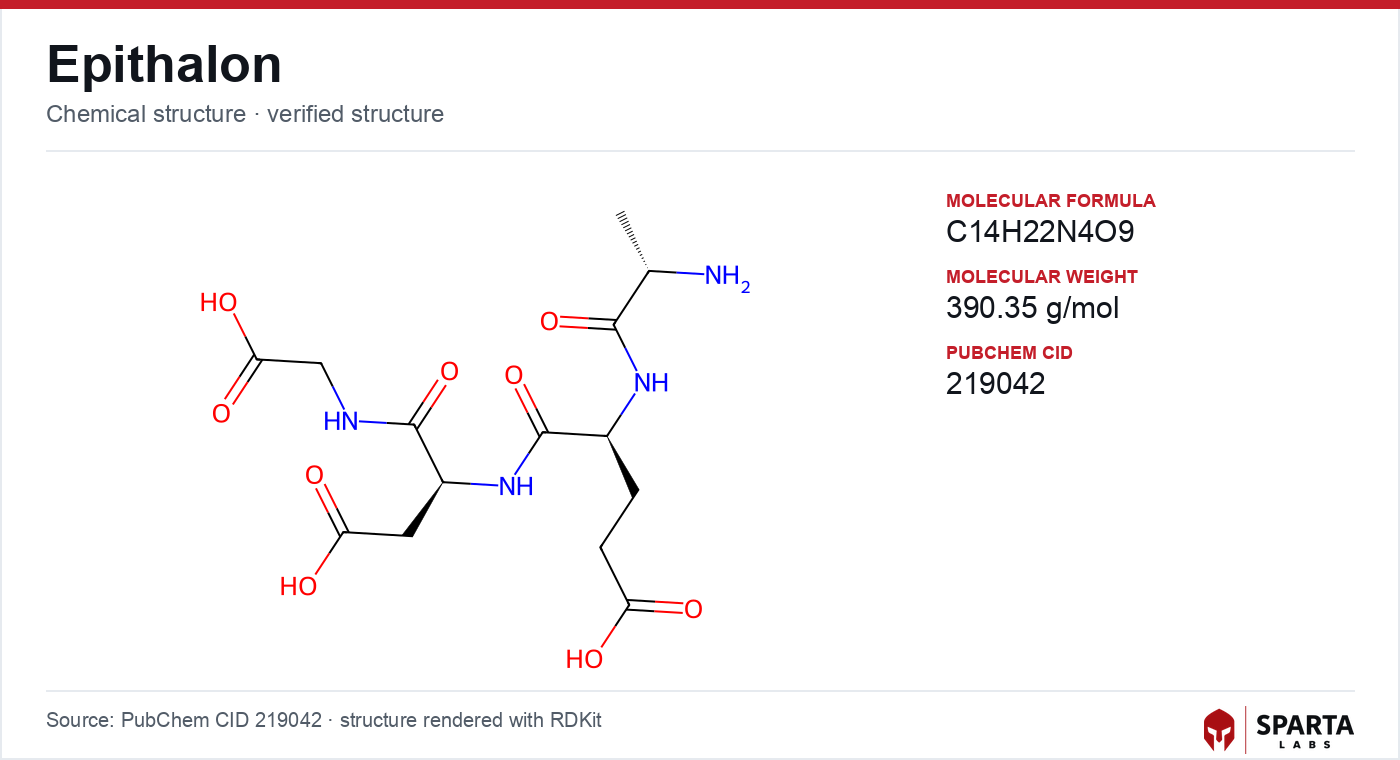
Figure: chemical structure of Epithalon (Ala-Glu-Asp-Gly).
From pineal extract to a four-residue sequence
The pineal gland (epiphysis cerebri) is an unpaired midline endocrine structure that synthesizes melatonin under circadian, light-entrained control. Beyond melatonin it produces peptide material that drew separate scientific interest. Starting in the early 1970s, a program at what became the St. Petersburg Institute of Bioregulation and Gerontology, led by Vladimir Kh. Khavinson and Vladimir G. Morozov, examined whether organ-derived polypeptide complexes could modulate aging-associated changes in animal models [2].
That program first characterized a native pineal extract, Epithalamin, and studied it as a whole preparation for two decades before its active fragments were resolved. Anisimov, Khavinson, and Morozov summarized that first phase in a 1994 retrospective spanning gerontological and oncological animal work with Epithalamin [2]. The reduction of that complex mixture to a single defined sequence came much later: Khavinson and colleagues reported in 2017 that the tetrapeptide AEDG is present within the Epithalamin polypeptide complex, using selective-reaction-monitoring mass spectrometry to identify it [3].
Findings from research models do not establish safety or efficacy in humans. Sparta Labs makes no claims about the use of this compound.
That analytical result is the hinge of the compound's identity. Epithalon is not a stand-in for Epithalamin; it is one sequence found within it, synthesized and studied on its own terms. The two should not be treated as interchangeable in the literature, and much of the confusion in secondary writing comes from collapsing the extract and the tetrapeptide into a single object.
Sequence chemistry: why four residues
Epithalon comprises four residues in the order L-alanine, L-glutamic acid, L-aspartic acid, glycine (Ala-Glu-Asp-Gly). The reported molecular formula is C14H22N4O9, with a molecular weight near 390.3 daltons; the compound is water-soluble and is handled as the free acid or an acetate salt.
Two of the four residues, glutamic acid and aspartic acid, carry acidic side chains, giving the short sequence a markedly anionic character at physiological pH. This acidity is chemically notable because the 2025 review discusses a proposed interaction between the compact AEDG sequence and nucleosomal histones as one mechanism examined in cell-based work [1]. Whether that interaction is what drives the observations attributed to the peptide remains an open question in the primary literature rather than a settled fact, and this overview reports the proposal without endorsing it.
The compactness itself is central to the design philosophy behind the compound. A four-residue peptide is chemically far more tractable than a heterogeneous tissue extract: it can be synthesized to a defined sequence, purified, and re-made batch to batch with a reproducibility that a native polypeptide complex cannot offer. Readers tracing how that purity is verified in practice can consult the Epithalon sourcing and verification reference.
The "short peptide bioregulator" classification
In the primary literature Epithalon is classified as a pineal peptide bioregulator, one of a family of short synthetic peptides derived from tissue-specific polypeptide extracts characterized within the Khavinson program. In that framework the shortest peptide fragment retaining the signal attributed to a parent polypeptide is isolated and synthesized as a discrete compound, trading the biological complexity of an extract for chemical definition.
These compounds are sometimes grouped in the Russian-language literature under the terms cytomaxes and cytogens: short di-, tri-, or tetrapeptides tied to organ-specific complexes. The pineal origin is what separates Epithalon from thymic-derived members such as Vilon (Lys-Glu) and from cerebral-cortex-derived members. Within Sparta Labs' library, a closely related pineal-context compound is covered in the Pinealon research overview, which shares the same research lineage while carrying a distinct sequence and reported target profile.
The classification matters for interpretation. Because the family was defined by extraction-then-reduction rather than by receptor-first pharmacology, the reported activities are framed around chromatin accessibility, gene expression, and enzymatic modulation observed in cell culture rather than around a single named receptor. The proposed pathways, including the telomerase observations, are examined in detail in the Epithalon mechanism of action article.
Telomerase and chromatin: what the cell-model literature reports
The single result most associated with Epithalon in secondary writing is a telomerase observation. Khavinson, Bondarev, and Butyugov reported in 2003 that exposure of cultured human somatic cells to the AEDG peptide was associated with induction of telomerase activity and telomere elongation in that in-vitro system [4]. This is a cell-culture finding, and its interpretation is bounded accordingly: it describes what was measured in a defined laboratory model, not an outcome in an organism or a person.
Later reviews situate that 2003 report inside a broader discussion of chromatin biology, noting that a small, acidic peptide could in principle interact with the histone-DNA interface and thereby influence which genes are accessible for transcription [1]. This chromatin framing is a hypothesis under continued examination rather than a demonstrated pathway, and the primary sources describe it in cautious, mechanistic language.
For a systematic walk through the individual studies rather than a summary characterization, the Epithalon published research article catalogues the reports by methodology and model type.
Neuroendocrine context: melatonin and circadian rhythm
Because the compound descends from a pineal extract, its research context is inseparable from the gland's best-known output, melatonin. Korkushko and colleagues reported in 2004 on the parent extract Epithalamin in relation to the circadian rhythm of pineal melatonin-producing function in elderly subjects [5]. That work concerns Epithalamin, the complex, rather than the isolated AEDG tetrapeptide, and it is cited here to establish the neuroendocrine setting from which the synthetic compound emerged rather than to attribute any specific outcome to Epithalon itself.
Keeping the extract-versus-sequence distinction visible is important precisely here: melatonin-adjacent findings reported for Epithalamin cannot be assumed to transfer to the four-residue peptide, and the primary literature treats the two preparations as related but non-identical subjects of study.
Regulatory status
Epithalon has no approved therapeutic indication from the United States Food and Drug Administration and is handled in the United States as a research-use-only material. It is not an approved drug, and no statement in this overview should be read as describing an authorized human use.
The wider Khavinson bioregulator program did yield peptide-based products registered as medicines within Russia, including Thymalin and Cortexin, which established a regulatory footprint for the peptide-bioregulator class in that jurisdiction. Epithalon, as the isolated synthetic tetrapeptide, does not carry the same separate registered-medicine status in the reviewed literature, and the parent extract Epithalamin was the subject of Russian observational study rather than of United States approval. The compound's fuller regulatory and discovery timeline is set out in the Epithalon discovery and regulatory history reference.
References
-
Araj SK, Brzezik J, Mądra-Gackowska K, Szeleszczuk Ł. Overview of Epitalon: Highly Bioactive Pineal Tetrapeptide with Promising Properties. Int J Mol Sci. 2025;26(6):2691. DOI: 10.3390/ijms26062691. Full text via DOI
-
Anisimov VN, Khavinson VKh, Morozov VG. Twenty Years of Study on Effects of Pineal Peptide Preparation: Epithalamin in Experimental Gerontology and Oncology. Ann N Y Acad Sci. 1994;719:483–493. DOI: 10.1111/j.1749-6632.1994.tb56853.x. Full text via DOI
-
Khavinson VKh, Kopylov AT, Vas'kovskiy BV, Ryzhak GA, Lin'kova NS. Identification of Peptide AEDG in the Polypeptide Complex of the Pineal Gland. Bull Exp Biol Med. 2017;164(1):41–43. DOI: 10.1007/s10517-017-3922-8. View on PubMed
-
Khavinson VKh, Bondarev IE, Butyugov AA. Epithalon Peptide Induces Telomerase Activity and Telomere Elongation in Human Somatic Cells. Bull Exp Biol Med. 2003;135(6):590–592. DOI: 10.1023/A:1025493705728. View on PubMed
-
Korkushko OV, Khavinson VKh, Shatilo VB, Antonyk-Sheglova IA. Effect of Peptide Preparation Epithalamin on Circadian Rhythm of Epiphyseal Melatonin-Producing Function in Elderly People. Bull Exp Biol Med. 2004;137(4):389–391. DOI: 10.1023/B:BEBM.0000035139.31138.bf. Full text via DOI
Disclaimer. Statements in this article have not been evaluated by the Food and Drug Administration. This compound is not intended to diagnose, treat, cure, or prevent any disease. Sparta Labs sells research-use-only materials. Content is provided for educational and informational purposes only and does not constitute medical advice. Consult a qualified medical professional for any health concerns.
Frequently asked questions
What is epithalon?
Epithalon (also spelled Epitalon) is a synthetic tetrapeptide composed of four amino acids in the sequence Ala-Glu-Asp-Gly. It was developed in Russia as a synthetic version of epithalamin, a peptide extract associated with the pineal gland, and is handled in research settings as a research-use-only material.
What is epithalon peptide?
Epithalon peptide is a short, synthetic four-amino-acid chain (Ala-Glu-Asp-Gly), a class of molecule known as a tetrapeptide. Reported literature describes it as a synthetic analog of the naturally occurring pineal peptide epithalamin, studied in laboratory and animal models rather than approved for any human use.
Is epitalon and epithalon the same?
Yes. Epitalon and epithalon are two spellings of the same synthetic tetrapeptide (Ala-Glu-Asp-Gly). The variation arises from transliteration of the original Russian research naming, and both spellings, along with epithalone, refer to the same compound in the scientific literature.
What does epithalon do?
Published preclinical research has examined epithalon primarily in relation to the pineal peptide system and telomere biology in cell and animal models. These are laboratory findings reported by researchers, not established effects in humans, and epithalon is not approved for any therapeutic use.
Is epithalon FDA approved?
No. Epithalon is not approved by the U.S. Food and Drug Administration for any use, and it has no recognized human therapeutic indication. It is studied within research contexts and is classified as a research-use-only material.
What is epithalon studied for in research?
Epithalon has appeared in published laboratory and animal studies investigating pineal-gland peptides, cellular aging, and telomerase activity in experimental models. This describes the topics researchers have studied, not proven outcomes; no human efficacy has been established and it remains a research-use-only compound.