
DSIP (Delta Sleep-Inducing Peptide): A Research Overview
A research-library overview of DSIP (delta sleep-inducing peptide): nonapeptide chemistry, neuropeptide classification, discovery history, and regulatory status. Educational reference.
For research use only. Not for human consumption. This article is educational reference material. It is not medical advice and is not a recommendation to use any substance.
Introduction
DSIP, or delta sleep-inducing peptide, is a naturally occurring nonapeptide first characterized in 1977 by the Swiss neurophysiologists Marcel Monnier and Guido Schoenenberger [1]. The peptide was named for the slow-wave (delta-frequency) electroencephalogram pattern observed after its infusion into rabbit models. Nearly five decades after its isolation, DSIP remains an object of ongoing scientific interest and, in the words of one review, a "still unresolved riddle": a well-defined molecule whose endogenous receptor, precursor gene, and physiological role have not been definitively established [2]. This overview summarizes the published record on DSIP's chemistry, classification, discovery, and regulatory status. Research-grade DSIP from Sparta Labs is characterized by HPLC purity analysis and third-party testing for each production batch.
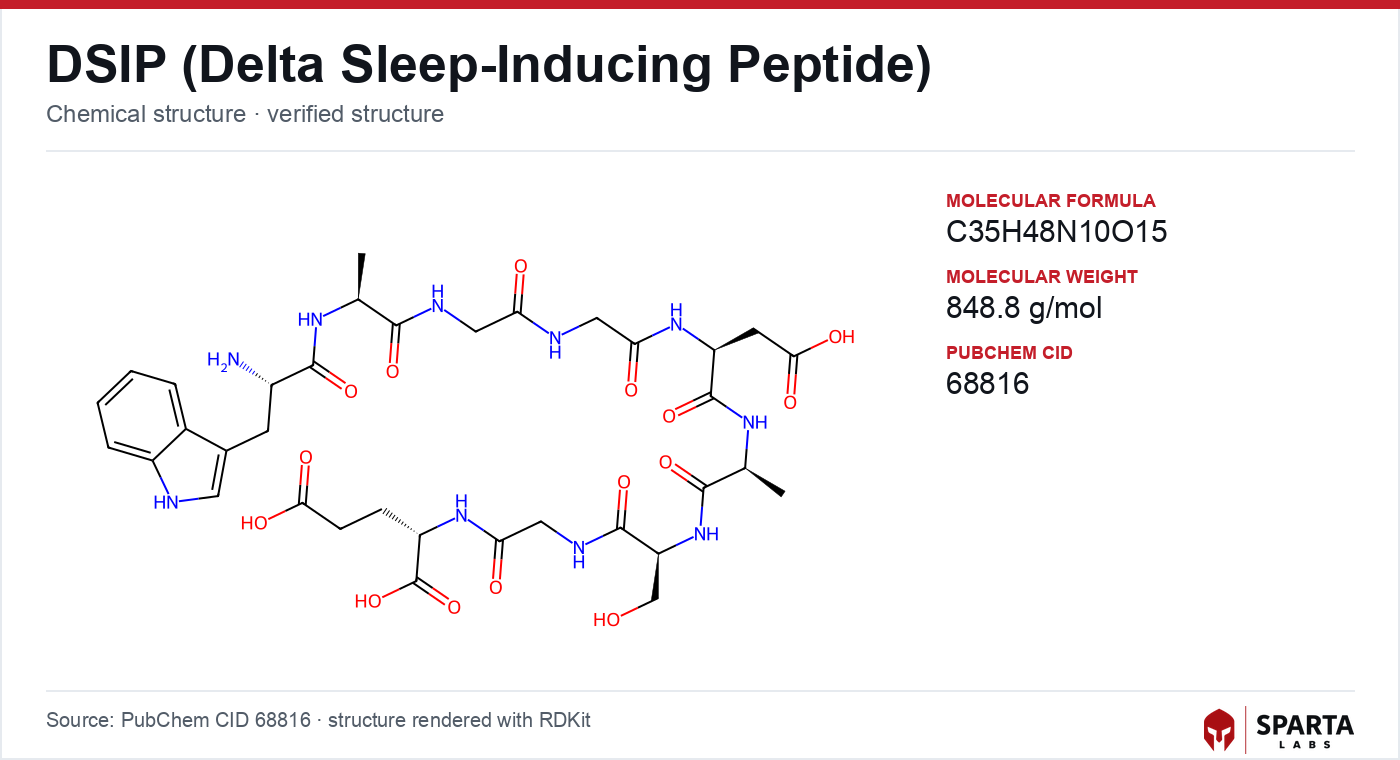
Figure: chemical structure of DSIP.
Background
The identification of DSIP arose from mid-twentieth-century "humoral" theories of sleep, which proposed that sleep pressure might be mediated in part by circulating chemical factors. Monnier and colleagues at the University of Bern pursued this hypothesis experimentally by inducing slow-wave sleep in donor rabbits through low-frequency electrical stimulation of the thalamus, collecting cerebral venous blood, and then testing dialysates of that blood in recipient animals.
Infusion of the isolated fraction into the mesodiencephalic ventricle of waking recipient rabbits was reported to be associated with an increase in spindle and delta electroencephalogram activity, the electrophysiological signature of deep, slow-wave sleep [1]. The active fraction was subsequently purified and resolved to a single small peptide, which the investigators designated delta sleep-inducing peptide. This work is frequently cited as an early example of a putative endogenous sleep factor being isolated and chemically defined.
Findings from research models do not establish safety or efficacy in humans. Sparta Labs makes no claims about the use of this compound.
Chemistry and Structure
DSIP is a linear nonapeptide composed of nine amino acid residues in the sequence L-tryptophan – L-alanine – glycine – glycine – L-aspartic acid – L-alanine – L-serine – glycine – L-glutamic acid (Trp-Ala-Gly-Gly-Asp-Ala-Ser-Gly-Glu), commonly abbreviated WAGGDASGE [3]. The molecular formula is reported as C35H48N10O15, corresponding to a molecular weight of approximately 849 daltons, and the compound carries CAS registry number 62568-57-4.
The full amino-acid analysis, sequence determination, and chemical synthesis of the nonapeptide were reported by Schoenenberger, Maier, Tobler, Wilson, and Monnier in 1978, a study that also synthesized several candidate metabolic fragments and nonapeptide analogues for comparison [3]. The molecule contains no cysteine residues and therefore forms no intramolecular disulfide bridge; it is an uncyclized, water-soluble sequence. Structural and conformational studies in solution have subsequently examined the peptide's flexibility and membrane interactions, noting that DSIP is a small, comparatively unstructured peptide in aqueous environments.
Pharmacological Classification
DSIP is classified in the primary literature as a neuropeptide, a short peptide sequence of neural origin studied in the context of central nervous system signaling. Unlike pineal-associated bioregulators such as Pinealon or Epithalon, which belong to distinct research families, DSIP has not been assigned to a defined receptor-agonist class, because a specific DSIP receptor has not been definitively isolated.
The 2006 review by Kovalzon in the Journal of Neurochemistry emphasized that the peptide's mechanistic classification is unusual: DSIP is a chemically defined, reproducibly synthesized molecule for which the endogenous gene, precursor protein, and cognate receptor all remain unidentified as of that publication [2]. Immunochemical studies have complicated the picture further. Sillard and colleagues reported in 1993 the isolation from porcine brain of a novel 77-residue peptide containing a leucine-zipper motif that was recognized by an antiserum raised against DSIP, suggesting that DSIP-immunoreactive material in tissue may not correspond to a simple free nonapeptide precursor [4]. The pharmacology of DSIP is examined in more detail in the DSIP mechanism of action article.
Regulatory Status
DSIP has no approved therapeutic indication from the United States Food and Drug Administration (FDA). It has not undergone the clinical evaluation and regulatory review required for marketing authorization as a medicine, and it is handled as a research-use-only material.
The compound was assigned the International Nonproprietary Name (INN) emideltide, reflecting historical interest in evaluating the peptide within formal drug-development frameworks. That evaluation did not result in an approved product, and DSIP is not listed as an active ingredient in any FDA-approved drug. As with other unapproved research peptides, published discussion of DSIP is confined to the scientific record; the compound is not represented here as suitable for any human use.
Discovery History
The discovery of DSIP is inseparable from the electrophysiological sleep research conducted in Bern during the 1960s and 1970s. The foundational report, Monnier and Schoenenberger's 1977 PNAS paper characterizing the delta-electroencephalogram-inducing peptide, established the molecule as a distinct, isolable factor [1]. The following year, the same research group published the complete amino-acid sequence, chemical synthesis, and comparative activity data for the nonapeptide, placing DSIP on a firm structural footing [3].
In the decades that followed, investigators in Europe, the Soviet Union, and elsewhere examined DSIP and its analogues across a range of experimental models. The 1993 Sillard study extended the record into molecular biology by probing the identity of endogenous DSIP-immunoreactive material [4], while the 2006 Kovalzon review synthesized the accumulated literature and articulated the central unresolved questions surrounding the peptide's origin and mechanism [2]. That review remains a widely cited reference point for the compound's scientific status. Contemporary interest in DSIP continues within the neuropeptide research literature, where it is studied primarily as a historically significant candidate sleep factor rather than as an established signaling agent.
References
-
Monnier M, Schoenenberger GA. Characterization of a delta-electroencephalogram (-sleep)-inducing peptide. Proc Natl Acad Sci U S A. 1977;74(3):1282–1286. DOI: 10.1073/pnas.74.3.1282. PMCID: PMC430668.
-
Kovalzon VM, Strekalova TV. Delta sleep-inducing peptide (DSIP): a still unresolved riddle. J Neurochem. 2006;97(2):303–309. DOI: 10.1111/j.1471-4159.2006.03693.x.
-
Schoenenberger GA, Maier PF, Tobler HJ, Wilson K, Monnier M. The delta EEG (sleep)-inducing peptide (DSIP). XI. Amino-acid analysis, sequence, synthesis and activity of the nonapeptide. Pflugers Arch. 1978;376(2):119–129. PMID: 568769.
-
Sillard R, Schulz-Knappe P, Vogel P, Raida M, Bensch KW, Forssmann WG, Mutt V. A novel 77-residue peptide from porcine brain contains a leucine-zipper motif and is recognized by an antiserum to delta-sleep-inducing peptide. Eur J Biochem. 1993;216(2):429–436. DOI: 10.1111/j.1432-1033.1993.tb18160.x.
Disclaimer. Statements in this article have not been evaluated by the Food and Drug Administration. This compound is not intended to diagnose, treat, cure, or prevent any disease. Sparta Labs sells research-use-only materials. Content is provided for educational and informational purposes only and does not constitute medical advice. Consult a qualified medical professional for any health concerns.
Frequently asked questions
What is DSIP peptide?
DSIP (delta sleep-inducing peptide) is a naturally occurring nonapeptide first reported by Schoenenberger and Monnier in the 1970s, isolated from the cerebral venous blood of rabbits. Its published amino acid sequence is Trp-Ala-Gly-Gly-Asp-Ala-Ser-Gly-Glu, with a molecular weight of roughly 848 daltons. It is sold as a research-use-only material.
What is DSIP?
DSIP stands for delta sleep-inducing peptide, a name given by the researchers who first isolated it because of the physiological context in which it was identified. Chemically it is a small nine-amino-acid peptide of scientific research interest. It is not an approved drug and is not intended for human consumption.
What does DSIP peptide do?
In the published literature, DSIP has been characterized as an endogenous neuropeptide, and early studies reported its association with electroencephalographic slow-wave activity in animal models. These are neutral descriptions of what researchers have observed and reported, not statements of any effect in humans. Sparta Labs makes no claims about this compound.
How does DSIP work?
The reported mechanism of DSIP is not fully established in the scientific literature. Published research has proposed that it acts as a neuromodulator, though a specific, well-defined receptor has not been conclusively identified. This reflects what researchers have hypothesized and observed in study models, not a demonstrated action in humans.
What is DSIP peptide used for in research?
In the scientific literature, DSIP has been used as a subject of neuropeptide and neurochemistry research since its isolation in the 1970s. Studies have examined its distribution, structure, and behavior in laboratory and animal models. Sparta Labs supplies it strictly as a research-use-only material and makes no claims about any human application.
Is DSIP FDA approved?
No. DSIP (delta sleep-inducing peptide) is not approved by the U.S. Food and Drug Administration for any medical use, and it is not an over-the-counter or prescription product. It is offered exclusively as a research-use-only chemical, not for human or veterinary consumption.