
DSIP (Delta Sleep-Inducing Peptide): Published Research
An educational reference summarizing peer-reviewed studies on DSIP (delta sleep-inducing peptide), a nonapeptide first isolated in 1977, spanning isolation and sequencing work, preclinical neuropharmacology, and clinical investigation.
For research use only. Not for human consumption. This article is educational reference material. It is not medical advice and is not a recommendation to use any substance.
Introduction
Delta sleep-inducing peptide (DSIP) is a nonapeptide (Trp-Ala-Gly-Gly-Asp-Ala-Ser-Gly-Glu) that was first isolated from the cerebral venous blood of rabbits in the 1970s and characterized as a candidate slow-wave-EEG factor. The published literature on DSIP spans isolation and sequencing chemistry, rodent neuroendocrine and neurotransmitter studies, plasma-stability investigations, emotional-stress and focal-stroke models, and a small set of dated clinical reports. This article summarizes peer-reviewed studies indexed in PubMed and related biomedical databases. For the receptor-level and signaling context underlying the studies discussed here, see the DSIP mechanism of action article, and for chemistry and classification background see the DSIP research overview.
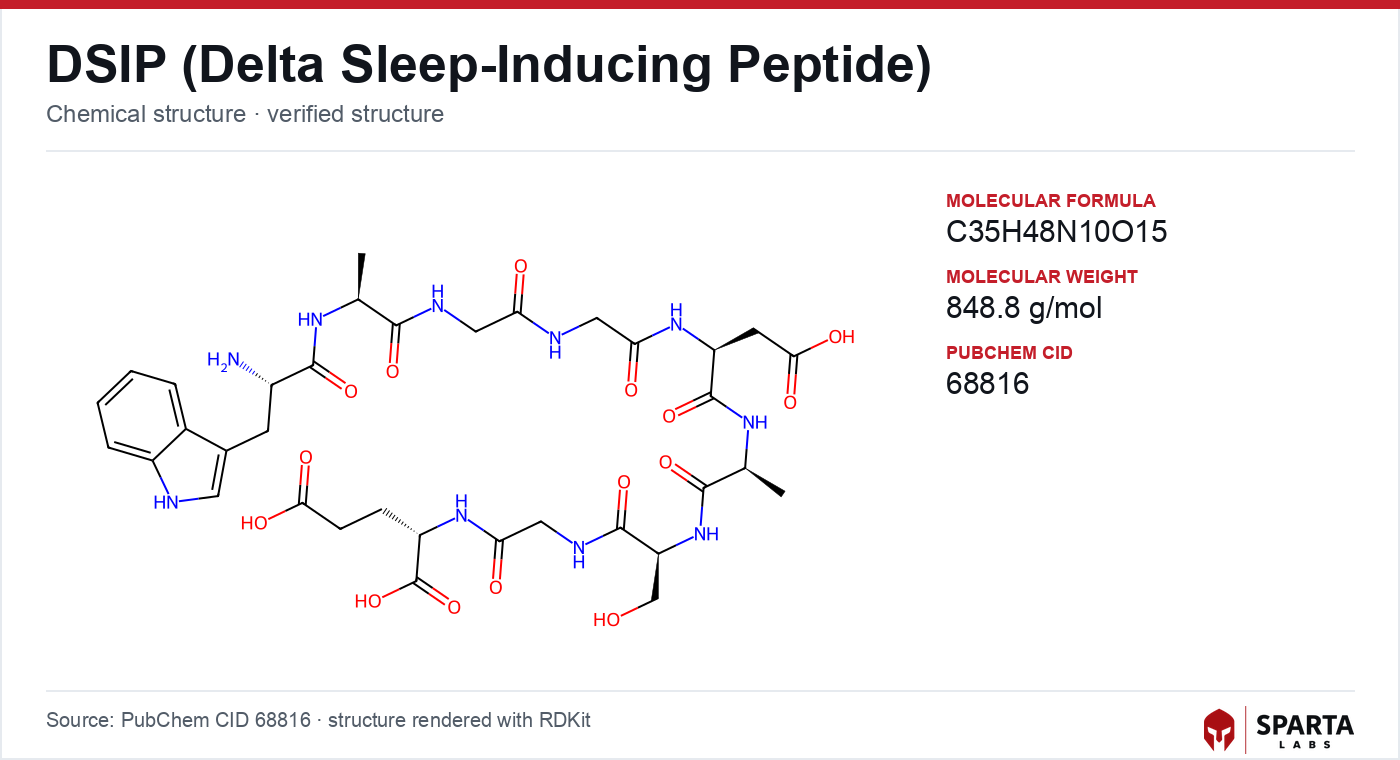
Figure: chemical structure of DSIP.
Methodology Types in the Published Literature
Published DSIP research has employed several distinct methodological approaches. Early work used bioassay-guided isolation and amino-acid sequencing to define the peptide's structure [1]. Rodent studies have applied radioimmunoassay, neurotransmitter quantification, and gene-expression methods to characterize neuroendocrine and central-nervous-system responses [2,3]. In vitro incubation assays in plasma and serum characterized the compound's degradation and aggregation behavior [4]. Behavioral and physiological models, including emotional-stress paradigms and a focal-ischemia model, have been used in later preclinical investigations [5,6]. The clinical literature consists of small, largely open-label studies using sleep-laboratory recordings or clinical symptom scales [7,8,9].
Summary of Published Studies
Isolation, Sequencing, and Early Characterization
The foundational chemistry was reported by Schoenenberger, Monnier, and colleagues at Basel. A 1978 paper in Pflügers Archiv, part of a numbered series on the delta-EEG-inducing peptide, described the amino-acid analysis, sequence, synthesis, and activity of the nonapeptide, establishing the Trp-Ala-Gly-Gly-Asp-Ala-Ser-Gly-Glu sequence and confirming activity of the synthetic material in the rabbit EEG model [1]. This work defined DSIP as a discrete, synthesizable peptide and set the reference point for subsequent structural and pharmacological research.
Findings from research models do not establish safety or efficacy in humans. Sparta Labs makes no claims about the use of this compound.
Neuroendocrine and Neurotransmitter Studies
A 1982 study in Pharmacology, Biochemistry and Behavior by Graf and colleagues reported that DSIP administration in rats was associated with changes in the daily concentration profiles of several brain neurotransmitters and plasma proteins, which the authors interpreted as evidence of a diffuse neuromodulatory rather than a single-target action [2]. A 1987 report in Neuroendocrinology by Iyer and McCann described that DSIP altered somatostatin release in an experimental system, an effect the authors attributed to a dopaminergic intermediary mechanism [3]. These studies positioned DSIP within neuroendocrine-signaling research rather than assigning it a defined receptor.
Plasma Stability and Degradation
A 1987 study in Peptides by Graf, Saegesser, and Schoenenberger examined the fate of DSIP and two analogs incubated in human and rat plasma and serum [4]. The authors reported that native DSIP disappeared rapidly through degradation, whereas certain analogs formed complexes and persisted longer in apparently intact form. This degradation profile has been cited in the literature as a factor complicating interpretation of the peptide's in vivo effects and is one reason later commentary emphasized the sparse human pharmacokinetic record.
Emotional-Stress and Stroke Models
A 1995 paper in the Annals of the New York Academy of Sciences by Sudakov and colleagues examined DSIP in rodent emotional-stress paradigms and reported associated changes in substance P, beta-endorphin, and corticosterone levels in the hypothalamus and plasma, which the authors described as consistent with a stress-resistance-related profile in their model [5]. A 2021 study in Molecules by Tukhovskaya and colleagues investigated DSIP in a rat model of focal cerebral ischemia, reporting differences in motor-function recovery measures between treated and control animals [6]. The authors framed the results as preliminary preclinical observations warranting further mechanistic characterization.
Clinical Investigations
The clinical record is limited and dates largely to the early 1980s. A 1981 study in Experientia by Schneider-Helmert and Schoenenberger examined the influence of synthetic DSIP on disturbed sleep in a small group of chronic insomniac subjects, reporting changes in recorded sleep parameters [7]. Two studies by groups in Geneva and Basel investigated DSIP in inpatients with alcohol or opiate withdrawal: a 1983 report in Neuropsychobiology by Dick, Grandjean, and Tissot described symptom changes in withdrawal patients and discussed a possible interaction with opioid-receptor systems [8], and a 1984 report in European Neurology by Dick and colleagues extended this observation to a larger withdrawal cohort treated with intravenous synthetic DSIP [9]. A companion 1984 European Neurology clinical report by Kaeser summarized additional trial experience [10]. All of these investigations were small, mostly open-label, and predate modern trial-registration and controlled-design standards.
Knowledge Gaps
A 2006 mini-review in the Journal of Neurochemistry by Kovalzon and Strekalova characterized DSIP as a "still-unresolved riddle," noting that no DSIP gene, protein precursor, or dedicated receptor had been isolated, and that the proposed sleep link remained weakly documented [11]. Several gaps persist in the published record. No specific high-affinity DSIP receptor has been identified, leaving reported effects attributable to indirect or multi-target mechanisms. Human pharmacokinetic data are sparse, and the plasma-degradation findings indicate rapid breakdown of the native peptide [4]. The clinical literature is dated and methodologically limited, with no large modern randomized controlled trials. These open questions parallel those in other neuropeptide research programs with active preclinical work but limited translational data, such as that summarized in the Selank published research article. Research-grade DSIP from Sparta Labs is intended for laboratory investigation of these open questions only.
References
-
Schoenenberger GA, Maier PF, Tobler HJ, Wilson K, Monnier M. The delta EEG (sleep)-inducing peptide (DSIP). XI. Amino-acid analysis, sequence, synthesis and activity of the nonapeptide. Pflügers Archiv. 1978;376(2):119–129. Full text via DOI PMID: 568769.
-
Graf M, Baumann JB, Girard J, Tobler HJ, Schoenenberger GA. DSIP-induced changes of the daily concentrations of brain neurotransmitters and plasma proteins in rats. Pharmacology, Biochemistry and Behavior. 1982;17(3):511–517. View on PubMed PMID: 6128743.
-
Iyer KS, McCann SM. Delta sleep inducing peptide inhibits somatostatin release via a dopaminergic mechanism. Neuroendocrinology. 1987;46(1):93–95. Full text via DOI PMID: 2886936.
-
Graf MV, Saegesser B, Schoenenberger GA. Degradation and aggregation of delta sleep-inducing peptide (DSIP) and two analogs in plasma and serum. Peptides. 1987;8(4):599–603. Full text via DOI PMID: 3628078.
-
Sudakov KV, Coghlan JP, Kotov AV, Salieva RM, Polyntsev YuV, Koplik EV. Delta-sleep-inducing peptide sequels in the mechanisms of resistance to emotional stress. Annals of the New York Academy of Sciences. 1995;771:240–251. Full text via DOI PMID: 8597403.
-
Tukhovskaya EA, Ismailova AM, Shaykhutdinova ER, Slashcheva GA, Prudchenko IA, Mikhaleva II, Khokhlova ON, Murashev AN, Ivanov VT. Delta sleep-inducing peptide recovers motor function in SD rats after focal stroke. Molecules. 2021;26(17):5173. Full text via DOI PMID: 34500605.
-
Schneider-Helmert D, Schoenenberger GA. The influence of synthetic DSIP (delta-sleep-inducing-peptide) on disturbed human sleep. Experientia. 1981;37(9):913–917. Full text via DOI PMID: 7028502.
-
Dick P, Grandjean ME, Tissot R. Successful treatment of withdrawal symptoms with delta sleep-inducing peptide, a neuropeptide with potential agonistic activity on opiate receptors. Neuropsychobiology. 1983;10(4):205–208. Full text via DOI PMID: 6328354.
-
Dick P, Costa C, Fayolle K, Grandjean ME, Khoshbeen A, Tissot R. DSIP in the treatment of withdrawal syndromes from alcohol and opiates. European Neurology. 1984;23(5):364–371. Full text via DOI PMID: 6548969.
-
Kaeser HE. A clinical trial with DSIP. European Neurology. 1984;23(5):386–388. Full text via DOI PMID: 6391926.
-
Kovalzon VM, Strekalova TV. Delta sleep-inducing peptide (DSIP): a still unresolved riddle. Journal of Neurochemistry. 2006;97(2):303–309. Full text via DOI PMID: 16539654.
Disclaimer. Statements in this article have not been evaluated by the Food and Drug Administration. This compound is not intended to diagnose, treat, cure, or prevent any disease. Sparta Labs sells research-use-only materials. Content is provided for educational and informational purposes only and does not constitute medical advice. Consult a qualified medical professional for any health concerns.
Frequently asked questions
What research has been done on DSIP?
Published research on DSIP spans roughly five decades, beginning with its isolation and sequencing from rabbit cerebral venous blood in the 1970s. The literature includes rodent neuroendocrine and neurotransmitter studies, plasma-stability and degradation work, emotional-stress models, focal-stroke recovery studies, and several small clinical investigations in disturbed sleep and withdrawal syndromes. A widely cited 2006 review characterized the compound as a still-unresolved research question.
What clinical trials exist for DSIP?
The clinical literature is limited and dated. Reported investigations include a 1981 study by Schneider-Helmert and Schoenenberger on disturbed human sleep, and studies by Dick and colleagues and by Kaeser in the early 1980s that administered synthetic DSIP to inpatients with alcohol or opiate withdrawal symptoms. These were small, largely open-label investigations, and no large modern randomized controlled trials have established clinical outcomes.
Was DSIP shown to induce sleep in humans?
A 2006 review in the Journal of Neurochemistry by Kovalzon and Strekalova noted that the proposed link between DSIP and sleep has never been firmly characterized, in part because no DSIP gene, protein precursor, or dedicated receptor has been isolated. The early sleep-related findings were reported in rabbit EEG models, and the human sleep data remain limited and inconsistent.
What are the knowledge gaps in DSIP research?
No specific DSIP receptor has been identified, and the compound's endogenous gene and biosynthetic precursor remain uncharacterized. Human pharmacokinetic data are sparse, and plasma-degradation studies indicate the peptide is rapidly broken down. Most mechanistic findings derive from rodent or in vitro models rather than controlled human trials.