
PT-141 vs Melanotan 2: A Structural and Regulatory Comparison
A structural and regulatory comparison of PT-141 (bremelanotide) and Melanotan 2, two cyclic alpha-MSH analogues from the same University of Arizona lineage that differ by a single C-terminal group and by regulatory status. Educational reference.
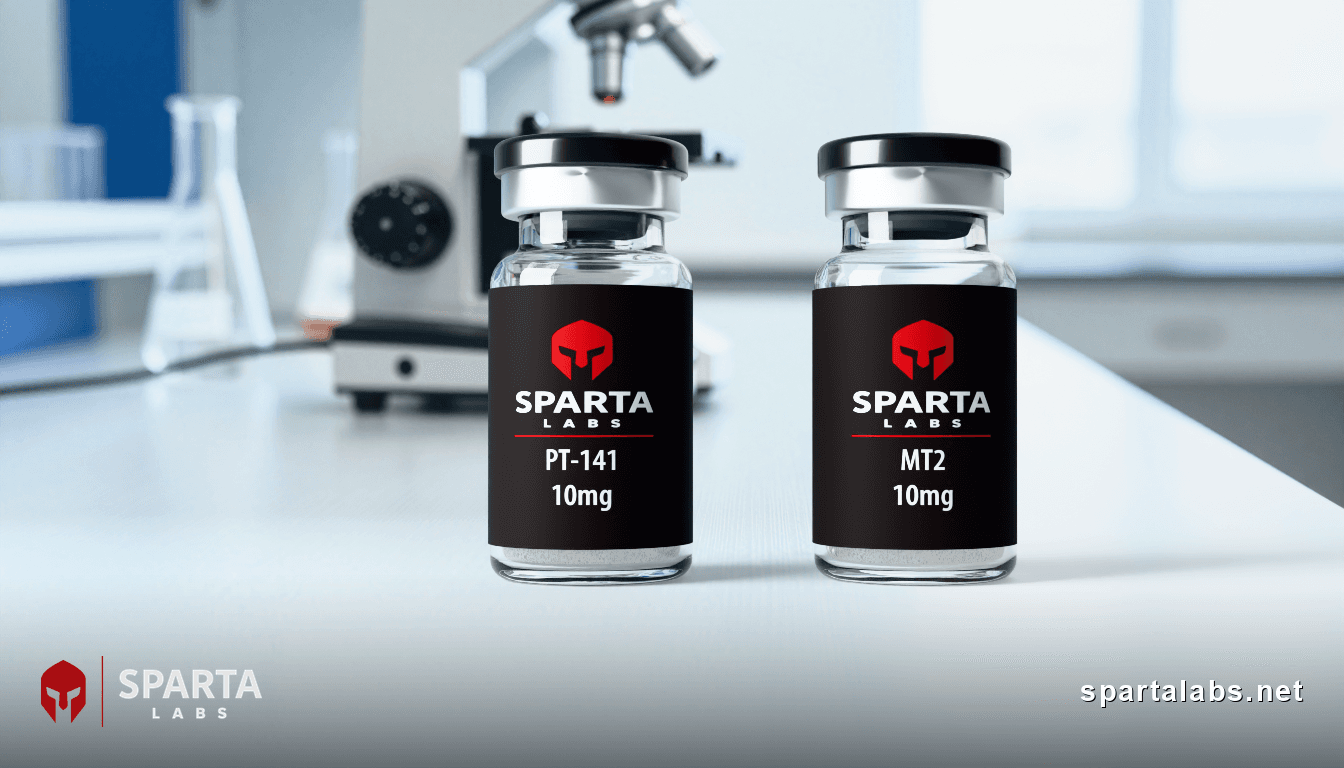
Introduction
PT-141 (bremelanotide) and Melanotan 2 (MT-II) are the two best-known members of a small family of cyclic alpha-melanocyte-stimulating hormone (alpha-MSH) analogues that originated in the same University of Arizona chemistry program. They share a seven-residue lactam-bridged scaffold and a common receptor family, and they differ at exactly one position: the C-terminus. That single chemical difference sits alongside a very large regulatory difference, because bremelanotide holds a 2019 FDA approval for a specific labeled indication while Melanotan 2 has never been approved by any regulator. This article compares the two compounds by structure, origin, pharmacological class, and regulatory record, reporting what investigators and regulators have published without drawing conclusions about either compound's suitability for any purpose. Research-grade PT-141 and Melanotan 2 reference materials are cataloged with per-batch certificates of analysis.
Melanotan 2: The Parent Cyclic Scaffold
Melanotan 2 is a synthetic cyclic heptapeptide with the sequence Ac-Nle-cyclo[Asp-His-D-Phe-Arg-Trp-Lys]-NH2. It was designed at the University of Arizona in the laboratories of Victor J. Hruby and Mac E. Hadley as part of a structure-activity program aimed at producing conformationally constrained, enzymatically stable analogues of native alpha-MSH, a linear 13-residue hormone whose plasma half-life is measured in minutes [3, 4]. Four design features distinguish the analogue from the native hormone: norleucine replaces the oxidation-prone methionine at position 4; D-phenylalanine replaces L-phenylalanine at position 7; a lactam bridge between the aspartate side chain at position 5 and the lysine side chain at position 10 closes the ring; and acetyl and amide caps protect the two termini from exopeptidases [3, 4]. Hruby's 2016 retrospective in Biopolymers described the lactam-bridge cyclization as the methodological contribution that fixed the His-Phe-Arg-Trp pharmacophore in a bioactive conformation [4].
The molecular framework for interpreting the compound arrived in 1992, when Mountjoy, Robbins, Mortrud, and Cone reported the cloning of a family of genes encoding the melanocortin receptors, revealing at least five G protein-coupled receptor subtypes with distinct tissue distributions [1]. Gantz and Fong's 2003 review of the melanocortin system summarized the subsequent pharmacology: MT-II behaves as a non-selective agonist at MC1R, MC3R, MC4R, and MC5R, and does not appreciably engage MC2R, which requires the longer ACTH sequence for recognition [2]. This pan-receptor profile is the reason MT-II became a widely used reference agonist in receptor-characterization studies before subtype-selective probes were available [3].
The compound's human research record is short. Dorr and colleagues published a pilot phase 1 evaluation of MT-II in Life Sciences in 1996, a single-blind, placebo-controlled study in three volunteers at the University of Arizona [5]. Hadley and Dorr's 2006 review in Peptides recounted the transition of the University of Arizona program toward clinical investigation and the licensing of the melanocortin intellectual property that followed [3]. A preparative solution-phase synthesis of MT-II was later described by Ryakhovsky and colleagues in 2008, documenting the chemistry by which the cyclic peptide can be produced at scale [6].
Findings from early-phase and preclinical research do not establish safety or efficacy in humans. Sparta Labs makes no claims about the use of this compound.
Melanotan 2 has no approved labeling in any jurisdiction. Case reports in the clinical toxicology literature, including a 2012 report by Nelson, Bryant, and Aks, have documented adverse events following self-administration of unregulated material outside research settings [10]. A fuller account of the compound's chemistry and classification is available in the Melanotan 2 research overview.
PT-141 (Bremelanotide): The Deamidated Derivative
Bremelanotide has the sequence Ac-Nle-cyclo[Asp-His-D-Phe-Arg-Trp-Lys]-OH, a molecular formula of C49H64N14O10, and a molecular weight of approximately 1,025 daltons [8]. Every design element of MT-II is retained: the norleucine at position 4, the D-phenylalanine at position 7, the Asp-Lys lactam bridge, and the N-terminal acetyl group. The one change is at the C-terminus, where the primary amide of MT-II is replaced by a free carboxylic acid. Molinoff and colleagues, writing in the Annals of the New York Academy of Sciences in 2003, described PT-141 as a metabolite of Melanotan 2 that lacks the C-terminal amide, which is why the compound is often referred to as the deamidated form of its parent [7].
Palatin Technologies advanced PT-141 as a distinct clinical candidate. Molinoff and colleagues reported the compound's preclinical receptor characterization and early clinical pharmacology in that same 2003 paper [7]. Published pharmacology characterizes bremelanotide as an agonist at MC3R and MC4R, with reported binding affinity at MC4R substantially higher than at MC1R or MC5R, placing MC4R as its principal target [7, 8]. The regulatory endpoint of the program was the RECONNECT phase 3 trials, reported by Kingsberg and colleagues in Obstetrics and Gynecology in 2019, which enrolled 1,267 premenopausal women across two parallel randomized, placebo-controlled studies [9].
On June 21, 2019, the FDA approved bremelanotide under the brand name Vyleesi (NDA 210557) for the treatment of acquired, generalized hypoactive sexual desire disorder in premenopausal women, stated here as regulatory fact drawn from the approved prescribing information [8]. The label describes a subcutaneous product with a mean terminal half-life of approximately 2.7 hours and carries precautionary language regarding transient blood pressure increases [8]. Bremelanotide is not approved for any other indication or population. The development timeline from the Arizona scaffold to the approved product is traced in the PT-141 history article.
Structural Comparison
- Ring and backbone. Both compounds are cyclic heptapeptides closed by a lactam bridge between Asp5 and Lys10, with the His-Phe-Arg-Trp core held inside the ring [3, 4]. Neither uses a disulfide; the lactam is an amide bond formed between side chains, which is what makes the ring resistant to reducing conditions.
- Non-native residues. Both carry Nle4 and D-Phe7. These substitutions were introduced in the linear alpha-MSH analogue series before cyclization and were carried unchanged into the cyclic scaffold [3].
- Termini. Both are N-acetylated. MT-II is C-amidated (-NH2); bremelanotide has a free C-terminal carboxylate (-OH). This is the only covalent difference between the two molecules, and it lowers the molecular weight by approximately one dalton while adding a negative charge at physiological pH [7, 8].
- Metabolic relationship. PT-141 is the deamidated metabolite of MT-II, as reported by Molinoff and colleagues [7]. The amide-to-acid conversion is a common route of peptide degradation, so the approved drug corresponds to a species that would also arise from hydrolysis of its parent.
- Receptor profile. MT-II is described as a non-selective MC1R/MC3R/MC4R/MC5R agonist [2, 3]. Bremelanotide is described as an MC3R/MC4R agonist with MC4R as its principal target [7, 8]. Both lack activity at MC2R [2].
- Regulatory status. Bremelanotide: FDA-approved (2019, Vyleesi) for one labeled indication [8]. Melanotan 2: never approved anywhere; research-use-only [3, 10].
Pharmacological Class Context
Both compounds belong to the melanocortin receptor agonist class, a group defined by activity at one or more of the five receptors cloned by Mountjoy and colleagues in 1992 [1]. The endogenous ligands of that class are alpha-, beta-, and gamma-MSH and ACTH, all derived from the proopiomelanocortin precursor, and all sharing the His-Phe-Arg-Trp message sequence that MT-II and bremelanotide rigidify [2]. Within the synthetic ligand literature, MT-II is grouped with NDP-MSH as a first-generation reference agonist, while bremelanotide represents the first melanocortin agonist to reach FDA approval, followed in 2020 by the MC4R-selective setmelanotide for specific genetic obesity syndromes [3]. The tripeptide KPV, a C-terminal fragment of alpha-MSH, sits at the other end of the size spectrum within the same class and is surveyed in the KPV research overview.
The two compounds compared here were never tested head-to-head in a published controlled trial, and the receptor-selectivity differences described in the literature derive from separate binding studies rather than direct comparison. This article accordingly makes no comparative efficacy statement about either compound. The signaling pathways downstream of the receptors, including Gs coupling and cyclic AMP elevation, are described in the Melanotan 2 mechanism of action article.
Research-grade PT-141 and Melanotan 2 sold by chemical suppliers are laboratory reference materials, not pharmaceutical products, and are strictly for research use only. The presence of an FDA-approved drug sharing bremelanotide's structure does not extend any approval to research-grade material.
References
- Mountjoy KG, Robbins LS, Mortrud MT, Cone RD. The cloning of a family of genes that encode the melanocortin receptors. Science. 1992;257(5074):1248-1251. PMID: 1325670. DOI: 10.1126/science.1325670
- Gantz I, Fong TM. The melanocortin system. Am J Physiol Endocrinol Metab. 2003;284(3):E468-E474. PMID: 12556347. DOI: 10.1152/ajpendo.00524.2002
- Hadley ME, Dorr RT. Melanocortin peptide therapeutics: historical milestones, clinical studies and commercialization. Peptides. 2006;27(4):921-930. PMID: 16412534. DOI: 10.1016/j.peptides.2005.01.029
- Hruby VJ. Design of cyclic peptides with biological activities from biologically active peptides: the case of peptide modulators of melanocortin receptors. Biopolymers. 2016;106(6):884-888. PMID: 27486849. DOI: 10.1002/bip.22929
- Dorr RT, Lines R, Levine N, Brooks C, Xiang L, Hruby VJ, Hadley ME. Evaluation of melanotan-II, a superpotent cyclic melanotropic peptide in a pilot phase-I clinical study. Life Sci. 1996;58(20):1777-1784. PMID: 8637402. DOI: 10.1016/0024-3205(96)00160-9
- Ryakhovsky VV, Khachiyan GA, Kosovova NF, Isamiddinova EF, Ivanov AS. The first preparative solution phase synthesis of melanotan II. Beilstein J Org Chem. 2008;4:39. PMID: 19043625. DOI: 10.3762/bjoc.4.39
- Molinoff PB, Shadiack AM, Earle D, Diamond LE, Quon CY. PT-141: a melanocortin agonist for the treatment of sexual dysfunction. Ann N Y Acad Sci. 2003;994:96-102. PMID: 12851303. DOI: 10.1111/j.1749-6632.2003.tb03167.x
- US Food and Drug Administration. Vyleesi (bremelanotide injection) prescribing information. NDA 210557. Approved June 21, 2019. FDA label
- Kingsberg SA, Clayton AH, Portman D, Williams LA, Krop J, Jordan R, Lucas J, Simon JA. Bremelanotide for the Treatment of Hypoactive Sexual Desire Disorder: Two Randomized Phase 3 Trials. Obstet Gynecol. 2019;134(5):899-908. PMID: 31599840. DOI: 10.1097/AOG.0000000000003500
- Nelson ME, Bryant SM, Aks SE. Melanotan II injection resulting in systemic toxicity and rhabdomyolysis. Clin Toxicol (Phila). 2012;50(10):1169-1173. PMID: 23121206. DOI: 10.3109/15563650.2012.740592
Frequently asked questions
What is the difference between PT-141 and Melanotan 2?
Both are cyclic heptapeptide analogues of alpha-melanocyte-stimulating hormone built on the same lactam-bridged scaffold developed at the University of Arizona. They differ at a single position, the C-terminus, where Melanotan 2 carries an amide group and PT-141 (bremelanotide) carries a free carboxylic acid. Published work describes PT-141 as the deamidated metabolite of Melanotan 2.
Is PT-141 FDA approved?
Yes. Bremelanotide was approved by the FDA on June 21, 2019, under the brand name Vyleesi (NDA 210557) for a single labeled indication, acquired generalized hypoactive sexual desire disorder in premenopausal women. Research-grade PT-141 sold by chemical suppliers is a laboratory reference material and is not the approved pharmaceutical product.
Is Melanotan 2 FDA approved?
No. Melanotan 2 has never received marketing approval from the FDA, the European Medicines Agency, or any equivalent regulator. Its published human record consists of small early-phase academic studies from the 1990s, and it exists today only as a research-use-only compound.
What receptors do PT-141 and Melanotan 2 act on?
Published pharmacology characterizes Melanotan 2 as a non-selective agonist at MC1R, MC3R, MC4R, and MC5R, with no meaningful activity at MC2R. Bremelanotide is reported to act at MC3R and MC4R, with published binding data placing MC4R as its principal target. Both compounds retain the His-Phe-Arg-Trp core that all melanocortin ligands share.
Who developed Melanotan 2 and PT-141?
Melanotan 2 was designed and characterized at the University of Arizona by Victor Hruby, Mac Hadley, and colleagues in the late 1980s and early 1990s. PT-141 was advanced as a distinct clinical candidate by Palatin Technologies from the Melanotan 2 scaffold, and the resulting drug, bremelanotide, reached FDA approval in 2019.