
Cagrilintide vs Semaglutide: A Structural and Pharmacological Comparison
A structural and pharmacological comparison of cagrilintide and semaglutide, two acylated peptides developed by Novo Nordisk, along their peptide backbones, receptor targets, molecular classification, and the type and regulatory status of their published research. Educational reference.
For research use only. Not for human consumption. This article is educational reference material. It is not medical advice and is not a recommendation to use any substance.
The search phrase "cagrilintide vs semaglutide" pairs two acylated peptides that were both developed by Novo Nordisk and are frequently discussed together because they are combined in the investigational product CagriSema. This article compares cagrilintide and semaglutide strictly along the dimensions permitted for a structural comparison: their origin and derivation, peptide backbone and acylation chemistry, receptor targets and molecular classification, and the type and regulatory status of the published research associated with each. It does not compare their relative activity, does not describe any use, and does not draw a conclusion about which compound is preferable for any purpose. The two sit in different pharmacological classes, an amylin receptor agonist and a glucagon-like peptide-1 (GLP-1) receptor agonist, and that class distinction, rather than any efficacy ranking, is the subject here.
Cagrilintide profile
Origin and derivation
Cagrilintide (development code AM833) is a synthetic, long-acting acylated analog of the human peptide hormone amylin, also known as islet amyloid polypeptide (IAPP). Amylin is a 37-amino-acid hormone co-secreted with insulin from pancreatic beta cells and was isolated and characterized by Cooper and colleagues in 1987 from amyloid-rich pancreatic deposits [1]. Cagrilintide's backbone was derived from the human amylin sequence with modifications informed by the calcitonin peptide family, and its design and characterization were reported by Kruse and colleagues in the Journal of Medicinal Chemistry in 2021 [2].
Findings from research models do not establish safety or efficacy in humans. Sparta Labs makes no claims about the use of this compound.
Peptide backbone and acylation chemistry
Cagrilintide is described in the primary literature as a 36-amino-acid acylated peptide. A proline substitution at position 37 (P37) reportedly reduces the amyloidogenic tendency of native amylin, a structural property that otherwise complicates concentrated peptide formulation [2]. The defining structural feature is a C20 fatty diacid moiety attached via a linker, which facilitates reversible non-covalent binding to serum albumin and is associated with a reported extended plasma half-life consistent with an extended dosing interval [2]. Additional structural detail is covered in the cagrilintide mechanism of action article.
Receptor target and molecular class
Published structural and pharmacological studies have characterized cagrilintide as a non-selective agonist at the calcitonin receptor (CTR) and at the AMY1, AMY2, and AMY3 receptor subtypes, heterodimeric G-protein-coupled receptors formed by CTR in complex with receptor activity-modifying proteins RAMP1, RAMP2, or RAMP3 [3]. A 2025 study reported that body-weight effects in mouse models were mediated principally through AMY1R and AMY3R in the brain [4]. By molecular class, cagrilintide is placed within the calcitonin peptide family as an amylin-biased agonist.
Published research and regulatory status
First-in-human pharmacokinetic data for cagrilintide administered concomitantly with semaglutide were reported in a Phase 1b trial published in The Lancet in 2021 [5]. In December 2025, Novo Nordisk submitted a New Drug Application (NDA) for CagriSema, a fixed-dose combination of cagrilintide and semaglutide, for chronic weight management in adults, based on Phase 3 REDEFINE program data [6]. As of the date of this article, cagrilintide is not individually FDA-approved, and that NDA review was ongoing. Further background is available in the cagrilintide research overview.
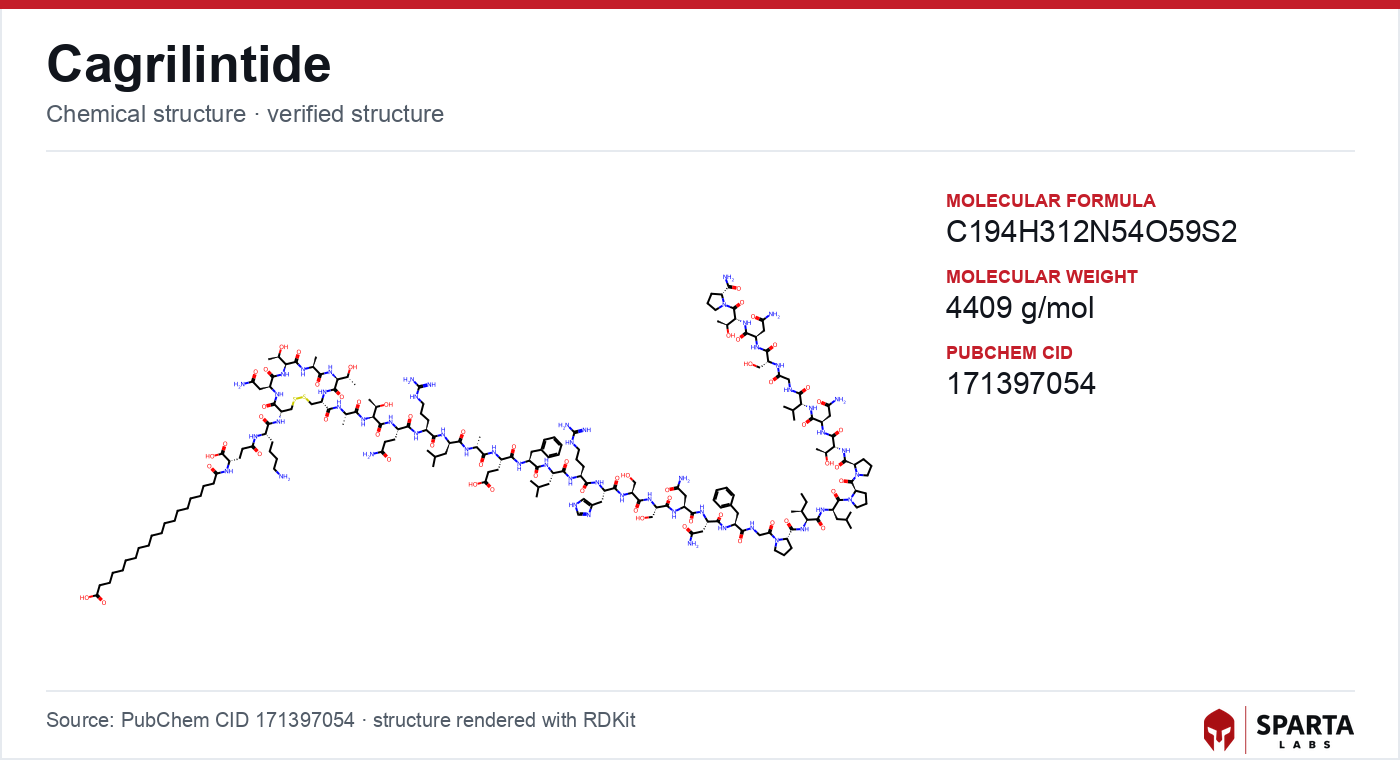
Figure: chemical structure of cagrilintide (one of the two peptides compared).
Semaglutide profile
Origin and derivation
Semaglutide is a synthetic analog of the incretin hormone glucagon-like peptide-1, specifically GLP-1(7-37). GLP-1 was identified as a potent insulinotropic factor in studies during the 1980s, including work reported by Mojsov and colleagues in 1987 describing insulin secretion from the perfused rat pancreas at picomolar concentrations [7]. The synthesis and structure-activity characterization of semaglutide were described by Lau, Bloch, Schäffer, and colleagues at Novo Nordisk in the Journal of Medicinal Chemistry in 2015 [8].
Peptide backbone and acylation chemistry
Semaglutide is a 31-amino-acid polypeptide analog of human GLP-1(7-37) [8]. Three modifications distinguish it from native GLP-1: an alpha-aminoisobutyric acid (Aib) substitution at position 8 that reportedly confers resistance to dipeptidyl peptidase-4 cleavage, an arginine substitution at position 34, and a C18 fatty diacid moiety conjugated at position 26 via a linker composed of gamma-glutamic acid and a short polyethylene-glycol spacer [8]. As with cagrilintide, this acyl side chain facilitates reversible albumin binding and an extended terminal half-life [8].
Receptor target and molecular class
Semaglutide is classified as a GLP-1 receptor agonist (GLP-1RA). The GLP-1 receptor belongs to the class B subfamily of G-protein-coupled receptors, characterized by an extracellular N-terminal domain involved in ligand recognition [8]. Within the GLP-1RA class, semaglutide is characterized by high albumin binding and high GLP-1R selectivity [8]. This receptor target, a single incretin receptor, contrasts with cagrilintide's activity across the calcitonin and AMY receptor landscape.
Published research and regulatory status
Semaglutide has received multiple FDA approvals across distinct formulations and indications, beginning with a subcutaneous formulation in December 2017, an oral tablet formulation in September 2019, a higher-concentration subcutaneous formulation in June 2021, and an added cardiovascular risk-reduction indication following the SELECT trial reported by Lincoff and colleagues in 2023 [9]. The compound has an extensive published clinical record across the SUSTAIN, PIONEER, STEP, and SELECT trial programs. Additional detail is available in the semaglutide research overview.
Structural comparison
Placed side by side, the two compounds share a design strategy but differ in nearly every specific structural particular.
Parent hormone. Cagrilintide is derived from amylin, a beta-cell hormone co-secreted with insulin [1]. Semaglutide is derived from GLP-1, an intestinal incretin hormone [7]. The two therefore trace to different endogenous peptide families with different physiological contexts in the literature.
Backbone length. Cagrilintide is described as a 36-amino-acid peptide [2], while semaglutide is described as a 31-amino-acid peptide [8]. Both are single-chain synthetic peptides rather than small-molecule compounds.
Acylation. Both use fatty-acid acylation to promote reversible albumin binding and half-life extension, a shared strategy that gives each an extended-interval pharmacokinetic profile [2, 8]. They differ in the specifics: cagrilintide carries a C20 fatty diacid moiety [2], whereas semaglutide carries a C18 fatty diacid moiety attached via a gamma-glutamic-acid-and-PEG linker at position 26 [8].
Amyloid handling. Cagrilintide's P37 substitution reportedly addresses the amyloidogenic tendency of native amylin [2]; semaglutide's modifications (Aib8, Arg34) instead address DPP-4 cleavage resistance and selectivity, reflecting the distinct formulation and stability challenges of each parent hormone [8].
Pharmacological class context
The central distinction between the two compounds is one of pharmacological class, not of relative effect. Cagrilintide is an amylin receptor agonist acting across the calcitonin receptor and the AMY1 to AMY3 subtypes [3]. Semaglutide is a GLP-1 receptor agonist acting at a single class B GPCR [8]. This is the sense in which the comparison is often framed as "amylin analog vs GLP-1", the two occupy adjacent but separate positions in the pharmacology of nutrient-response peptides.
The two are also linked at the level of combination research. The investigational product CagriSema pairs cagrilintide with semaglutide in a single fixed-dose combination, and the first-in-human data for cagrilintide were generated in concomitant administration with semaglutide [5, 6]. Readers examining a related incretin pairing may also consult the semaglutide vs tirzepatide comparison. Research-grade cagrilintide from Sparta Labs is verified by third-party HPLC and mass spectrometry analysis; sourcing detail is covered in the cagrilintide sourcing and quality article. Descriptions of receptor targets and biochemistry above are drawn from the cited primary sources and are not statements of clinical effect.
References
Each reference below was checked against its PubMed record or the issuing organization; authors, journals, years, volumes, and identifiers reflect those source records.
-
Cooper GJ, Willis AC, Clark A, Turner RC, Sim RB, Reid KB. Purification and characterization of a peptide from amyloid-rich pancreases of type 2 diabetic patients. Proc Natl Acad Sci USA. 1987;84(23):8628–8632. View on PubMed (PMID: 3317417; DOI: 10.1073/pnas.84.23.8628)
-
Kruse T, Hansen JL, Dahl K, Schäffer L, Sensfuss U, Poulsen C, et al. Development of cagrilintide, a long-acting amylin analogue. J Med Chem. 2021;64(15):11183–11194. View on PubMed (PMID: 34288673; DOI: 10.1021/acs.jmedchem.1c00565)
-
Cao J, Belousoff MJ, Johnson RM, Keov P, Mariam Z, Deganutti G, et al. Structural and dynamic features of cagrilintide binding to calcitonin and amylin receptors. Nat Commun. 2025;16:3389. View on PubMed (PMID: 40204768; DOI: 10.1038/s41467-025-58680-y)
-
Carvas AO, Leuthardt A, Kulka P, Lommi G, Hassan S, Coester B, et al. Cagrilintide lowers bodyweight through brain amylin receptors 1 and 3. EBioMedicine. 2025;118:105836. View on PubMed (PMID: 40609154; PMC: PMC12270663; DOI: 10.1016/j.ebiom.2025.105836)
-
Enebo LB, Berthelsen KK, Kankam M, Lund MT, Rubino DM, Satylganova A, et al. Safety, tolerability, pharmacokinetics, and pharmacodynamics of concomitant administration of multiple doses of cagrilintide with semaglutide 2·4 mg for weight management: a randomised, controlled, phase 1b trial. Lancet. 2021;397(10286):1736–1748. View on PubMed (PMID: 33894838; DOI: 10.1016/S0140-6736(21)00845-X)
-
Novo Nordisk. Novo Nordisk files for FDA approval of CagriSema, the first once-weekly combination of GLP-1 and amylin analogues for weight management. Press release. December 2025. Source: novonordisk.com
-
Mojsov S, Weir GC, Habener JF. Insulinotropin: glucagon-like peptide I (7-37) co-encoded in the glucagon gene is a potent stimulator of insulin release in the perfused rat pancreas. J Clin Invest. 1987;79(2):616–619. View on PubMed (PMID: 3543057; DOI: 10.1172/JCI112855)
-
Lau J, Bloch P, Schäffer L, Pettersson I, Spetzler J, Kofoed J, et al. Discovery of the once-weekly glucagon-like peptide-1 (GLP-1) analogue semaglutide. J Med Chem. 2015;58(18):7370–7380. View on PubMed (PMID: 26308095; DOI: 10.1021/acs.jmedchem.5b00726)
-
Lincoff AM, Brown-Frandsen K, Colhoun HM, Deanfield J, Emerson SS, Esbjerg S, et al. Semaglutide and cardiovascular outcomes in obesity without diabetes (SELECT). N Engl J Med. 2023;389(24):2221–2232. View on PubMed (PMID: 37952131; DOI: 10.1056/NEJMoa2307563)
Disclaimer. Statements in this article have not been evaluated by the Food and Drug Administration. This compound is not intended to diagnose, treat, cure, or prevent any disease. Sparta Labs sells research-use-only materials. Content is provided for educational and informational purposes only and does not constitute medical advice. Consult a qualified medical professional for any health concerns.
Frequently asked questions
What is the difference between cagrilintide and semaglutide?
The two belong to different pharmacological classes despite a shared design strategy. Cagrilintide is a long-acting analog of the peptide hormone amylin and acts as an agonist at calcitonin and amylin (AMY) receptors, while semaglutide is a glucagon-like peptide-1 (GLP-1) receptor agonist analogous to the incretin hormone GLP-1. Both were developed by Novo Nordisk and both use fatty-acid acylation to bind serum albumin, but their peptide backbones, receptor targets, and physiological signaling profiles differ.
Is cagrilintide an amylin analog and semaglutide a GLP-1 analog?
Yes. Cagrilintide is described in the primary literature as a long-acting acylated analog of human amylin, derived from the amylin sequence with a P37 substitution. Semaglutide is a 31-amino-acid analog of human GLP-1(7-37) engineered with an Aib substitution at position 8, an Arg substitution at position 34, and a C18 fatty diacid side chain. This is why the comparison is often framed as amylin analog vs GLP-1 receptor agonist.
What is CagriSema?
CagriSema is the development designation for a fixed-dose combination of cagrilintide and semaglutide studied by Novo Nordisk. In December 2025 the company submitted a New Drug Application to the FDA for CagriSema for chronic weight management in adults, based on Phase 3 REDEFINE program data. The combination pairs an amylin receptor agonist with a GLP-1 receptor agonist in a single once-weekly product.
Are cagrilintide and semaglutide FDA approved?
Semaglutide has received multiple FDA approvals across formulations and indications since December 2017. Cagrilintide is not individually FDA approved; as of the date of this article the CagriSema combination NDA review was ongoing and a dedicated cagrilintide monotherapy program was underway. Regulatory status should be verified against current FDA records.