
Cagrilintide: A Research Overview
How cagrilintide (AM833) re-engineers the amylin scaffold: the amyloid-fibril problem in native amylin, the C20 acylation strategy behind extended circulation, and its place in the CagriSema program. Educational reference.
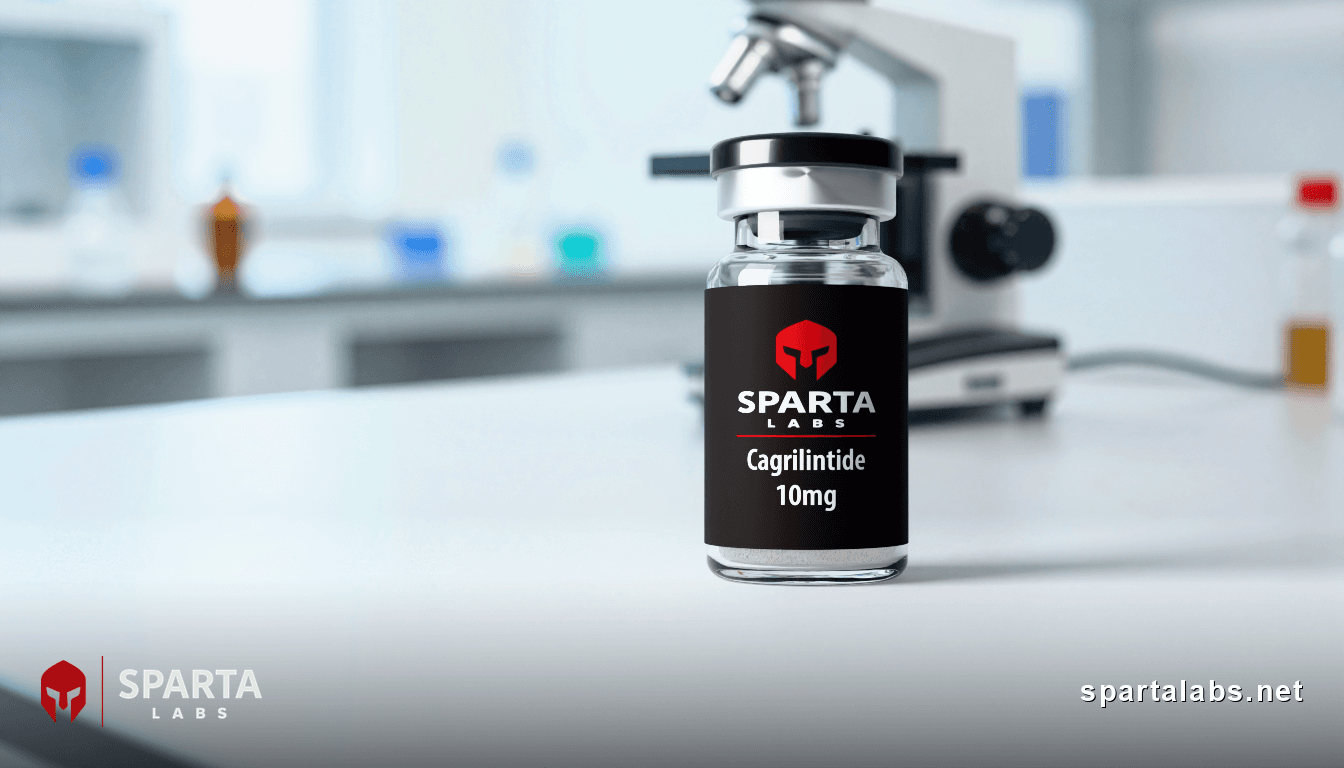
For research use only. Not for human consumption. This article is educational reference material. It is not medical advice and is not a recommendation to use any substance.
Why Native Amylin Resisted Being Made Into a Drug
Cagrilintide (development code AM833) is a synthetic, acylated analog of the human peptide hormone amylin. To understand why the molecule exists in its particular form, it helps to begin not with cagrilintide but with the problem it was engineered to solve: native human amylin is a chemically difficult peptide to turn into a stable pharmaceutical.
Amylin, also called islet amyloid polypeptide (IAPP), is a 37-amino acid peptide hormone co-secreted with insulin from pancreatic beta cells. It was first purified and characterized by Cooper and colleagues in 1987 from the amyloid-rich pancreatic deposits of individuals with type 2 diabetes [1]. The name of the source tissue is itself the clue: human amylin has a strong intrinsic tendency to self-associate into insoluble amyloid fibrils. That same aggregation behavior that deposits amyloid in the pancreas also makes concentrated aqueous formulations of the wild-type peptide unstable, which is a first-order obstacle for any injectable product.
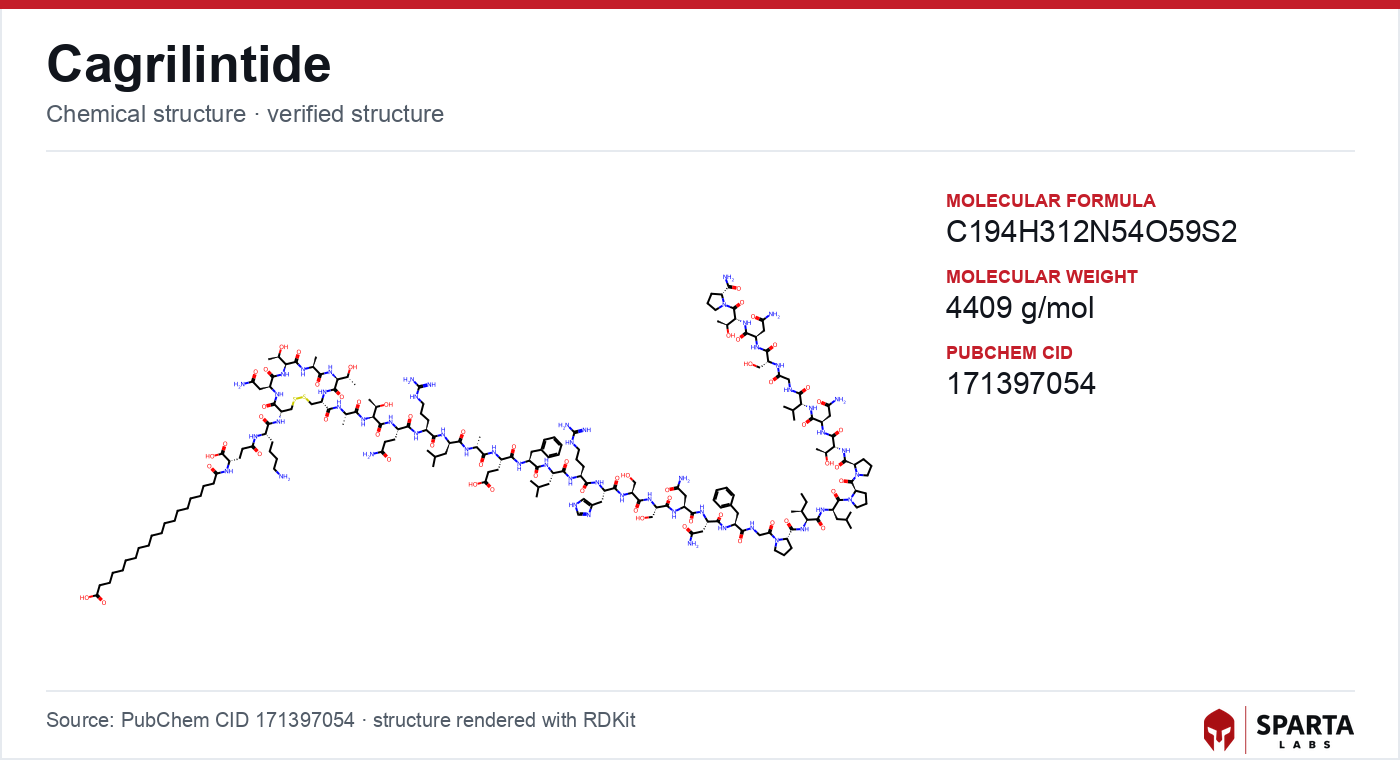
Figure: chemical structure of Cagrilintide.
The Pramlintide Precedent and Its Pharmacokinetic Ceiling
The first pharmacological answer to the amyloidogenesis problem was pramlintide, an amylin analog in which proline substitutions borrowed from rat amylin disrupt the fibril-forming region. Pramlintide was approved by the United States Food and Drug Administration (FDA) in 2005 under the brand name Symlin [2]. It established a practical point that shaped everything that followed: amylin receptor pharmacology could be accessed with a soluble, formulable synthetic peptide.
Findings from research models do not establish safety or efficacy in humans. Sparta Labs makes no claims about the use of this compound.
Pramlintide, however, carried a short circulating half-life on the order of an hour, which constrained its pharmacokinetic profile to frequent administration. That ceiling defined the target profile for the next generation of amylin analogs: retain the anti-amyloidogenic backbone chemistry that made pramlintide formulable, but add a mechanism to extend circulation substantially. Cagrilintide is the analog that pursued both goals in one scaffold.
The Cagrilintide Scaffold: Two Engineering Decisions
Cagrilintide is a 36-amino acid acylated peptide, and its structure reflects two distinct engineering decisions layered onto the amylin sequence.
The first decision addresses aggregation. The backbone incorporates substitutions, including in the amyloidogenic mid-sequence region, that abolish the fibril-forming tendency of native amylin. This is the same class of problem pramlintide solved, approached with cagrilintide's own sequence design so that concentrated, stable formulation becomes feasible.
The second decision addresses circulation time. The defining structural feature of cagrilintide is a C20 fatty-diacid moiety attached through a linker to the peptide scaffold. This lipidation drives reversible, non-covalent binding to circulating serum albumin, which shields the peptide from rapid renal clearance and proteolysis and thereby extends its residence in plasma. The medicinal-chemistry campaign that evaluated a series of lipidated amylin analogs and selected cagrilintide as the clinical candidate was reported by Andreassen and colleagues in the Journal of Medicinal Chemistry in 2021 [3].
This albumin-anchoring strategy is conceptually the same half-life-extension approach used in the GLP-1 receptor agonist semaglutide, even though the two peptides target different receptor families and carry different backbone sequences. Readers comparing the acylation designs of long-acting analogs may also find the fatty-acid conjugation discussion in the tirzepatide research overview a useful point of contrast, since tirzepatide combines two incretin activities in a single acylated chain.
Pharmacological Classification
Cagrilintide is classified as an amylin receptor agonist. Amylin does not act through a single dedicated receptor. Instead, it signals through a family of heterodimeric G protein-coupled receptors formed by the calcitonin receptor (CTR) in complex with one of three receptor activity-modifying proteins (RAMP1, RAMP2, or RAMP3), producing the AMY1, AMY2, and AMY3 receptor subtypes respectively. This molecular architecture, in which an accessory protein reshapes the pharmacology of a shared core receptor, was characterized in the amylin receptor literature reviewed by Hay and colleagues [4].
Because cagrilintide is derived from the amylin sequence, its pharmacology is described within this calcitonin-family receptor landscape rather than as a single-target agonist. This places it in the same broad structural family as calcitonin and native amylin while distinguishing it as an amylin-oriented analog engineered for extended action. For a closer treatment of receptor-level signaling, the cagrilintide mechanism of action article addresses the reported binding pharmacology in more detail.
Clinical Investigation and the CagriSema Combination
Cagrilintide entered public clinical investigation most prominently in combination with semaglutide. Enebo and colleagues reported a randomized, controlled Phase 1b trial in The Lancet in 2021 describing the safety, tolerability, pharmacokinetics, and pharmacodynamics of concomitant administration of cagrilintide with semaglutide across multiple dose levels [5]. That trial provided the first-in-human pharmacokinetic characterization consistent with an extended-interval profile and framed the co-administration concept that became known as CagriSema, a fixed-dose combination of an amylin receptor agonist and a GLP-1 receptor agonist.
Findings reported in research trials describe the compound's behavior within those specific study designs and populations; they do not establish general conclusions. The compound is investigational, and its regulatory status continues to evolve.
Cagrilintide in the Broader Analog Landscape
Cagrilintide sits within a wider generation of engineered metabolic peptides that combine backbone redesign with lipidation for extended action. Within that landscape it is distinguished by its amylin lineage rather than an incretin lineage. Readers surveying adjacent compounds may find the mazdutide research overview a useful comparison point, since mazdutide is likewise an engineered dual-activity peptide developed in the metabolic-analog space, illustrating how different receptor families are being addressed with similar structural toolkits.
Documentation of purity specifications, analytical methods, and certificate-of-analysis practices for research-grade material is covered in the cagrilintide sourcing and quality article. Research-grade cagrilintide from Sparta Labs is characterized by third-party HPLC and mass spectrometry analysis.
References
-
Cooper GJS, Willis AC, Clark A, Turner RC, Sim RB, Reid KBM. Purification and characterization of a peptide from amyloid-rich pancreases of type 2 diabetic patients. Proc Natl Acad Sci USA. 1987;84(23):8628–8632. PMID: 3320585.
-
US Food and Drug Administration. SYMLIN (pramlintide acetate) injection: prescribing information, NDA 021332. 2005. Available at: Source: accessdata.fda.gov
-
Andreassen KV, Feigh M, Hjuler ST, Christoffersen BØ, Damgaard Møller A, Rolin B, et al. Development of cagrilintide, a long-acting amylin analogue. J Med Chem. 2021;64(15):11183–11194. DOI: 10.1021/acs.jmedchem.1c00565.
-
Hay DL, Christopoulos G, Christopoulos A, Sexton PM. Amylin receptors: molecular composition and pharmacology. Biochem Soc Trans. 2004;32(5):865–867. PMID: 15494035. DOI: 10.1042/BST0320865.
-
Enebo LB, Berthelsen KK, Kankam M, Lund MT, Rubino DM, Satylganova A, et al. Safety, tolerability, pharmacokinetics, and pharmacodynamics of concomitant administration of multiple doses of cagrilintide with semaglutide for weight management: a randomised, controlled, phase 1b trial. Lancet. 2021;397(10288):1736–1748. PMID: 33894838. DOI: 10.1016/S0140-6736(21)00845-X.
Disclaimer. Statements in this article have not been evaluated by the Food and Drug Administration. This compound is not intended to diagnose, treat, cure, or prevent any disease. Sparta Labs sells research-use-only materials. Content is provided for educational and informational purposes only and does not constitute medical advice. Consult a qualified medical professional for any health concerns.
Frequently asked questions
What is cagrilintide?
Cagrilintide is a synthetic, long-acting analog of amylin, a peptide hormone. It is an investigational compound that has been studied in clinical research and is not approved by the FDA for any use. In published literature it is classified as an amylin-receptor agonist.
What is cagrilintide peptide?
Cagrilintide is a peptide, specifically an engineered analog of the naturally occurring hormone amylin. Published research describes it as a long-acting amylin-receptor agonist developed as an investigational agent; it is not an FDA-approved product and is designated for research use only.
How does cagrilintide work?
Published research reports that cagrilintide acts as an amylin-receptor agonist, binding receptors that native amylin engages. Reviews describe its long-acting design as an area of pharmacological study. These are descriptions of reported research mechanisms, not established outcomes in any individual.
What does cagrilintide do?
According to published literature, cagrilintide is an amylin analog that interacts with amylin and calcitonin receptors as reported in pharmacology studies. Its activity has been characterized in investigational research contexts. Sparta Labs makes no claims about the compound's effects; findings from research models do not establish outcomes in humans.
What is cagrilintide used for in research?
Cagrilintide has been evaluated in clinical research programs as an investigational amylin-receptor agonist, including trials studying it alone and alongside other investigational peptides. It has no FDA-approved use. This describes the research context only, not any therapeutic outcome or recommendation.
Is cagrilintide a GLP-1?
No. Cagrilintide is classified in published literature as an amylin analog (an amylin-receptor agonist), not a GLP-1 receptor agonist. The two are distinct pharmacological classes acting on different receptors, though both have been studied as investigational peptides.