
Mazdutide: A Research Overview
A research-library profile of mazdutide (IBI362 / LY3305677): an engineered oxyntomodulin analog and dual GLP-1/glucagon receptor agonist, examined through its peptide chemistry, incretin lineage, and documented NMPA regulatory timeline. Educational reference.
For research use only. Not for human consumption. This article is educational reference material. It is not medical advice and is not a recommendation to use any substance.
Introduction
Mazdutide (development designations IBI362 and LY3305677) is a synthetic peptide classified in the published literature as a dual agonist of the glucagon-like peptide-1 receptor (GLP-1R) and the glucagon receptor (GCGR). Unlike the single-target incretin mimetics that dominated the first generation of GLP-1 pharmacology, mazdutide belongs to a design lineage that deliberately reconstructs the activity of a naturally occurring dual-receptor gut hormone, oxyntomodulin. This overview examines mazdutide from the perspective a researcher would take: what molecule it is engineered from, how its peptide chemistry addresses the shortcomings of its natural template, how its two receptor activities are balanced, and how its development and regulatory record are documented in primary sources.
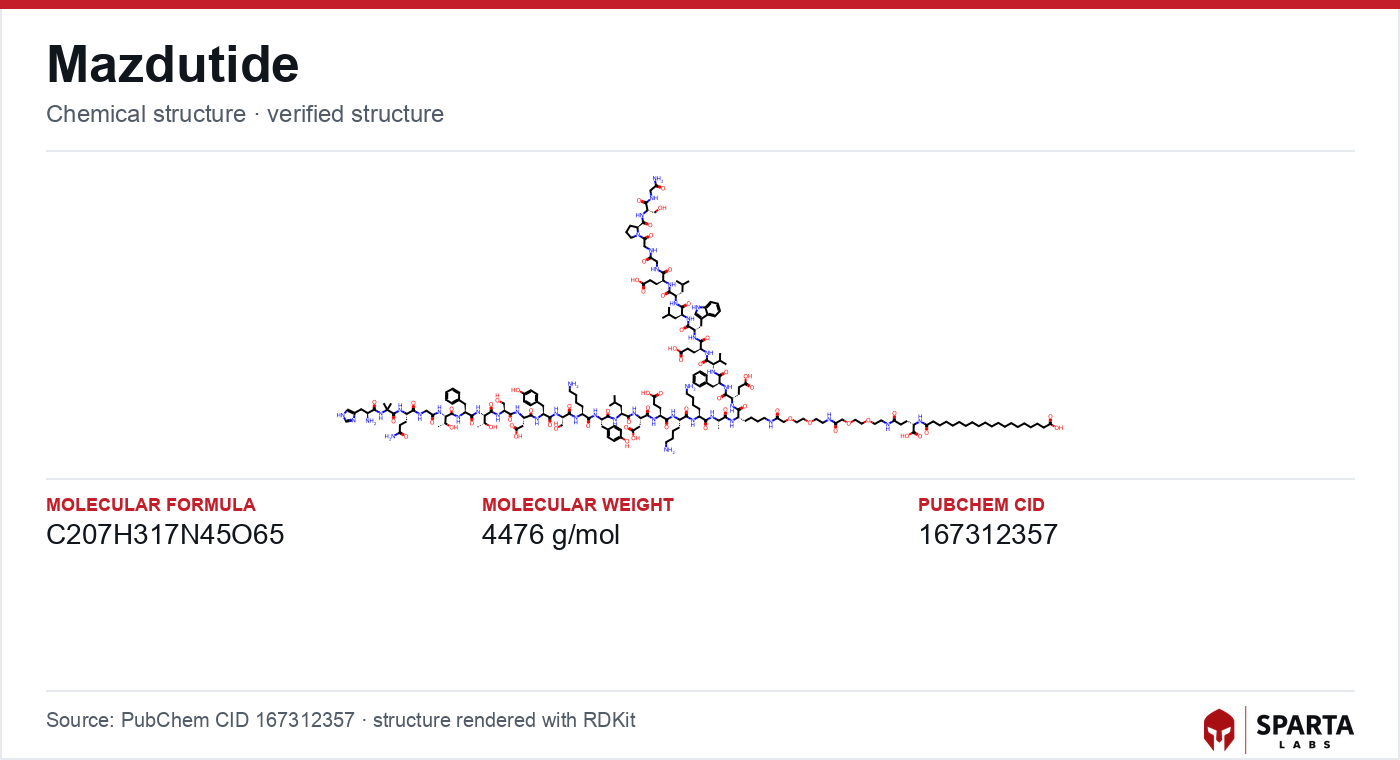
Figure: chemical structure of Mazdutide.
The oxyntomodulin problem mazdutide was engineered to solve
To understand mazdutide, it helps to start with the endogenous peptide it imitates. Oxyntomodulin is a 37-amino-acid hormone released from intestinal L cells after nutrient ingestion, co-secreted alongside GLP-1. Structurally it contains the full glucagon sequence extended by a C-terminal octapeptide, which is the reason it can engage both the GLP-1 receptor and the glucagon receptor rather than a single target.
Human research on native oxyntomodulin established that the peptide is pharmacologically active. Cohen and colleagues (2003) reported that oxyntomodulin administration was associated with reduced food intake in a controlled human study [1]. Wynne and colleagues (2005) subsequently reported changes in body weight over a repeated-administration study in overweight and obese participants [2]. These findings established a scientific rationale for dual GLP-1R/GCGR engagement, but they also exposed the central limitation of the natural molecule: oxyntomodulin is cleaved rapidly by dipeptidyl peptidase-4 and other proteases, giving it a plasma half-life measured in minutes. That pharmacokinetic fragility made native oxyntomodulin impractical as a durable research or therapeutic tool.
Findings from research models do not establish safety or efficacy in humans. Sparta Labs makes no claims about the use of this compound.
Mazdutide was designed as the engineered answer to that problem: an oxyntomodulin-derived peptide intended to preserve balanced dual-receptor engagement while resisting proteolysis long enough to support extended dosing intervals in clinical study designs.
Peptide chemistry and half-life engineering
Mazdutide is a synthetic peptide built on the oxyntomodulin backbone and modified to extend its residence time in circulation. The molecule incorporates amino-acid substitutions that reduce susceptibility to enzymatic degradation, together with a lipophilic fatty-acid moiety attached through a linker. This fatty-acid conjugation strategy is a recurring theme in modern incretin design: the appended lipid chain enables reversible, non-covalent binding to circulating serum albumin, which slows renal clearance and proteolysis and thereby lengthens the effective half-life.
The same albumin-anchoring principle appears across several engineered peptides in this class, and the structural trade-offs between different linker and lipidation approaches are a useful point of comparison with molecules such as semaglutide and tirzepatide, which reach comparable pharmacokinetic durability through related but distinct chemistry. What distinguishes mazdutide chemically is that this half-life engineering is applied to an oxyntomodulin scaffold rather than to an exendin- or GIP-derived one, which is what gives the molecule its dual GLP-1R/GCGR pharmacology rather than a GLP-1-only or GLP-1/GIP profile.
Balanced dual-receptor pharmacology
Both of mazdutide's molecular targets (GLP-1R and GCGR) are members of the class B1 (secretin-like) subfamily of G protein-coupled receptors. A defining research question for any dual agonist is not merely whether it engages both receptors, but the ratio of its activities at each. A molecule that binds both receptors but is heavily weighted toward one behaves, functionally, closer to a single-target agonist.
The concept of tuning glucagon-versus-GLP-1 activity to obtain a defined pharmacological balance was established in foundational preclinical work. Pocai and colleagues (2009) reported that a GLP-1/glucagon coagonist peptide produced metabolic effects in obese rodent models distinct from those of a GLP-1-only comparator, providing an early demonstration that the two activities could be combined and titrated in a single molecule [3]. The broader physiological logic (that glucagon receptor signaling contributes to hepatic lipid metabolism and energy expenditure, and is not merely a hyperglycemic liability) was consolidated in the review by Habegger and colleagues (2010), which reframed glucagon as a target of interest for cardiometabolic peptide design rather than solely a counter-regulatory hormone [4].
Against that backdrop, mazdutide is described in the primary clinical literature as engaging both receptors within a comparable affinity range. Ji and colleagues (2021), reporting the first-in-class phase 1b characterization of the compound under its IBI362 designation, documented its pharmacokinetics and tolerability across ascending exposure cohorts in a randomized, placebo-controlled design [5]. The receptor-level interactions and downstream signaling that these clinical observations rest on are examined in more depth in the companion mazdutide mechanism of action article.
Where mazdutide sits among incretin-class research compounds
Mazdutide occupies a specific niche in the taxonomy of engineered incretin peptides. Selective GLP-1 receptor agonists engage GLP-1R alone. Dual GLP-1/GIP agonists add glucose-dependent insulinotropic polypeptide receptor activity. Triple agonists extend engagement to GLP-1R, GCGR, and GIPR simultaneously, a profile represented by research compounds such as retatrutide. A separate design axis is represented by amylin-analog research peptides such as cagrilintide, which act through an entirely different receptor system and are studied in combination with incretin agonists rather than as incretin agonists themselves.
Within that map, mazdutide is defined by its GLP-1R + GCGR pairing and its oxyntomodulin ancestry. This makes it a useful reference point for researchers comparing how different receptor combinations map onto different molecular scaffolds, and it distinguishes mazdutide from the GIP-containing multi-agonists that share the same broad "next-generation incretin" label but arrive at that label by different chemistry.
Development lineage and the two code names
Mazdutide's development record is notable for its two-territory structure, which is why the compound appears under two distinct code names in the literature. The molecule originated within Eli Lilly and Company's metabolic research pipeline under the designation LY3305677. In 2019, Innovent Biologics acquired the rights to develop, manufacture, and commercialize the compound in China and redesignated it IBI362, while Eli Lilly retained rights in other territories. As a result, the earliest peer-reviewed clinical reports refer to the same molecule as "IBI362 (LY3305677)," and a researcher searching the literature should treat the two identifiers as interchangeable [5].
The first wave of published clinical characterization was conducted in Chinese study populations. Beyond the initial phase 1b overweight/obesity cohort [5], parallel phase 1b investigation in participants with type 2 diabetes was reported by Jiang and colleagues (2022) in Nature Communications, extending the pharmacokinetic and tolerability profile into a second study population [6]. These early-phase reports form the documented foundation for the later-stage programs that supported the compound's regulatory submissions.
Regulatory record and research-use status
According to the developers' regulatory disclosures, mazdutide received marketing approval from China's National Medical Products Administration (NMPA) in 2025, making it the first molecule of its GCGR/GLP-1 dual-agonist class to reach a national marketing authorization. Manufacturer statements describe this approval in the context of chronic weight management in an approved clinical setting, with a subsequent authorization addressing glycemic control. These milestones are regulatory events rather than efficacy conclusions, and they apply only within the jurisdiction and clinical framework in which the approval was granted.
As of this writing, mazdutide has not received approval from the US Food and Drug Administration (FDA) or the European Medicines Agency (EMA). Its status as an approved therapeutic in one jurisdiction is entirely separate from its status as a research-use-only material used in non-clinical laboratory research. Research-grade mazdutide from Sparta Labs is supplied for laboratory research use and accompanied by batch-specific third-party analytical documentation; that documentation speaks to material identity and purity, not to any clinical property. Researchers comparing the incretin cluster may also find the parallel structural context in the semaglutide research overview and the tirzepatide mechanism of action reference useful.
References
-
Cohen MA, Ellis SM, Le Roux CW, Batterham RL, Park A, Patterson M, et al. Oxyntomodulin suppresses appetite and reduces food intake in humans. J Clin Endocrinol Metab. 2003;88(10):4696-4701. PMID: 14557443. DOI: 10.1210/jc.2003-030421
-
Wynne K, Park AJ, Small CJ, Patterson M, Ellis SM, Murphy KG, et al. Subcutaneous oxyntomodulin reduces body weight in overweight and obese subjects: a double-blind, randomized, controlled trial. Diabetes. 2005;54(8):2390-2395. PMID: 16046306. DOI: 10.2337/diabetes.54.8.2390
-
Pocai A, Carrington PE, Adams JR, Wright M, Eiermann G, Zhu L, et al. Glucagon-like peptide 1/glucagon receptor dual agonism reverses obesity in mice. Diabetes. 2009;58(10):2258-2266. PMID: 19602537. DOI: 10.2337/db09-0278
-
Habegger KM, Heppner KM, Geary N, Bartness TJ, DiMarchi R, Tschöp MH. The metabolic actions of glucagon revisited. Nat Rev Endocrinol. 2010;6(12):689-697. PMID: 21060334. DOI: 10.1038/nrendo.2010.187
-
Ji L, Jiang H, Shi W, Wang H, Cheng Z, Pan T, et al. IBI362 (LY3305677), a weekly-dose GLP-1 and glucagon receptor dual agonist, in Chinese adults with overweight or obesity: a randomised, placebo-controlled, multiple ascending dose phase 1b study. eClinicalMedicine. 2021;40:101088. PMCID: PMC8374649. DOI: 10.1016/j.eclinm.2021.101088
-
Jiang H, Pang S, Zhang Y, Liu J, Chen Y, Yang L, et al. A phase 1b randomised controlled trial of a glucagon-like peptide-1 and glucagon receptor dual agonist IBI362 (LY3305677) in Chinese patients with type 2 diabetes. Nat Commun. 2022;13(1):3613. PMCID: PMC9232612. DOI: 10.1038/s41467-022-31328-x
Disclaimer. Statements in this article have not been evaluated by the Food and Drug Administration. This compound is not intended to diagnose, treat, cure, or prevent any disease. Sparta Labs sells research-use-only materials. Content is provided for educational and informational purposes only and does not constitute medical advice. Consult a qualified medical professional for any health concerns.
Frequently asked questions
What is mazdutide?
Mazdutide is an investigational synthetic peptide characterized in published research as a dual agonist of the glucagon-like peptide-1 (GLP-1) receptor and the glucagon (GCG) receptor. It is also referred to in the literature as LY3305677 and IBI362. It is not an FDA-approved drug and is classified as a research-use-only compound.
What is mazdutide peptide?
Mazdutide is a peptide, a molecule made of a short chain of amino acids. Published literature describes it as a GLP-1/glucagon dual receptor agonist based on the structure of oxyntomodulin, a naturally occurring gut hormone. It is studied only as a research material and is not approved for human use in the United States.
What does mazdutide do?
In published pharmacology research, mazdutide has been reported to act on two receptors, the GLP-1 receptor and the glucagon receptor. Investigators describe this dual-receptor mechanism as the basis for the compound's study; the research literature reports the receptor activity itself rather than establishing any outcome. It remains investigational and is not FDA-approved.
Who makes mazdutide?
Mazdutide was developed as a co-development program between Innovent Biologics and Eli Lilly and Company, which is why it appears in the literature under the codes IBI362 (Innovent) and LY3305677 (Lilly). Clinical-trial sponsorship and development have been associated with Innovent in China. It is not an FDA-approved product.
When will mazdutide be available?
As of publication, mazdutide is an investigational compound and is not approved by the US Food and Drug Administration for any use. Regulatory filings and clinical trials have been reported outside the United States, but no US approval has been granted. Any material sold under this name is offered strictly for research use only.
How does mazdutide compare to tirzepatide?
Mazdutide and tirzepatide are both classified in the literature as multi-receptor peptide agonists, but they act on different receptor combinations: published research describes mazdutide as a GLP-1/glucagon dual agonist and tirzepatide as a GLP-1/GIP dual agonist. This distinction is one of pharmacological classification and receptor targets, not a comparison of effects. Both remain distinct research compounds.