
Mazdutide: Mechanism of Action
A mechanism-focused reference on mazdutide (IBI362 / LY3305677), tracing its oxyntomodulin-derived design, balanced GLP-1R and glucagon-receptor binding, and Gs/cAMP signaling as reported in primary literature. Educational reference.
For research use only. Not for human consumption. This article is educational reference material. It is not medical advice and is not a recommendation to use any substance.
Introduction
Mazdutide (development codes IBI362 and LY3305677) is a synthetic peptide characterized in the literature as a dual agonist of the glucagon-like peptide-1 receptor (GLP-1R) and the glucagon receptor (GCGR). What makes its mechanism distinctive is not a single novel target but the deliberate re-creation of a natural dual-receptor signal: mazdutide traces its design directly to oxyntomodulin, an endogenous gut peptide that already engages both receptors. This article follows that lineage, from the biology of the two proglucagon-derived hormones, through the engineering rationale that converted a short-lived natural peptide into a long-acting research compound, to the receptor-level and intracellular signaling events reported in primary literature. The broader clinical-study context is summarized in the mazdutide published research article.
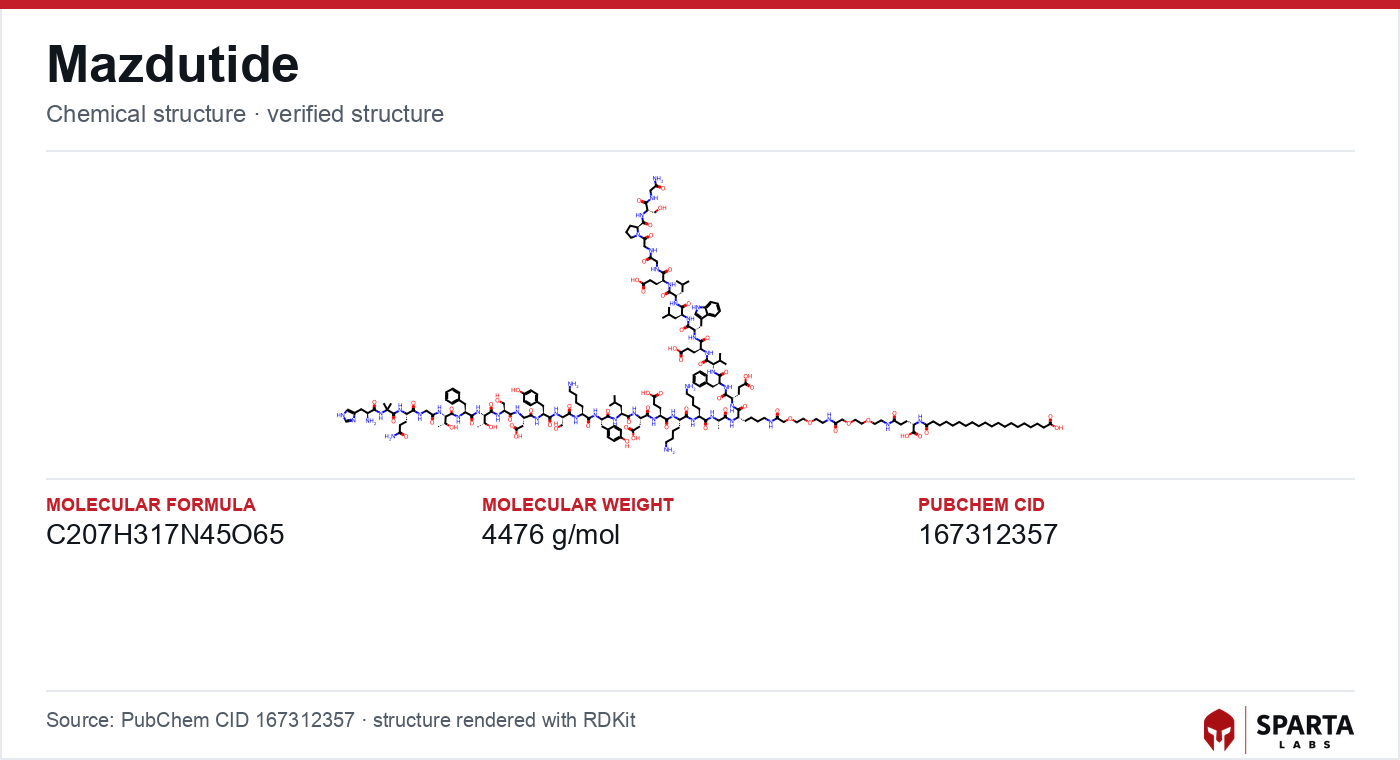
Figure: chemical structure of Mazdutide.
The Two Hormones Behind the Mechanism
Mazdutide's pharmacology cannot be understood without the two peptide hormones it mimics, both of which originate from a single precursor. The proglucagon gene is processed differently depending on tissue: in pancreatic alpha cells it yields glucagon, while in intestinal L cells and specific neurons it yields glucagon-like peptide-1 (GLP-1). Holst (2007) reviewed the physiology of GLP-1 in detail, describing its glucose-dependent stimulation of insulin secretion, its action on gastrointestinal motility, and its central signaling at circuits regulating food intake [1].
Glucagon, the counter-regulatory hormone, engages the glucagon receptor primarily in the liver. Habegger and colleagues (2010) reviewed the metabolic actions of glucagon, describing its role in hepatic glucose output and its influence on lipid and energy substrate handling through cAMP-dependent signaling [2]. The apparent tension between an incretin that lowers glucose and a hormone classically associated with raising it is precisely what a balanced dual agonist is engineered to reconcile: the two signals are recruited together, and their net metabolic effect is a subject of continued research rather than a settled conclusion.
From Oxyntomodulin to a Long-Acting Peptide
A third proglucagon-derived peptide sits at the center of mazdutide's origin story. Oxyntomodulin is co-secreted with GLP-1 from intestinal L cells and natively activates both GLP-1R and GCGR, making it a naturally occurring dual agonist. Wynne and colleagues (2005) reported a double-blind, randomized, controlled trial of subcutaneous oxyntomodulin in overweight and obese subjects, one of the earliest human studies establishing that this endogenous dual-receptor peptide was biologically active in people [3].
Findings from research models do not establish safety or efficacy in humans. Sparta Labs makes no claims about the use of this compound.
Native oxyntomodulin is limited as a research tool by a very short plasma half-life, driven by rapid enzymatic degradation and renal clearance. Mazdutide belongs to a generation of engineered peptides built to preserve the dual-receptor signal while extending circulating persistence. Its reported design incorporates sequence substitutions that resist degradation and a fatty-acid moiety conjugated through a linker, which supports reversible binding to serum albumin. This albumin-tethering strategy slows clearance without altering the fundamental two-receptor pharmacology. The structural and manufacturing considerations of the resulting molecule are discussed further in the mazdutide sourcing and quality article.
Rational Design of Dual Agonists
Mazdutide did not emerge in isolation; it is part of a defined pharmacological lineage of engineered GLP-1R/GCGR co-agonists. Day and colleagues (2009) first reported a rationally designed, single-molecule GLP-1/glucagon co-agonist, demonstrating that a chimeric peptide could balance activity across both receptors and providing the medicinal-chemistry template that later co-agonists refined [4]. This established the central design problem of the class: tuning the ratio of GLP-1R to GCGR potency, because the two signals contribute differently to observed metabolic profiles.
Mazdutide is one embodiment of that design space, distinguished by its oxyntomodulin backbone and albumin-binding tail. Other multi-receptor metabolic peptides pursue different receptor combinations; the class B1 GPCR signaling shared across this family is examined in the tirzepatide mechanism of action article, while a related amylin-receptor agonist is described in the cagrilintide mechanism of action article.
Receptor Binding Reported in the Literature
Both GLP-1R and GCGR are class B1 (secretin-like) G protein-coupled receptors, a family defined by a large extracellular domain that captures the peptide C-terminus and a transmembrane bundle that the peptide N-terminus penetrates to trigger activation. This two-domain "two-step" binding model is characteristic of the class and frames how any dual agonist must interact with both receptors.
Ji and colleagues (2021) reported a study of IBI362 in Chinese adults with overweight or obesity and characterized its receptor engagement, describing binding at human and murine GLP-1R and GCGR in the nanomolar range [5]. A balanced, nanomolar-range affinity at both receptor subtypes is the defining feature that separates a dual agonist from a compound with strongly preferential engagement of one receptor. The precise potency ratio between the two receptors is a key determinant of a co-agonist's pharmacological identity, and small shifts in that balance distinguish one member of the class from another.
Intracellular Signaling and Downstream Cascades
Upon agonist binding, both GLP-1R and GCGR couple predominantly to the stimulatory G protein Gs. Gs activation stimulates adenylate cyclase, raising intracellular cyclic adenosine monophosphate (cAMP), which in turn activates protein kinase A (PKA) and the exchange proteins directly activated by cAMP (Epac). From this shared node, the cascades diverge by receptor and tissue.
At GLP-1R in pancreatic beta cells, cAMP/PKA signaling potentiates glucose-dependent insulin secretion, the incretin effect described by Holst (2007), without provoking insulin release when glucose is not elevated [1]. GLP-1R signaling in the central nervous system additionally participates in satiety-related circuitry. At GCGR in hepatocytes, cAMP/PKA signaling participates in the hepatic metabolic actions reviewed by Habegger and colleagues (2010), including effects on glucose output and lipid handling [2]. In a balanced dual agonist, these two receptor-specific cascades are recruited concurrently, and how their outputs integrate at the whole-organism level remains an active research question rather than an established result.
Structural Characterization and Its Limits
High-resolution structural biology has advanced understanding of how dual agonists dock onto each receptor, though direct structures of mazdutide itself remained outside the peer-reviewed record at the time this reference was prepared. Zhou and colleagues (2023) reported a cryo-electron microscopy analysis of dual agonism at GLP-1R and GCGR, resolving receptor complexes with Gs protein and dual-agonist peptides and describing how differences in peptide N-terminal conformation influence receptor selectivity, while the peptide mid-region contacts the extracellular loops of each receptor [6]. These findings provide the structural framework used to reason about mazdutide by analogy, but inference from structurally related co-agonists is not equivalent to a structure of the compound itself.
Limits of Current Understanding
Several mechanistic questions about mazdutide remain open in the published literature. The relative contribution of GLP-1R versus GCGR engagement to its overall observed pharmacological profile has not been definitively apportioned, and the effective potency balance between the two receptors may differ between in-vitro binding assays and the in-vivo setting. Biased signaling, receptor desensitization kinetics, and internalization dynamics at each target, well studied for single-target GLP-1R agonists, await systematic characterization specific to mazdutide. These frontiers make the compound a continuing subject of receptor-pharmacology research. Researchers evaluating material for such mechanistic work can review identity and purity specifications on the mazdutide product page.
References
-
Holst JJ. The physiology of glucagon-like peptide 1. Physiol Rev. 2007;87(4):1409-1439. PMID: 17928588. DOI: 10.1152/physrev.00034.2006. View on PubMed
-
Habegger KM, Heppner KM, Geary N, Bartness TJ, DiMarchi R, Tschöp MH. The metabolic actions of glucagon revisited. Nat Rev Endocrinol. 2010;6(12):689-697. PMID: 20957001. DOI: 10.1038/nrendo.2010.187. View on PubMed
-
Wynne K, Park AJ, Small CJ, Patterson M, Ellis SM, Murphy KG, et al. Subcutaneous oxyntomodulin reduces body weight in overweight and obese subjects: a double-blind, randomized, controlled trial. Diabetes. 2005;54(8):2390-2395. PMID: 16046306. DOI: 10.2337/diabetes.54.8.2390. View on PubMed
-
Day JW, Ottaway N, Patterson JT, Gelfanov V, Smiley D, Gidda J, et al. A new glucagon and GLP-1 co-agonist eliminates obesity in rodents. Nat Chem Biol. 2009;5(10):749-757. PMID: 19597507. DOI: 10.1038/nchembio.209. View on PubMed
-
Ji L, Jiang H, Cheng Z, Qiu W, Liao L, Zhang Y, et al. A phase 1b/2a study of IBI362 (LY3305677), a weekly-dose GLP-1 and glucagon receptor dual agonist, in Chinese adults with overweight or obesity. eClinicalMedicine. 2021;41:101088. PMID: 34766056. DOI: 10.1016/j.eclinm.2021.101088. View on PubMed
-
Zhou F, Zhang H, Cong Z, Zhao LH, Zhou Q, Mao C, et al. Structural insights into ligand recognition and activation of the human glucagon and GLP-1 receptors by dual agonists. Proc Natl Acad Sci USA. 2023;120(35):e2303696120. PMID: 37585461. DOI: 10.1073/pnas.2303696120. View on PubMed
Disclaimer. Statements in this article have not been evaluated by the Food and Drug Administration. This compound is not intended to diagnose, treat, cure, or prevent any disease. Sparta Labs sells research-use-only materials. Content is provided for educational and informational purposes only and does not constitute medical advice. Consult a qualified medical professional for any health concerns.
Frequently asked questions
What two receptors does mazdutide engage?
Mazdutide is described in the literature as a dual agonist of the glucagon-like peptide-1 receptor (GLP-1R) and the glucagon receptor (GCGR). Both are class B1 G protein-coupled receptors that share a common ancestry and couple predominantly to stimulatory Gs proteins. Ji and colleagues (2021) reported nanomolar-range binding affinities at human and murine forms of each receptor.
Why is mazdutide described as an oxyntomodulin analog?
Oxyntomodulin is an endogenous proglucagon-derived peptide that natively activates both GLP-1R and GCGR but has a very short circulating half-life. Mazdutide was engineered from this dual-receptor template with sequence modifications and a fatty-acid conjugate that supports reversible albumin binding, extending its plasma residence while retaining activity at both receptors.
What intracellular signaling follows mazdutide binding?
Both GLP-1R and GCGR couple to Gs proteins, so agonist binding activates adenylate cyclase and raises intracellular cyclic AMP (cAMP). Elevated cAMP activates protein kinase A (PKA) and Epac, initiating receptor- and tissue-specific downstream cascades documented across the class B1 GPCR literature.
How does the dual-agonist concept behind mazdutide differ from a single GLP-1R agonist?
Single-target GLP-1R agonists engage one receptor, whereas balanced GLP-1R/GCGR co-agonists were designed to recruit glucagon-receptor signaling alongside GLP-1R signaling. Day and colleagues (2009) first reported a rationally designed GLP-1/glucagon co-agonist peptide, and mazdutide belongs to this later co-agonist lineage.
Has mazdutide's receptor-binding geometry been resolved structurally?
Direct high-resolution structures of mazdutide bound to each receptor were not established in peer-reviewed literature at the time this reference was prepared. Structural inference has drawn on cryo-electron microscopy of related GLP-1R/GCGR dual agonists, such as the work reported by Zhou and colleagues (2023).